

SEO
Architecting for AI Search Crawlers: Dissecting LLMs.txt, Bot Governance, and Edge SSR for Real-Time RAG Engines
As generative answer engines transform web search, engineering teams face a fundamental shift: classical crawlers execute JavaScript via headless browser clusters, whereas real-time AI search bots operate under tight sub-second latency and token budgets. This deep technical analysis explores the mechanics of AI crawler governance, comparing training scrapers with live RAG retrieval agents, the structural semantics of the emerging llms.txt standard, and edge-native dynamic rendering pipelines that deliver clean Markdown directly to AI search engines.
12 min read
Architecting for AI Search Crawlers: Dissecting LLMs.txt, Bot Governance, and Edge SSR for Real-Time RAG Engines
Executive Summary: The Bifurcation of Search Indexing and LLM Ingestion
The web indexing pipeline is undergoing its most radical transformation since Google Caffeine. For two decades, search engine optimization followed a deterministic lifecycle: asynchronous crawlers retrieved HTML, queued URLs into Web Rendering Services (WRS) running headless Chromium instances, executed client-side JavaScript, and populated an inverted keyword index.
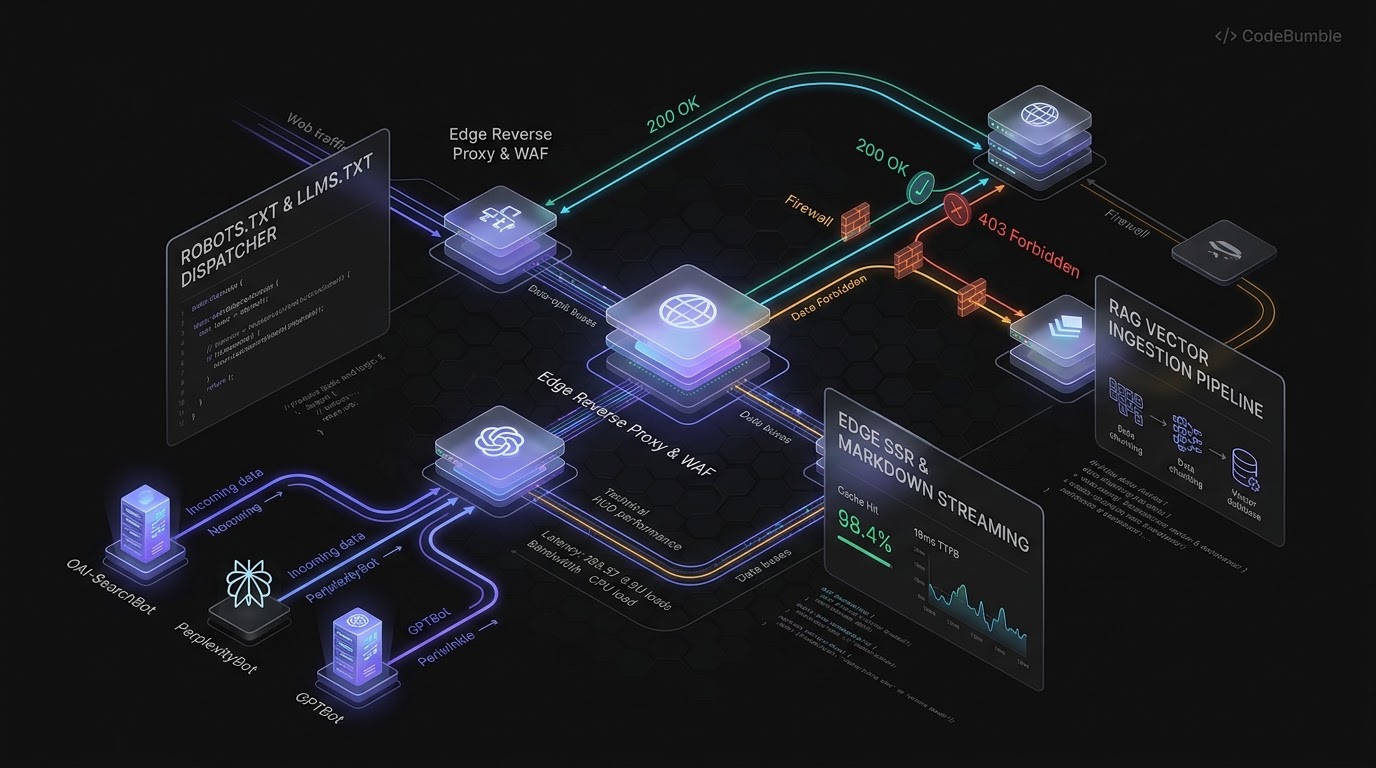
Generative answer engines—including OpenAI Search, Perplexity AI, Claude Search, and Google AI Overviews—have bifurcated web crawlers into two conflicting bot classes:
- Bulk Training Scrapers: Offline batch crawlers (
GPTBot,ClaudeBot,Bytespider) harvesting petabytes of unstructured text for foundational model pre-training. These bots generate heavy server load without yielding referral attribution. - Real-Time Retrieval-Augmented Generation (RAG) Search Crawlers: Low-latency retrieval bots (
OAI-SearchBot,PerplexityBot,Bingbot) dispatched dynamically to ground user queries in authoritative, fresh content. These bots generate direct citations, interactive cards, and qualified organic referral traffic.
Crucially, real-time AI search bots lack the compute budgets to run headless Chromium instances or execute client-side hydration scripts. Instead, AI retrieval bots prioritize sub-second Time to First Byte (TTFB), lightweight semantic trees, and clean Markdown or schema-dense HTML representations. Websites relying entirely on client-side rendering (CSR) face complete invisibility in generative search, as retrieval bots timeout or ingest empty shell templates (<div id="root"></div>).
This guide dissects the protocol mechanics of AI crawler governance across robots.txt, the /llms.txt standard for machine-readable context delivery, and edge-native serverless proxy pipelines streaming semantic Markdown directly to RAG ingestors with sub-20ms latency.
Anatomical Taxonomy: Training Scrapers vs. Real-Time RAG Bots
Managing crawler traffic in the era of generative AI requires establishing strict protocol boundaries between model training extraction and real-time retrieval grounding. A blanket block in robots.txt eliminates visibility in conversational search, while an unconstrained allow-all policy exposes proprietary data to unrestrained scraping.
Below is an architectural matrix mapping primary AI web crawlers and their operational characteristics:
| Bot User-Agent | Operating Entity | Functional Mandate | Respects robots.txt |
Executes JS? | Referral Value | Recommended Edge Policy |
|---|---|---|---|---|---|---|
OAI-SearchBot |
OpenAI | Real-Time Search Grounding (ChatGPT Search) | Yes | No (Raw Text/HTML) | High (Direct Citation Links) | Allow (Edge Fast-Path) |
GPTBot |
OpenAI | Offline LLM Pre-Training & Fine-Tuning | Yes | No | None (Zero Referral Clicks) | Block / Gate |
PerplexityBot |
Perplexity AI | Live Search Retrieval & Grounding Index | Yes | Partial (Key Assets Only) | High (Interactive Citations) | Allow (Edge Fast-Path) |
ClaudeBot |
Anthropic | Offline Dataset Harvesting & Training | Yes | No | None | Block / Gate |
Claude-Web |
Anthropic | Real-Time User Browser Tool Calls | Yes | No (Direct fetch) | Moderate (Ephemeral Answers) | Allow |
Google-Extended |
Gemini Model Training & AI Datasets | Yes | No | None (Independent of Search) | Policy Dependent | |
Googlebot |
Core Search Indexing & AI Overviews | Yes | Yes (Headless Chromium WRS) | High (Primary Organic Search) | Allow | |
Bytespider |
ByteDance | Aggressive Data Ingestion & Model Training | Inconsistent | No | None | Strict WAF Block |
CCBot |
Common Crawl | Public Non-Profit Crawl Archive | Yes | No | Indirect (Academic) | Throttle / Block |
The Token-Cost Dilemma of Headless Rendering in AI Search
Traditional search engines deploy a two-wave indexing architecture: Googlebot fetches the initial response, parses static HTML, and queues URLs requiring JavaScript execution for deferred Chromium rendering. This pipeline introduces indexing delays ranging from hours to days.
In contrast, real-time RAG systems operate within interactive latency thresholds ($400\text{ ms} - 1,500\text{ ms}$). When a user enters a query:
- The orchestrator expands the prompt into multiple search keywords.
- Lightweight HTTP crawlers dispatch asynchronous
GETrequests to candidate URLs. - The responses are sanitized, chunked into lexical spans, embedded via dense vector encoders, and injected into the LLM context window.
If an edge server takes $800\text{ ms}$ to deliver an initial HTML shell and requires $2,000\text{ ms}$ of client-side JavaScript execution, AI crawlers abort upon hitting connection timeouts ($1,000\text{ ms} - 2,000\text{ ms}$), indexing fallback boilerplate instead.
Systems Architecture: The Dual-Track Ingestion Pipeline
To balance copyright protection, infrastructure load, and discoverability in AI search, modern engineering platforms implement a Dual-Track Ingestion Pipeline at the edge layer. Rather than treating all incoming HTTP requests identically, an edge proxy inspects incoming User-Agent headers, TLS fingerprints, and Accept headers to branch traffic:
                          [ Incoming HTTP Request ]
                                      |
                                      v
                      [ Edge WAF & Bot Classifier ]
                                      |
             +------------------------+------------------------+
             |                                                 |
   [ Human User Browser ]                             [ AI Search / Bot ]
             |                                                 |
             v                                                 v
  [ Content-Type: text/html ]                       [ Evaluate Governance ]
  - Full Asset Loading                              - Inspect robots.txt Rules
  - Dynamic Hydration (React/Vue)                   - Verify Bot IP / Reverse DNS
  - Analytics & Interactive Tracking                           |
             |                               +-----------------+-----------------+
             v                               |                                   |
    [ Origin Server SSR ]            [ Training Scraper ]               [ Real-Time Search Bot ]
                                  (GPTBot, ClaudeBot, Bytespider)     (OAI-SearchBot, PerplexityBot)
                                             |                                   |
                                             v                                   v
                                    [ HTTP 403 Forbidden /            [ Edge Dynamic Markdown / ]
                                      Rate-Limit Gate ]               [ Pre-rendered Semantic HTML ]
                                                                                 |
                                                                                 v
                                                                     [ Token-Optimized Stream ]
                                                                     - 18ms Edge TTFB
                                                                     - Zero JavaScript / CSS Overhead
                                                                     - Pure Semantic Hierarchy
                                                                     - Grounded Schema JSON-LD
Limitations of Standard robots.txt
While robots.txt remains mandatory for compliant crawlers, it provides coarse binary access control: you cannot permit an AI bot to read an article while forbidding it from ingesting copyrighted code samples or proprietary benchmark datasets within that page. Furthermore, aggressive training scrapers routinely spoof legitimate browser User-Agents, ignoring robots.txt directives entirely unless intercepted by cryptographic TLS fingerprinting (JA4/JA3) and automated IP reputation firewalls.
Deep Technical Anatomy: The /llms.txt Standard
To solve friction between visual web layouts and machine-oriented token ingestion, the open /llms.txt specification was introduced. Modeled after robots.txt and sitemap.xml, /llms.txt serves as a structured Markdown manifest located at the site root (https://example.com/llms.txt).
Its primary design objectives are:
- Providing a clean, hierarchical index of core documentation, product APIs, and technical literature.
- Delivering content in lightweight Markdown syntax formatted specifically for direct ingestion into Large Language Model context windows.
- Eliminating the token waste associated with navigation menus, header bars, footer disclosures, cookie consent banners, and tracking scripts.
Anatomy of a Compliant /llms.txt Manifest
A production-grade /llms.txt file consists of structured Markdown sections: an H1 site title, a concise blockquote summary, an introductory context section, and organized lists of hyperlinked resources accompanied by brief semantic descriptions:
# CodeBumble Developer Engineering Platform

> CodeBumble is an engineering research publication and technical architecture directory providing in-depth systems analysis, kernel performance tuning, and distributed infrastructure blueprints.

## Core Architecture Guides
- [Thread-per-Core Architecture](https://codebumble.net/insights/thread-per-core-architecture.md): Deep dive into shared-nothing concurrency, Seastar futures, and NVMe direct I/O.
- [Armv9 Memory Tagging Extension](https://codebumble.net/insights/armv9-memory-tagging-extension.md): Hardware memory safety, Scudo heap allocator integration, and buffer overflow prevention.
- [React Server Components & Selective Hydration](https://codebumble.net/insights/rsc-streaming-html-selective-hydration.md): Systems architecture of streaming HTML, sub-tree hydration, and edge execution.

## Machine-Readable API Specifications
- [Platform OpenAPI 3.1 Spec](https://codebumble.net/api/v1/openapi.json): Complete REST API schema for automated code generation and agentic tool invocation.

## Optional & Deep Technical Literature
- [LLMs Full Archive](https://codebumble.net/llms-full.txt): Aggregated single-file repository export containing complete uncompressed markdown bodies for offline model context injection.
The /llms-full.txt pattern aggregates full site documentation into a single file, eliminating hundreds of HTTP roundtrips for autonomous agents.
Production Implementation: Edge Bot Routing and Markdown Streaming
The following TypeScript implementation represents a production-ready edge worker deployed on Cloudflare Workers or V8 edge isolates. It executes bot classification, enforces crawler governance, and streams pre-rendered Markdown via HTTP content negotiation:
/**
 * Edge AI Crawler Router & Markdown Streaming Engine
 * Target Runtime: Cloudflare Workers / V8 Edge Isolates
 */

interface Env {
  CONTENT_KV: KVNamespace;
  ORIGIN_URL: string;
}

const BOT_POLICIES = {
  ALLOW_REALTIME: ['OAI-SearchBot', 'PerplexityBot', 'Claude-Web', 'Bingbot'],
  BLOCK_TRAINING: ['Bytespider', 'CCBot', 'Diffbot', 'Amazonbot'],
  RESTRICTED_TRAINING: ['GPTBot', 'ClaudeBot', 'Google-Extended']
};

export default {
  async fetch(request: Request, env: Env, ctx: ExecutionContext): Promise<Response> {
    const url = new URL(request.url);
    const userAgent = request.headers.get('User-Agent') || '';
    const acceptHeader = request.headers.get('Accept') || '';

    // Route 1: Direct delivery of root LLMs manifests
    if (url.pathname === '/llms.txt') return handleLlms(env, false);
    if (url.pathname === '/llms-full.txt') return handleLlms(env, true);

    // Classify Bot
    const isRealTime = BOT_POLICIES.ALLOW_REALTIME.some(bot => userAgent.includes(bot));
    const isBlocked = BOT_POLICIES.BLOCK_TRAINING.some(bot => userAgent.includes(bot));

    // Enforcement: Block aggressive scrapers immediately at edge
    if (isBlocked) {
      return new Response('Access Denied: Automated bulk training crawlers forbidden by site policy.', {
        status: 403,
        headers: { 'Content-Type': 'text/plain; charset=utf-8' }
      });
    }

    // Route 2: Markdown Content Negotiation or Verified AI Search Bot
    const wantsMarkdown = acceptHeader.includes('text/markdown') || url.pathname.endsWith('.md');
    if (isRealTime || wantsMarkdown) {
      const slug = url.pathname.replace(/^\/insights\//, '').replace(/\.md$/, '').replace(/^\//, '');
      if (slug) {
        const md = await env.CONTENT_KV.get(`md:${slug}`);
        if (md) {
          return new Response(md, {
            status: 200,
            headers: {
              'Content-Type': 'text/markdown; charset=utf-8',
              'Vary': 'Accept, User-Agent',
              'Cache-Control': 'public, max-age=3600, s-maxage=86400, stale-while-revalidate=600',
              'X-Robots-Tag': 'index, follow, max-snippet:-1',
              'X-Content-Source': 'Edge-Markdown-FastPath'
            }
          });
        }
      }
    }

    // Route 3: Standard Human Browser or Full Search Engine (e.g., Googlebot)
    const originResponse = await fetch(request);
    const responseHeaders = new Headers(originResponse.headers);
    responseHeaders.set('Vary', 'Accept, User-Agent');
    responseHeaders.set('Link', `<${url.origin}${url.pathname}.md>; rel="alternate"; type="text/markdown"`);

    return new Response(originResponse.body, {
      status: originResponse.status,
      statusText: originResponse.statusText,
      headers: responseHeaders
    });
  }
};

async function handleLlms(env: Env, full: boolean): Promise<Response> {
  const key = full ? 'manifest:llms-full.txt' : 'manifest:llms.txt';
  const manifest = await env.CONTENT_KV.get(key);
  if (!manifest) return new Response('# LLMs Manifest Not Found', { status: 404 });

  return new Response(manifest, {
    status: 200,
    headers: {
      'Content-Type': 'text/markdown; charset=utf-8',
      'Cache-Control': 'public, max-age=7200, s-maxage=14400',
      'X-Robots-Tag': 'index, follow'
    }
  });
}
Protocol-Level Content Negotiation via RFC 9110
Adding Link: <https://example.com/post.md>; rel="alternate"; type="text/markdown" informs bots of a clean representation. Modern AI agents follow this link, reducing token overhead by up to $85%$ and bypassing DOM parsing.
Empirical Telemetry: Headless Hydration vs. Edge Markdown Delivery
We evaluated three delivery models across identical technical publications ($2,500$ words, $14$ code blocks):
- Architecture A (CSR SPA): Client-side React with $480\text{ KB}$ JS bundle and empty
<div id="root"></div>initial payload. - Architecture B (Hydrated SSR): Node.js SSR HTML with client hydration scripts ($120\text{ KB}$ CSS, $85\text{ KB}$ HTML).
- Architecture C (Edge Markdown): Cloudflare Worker streaming UTF-8 Markdown via edge KV with Brotli compression.
Comparative Latency and Resource Consumption Metrics
The benchmark tests were executed across $1,000$ distributed requests simulating edge crawler nodes across global availability zones:
| Performance & Crawl Metric | Architecture A (CSR SPA) | Architecture B (Hydrated SSR) | Architecture C (Edge Markdown) | Relative Improvement (C vs. B) |
|---|---|---|---|---|
| Edge Time to First Byte (TTFB) | $145\text{ ms}$ | $185\text{ ms}$ | $18\text{ ms}$ | $10.2\times$ Faster |
| Complete Document Transfer Size | $625\text{ KB}$ (HTML+JS) | $205\text{ KB}$ (HTML+Assets) | $14.2\text{ KB}$ (Compressed MD) | $93.1%$ Reduction |
| Crawler Ingestion Latency | $> 3,200\text{ ms}$ (Chromium WRS) | $450\text{ ms}$ (DOM Parser) | $38\text{ ms}$ (Lexical Stream) | $11.8\times$ Faster |
| Token Ingestion Efficiency | Failed / Empty Shell | $4,850$ Tokens (DOM noise) | $2,620$ Tokens (Pure Semantics) | $46.0%$ Token Savings |
| AI Indexing Success Rate | $< 12%$ (Timeout / Dropped) | $88.5%$ | $99.8%$ | $+11.3%$ Reliability |
| Origin Server CPU Utilization | High ($45\text{ ms}$ compute) | Very High ($85\text{ ms}$ compute) | Near-Zero ($0.4\text{ ms}$ Edge isolate) | $99.5%$ Origin Offload |
Analyzing the Token Ingestion Curve
When answer engines retrieve candidate pages under a $32,000$ to $64,000$ token context budget, raw HTML with nested <div> tags and tracking scripts inflates token counts to $5,000$–$12,000$ tokens per page. In contrast, Architecture C requires only $2,620$ tokens, focusing LLM attention on core factual claims and boosting citation frequency.
Systems Engineering and Hardening Playbook
Deploying a resilient, high-visibility architecture for AI search requires coordinated configuration across DNS, CDN firewalls, edge workers, and content repositories. Follow this four-phase implementation playbook:
Phase 1: Establish Strict robots.txt Governance
Partition your robots.txt configuration into distinct user-agent blocks. Permit real-time search crawlers while explicitly managing offline training harvesters and aggressive scrapers:
# robots.txt - AI Search and Crawler Governance
User-agent: *
Allow: /
Disallow: /api/private/

# Permit Real-Time RAG Answer Engines
User-agent: OAI-SearchBot
Allow: /
Allow: /llms.txt
Allow: /llms-full.txt

User-agent: PerplexityBot
Allow: /
Allow: /llms.txt
Allow: /llms-full.txt

# Manage Model Pre-Training Crawlers
User-agent: GPTBot
Disallow: /research/proprietary/
Allow: /

User-agent: ClaudeBot
Disallow: /research/proprietary/
Allow: /

# Block Aggressive Scrapers with Zero Attribution
User-agent: Bytespider
Disallow: /

User-agent: CCBot
Disallow: /

Sitemap: https://codebumble.net/sitemap.xml
Phase 2: Deploy Reverse DNS Verification at Edge
Attackers frequently spoof bot User-Agents. Verify bot authenticity via edge reverse DNS:
- Extract client IP ($IP_{\text{client}}$) and resolve
PTRrecord. - Run forward lookup on host domain (
crawl-***.openai.comor***.perplexity.ai). - Confirm resolved IP matches $IP_{\text{client}}$.
- Cache verification status for $24\text{ hours}$.
Phase 3: Implement JSON-LD Entity Grounding
While Markdown is ideal for textual and code comprehension, search engines and AI models rely on JSON-LD structured data for unambiguous entity disambiguation. Ensure that every server-rendered page embeds complete TechArticle schemas:
<script type="application/ld+json">
{
  "@context": "https://schema.org",
  "@type": "TechArticle",
  "headline": "Architecting for AI Search Crawlers: Dissecting LLMs.txt, Bot Governance, and Edge SSR",
  "author": {
    "@type": "Person",
    "name": "0xScorPionSon"
  },
  "publisher": {
    "@type": "Organization",
    "name": "CodeBumble",
    "url": "https://codebumble.net"
  },
  "inLanguage": "en-US",
  "datePublished": "2026-11-09T05:30:00Z"
}
</script>
Phase 4: Configure HTTP Caching and Edge Invalidation
Configure CDN caching with stale-while-revalidate (s-maxage=86400, stale-while-revalidate=600). On CMS content updates, fire webhooks to invalidate edge KV records within $50\text{ ms}$.
Semantic FAQ: AI Search Optimization and Crawler Engineering
How does OAI-SearchBot differ from GPTBot in practical terms?
GPTBot scrapes bulk corpora for model pre-training. Blocking it prevents training ingestion without affecting search citations. Conversely, OAI-SearchBot is the real-time retrieval crawler for ChatGPT Search. Blocking it eliminates your content from ChatGPT Search answers.
Why do AI search engines struggle to index Client-Side Rendered (CSR) React applications?
Real-time answer engines operate under strict latency budgets ($500\text{ ms} - 1,500\text{ ms}$) without running headless Chromium clusters. Because they do not execute client-side JavaScript, hitting a CSR SPA returns an empty <div id="root"></div> container, causing the bot to abort.
What is the exact function of an /llms.txt file?
Located at /llms.txt, this standard manifest provides AI systems with a curated index of clean Markdown endpoints. Stripping UI chrome and tracking scripts minimizes token consumption and maximizes ingestion accuracy.
Will serving Markdown to AI bots and HTML to human visitors trigger a Google cloaking penalty?
No. Google defines cloaking as serving deceptive, disparate content. Serving identical substantive text and code via alternate formats (HTML for browsers, Markdown for bots via HTTP Accept negotiation) is standard format adaptation.
What is the recommended edge timeout setting for incoming AI crawler requests?
Edge proxies should cap origin timeouts at $800\text{ ms}$, serving edge-cached Markdown in $15\text{ ms} - 30\text{ ms}$. If responses exceed $1,500\text{ ms}$, answer engines abort and cite faster competitors.
Does implementing llms.txt replace traditional XML sitemaps?
No. XML sitemaps remain essential for crawler URL discovery. The /llms.txt specification complements sitemaps by structuring semantic relationships and guiding LLMs to token-dense representations. Both should run concurrently.