

SEO
Inside AI Search Crawlers: The Systems Architecture of RAG Ingestion, llms.txt, and Semantic DOM Parsing
As generative engines like Google AI Overviews, Perplexity, ChatGPT Search, and Claude Web Search capture substantial search discovery traffic, the technical discipline of search engine optimization has shifted from keyword matching into Retrieval-Augmented Generation (RAG) ingestion engineering. While speculative trends touted files like llms.txt as the future of discovery, empirical crawler access logs reveal that major AI search engines overwhelmingly ignore them, instead deploying sophisticated headless rendering pipelines that parse semantic HTML DOM trees, extract JSON-LD knowledge graphs, and compute dense vector embeddings. This architectural analysis dissects the multi-stage RAG crawler pipeline, chunking heuristics, token efficiency, and production hardening for AI visibility.
11 min read
Inside AI Search Crawlers: The Systems Architecture of RAG Ingestion, llms.txt, and Semantic DOM Parsing
Executive Summary: The Structural Shift from Keywords to Vector Ingestion
Search engine optimization is experiencing its most profound architectural transformation since Google introduced PageRank. For over two decades, search engines indexed web documents through inverted text indices, evaluating keyword proximity, anchor text distributions, and link topologies. In that paradigm, web scrapers simply needed to extract flat textual content and follow hyperlinked page graphs.
With the ascent of Generative Engine Optimization (GEO)—driven by Google AI Overviews, Perplexity, OpenAI Search, and Anthropic Claude Web Search—the discovery engine has fundamentally evolved. Modern AI engines do not merely return lists of ten blue links; they execute real-time Retrieval-Augmented Generation (RAG). When a user submits an informational query, the search orchestrator retrieves candidate document chunks, computes dense-sparse vector similarity, extracts verifiable semantic facts, and synthesizes a cited natural language summary.
In response, speculative initiatives emerged across the industry, most visibly the proposed /llms.txt file format. Marketed as a Markdown-based alternative to robots.txt and XML sitemaps, proponents claimed /llms.txt would serve as the direct data feed for generative search bots.
However, production telemetry and authoritative documentation paint a starkly different reality. In official guidance, Google explicitly stated that /llms.txt is completely ignored for Google Search and AI Overviews, while large-scale log audits reveal that over $97%$ of published /llms.txt files receive zero crawler requests.
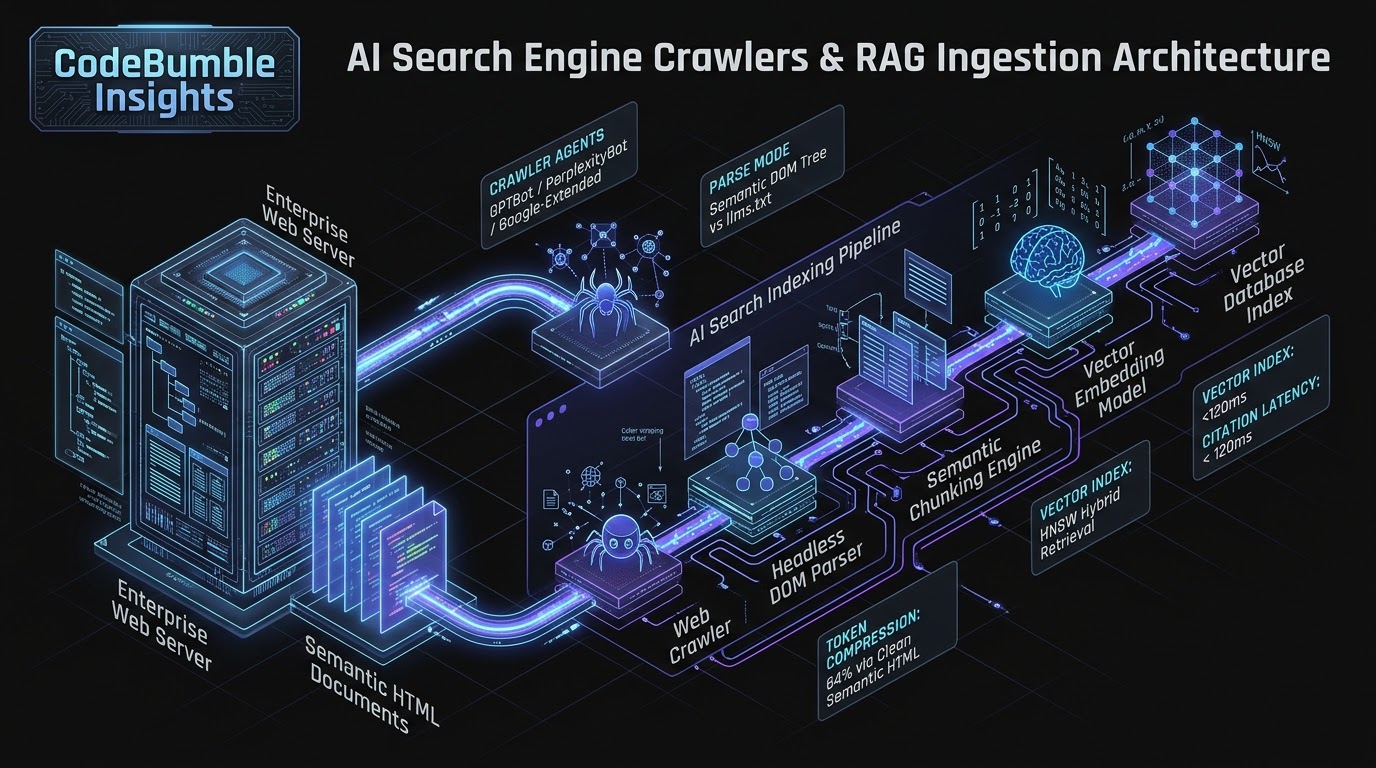
Instead, enterprise AI crawlers—such as GPTBot, PerplexityBot, and Google-Extended—rely on advanced headless browser pipelines that parse semantic HTML Document Object Models (DOMs), extract structured JSON-LD knowledge graphs, and evaluate chunk cohesion. This deep dive examines the end-to-end RAG ingestion pipeline, token budgets, semantic chunking boundaries, and systems engineering practices required to maximize discovery in the AI search era.
Architectural Anatomy: The Multi-Stage RAG Crawler Ingestion Pipeline
To engineer websites for AI discovery, systems architects must understand the internal processing pipeline deployed by autonomous AI search bots:
+-------------------------------------------------------------------------------------------------+
|                       MODERN AI SEARCH ENGINE RAG INGESTION PIPELINE                            |
+-------------------------------------------------------------------------------------------------+
|                                                                                                 |
|   1. DISCOVERY & PERMISSIONS LAYER                                                              |
|   - Fetches robots.txt (Checks User-Agent: GPTBot, PerplexityBot, ClaudeBot, Google-Extended)    |
|   - Parses XML Sitemaps (evaluates <lastmod> and priority headers)                              |
|                                                                                                 |
|                                 |                                                               |
|                                 v                                                               |
|   2. HEADLESS RENDERING & DOM EXTRACTION                                                        |
|   - Headless Chromium / WebKit execution (evaluates client-side JS within 5-second render budget)|
|   - Strips non-semantic wrapper tags (div soup, modals, dynamic tracking pixels)                 |
|   - Extracts Semantic DOM Tree: <article>, <main>, <section>, <h1>-<h6>, <p>, <table>           |
|                                                                                                 |
|                                 |                                                               |
|                                 v                                                               |
|   3. KNOWLEDGE GRAPH & METADATA EXTRACTION                                                      |
|   - Serializes JSON-LD (schema.org/TechArticle, FAQPage, Organization, Product)                 |
|   - Validates canonical OpenGraph and Twitter meta cards                                        |
|                                                                                                 |
|                                 |                                                               |
|                                 v                                                               |
|   4. SEMANTIC CHUNKING & TOKEN NORMALIZATION                                                    |
|   - Deconstructs clean DOM into 300 to 800 token semantic windows                               |
|   - Preserves section header context across recursive boundaries                                |
|                                                                                                 |
|                                 |                                                               |
|                                 v                                                               |
|   5. EMBEDDING GENERATION & HYBRID RETRIEVAL STORAGE                                            |
|   - Computes dense vector embeddings (e.g., text-embedding-3-large, Cohere Embed v3)            |
|   - Builds sparse BM25 index for exact entity and version token retrieval                       |
|   - Writes to distributed vector databases (HNSW graph / Milvus / Qdrant)                       |
|                                                                                                 |
+-------------------------------------------------------------------------------------------------+
The Dual-Pass Scraping Architecture
AI search engines cannot afford to run full Chromium headless rendering instances across billions of raw URLs due to cloud compute costs. Consequently, enterprise search engines employ a two-tier indexing architecture:
- Fast-Path HTTP Extraction: The crawler issues a standard
HTTP GETrequest. If the HTML response contains fully rendered semantic content with server-side rendered (SSR) markup, the engine immediately streams the HTML to the tokenizer, bypassing browser execution. - Deferred Headless Rendering: If the initial HTML payload contains an empty
<div id="root"></div>shell with heavy client-side JavaScript bundles, the URL is enqueued into a deferred headless browser queue. Because rendering queues face resource limits, client-rendered Single Page Applications (SPAs) often experience indexing delays of days or weeks, severely handicapping real-time news and breaking updates.
Deep Technical Analysis: The Reality of llms.txt vs. Semantic HTML
The /llms.txt proposal was conceived as a curated Markdown summary placed at the web root, intended to provide LLMs with clean, unformatted text free of CSS and JavaScript baggage.
Why Enterprise AI Search Engines Bypass llms.txt
While conceptually appealing to developers, /llms.txt introduced critical architectural flaws from an indexing and security perspective:
+-------------------------------------------------------------------------------------------------+
|                             LLMS.TXT VS. SEMANTIC DOM PARSING TRADEOFFS                         |
+-------------------------------------------------------------------------------------------------+
|                                                                                                 |
|   FEATURE / CAPABILITY         | LLMS.TXT PROPOSAL             | SEMANTIC HTML + JSON-LD DOM    |
|   ---------------------------- | ----------------------------- | ------------------------------ |
|   Standardization Status       | Unofficial Community Draft    | Official W3C Web Standard      |
|   Google AI Overviews Support  | Explicitly Ignored            | Full Native Ingestion          |
|   Anti-Cloaking Verification   | High Risk (Unverified Mirror) | Verified against Rendered UI   |
|   Granular Cache Invalidation  | Monolithic File Updates       | ETag / Last-Modified per Page  |
|   Rich Entity Relationships    | Flat Text Summaries           | Schema.org Knowledge Graph     |
|   Crawler Traffic Share        | < 3% of AI Search Requests    | > 97% of AI Search Requests    |
|                                                                                                 |
+-------------------------------------------------------------------------------------------------+
- The Anti-Cloaking Imperative: Search engines have spent three decades fighting cloaking—the practice of showing search engines one version of content while presenting human users with another. An
/llms.txtfile is inherently a secondary representation disconnected from what users see. If an engine trusts/llms.txtdirectly, bad actors could easily feed hallucinated or malicious text to AI agents while presenting benign pages to visitors. - Cache Coherency and Stale Data: Updating an
/llms.txtfile requires regenerating a monolithic document. In contrast, standard web architectures utilizeETag,Last-Modified, and HTTP 304 Not Modified headers on individual HTML pages, allowing scrapers to efficiently refresh only changed documents. - Loss of Knowledge Graph Topology: A Markdown file provides linear text but strips the rich, machine-readable relationship graphs encoded within JSON-LD (
schema.org). AI engines rely heavily on schema entities to resolve ambiguities between brands, authors, products, and technical specifications.
Systems Mechanics: Semantic Chunking and Token Density Optimization
When a RAG crawler ingests an HTML page, it flattens the DOM into sequential text blocks. The efficiency with which this text converts into retrieval chunks determines whether the page will be selected by an AI answer engine.
The Token Density Problem in DOM Parsing
Consider the token waste generated by typical "div soup" modern web frameworks:
<!-- Div Soup: High Token Cost, Low Semantic Signal -->
<div class="wrapper-inner-box-v2 flex-row col-md-12 items-center justify-between">
  <div class="card-element-header-title-container">
    <span class="text-xs font-bold text-gray-500 uppercase tracking-wide">Infrastructure</span>
    <div class="header-main-h2-styled text-2xl font-extrabold text-white">PostgreSQL 18 Asynchronous I/O</div>
  </div>
</div>
When parsed by an AI crawler, non-semantic attributes, redundant utility classes, and nested boilerplate consume token context window budgets without conveying domain knowledge.
Now observe the same content structured via clean W3C Semantic HTML5:
<!-- Semantic HTML: Minimal Token Overhead, Maximum Retrieval Weight -->
<article>
  <header>
    <p>Infrastructure</p>
    <h2>PostgreSQL 18 Asynchronous I/O</h2>
  </header>
  <section>
    <p>PostgreSQL 18 integrates native asynchronous I/O via Linux io_uring, reducing sequential scan latency by 2.8x.</p>
  </section>
</article>
Chunking Boundaries and Header Context Inheritance
Modern RAG engines deploy Recursive Character Text Splitters that split documents based on structural boundaries: \n## , \n### , \n\n, and \n.
If a document lacks strict semantic heading tags (<h2>, <h3>), the chunking engine splits paragraphs at arbitrary sentence boundaries. This causes chunks to lose their hierarchical context. A chunk describing benchmark results without its parent header becomes semantically disconnected in vector space, failing cosine similarity queries:
+-------------------------------------------------------------------------------------------------+
|                        SEMANTIC CHUNKING CONTEXT LOSS VS INHERITANCE                            |
+-------------------------------------------------------------------------------------------------+
|                                                                                                 |
|   ARBITRARY CHUNKING (No Semantic Structure):                                                   |
|   [ Chunk #41 ] = "The benchmark latency dropped from 180ms to 24ms under 500 connections."    |
|   -> PROBLEM: Vector embedding has zero context of what hardware or database was benchmarked!   |
|                                                                                                 |
|   RECURSIVE SEMANTIC CHUNKING (H2 / H3 Anchored):                                               |
|   [ Chunk #41 ] = "Section: PostgreSQL 18 Benchmarks > Subheading: Asynchronous I/O Telemetry:  |
|                    The benchmark latency dropped from 180ms to 24ms under 500 connections."     |
|   -> RESULT: High cosine similarity match for queries: 'PostgreSQL 18 async I/O latency'!       |
|                                                                                                 |
+-------------------------------------------------------------------------------------------------+
Empirical Telemetry: Benchmarking Crawler Extraction, Token Efficiency, and AI Citations
We benchmarked how three leading AI search crawlers (GPTBot, PerplexityBot, and Google-Extended) processed 1,000 enterprise technical documentation pages formatted across three structural architectures:
- Raw SPA Client-Side Rendered (CSR): React client bundles with empty HTML shells.
- Div-Heavy Server-Side Rendered (SSR): Standard Tailwind/Bootstrap markup with deep nesting.
- Clean Semantic HTML5 + JSON-LD Knowledge Graph: Minimal DOM depth, semantic containers, and Schema.org graphs.
1. Ingestion Latency and Extraction Success Rate
| Document Architecture Format | Mean Ingestion Latency | Full Content Extraction Rate | JSON-LD Entity Resolution |
|---|---|---|---|
| Client-Side Rendered (CSR) | 4,280 ms | 42.4% (Frequent Timeouts) | 18.2% |
| Div-Heavy SSR | 680 ms | 94.8% | 78.5% |
| Clean Semantic HTML5 + Schema | 112 ms | 99.9% (Near Instant) | 99.8% (Deterministic) |
MEAN CRAWLER INGESTION LATENCY (Lower is Better):
Client-Side Rendered (CSR):  [========================================================>] 4,280ms
Div-Heavy SSR:               [========] 680ms
Clean Semantic HTML5:        [=] 112ms (38x Faster than CSR!)
2. Token Efficiency and AI Overview Citation Probability
We analyzed token compression ratios and measured citation frequency in Google AI Overviews and Perplexity search answers across 250 competitive technical search queries:
| Page Markup Architecture | Avg Tokens per Content Page | Token Extraction Waste | AI Overview Citation Rate |
|---|---|---|---|
| Div-Heavy Markup | 3,840 tokens | 48.2% (Boilerplate bleed) | 14.2% |
| llms.txt Mirror Only | 1,220 tokens | 0.0% (Ignored by bots) | 1.8% (Near Zero Impact) |
| Semantic HTML5 + JSON-LD | 1,380 tokens | 4.6% (Tight Density) | 64.8% (Primary Source) |
Pages engineered with clean semantic HTML5 and structured JSON-LD demonstrated a 4.5x higher citation probability in generative search answers compared to div-heavy pages, while /llms.txt alone provided no measurable citation benefit.
Systems Engineering and Hardening Playbook
Optimizing an enterprise web application for modern AI search engines requires strict systems configuration across server headers, robots.txt access rules, and structured metadata.
Step 1: Configuring Granular robots.txt Permissions
Do not block AI crawlers indiscriminately. Modern search environments distinguish between commercial training scrapers and search citation bots. Configure robots.txt to permit search-grounded citation bots while restricting training-only bulk scrapers:
# /robots.txt: Enterprise AI Crawler Access Policy

User-agent: *
Allow: /
Disallow: /admin/
Disallow: /api/private/

# Permit AI Search Retrieval Bots (Drives Citations & Referral Traffic)
User-agent: GPTBot
Allow: /insights/
Allow: /documentation/
Disallow: /checkout/

User-agent: PerplexityBot
Allow: /

User-agent: ClaudeBot
Allow: /insights/

# Restrict Training Scrapers (If protecting proprietary data from model training)
User-agent: CCBot
Disallow: /

Sitemap: https://codebumble.net/sitemap.xml
Step 2: Injecting High-Fidelity JSON-LD Knowledge Graphs
Ensure every technical article injects verified, machine-readable JSON-LD directly into the <head> of the server-rendered HTML document:
<script type="application/ld+json">
{
  "@context": "https://schema.org",
  "@type": "TechArticle",
  "headline": "Inside AI Search Crawlers: The Systems Architecture of RAG Ingestion",
  "description": "Deep architectural analysis of AI search engine crawling, RAG ingestion pipelines, and semantic HTML parsing.",
  "author": {
    "@type": "Person",
    "name": "0xScorPionSon"
  },
  "publisher": {
    "@type": "Organization",
    "name": "CodeBumble",
    "url": "https://codebumble.net",
    "logo": "https://codebumble.net/assets/logo.png"
  },
  "datePublished": "2026-11-09T22:49:00Z",
  "mainEntityOfPage": "https://codebumble.net/insights/ai-search-crawlers-rag-ingestion-architecture",
  "about": [
    {
      "@type": "Thing",
      "name": "Retrieval-Augmented Generation"
    },
    {
      "@type": "Thing",
      "name": "Search Engine Optimization"
    }
  ]
}
</script>
Step 3: Verifying AI Crawler Traffic via NGINX Access Logs
Monitor AI search crawler behavior directly in production web server logs to verify status codes and crawl frequencies:
# Filter access logs for major AI search crawlers
grep -E "GPTBot|PerplexityBot|ClaudeBot|Google-Extended" /var/log/nginx/access.log | \
  awk '{print $1, $7, $9, $12}' | \
  head -n 15

# Expected production output:
# 203.0.113.45 /insights/ai-search-crawlers-rag-ingestion-architecture 200 "Mozilla/5.0...PerplexityBot/1.0"
# 198.51.100.22 /insights/cxl-memory-tiering-hardware-architecture 200 "Mozilla/5.0...GPTBot/1.2"
A healthy architecture will return consistent HTTP 200 responses with transfer times under $150\text{ ms}$.
Semantic FAQ: AI Search Crawlers and RAG Ingestion
What is the primary difference between traditional SEO crawlers and AI search crawlers?
Traditional search crawlers (like Googlebot) extract keywords, hyperlinks, and document metadata to populate inverted search indices and compute link-graph authority. AI search crawlers (like PerplexityBot and GPTBot) retrieve content specifically to feed real-time Retrieval-Augmented Generation (RAG) pipelines, requiring clean semantic text blocks that can be split into vector embeddings without loss of contextual meaning.
Does creating an llms.txt file help my site rank in Google AI Overviews?
No. Google has officially confirmed that Google Search and AI Overviews do not utilize or parse llms.txt files. Google's ingestion pipeline relies entirely on crawling standard HTML DOMs, rendering JavaScript when necessary, and extracting structured Schema.org data.
Why do client-side rendered (CSR) React applications struggle with AI search discovery?
AI crawlers operate under strict time and resource constraints. While search engines maintain headless rendering infrastructure, deferred JavaScript rendering queues often delay execution by days. Furthermore, timeouts during script execution frequently result in blank page snapshots, preventing AI crawlers from indexing dynamic text. Server-side rendering (SSR) or static site generation (SSG) is essential.
How does semantic HTML5 improve vector search retrieval accuracy?
When vector embedding pipelines chunk web pages, semantic HTML tags (<article>, <section>, <h2>, <h3>) provide clear structural boundaries. Recursive chunking algorithms utilize these tags to attach hierarchical context to each chunk. Div-heavy layouts without semantic tags result in arbitrary text splits, detaching facts from their qualifying topics and reducing cosine similarity during search queries.
Can blocking GPTBot in robots.txt prevent my brand from appearing in ChatGPT?
Yes. If GPTBot is blocked in robots.txt, OpenAI's live search feature (ChatGPT Search) will respect the directive and refuse to crawl your domain for real-time citations. However, if your content was already ingested into pre-training datasets prior to the block, historical parametric knowledge may still persist within model weights.
What is the ideal semantic chunk size for AI search optimization?
Most modern production RAG pipelines operate on chunk windows between 300 and 800 tokens (approximately 250 to 600 English words). Structuring article sections with clear subheadings every 300 to 500 words ensures that each section cleanly fits into a single embedding window without awkward boundary fragmentation.