

Engineering
AWS Nitro Sandboxes for EKS, ECS, and EC2: MicroVM Isolation Boundaries, KMS Attestation, and Day-One Limits
AWS Nitro Sandboxes give every EKS pod, ECS task, or EC2 workload its own Firecracker microVM via a single RuntimeClass field—at zero extra charge. Learn how isolated-sandbox differs from confidential-sandbox KMS attestation, why SMT halves x86 density, and what day-one GPU and Kubernetes 1.36+ limits apply.
8 min read
AWS Nitro Sandboxes for EKS, ECS, and EC2: MicroVM Isolation Boundaries, KMS Attestation, and Day-One Limits
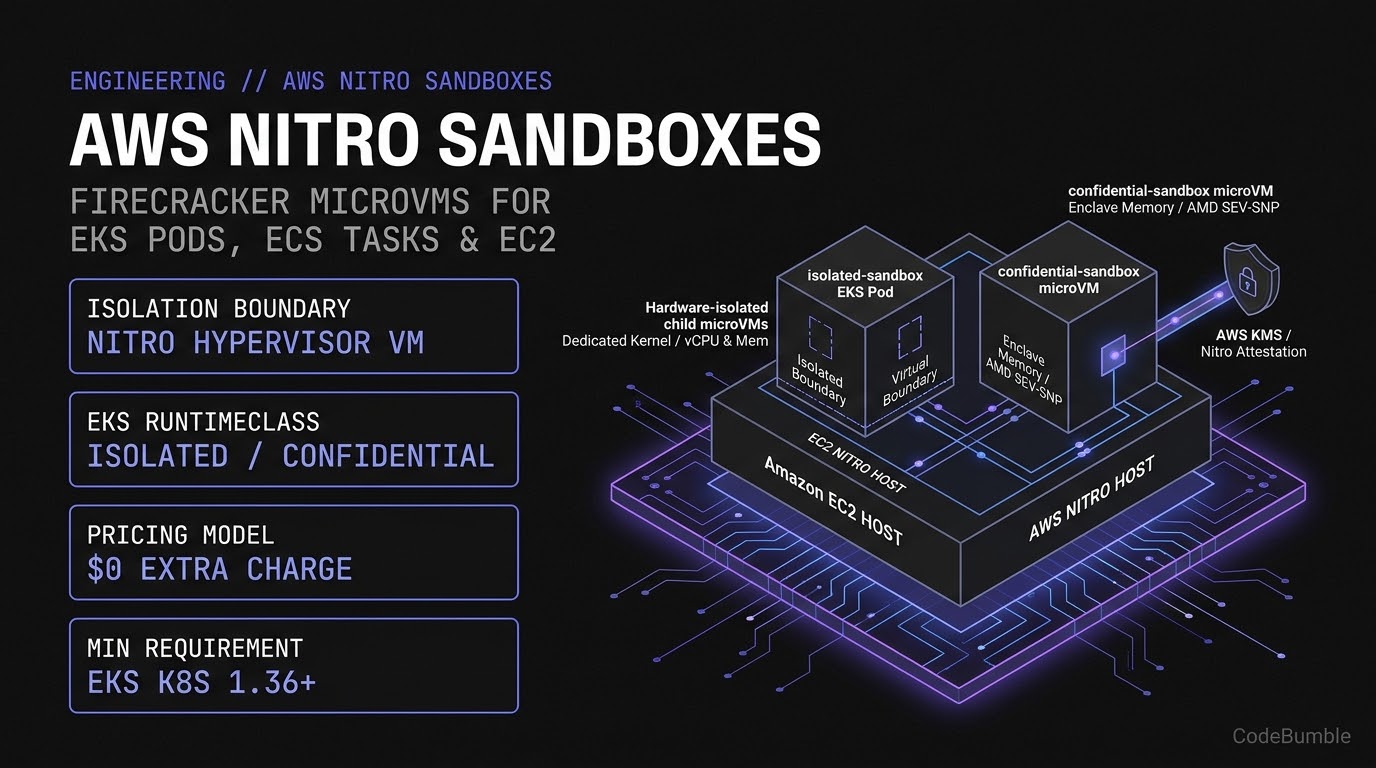
Executive Summary
Highlighted in the AWS Weekly Roundup on November 16, 2026 and analyzed by InfoQ on November 16, 2026, AWS Nitro Sandboxes (launched November 9, 2026) introduce hardware-isolated child virtual machines for Amazon EKS pods, Amazon ECS tasks, and Amazon EC2 workloads at no additional service charge. On Amazon EKS, opting a pod into hardware virtualization requires a single field—runtimeClassName: isolated-sandbox or runtimeClassName: confidential-sandbox—while keeping Pod Identity, VPC CNI, EBS/EFS/S3 storage, and CloudWatch logging intact.
For platform engineers running AI coding agents, multi-tenant SaaS, or untrusted CI builds, Nitro Sandboxes close a long-standing gap between standard Linux namespaces and full single-tenant EC2 nodes. However, the architecture comes with critical trust-boundary nuances and day-one operational constraints: isolated-sandbox trusts the parent EC2 host (meaning a compromised host can still observe unencrypted traffic or mint Pod Identity tokens), confidential-sandbox requires explicit AWS KMS PCR attestation policies to be complete, and GPU passthrough, snapshots, and live migration are unavailable at launch.
Confidence level: High for architecture, RuntimeClass mechanics, density caps, and day-one limitations, all verified against official AWS announcements, the November 16 InfoQ technical breakdown, and Qovery's EKS engineering analysis. Published cold-start latency benchmarks for Nitro Sandboxes are not yet provided by AWS (warm-pool pre-booted VMs via agent-sandbox are cited at roughly two seconds); teams should benchmark startup latency and I/O throughput on their target EC2 instance families.
Technical Mechanics and Architecture
How containerd-shim-nitro-sandbox-v2 Carves Out Child MicroVMs
According to the AWS announcement and InfoQ's November 16 analysis, a Nitro Sandbox runs as a lightweight child virtual machine alongside standard workloads on a Nitro-based EC2 instance. The parent instance donates vCPUs and memory, while the AWS Nitro hypervisor enforces hardware-assisted virtualization boundaries.
On Amazon EKS and ECS:
kubeletinvokescontainerdon the parent EC2 node, which spawns acontainerd-shim-nitro-sandbox-v2process.- The shim launches a Firecracker microVM running on Nitro (rather than KVM) as a first-level guest with its own dedicated guest Linux kernel and isolated memory mappings.
- Inside the microVM, an in-guest agent runs its own
containerddaemon to start the pod's containers unchanged, communicating with the host shim overvirtioandvsock.
+-------------------------------------------------------------------------+
|                  AMAZON EC2 NITRO HOST INSTANCE                         |
|                                                                         |
|  [kubelet] ---> [containerd] ---> [containerd-shim-nitro-sandbox-v2]    |
|                                        | (virtio / vsock)               |
|  ======================================|==============================  |
|  AWS Nitro Hypervisor Boundary         v                                |
|  +---------------------------------+  +------------------------------+  |
|  | isolated-sandbox (Firecracker)  |  | confidential-sandbox         |  |
|  | - Dedicated guest kernel        |  | - Dedicated guest kernel     |  |
|  | - Trusts parent host            |  | - Untrusted parent host      |  |
|  | - kubectl exec / logs enabled   |  | - exec & stdin DENIED        |  |
|  | - Protects host from pod        |  | - Cedar policy + NSM PCRs    |  |
|  +---------------------------------+  +--------------+---------------+  |
|                                                      | Attestation      |
|                                                      v                  |
|                                            [AWS KMS Key Policy]         |
+-------------------------------------------------------------------------+
isolated-sandbox vs. confidential-sandbox: Two Distinct Threat Models
Choosing the wrong RuntimeClass leaves a silent gap in your threat model:
isolated-sandbox(One-Way Trust: Protects Host from Pod): Designed for untrusted tenant code, CI jobs, and LLM-generated scripts. The host is trusted, sokubectl exec,kubectl logs, and process inspection continue to work. However, as AWS Container Hero Sandip Das noted in InfoQ's report, protection runs in one direction: a compromised parent node can still inspect unencrypted pod traffic, modify/etc/hosts, or mint Pod Identity credentials.confidential-sandbox(Two-Way Isolation: Protects Workload from Host): Designed for regulated workloads and sensitive secrets. The parent node is treated as untrusted:kubectl execandstdinare denied, a Cedar policy generated from the pod spec pins image digests, arguments, mounts, and capabilities, and the Nitro Secure Module (NSM) measures the image and policy into Platform Configuration Registers (PCRs). Crucially, AWS documentation warns that without an AWS KMS key policy (or external verifier) checking those PCR values, attestation is recorded but never enforced.
Separately, a network-isolated annotation boots the sandbox with no network interface at all—removing DNS, NTP, IMDS, and Pod Identity (and breaking HTTP/TCP readiness probes).
Safe Pod & KMS Policy Configuration
Below is a defensive EKS Pod manifest using confidential-sandbox with explicit resource limits and an AWS KMS key policy condition structure (requiring kms:RecipientAttestation:ImageSha384 or PCR verification against your measured Nitro Sandbox):
apiVersion: v1
kind: Pod
metadata:
  name: untrusted-agent-runner
  namespace: agent-sandboxes
spec:
  runtimeClassName: confidential-sandbox
  automountServiceAccountToken: false
  containers:
    - name: runner
      image: 123456789012.dkr.ecr.us-east-1.amazonaws.com/agent-runner@sha256:replace-with-pinned-digest
      securityContext:
        allowPrivilegeEscalation: false
        readOnlyRootFilesystem: true
        runAsNonRoot: true
        capabilities:
          drop: ["ALL"]
      resources:
        requests:
          cpu: "1000m"
          memory: "1Gi"
        limits:
          cpu: "1000m"
          memory: "1Gi"
Evidence, Constraints, and Comparison
Before adopting Nitro Sandboxes in production, platform teams should account for the density, hardware, and prerequisite constraints documented across the InfoQ November 16 breakdown and Qovery's architectural comparison:
| Capability / Constraint | AWS Nitro Sandboxes (isolated / confidential) |
GKE Sandbox (gVisor / microVM) |
Hosted Sandboxes (E2B / Daytona) |
|---|---|---|---|
| Isolation Mechanism | Firecracker microVM on Nitro hypervisor | gVisor user-space kernel or Kata/Cloud Hypervisor | Hosted microVMs |
| Extra Service Charge | $0 (EC2 / EKS Auto Mode / ECS fees apply) | Included on GKE | Per-second / SaaS billing |
| Min Kubernetes Version | EKS 1.36+ (with Nitro Enclaves & Pod Identity) | GKE supported versions | N/A (external API) |
| GPU Passthrough | Not supported at launch | gVisor supports CUDA on subset of GPUs | Vendor-dependent |
| Startup / Warm Pools | No published cold-start figure; ~2s via agent-sandbox |
< 200 ms (gVisor) / 1–2 s (microVM) |
Sub-second warm pools |
| Snapshot / Live Migration | Not supported at launch | Limited | Supported (pause/resume) |
Key Density and SMT Arithmetic Gotchas
- 5x vCPU and Sandbox Count Cap: Total sandbox vCPUs cannot exceed 5x the parent node's vCPU count, and total sandbox count is capped at 5x the node's vCPU count (halved on CPU-overcommit instance types). On a 4-vCPU node, you can run at most twenty 1-vCPU sandboxes or five 4-vCPU sandboxes.
- SMT / Hyper-Threading Penalty on x86: Core scheduling prevents two sandboxes from sharing sibling threads on the same physical core, effectively cutting usable vCPUs roughly in half on x86 instances with Simultaneous Multithreading (SMT). AWS Graviton instances (one thread per core) are unaffected.
- Karpenter & Managed Node Group Prerequisites: Outside EKS Auto Mode (where
isolated-sandboxandconfidential-sandboxship out of the box), standard EKS clusters require Karpenter 1.14+,enclaveOptionsenabled in theEC2NodeClass/ launch template, a sandbox-enabled AMI, and EKS Pod Identity (not IRSA). Without Nitro Enclaves enabled on the node launch template, sandboxed pods remain stuck inPending.
Hardening and Deployment Playbook
Follow these six steps to deploy AWS Nitro Sandboxes safely on Amazon EKS.
1. Verify EKS Version, Pod Identity, and Node AMI Readiness
Confirm your cluster runs Kubernetes 1.36 or later, uses EKS Pod Identity instead of legacy IRSA for sandboxed pods, and—if not using EKS Auto Mode—provisions nodes via Karpenter 1.14+ with enclaveOptions enabled.
# Safe read-only check for cluster version and available RuntimeClasses
kubectl version --short 2>/dev/null || kubectl version
kubectl get runtimeclass
2. Prefer AWS Graviton Instances for x86-Free Core Scheduling
To avoid losing roughly half of advertised vCPUs to SMT core-scheduling isolation, target AWS Graviton Nitro instances for sandbox node pools.
3. Pin Container Images by Immutable SHA-256 Digest
In confidential-sandbox mode, Cedar policy enforcement pins image digests and Nitro Secure Module PCRs. Always reference ECR images by @sha256:... rather than mutable :latest tags.
4. Enforce KMS Attestation Policies for Confidential Secrets
Never rely on confidential-sandbox without configuring an AWS KMS key policy (or external attestation verifier) that validates the Nitro Secure Module PCR measurements before releasing decryption keys.
5. Use agent-sandbox Warm Pools for Latency-Sensitive Coding Agents
If your AI agent workflow cannot tolerate cold microVM boot times, deploy the open-source agent-sandbox warm-pool pattern referenced by AWS to allocate pre-booted sandboxes in roughly two seconds.
6. Rollback Note
Because Nitro Sandboxes are selected per pod via runtimeClassName, rolling back a workload requires only removing runtimeClassName (or switching back to your prior RuntimeClass) in the Deployment spec and triggering a rolling update. For node pools, drain and cordon the Nitro Sandbox NodePool cleanly without disrupting standard workloads.
Frequently Asked Questions (FAQ)
1. Do AWS Nitro Sandboxes cost extra per pod or per microVM?
No. Per the AWS Weekly Roundup (November 16, 2026), Nitro Sandboxes carry no additional charge on supported Nitro EC2 instances; standard EC2, EKS Auto Mode, or ECS Managed Instances charges still apply.
2. What is the difference between isolated-sandbox and confidential-sandbox?
isolated-sandbox protects the EC2 host from untrusted pod code while allowing kubectl exec and logs. confidential-sandbox treats the host as untrusted, disables exec and stdin, enforces a Cedar pod policy, and measures the workload into Nitro Secure Module PCRs for AWS KMS attestation.
3. Why are my Nitro Sandbox pods stuck in Pending on EKS?
On standard EKS managed node groups or Karpenter, sandboxed pods sit in Pending if the node launch template lacks Nitro Enclaves enabled, the AMI lacks the sandbox runtime, or the cluster is below Kubernetes 1.36 (InfoQ).
4. Can I attach a GPU to an AWS Nitro Sandbox?
Not at launch. Firecracker does not currently support host GPU or device passthrough into a Nitro Sandbox guest.
5. Does confidential-sandbox automatically protect my secrets without KMS changes?
No. AWS documentation explicitly warns that unless a KMS key policy or external verifier checks the PCR attestation measurements, the confidentiality guarantees of confidential-sandbox are incomplete.
Sources
- AWS News Blog — AWS Weekly Roundup: AWS Nitro Sandboxes, AWS Emulator, and more (Published November 16, 2026)
- InfoQ — AWS Nitro Sandboxes Put Each EKS Pod in Its Own MicroVM with One RuntimeClass Field (Published November 16, 2026)
- AWS What's New — Introducing AWS Nitro Sandboxes on Amazon EKS, ECS and EC2 (Published November 9, 2026)
- Qovery — AWS Nitro Sandboxes on EKS vs. Daytona, E2B and Modal (Published November 10, 2026)