

Web performance
Inside CDN Migration Performance: Why Fast Edge Responses Trigger Origin Overload and How to Warm Caches Without Blocking Crawlers
On November 11, 2026, Google Search Central warned that moving a website to a CDN can trigger an immediate crawl surge on the origin server because faster edge responses raise crawl capacity limits while cold caches pass every first-time URL miss straight back to origin. Turning on blanket CAPTCHA or 403 blocks then drops pages from Search. Here is the technical architecture, cache-warming script, and 429/503 backpressure playbook.
12 min read
Inside CDN Migration Performance: Why Fast Edge Responses Trigger Origin Overload and How to Warm Caches Without Blocking Crawlers
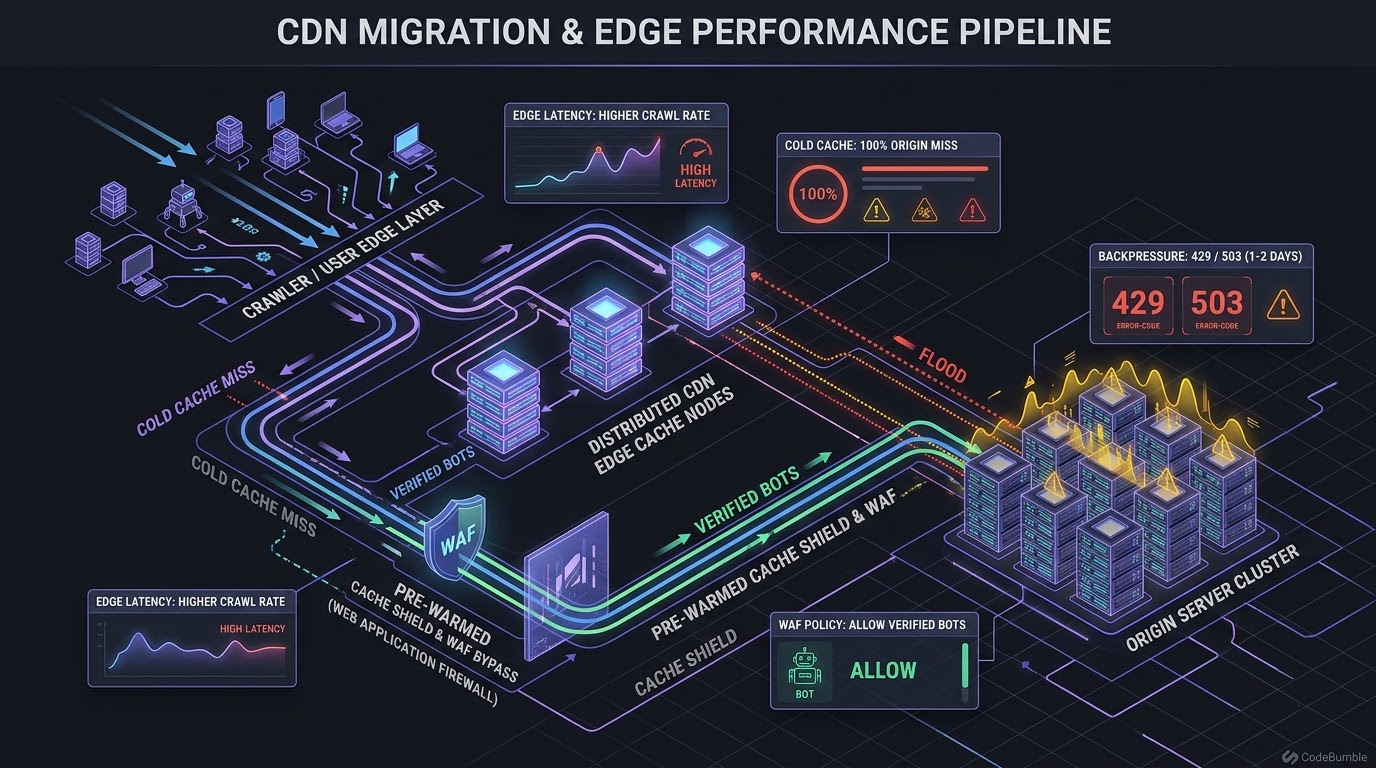
Executive Summary
On November 11, 2026, Google Search Central published new technical guidance—authored by Search Quality Analyst Cherry Prommawin and Search Relations Lead Gary Illyes—addressing a counterintuitive failure mode in web infrastructure: "Moving to a CDN without overwhelming your origin (or blocking Googlebot)." Accompanied by the Season 1 finale of The Non-Canonical Cabinet, the advisory explains why deploying a Content Delivery Network (CDN) frequently causes an immediate, severe traffic surge on the origin server rather than relieving load.
Under standard web performance assumptions, placing a reverse-proxy CDN in front of an origin server reduces Time to First Byte (TTFB) and offloads bandwidth. However, two coupled mechanisms invert that expectation on cutover day:
- Latency-Driven Crawl Rate Escalation: Google's crawling infrastructure continuously calculates a per-hostname crawl capacity limit (hostload) based on connection latency and error rates. When DNS cuts over to a fast CDN edge, improved edge response times signal to Googlebot that the site can sustain higher concurrency, prompting crawlers to ramp up request volume.
- Cold-Cache Inventory Amplification: A newly provisioned CDN starts with an empty cache. While human visitors cluster around a small working set of popular pages—warming those specific URLs rapidly—crawlers systematically traverse the entire breadth of a site's URL inventory. Every uncached URL triggers a 100% cache miss that passes straight through to the origin server.
When operations teams observe spiking origin CPU and bandwidth graphs immediately after cutover, a common reflex is to enable blanket bot protection or aggressive Web Application Firewall (WAF) challenges. Google warns that intercepting verified crawlers with CAPTCHA challenges or 403 Forbidden walls causes crawlers to back off and eventually drop pages—including Shopping listings—from Search.
This engineering guide dissects the mechanics of CDN cold-cache crawl amplification, provides a controlled cache-warming script and NGINX/CDN backpressure configurations (429/503 with Retry-After), and outlines a production-safe cutover playbook.
Technical Mechanics and Architecture
To understand why a CDN migration can overload an origin server before stabilizing, one must trace how edge caching interacts with automated crawler hostload algorithms.
+-------------------------------------------------------------------------------+
|                     PHASE 1: CUTOVER WITH COLD CDN CACHE                      |
+-------------------------------------------------------------------------------+
  [Googlebot & Crawlers]                [Human Visitors]
           |                                    |
           | Systematic breadth crawl           | Clustered on top 1-5% URLs
           v                                    v
+-------------------------------------------------------------------------------+
|                        CDN EDGE NODES (COLD / EMPTY)                          |
|  * Low Edge TTFB signals "healthy capacity" -> Googlebot raises hostload cap  |
|  * First request per unique URL = CACHE MISS                                  |
+-------------------------------------------------------------------------------+
           |                                    |
           | 100% Pass-Through on Misses        | Warms popular pages quickly
           v                                    v
+-------------------------------------------------------------------------------+
|                         ORIGIN SERVER CLUSTER                                 |
|  * Absorbs full crawler inventory sweep at elevated concurrency               |
|  * Risk: CPU/DB saturation if unshielded                                      |
|  * WRONG FIX: Blanket WAF / CAPTCHA / 403 -> Drops pages from Search          |
|  * RIGHT FIX: Pre-warm cache + Verified-Bot Allowlist + 429/503 (1-2 days)    |
+-------------------------------------------------------------------------------+
1. How Edge Latency Drives Crawl Capacity Limits (Hostload)
Google's crawling infrastructure manages request concurrency per hostname through a dynamic crawl capacity limit, also known as hostload. Rather than using a fixed requests-per-second cap, Googlebot tracks the aggregate time a target host spends holding connections open—factoring in both parallel connection counts and response latency (including Time to First Byte).
When a site migrates behind a global CDN, two signals shift simultaneously:
- Reduced RTT and TTFB: Edge Points of Presence (PoPs) terminate TLS handshakes and serve cached or keep-alive responses closer to crawler egress nodes. Googlebot observes lower response times and interprets the improvement as a hardware or capacity upgrade.
- CDN Infrastructure Heuristics: As Google previously documented in December 2024, its crawling infrastructure also infers CDN-backed deployments from answering IP ranges, permitting higher baseline throttling thresholds on the assumption that edge infrastructure can absorb concurrent connections.
As a result, if there is unmet crawl demand in the URL frontier, Googlebot accelerates its request rate shortly after DNS propagation.
2. The Asymmetric Access Pattern: Humans vs. Crawlers
A CDN only shields the origin server on the second and subsequent requests for a given cacheable resource within its Time-to-Live (TTL) window. On the first request at an edge PoP, the CDN has no stored copy of the HTML document, CSS, JavaScript, or image asset. It must traverse the backhaul link to the origin, fetch the response, store a cacheable copy, and return it to the client.
Human traffic exhibits high locality of reference (following a Zipf distribution): most visitors request the homepage, top landing pages, or active promotional URLs. Those hot keys warm up in edge caches within minutes.
Crawlers exhibit the exact opposite access pattern. Their mandate is to discover and refresh the entire URL inventory—including deep archive pages, long-tail product SKUs, faceted URLs, and unvisited assets. Because each unique URL is a cache miss on its first edge traversal, a site with 100,000 or 1,000,000+ unique URLs funnels nearly 100% of crawler requests directly to the origin until the edge cache is populated.
3. Why Blanket WAF Rules and 403 Walls Break Indexing
When origin telemetry spikes during cutover, engineering teams often misdiagnose legitimate crawler sweeps as a Layer-7 Distributed Denial of Service (DDoS) or scraper attack. Enabling blanket "Under Attack" modes or strict WAF bot challenges introduces two distinct failure modes:
- Soft Blocks (CAPTCHA / JS Challenges): Automated crawlers cannot solve interactive visual puzzles or arbitrary client-side bot challenges. From Googlebot's perspective, the site returns an unusable error or interstitial page.
- Hard Blocks (
401 Unauthorized/403 Forbidden): Google's HTTP status code documentation explicitly warns against using401or403responses as rate-limiting mechanisms. Unlike429or503,4xxstatus codes (other than429) do not instruct Googlebot to throttle down cleanly; persistent403or challenge responses cause crawlers to treat URLs as deliberately restricted or broken, leading to rapid de-indexing of web pages and Shopping feeds.
Instead, Google recommends using HTTP 429 Too Many Requests or 503 Service Unavailable with a Retry-After header as a temporary backpressure brake—strictly capped at a few hours, or 1–2 days at most. Extending 429/503 responses on the same URL for multiple days risks dropping those URLs from the search index.
Defensive Cache-Warming and Telemetry Verification Script
To prevent cold-cache origin shocks during a CDN cutover, engineers should pre-warm edge caches at a controlled pace before shifting production DNS, prioritizing high-traffic pages and top Googlebot-crawled URLs extracted from origin access logs.
The following safe Python script parses an NGINX/Apache access log (or URL inventory list) to extract the top unique URLs requested by Googlebot and executes a rate-limited, concurrent cache-warming pass through the staging CDN endpoint.
  // cdn_cache_warmer.py
  // Safely pre-warms CDN edge caches at a controlled rate prior to DNS cutover
  // Extracts top crawled URLs and verifies Cache-Status / X-Cache headers

import sys
import time
import urllib.request
import urllib.error
from collections import Counter
import re

LOG_URL_PATTERN = re.compile(r'"(?:GET|HEAD)\s+([^\s?]+)')

def extract_top_urls(log_path: str, limit: int = 100) -> list:
    counts = Counter()
    with open(log_path, 'r', encoding='utf-8', errors='ignore') as f:
        for line in f:
            if 'Googlebot' in line:
                match = LOG_URL_PATTERN.search(line)
                if match:
                    path = match.group(1)
                    if not path.endswith(('.css', '.js', '.png', '.jpg', '.woff2')):
                        counts[path] += 1
    return [url for url, _ in counts.most_common(limit)]

def warm_cdn_urls(cdn_base_url: str, paths: list, delay_sec: float = 0.25):
    print(f"[*] Starting controlled cache warm-up against {cdn_base_url}")
    print(f"[*] Target URLs: {len(paths)} | Pacing: {delay_sec}s per request\n")

    hits = 0
    misses = 0
    errors = 0

    for idx, path in enumerate(paths, 1):
        target = f"{cdn_base_url.rstrip('/')}{path}"
        req = urllib.request.Request(
            target,
            headers={
                "User-Agent": "CodeBumble-CacheWarmer/1.0",
                "Accept-Encoding": "gzip, br"
            }
        )
        try:
            with urllib.request.urlopen(req, timeout=10) as resp:
                cache_hdr = (
                    resp.headers.get("CF-Cache-Status")
                    or resp.headers.get("X-Cache")
                    or resp.headers.get("X-Cache-Status")
                    or "UNKNOWN"
                )
                status = resp.status
                if "HIT" in cache_hdr.upper():
                    hits += 1
                else:
                    misses += 1
                print(f"[{idx}/{len(paths)}] {status} | Cache: {cache_hdr:10s} | {path}")
        except urllib.error.HTTPError as e:
            errors += 1
            print(f"[{idx}/{len(paths)}] HTTP {e.code} | {path}")
        except Exception as e:
            errors += 1
            print(f"[{idx}/{len(paths)}] ERROR: {e} | {path}")

        time.sleep(delay_sec)

    print("\n--- CACHE WARMING SUMMARY ---")
    print(f"Total Processed : {len(paths)}")
    print(f"Edge Cache HITs : {hits}")
    print(f"Edge Cache MISS : {misses} (Now populated at edge)")
    print(f"Errors          : {errors}")

if __name__ == "__main__":
    if len(sys.argv) < 3:
        print("Usage: python3 cdn_cache_warmer.py <cdn_staging_url> <access_log_path> [limit]")
        sys.exit(1)

    base_url = sys.argv[1]
    log_file = sys.argv[2]
    max_urls = int(sys.argv[3]) if len(sys.argv) > 3 else 100

    top_paths = extract_top_urls(log_file, limit=max_urls)
    if not top_paths:
        print("[-] No Googlebot URLs found in log. Provide a valid access log.")
        sys.exit(1)

    warm_cdn_urls(base_url, top_paths)
Production Evidence and Operational Impact
Analysis of Google Search Central's November 11, 2026 advisory alongside historical CDN migration telemetry (including Google's December 24, 2024 Crawling December documentation and October 6, 2026 Reduce Google Crawl Rate updates) highlights critical production constraints:
1. The Verified Crawler Verification Gap
Google explicitly notes that CDN and WAF IP blocklists can automatically absorb crawler IP addresses without administrator awareness. Because Google publishes official JSON IP range feeds (googlebot.json, special-crawlers.json, and user-triggered-fetchers.json) alongside reverse/forward DNS verification standards (*.googlebot.com, *.google.com), relying on generic behavioral heuristics causes false positives.
Furthermore, leaving a blanket challenge active impacts more than organic web search:
- Google Shopping & Ads: Product feeds and landing page price/availability crawlers fail CAPTCHA challenges, causing merchant center disapprovals or paused Google Ads campaigns.
- Freshness Latency: When
429or503responses trigger a hostname-wide crawl slowdown, Googlebot discovers fewer new pages, delays updating pricing/inventory changes, and retains deleted URLs in the index longer.
2. Origin Shielding and Cache-Hit Ratio Dynamics
In multi-PoP CDN architectures, a request hitting Tokyo does not warm the edge cache in Frankfurt unless an Origin Shield (tiered caching layer) is enabled. Without tiered caching, a globally distributed crawler pool hitting multiple regional PoPs can multiply cold-cache misses against the origin server for the exact same URL. Enabling Origin Shielding consolidates cache misses through a single designated regional parent PoP before hitting the origin.
Enterprise CDN Migration and Hardening Playbook
To execute a zero-downtime CDN migration without triggering origin saturation or search de-indexing, infrastructure and SRE teams should follow this four-phase playbook.
Phase 1: Pre-Cutover Cache Warming and Origin Shielding
- Enable Tiered Caching / Origin Shield: Configure your CDN (Cloudflare Tiered Cache, Fastly Shielding, or CloudFront Origin Shield) so regional edge nodes query a central shield PoP rather than hitting the origin independently on cold misses.
- Pre-Warm Top Inventory: Use recent server access logs to identify the top 10% most-visited URLs, upcoming seasonal/promotional pages, and the highest-frequency Googlebot crawl targets. Run
cdn_cache_warmer.pyagainst the CDN staging CNAME at a controlled rate prior to public DNS cutover. - Audit
Cache-ControlHeaders: Ensure cacheable HTML, CSS, JS, and media assets emit explicitCache-Control: public, max-age=..., s-maxage=...headers so the CDN actually caches responses rather than passing throughno-storeorprivatedefaults.
Phase 2: Verified Bot Exemptions in WAF and Edge Rules
- Enable Built-In Verified Bot Allowlists: Activate your CDN or WAF provider's managed "Allow Known/Verified Bots" rule (supported natively in Cloudflare, Akamai, Fastly, F5, and Google Cloud Armor) before enabling rate-limiting or JS challenge rules.
- Never Use
403for Rate Limiting: Verify that automated DDoS and rate-limiting rules are configured to exempt verified search engine crawlers from403 Forbiddenand CAPTCHA challenge actions.
Phase 3: Controlled Origin Backpressure (429 / 503 with Retry-After)
If origin CPU or database connection pools reach critical saturation while caches warm up, configure NGINX or your edge proxy to shed excess load gracefully using 429 or 503 with a Retry-After header—never 403:
  // NGINX Emergency Origin Backpressure Configuration
  // Returns HTTP 429 with Retry-After header when connection limits are exceeded

http {
    # Define rate limit zone (e.g., 20 requests/sec per IP, 10MB shared state)
    limit_req_zone $binary_remote_addr zone=origin_shield:10m rate=20r/s;
    limit_req_status 429;

    server {
        listen 443 ssl http2;
        server_name example.com;

        location / {
            limit_req zone=origin_shield burst=40 nodelay;
            error_page 429 = @rate_limited;
            proxy_pass http://app_backend;
        }

        location @rate_limited {
            # Instruct Googlebot and clients to wait 300 seconds (5 minutes)
            add_header Retry-After 300 always;
            add_header Content-Type text/plain always;
            return 429 "Origin warming in progress. Please retry after 300 seconds.\n";
        }
    }
}
Rollback & Duration Rule: Monitor origin load continuously and remove aggressive 429/503 throttling as soon as edge cache hit ratios stabilize—strictly within a few hours to 1–2 days maximum.
Phase 4: Post-Cutover Verification in Search Console
- Run the URL Inspection Tool: Immediately after DNS cutover, test representative URLs in Google Search Console's URL Inspection Tool and inspect the rendered screenshot and HTTP response code. Verify that Googlebot sees your actual page rather than an empty page, a
403block, or a CDN CAPTCHA challenge. - Monitor Crawl Stats Report: Track
Crawl Statsin Search Console over the 72 hours following cutover to confirm response times drop and5xx/429error rates return to baseline.
Frequently Asked Questions (FAQ)
Why did origin server traffic increase right after enabling a CDN?
A newly deployed CDN starts with an empty cache. Because edge servers respond with much lower latency than a direct origin connection, Googlebot's hostload algorithm interprets the faster response times as increased server capacity and raises the site's crawl rate. Every unique URL not yet cached at the edge triggers a cache miss that passes straight back to your origin server.
Should I block bots with a 403 error or CAPTCHA if my origin is overloaded during migration?
No. Google explicitly warns against using 403 Forbidden, 401 Unauthorized, or CAPTCHA challenges to throttle crawl spikes. Crawlers fail interactive challenges, interpret 403 blocks as broken or restricted content, and will back off—causing your web pages and Shopping listings to drop out of Search.
How long can I safely return HTTP 429 or 503 to slow down Googlebot?
According to Google Search Central's November 11, 2026 guidance and its Reduce Google Crawl Rate documentation, you should only return 429 or 503 responses (ideally paired with a Retry-After header) for a few hours, or 1–2 days at most. Keeping those status codes active on the same URLs for several days can result in URLs being dropped from the index.
How can I verify that requests claiming to be Googlebot are genuine?
Never rely solely on the User-Agent header. Use your CDN's Verified Bot exemption or validate client IPs via forward/reverse DNS (*.googlebot.com) and Google's published IP range JSON files.
Does enabling a CDN protect my origin from the very first request?
No. A CDN shields your origin starting from the second request for a cacheable URL. The first request is always a cache miss, making pre-warming and Origin Shielding essential.
Intelligence Sources and References
- Google Search Central Blog (November 11, 2026): Moving to a CDN without overwhelming your origin (or blocking Googlebot) by Cherry Prommawin and Gary Illyes — Official technical advisory on edge latency crawl escalation, cold-cache misses, verified-bot exemptions, and 429/503 backpressure.
https://developers.google.com/search/blog/2026/11/crawling-cdn - Search Engine Roundtable (November 11, 2026): Google On How Moving to a CDN Can Accidentally Overwhelm Your Website by Barry Schwartz — Coverage of The Non-Canonical Cabinet Season 1 finale and CDN cutover failure modes.
https://www.seroundtable.com/google-search-cdn-42511.html - The SEO Handbook (November 12, 2026): Moving to a CDN: Google's crawl advice — Summary of pre-warming strategies, verified-bot WAF toggles, and
429/503vs403status code guidance.https://seohandbook.co.uk/seo-news-updates/google-cdn-migration-crawl-surge/ - PPC Land (November 12, 2026): Google says CDN bot blocks can drop products from Shopping and Ads — Analysis of Shopping feed impacts and crawler IP verification requirements.
https://ppc.land/google-says-cdn-bot-blocks-can-drop-products-from-shopping-and-ads/ - NemoCiment Technical Review (November 12, 2026): Moving to a CDN without blocking Googlebot or your server — Cross-reference of the November 11, 2026 advisory with Google's Crawl Budget Management, Reduce Google Crawl Rate (updated Oct 6, 2026), and December 2024 CDN documentation.
https://nemociment.fr/en/blog/cdn-migration-google-crawling-googlebot/