

Engineering
CloudLinux 10.3 and AlmaLinux 10.3 Arrive With Kernel 6.12, Podman 6, and the Return of ModSecurity OWASP CRS 4
CloudLinux 10.3 and 9.9 are now generally available, tracking AlmaLinux OS 10.3 ('Mauve Lion') and 9.9 ('Chartreuse Bobcat'). From ISO-less cldeploy provisioning and ModSecurity 2.9.14 with OWASP CRS 4.22 to Podman 6's config relocation and 36 upstream kernel CVE backports, here is the engineering breakdown and pre-upgrade checklist.
9 min read
CloudLinux 10.3 and AlmaLinux 10.3 Arrive With Kernel 6.12, Podman 6, and the Return of ModSecurity OWASP CRS 4
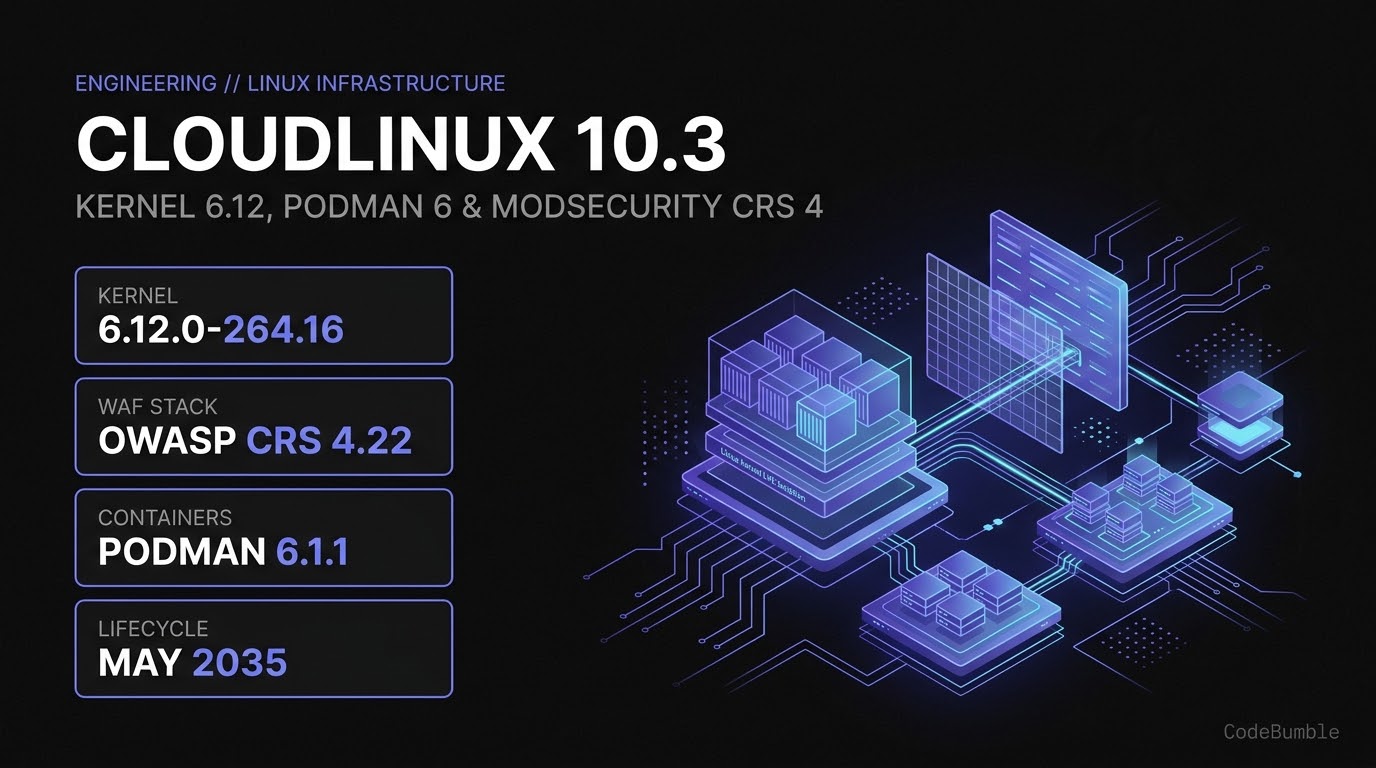
Executive Summary
On November 16, 2026, CloudLinux announced the general availability of CloudLinux 10.3 Stable Release alongside CloudLinux 9.9 Stable Release, synchronized directly with AlmaLinux OS 10.3 ("Mauve Lion") and 9.9 ("Chartreuse Bobcat"). CloudLinux 10.3 runs on the unmodified upstream AlmaLinux 6.12 kernel (6.12.0-264.16.1.el10_3) paired with a rebuilt Lightweight Virtual Environment module (kmod-lve-2.1-82.el10) with Secure Boot support, and carries lifecycle support through May 2035.
For hosting providers, platform engineers, and Enterprise Linux administrators, this point release introduces several operational changes that can break assumptions carried over from EL9 or early EL10 deployments:
- No CloudLinux 10 ISOs: Fresh CloudLinux 10.3 installs start from AlmaLinux OS 10.3 followed by
cldeploy, and/etc/os-releasecontinues to report AlmaLinux rather than CloudLinux. - ModSecurity returns with a breaking jump:
mod_security2.9.14 and OWASP Core Rule Set (CRS) 4.22.0 return to EL10 after being absent in 10.0–10.2, replacing CRS 3.3.5 from EL9 with a reorganized rule set. - Podman 6 relocates defaults and drops legacy backends: Container vendor defaults move from
/etc/containersto/usr/share/containers, while CNI, BoltDB,slirp4netns,cgroups v1, andiptablesfirewall rules are removed. - Kernel CVE regression prevention: According to the AlmaLinux 10.3 Release Notes and release blog, AlmaLinux restored 30 CVE fixes present in the final RHEL 10.2 kernel that were missing from RHEL 10.3, plus 6 community-requested CVE fixes (36 total CVEs patched beyond RHEL 10.3).
All version numbers, package releases, and upgrade behaviors in this analysis are directly verified against CloudLinux and AlmaLinux primary documentation published November 14–16, 2026. Independent throughput benchmarks for kmod-lve on kernel 6.12 vs 5.14 were not published in the release notes and are omitted accordingly.
Technical Mechanics and Architecture
CloudLinux 10.3 shifts away from shipping a custom-rebuilt kernel and standalone ISO media. Instead, it layers CloudLinux's multi-tenant resource isolation (kmod-lve), PHP/Python/Node.js Selectors, and verification utilities (cldetect, cldiag) directly onto AlmaLinux OS 10.3's upstream kernel and userland.
+-------------------------------------------------------------------+
| Multi-Tenant Web & App Plane (CloudLinux 10.3)                    |
|  - ModSecurity 2.9.14 + OWASP CRS 4.22.0 (WAF Ingress)            |
|  - Node.js 26.12.1 / PHP & Python Selectors / Valkey 8.1.10       |
|  - Podman 6.1.1 + Buildah 1.45.0 + crun 1.30.1 (Netavark/SQLite)  |
+-------------------------------------------------------------------+
         |                                      |
         v  (/usr/share/containers defaults     v  (fapolicyd 2.0.1
             + /etc/containers overrides)          parallel trust DB)
+-------------------------------------------------------------------+
| System Verification & Security Layer                              |
|  - /etc/os-release -> reports AlmaLinux 10.3 ("Mauve Lion")       |
|  - cldetect & cldiag -> verifies CloudLinux LVE & Selector state  |
|  - OpenSSL 3.5.9 / OpenSSH 9.9p1-33 / audit 4.2.1 (PQ TLS)        |
+-------------------------------------------------------------------+
         |
         v  (Secure Boot signed ABI)
+-------------------------------------------------------------------+
| Kernel & Isolation Layer                                          |
|  - Upstream AlmaLinux Kernel 6.12.0-264.16.1.el10_3 (unmodified)  |
|  - kmod-lve-2.1-82.el10 (rebuilt against 10.3 kernel ABI)         |
|  - 36 extra CVE fixes (30 restored from 10.2 + 6 community)       |
+-------------------------------------------------------------------+
Key Architectural Shifts in 10.3 and 9.9
- Identity and Provisioning (
cldeploy,cldetect,cldiag): Automation scripts, configuration management facts (Ansible, Puppet, Chef), and monitoring agents that parse/etc/os-releasewill seeAlmaLinuxeven after CloudLinux 10.3 is installed. Administrators must rely oncldetectandcldiagto confirm CloudLinux licensing, LVE kernel module attachment, and Selector integrity. - Podman 6 Container Stack Cutover: The container toolchain moves together (
Podman 6.1.1,Buildah 1.45.0,skopeo 1.24.0,crun 1.30.1). Vendor defaults move to/usr/share/containers, while administrator overrides in/etc/containersremain authoritative. Crucially, rootless and rootful storage configurations now use separate drop-in directories (for example,/etc/containers/containers.rootless.conf.d/), and legacy components—CNI, BoltDB,slirp4netns(replaced bypasta),cgroups v1, andiptables—are gone. fapolicyd 2.0andauthselectBehavior Changes: Both CloudLinux 10.3 / AlmaLinux 10.3 and 9.9 upgradefapolicydfrom 1.4 to2.0.1, introducing parallel decision-making and atomic single-transaction updates to its policy and trust database. Meanwhile,authselect 1.2.7disablesnsswitch.confgroup merging by default to speed up lookups on systems without mixed local/SSSD group definitions.- Compiler Defaults (
GCC Toolset 16): GCC Toolset 16 (GCC 16.2.1,Binutils 2.46) defaults tognu++20instead ofgnu++17. While the system compiler (GCC 14.4.1on 10.3) is unchanged, CI/CD pipelines invoking GCC Toolset 16 must explicitly pass-std=gnu++17if legacy C++ codebases fail under C++20 rules.
Defensive Pre-Upgrade Audit Script (Read-Only)
Before running dnf clean all && dnf update on CloudLinux 10.2 or 9.8 hosts—or deploying CloudLinux 10.3 onto AlmaLinux 10.3—engineers can run this read-only Bash audit script to surface breaking dependencies (ModSecurity CRS, Podman legacy backends, authselect group merging, and fapolicyd trust state):
#!/usr/bin/env bash
# Read-only pre-flight audit for CloudLinux 10.3 / AlmaLinux 10.3 & 9.9 upgrades
set -euo pipefail

echo "=== 1. OS & CloudLinux Identity ==="
grep -E '^(NAME|VERSION_ID)=' /etc/os-release || true
if command -v cldetect >/dev/null 2>&1; then
    cldetect --check-license 2>/dev/null || echo "cldetect present (run as root for full check)"
else
    echo "cldetect not found (base AlmaLinux or non-CloudLinux host)"
fi

echo "=== 2. Kernel & LVE Module ==="
uname -r
lsmod | grep -E '^kmod_lve|^lve' || echo "LVE module not currently loaded"

echo "=== 3. ModSecurity / CRS Rules Check ==="
rpm -q mod_security mod_security_crs 2>/dev/null || echo "mod_security / CRS not installed"
if [ -d /etc/httpd/modsecurity.d ]; then
    echo "Custom ModSecurity files found in /etc/httpd/modsecurity.d (review before CRS 4.22 migration)"
fi

echo "=== 4. Podman Legacy Backend Check ==="
if command -v podman >/dev/null 2>&1; then
    podman --version
    podman info --format '{{.Store.GraphDriverName}} / net={{.Host.NetworkBackend}}' 2>/dev/null || true
    [ -d /etc/cni/net.d ] && echo "WARNING: /etc/cni/net.d exists (CNI removed in Podman 6; migrate to Netavark)"
fi

echo "=== 5. authselect & fapolicyd Check ==="
if command -v authselect >/dev/null 2>&1; then
    authselect current 2>/dev/null | grep -E 'Profile ID|Enabled features' || true
fi
rpm -q fapolicyd 2>/dev/null || echo "fapolicyd not installed"
Evidence: CloudLinux 10.3 vs 9.9 and Upstream AlmaLinux Deltas
The table below consolidates verified component versions and lifecycle boundaries from CloudLinux 10.3, CloudLinux 9.9, AlmaLinux 10.3 / 9.9, and 9to5Linux.
| Subsystem | CloudLinux 10.3 ("Mauve Lion" base) | CloudLinux 9.9 ("Chartreuse Bobcat" base) | Operational Impact |
|---|---|---|---|
| Kernel | 6.12.0-264.16.1.el10_3 (unmodified upstream) |
5.14.0-741.22.1.el9_9 (unmodified upstream) |
kmod-lve-2.1-82 rebuilt with Secure Boot support |
| Extra Kernel CVEs | 36 CVEs beyond RHEL 10.3 (30 restored from 10.2 + 6 community) | 44 CVEs beyond RHEL 9.9 (43 restored from 9.8 + 1 community) | Prevents CVE regressions during minor point upgrades |
| Installation Media | No ISOs; install AlmaLinux 10.3 + cldeploy |
Boot, DVD, minimal ISOs + cldeploy |
Provisioning automation must drop CloudLinux 10 ISO assumptions |
| WAF / Web Stack | ModSecurity 2.9.14 + OWASP CRS 4.22.0 |
ModSecurity 2.9.6 + CRS 3.3.5 (inherited EL9 baseline) |
CRS 3.3 tuning rules must be audited before CRS 4.22 cutover |
| Container Stack | Podman 6.1.1, Buildah 1.45.0, crun 1.30.1 |
Podman 5.8.5, Buildah 1.43.4, crun 1.29.1 |
10.3 drops CNI, BoltDB, slirp4netns, cgroups v1, iptables |
| Runtimes & Toolchains | Node.js 26.12.1, GCC Toolset 16, LLVM 22.1.8, Rust 1.97.1, .NET 11 preview |
Node.js 26 stream, PHP 8.4 stream, GCC Toolset 15 & 16 |
GCC Toolset 16 defaults to gnu++20 |
| Security & Observability | fapolicyd 2.0.1, OpenSSL 3.5.9, OpenSSH 9.9p1-33, audit 4.2.1, bpftrace 0.26.1 |
fapolicyd 2.0.1, authselect 1.2.7, Keylime 7.14.3, opencryptoki 3.27.0 |
Test fapolicyd trust DBs and authselect group merging |
| Support Lifecycle | Through May 2035 | Through May 2032 | Free in-place upgrade within major version |
Kernel Security Patch Parity Note
One of the most consequential engineering findings in the November 16, 2026 release cycle comes from AlmaLinux's upstream comparison: the RHEL 10.3 kernel lacked 30 CVE fixes that had already shipped in the final RHEL 10.2 kernel (6.12.0-211.74.1.el10_2), and the RHEL 9.9 kernel lacked 43 CVE fixes from the final RHEL 9.8 kernel. Because CloudLinux 10.3 and 9.9 ship the AlmaLinux kernels directly as-is, CloudLinux hosts inherit those restored fixes automatically—eliminating silent vulnerability regressions during point-release updates.
Hardening Playbook
Follow this staged sequence when rolling out CloudLinux 10.3 or 9.9 across production fleets:
1. Stage Canary Nodes and Verify CloudLinux Components
Never rely on /etc/os-release on CloudLinux 10.x. After deploying via cldeploy on AlmaLinux 10.3 or running dnf clean all && dnf update on 10.2, validate LVE and Selector health:
# Verify CloudLinux registration, LVE kernel module, and system diagnostics
cldetect --check-license
cldiag --all
For CloudLinux 9.8 systems, note that cloudlinux-release for 9.9 rolls out gradually over two weeks via dnf update. To stage an immediate test upgrade in a non-production environment:
dnf --enablerepo=cloudlinux-rollout-8-bypass install cloudlinux-release
dnf update
2. Audit ModSecurity CRS 4.22.0 Rules in DetectionOnly Mode
Because OWASP CRS 4.22.0 is a structural rework compared to CRS 3.3.5, enabling blocking mode (SecRuleEngine On) immediately on migrated Apache/Nginx virtual hosts can trigger false-positive 403 blocks on legacy PHP or WordPress workloads. Stage CRS 4.22.0 with SecRuleEngine DetectionOnly first, monitor /var/log/httpd/modsec_audit.log for rule ID collisions, and convert custom exclusions to CRS 4 syntax before enforcing blocks.
3. Validate Podman 6 Rootless Storage and Network Backends
Before upgrading container hosts to CloudLinux 10.3:
- Confirm no workloads depend on CNI plugins, BoltDB state, or
slirp4netns. - Verify custom overrides in
/etc/containers/still merge cleanly with new vendor defaults in/usr/share/containers/. - Place rootless-specific storage overrides in
/etc/containers/containers.rootless.conf.d/so rootful daemon settings remain isolated.
4. Re-Enable authselect Group Merging and Test fapolicyd 2.0
If your hosts combine local /etc/group entries with SSSD or LDAP groups, restore group merging immediately after upgrading to 10.3 or 9.9:
sudo authselect enable-feature with-group-merging
On hosts enforcing application allowlisting with fapolicyd 2.0.1, validate your trust database in permissive/debug mode on a staging host before enforcing execution blocks in production.
5. Rollback Strategy
- RPM /
dnftransactions: Record the pre-upgrade transaction ID withdnf history listso you can inspect or revert package-level regressions (noting that full major-to-minor kernel rollbacks require selecting the prior6.12.0-211or5.14entry in GRUB and keeping the matchingkmod-lvepackage installed). - VM / Snapshot safety: Always take a storage or hypervisor snapshot prior to upgrading
fapolicyd 2.0or migratingPodman 5 -> 6BoltDB state to SQLite.
Frequently Asked Questions (FAQ)
Why are there no ISO images for CloudLinux 10.3?
Starting with CloudLinux 10, CloudLinux stopped publishing standalone ISOs. Fresh deployments install AlmaLinux OS 10.3 first and then convert the host in-place using the cldeploy script. CloudLinux 9.9 continues to provide boot, DVD, and minimal ISO images.
Why does /etc/os-release still say AlmaLinux on CloudLinux 10.3?
By design in CloudLinux 10+, /etc/os-release continues to identify the operating system as AlmaLinux after cldeploy runs. Use cldetect and cldiag to verify CloudLinux-specific kernel modules, licensing, and Selectors.
Can I copy my ModSecurity CRS 3.3 rules directly to CloudLinux 10.3?
No, not without review. CloudLinux 10.3 ships ModSecurity 2.9.14 with OWASP CRS 4.22.0, which reorganized the rule set compared to CRS 3.3.5 on EL9. Test migrated rules in DetectionOnly mode before enabling blocking.
Does CloudLinux 10.3 still support older x86_64 CPUs or 32-bit CI builds?
CloudLinux 10.3 targets x86_64 with the standard RHEL 10 (x86_64_v3) baseline. Upstream AlmaLinux 10.3 additionally maintains a parallel x86_64_v2 build for older hardware and i686 userspace packages on vault.almalinux.org for 32-bit CI pipelines.
How long are CloudLinux 10.3 and CloudLinux 9.9 supported?
CloudLinux 10 follows the RHEL 10 lifecycle with support through May 2035, while CloudLinux 9 follows the RHEL 9 lifecycle with support through May 2032.
Sources
- CloudLinux Blog: Introducing CloudLinux 10.3 Stable Release (Published November 16, 2026)
- CloudLinux Blog: Introducing CloudLinux 9.9 Stable Release (Published November 16, 2026)
- AlmaLinux OS Blog: AlmaLinux OS 10.3 and 9.9 are now available (Published November 16, 2026)
- AlmaLinux Wiki: AlmaLinux 10.3 Release Notes (Updated November 14, 2026)
- 9to5Linux: AlmaLinux OS 10.3 Released as Free Alternative to Red Hat Enterprise Linux 10.3 (Published November 16, 2026)