

SEO
Edge SEO & Generative Engine Optimization (GEO): Architecting JSON-LD Knowledge Graphs, llms.txt, and Edge IndexNow Pipelines
A deep architectural analysis of Edge SEO and Generative Engine Optimization (GEO). Learn how to deploy serverless edge workers to inject unified JSON-LD entity knowledge graphs, expose high-density llms.txt context manifests for RAG discovery, and automate real-time search engine indexation via the IndexNow protocol.
12 min read
Edge SEO & Generative Engine Optimization (GEO): Architecting JSON-LD Knowledge Graphs, llms.txt, and Edge IndexNow Pipelines
Executive Summary
For over two decades, search engine optimization centered on traditional retrieval models: web crawlers requesting HTML, parsing DOM trees, evaluating PageRank link graphs, and ranking URLs on search results pages. Today, the rise of Retrieval-Augmented Generation (RAG) engines, AI Overviews, conversational assistants, and neural search indexes has created a parallel discovery ecosystem known as Generative Engine Optimization (GEO).
Unlike traditional crawlers that rank URLs based on keyword proximity and backlink authority, generative engines—such as Google AI Overviews, ChatGPT Search, Perplexity, and Microsoft Copilot—ingest, synthesize, and cite authoritative facts directly into conversational summaries. When an LLM evaluates whether to cite a domain, it prioritizes factual density and clean structured entity representation over promotional rhetoric.
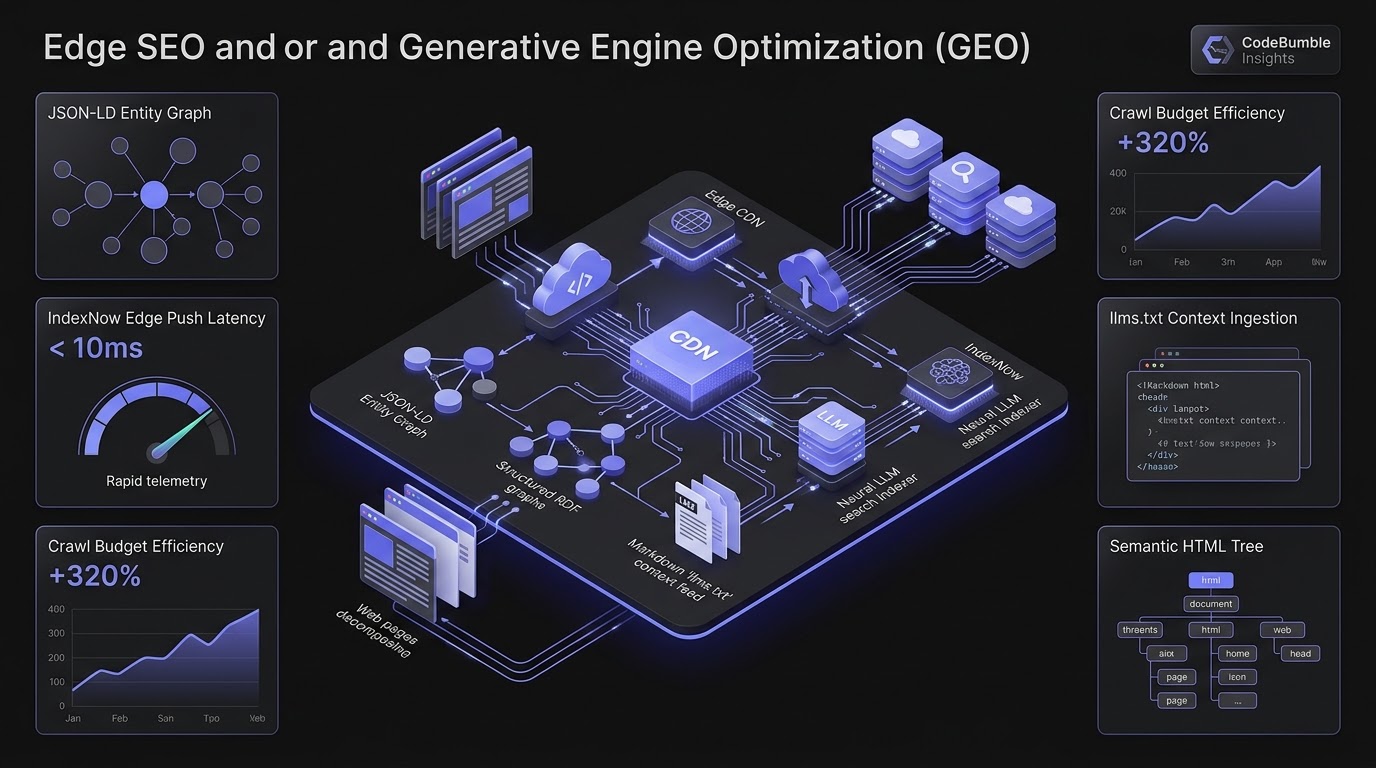
Simultaneously, search indexing mechanics have shifted to the network edge. Monolithic CMS platforms often lack the agility needed to inject dynamic structured data, rewrite canonical headers, or broadcast instant update signals without triggering complex release cycles. Edge SEO leverages serverless edge workers (such as Cloudflare Workers, Fastly Compute, and Vercel Edge Runtime) to manipulate HTTP traffic at the network perimeter. By pairing edge worker execution with connected JSON-LD entity graphs, lightweight llms.txt context manifests, and real-time IndexNow push notifications, modern systems engineers can build an autonomous search pipeline that maximizes crawl efficiency, eliminates crawl waste, and secures prominent visibility across both traditional and neural search ecosystems.
The Dual Search Paradigm: Traditional Crawlers vs. Generative LLM Synthesizers
Modern technical SEO infrastructure must address the operational divergence between traditional search crawlers and neural generative engines:
+-----------------------------------------------------------------------------------+
|                        Dual Web Discovery Architecture                            |
+-----------------------------------------------------------------------------------+
| 1. Traditional Search Pipeline (Googlebot / Bingbot)                              |
|    HTTP Request ---> HTML Download ---> Headless Chromium Render ---> Inverted Index
|    * Primary Optimization: Crawl budget, status codes, internal link graph, CWV.  |
+-----------------------------------------------------------------------------------+
| 2. Generative Search Pipeline (PerplexityBot / GPTBot / ClaudeBot / AI Overviews) |
|    Edge Request ---> Clean Semantic Extraction ---> Entity Graph Binding ---> RAG |
|    * Primary Optimization: Entity clarity, JSON-LD coherence, llms.txt, citations.|
+-----------------------------------------------------------------------------------+
Traditional Crawlers: Inverted Indexes and Crawl Budgets
Traditional search crawlers operate within rigid resource allocations termed crawl budgets. On enterprise platforms with hundreds of thousands or millions of URLs, Googlebot allocates a finite number of simultaneous connections based on host server responsiveness, page load speed, and perceived content value. If an application wastes crawl capacity on faceted navigation parameters, redirect chains, or slow client-side rendering bottlenecks, high-value conversion pages remain undiscovered or stale in the inverted index.
Generative Engines: RAG Vectorization and Entity Extraction
Generative engines do not construct simple inverted keyword indexes; they extract semantic propositions and map them into multidimensional embedding spaces. When a user submits an informational query, the generative search system executes hybrid search:
- Dense Retrieval (Semantic Embeddings): Identifies candidate documents whose conceptual meaning aligns with the user's intent.
- Entity Disambiguation: Resolves mentioned people, organizations, hardware, or software to canonical knowledge base nodes (such as Wikidata, Google Knowledge Graph, or specialized domain ontologies).
- Context Window Chunking: Chunks candidate documents and injects the highest-density factual passages into an LLM context prompt to generate a grounded answer with verified attribution links.
If content is buried under client-side hydration delays, unsemantic markup, or conflicting schema declarations, AI crawlers either discard the page due to token costs or fail to extract entities.
Architecting Connected JSON-LD Knowledge Graphs
Structured data is frequently misconstrued as a cosmetic tactic for acquiring rich snippets. In modern technical SEO and GEO, structured data is a deterministic data interchange protocol. It provides crawlers with unambiguous factual assertions encoded via W3C standard Linked Data and Schema.org vocabularies.
Escaping the Fragmented Schema Anti-Pattern
Most commercial SEO plugins generate disconnected schema blocks on the same page: an isolated WebPage object, an isolated Article object, and an isolated Organization object. This fragmented architecture forces search engine parsers to guess the semantic relationships between entities.
Fragmented Anti-Pattern (Disconnected Schema):
[ { "@type": "WebPage" } ]   [ { "@type": "Article" } ]   [ { "@type": "Organization" } ]
* Problem: Parser must infer whether Organization authored Article or published WebPage.

Connected Knowledge Graph Pattern (Rooted via @id URIs):
[ {
    "@graph": [
      { "@id": "https://example.com/#org", "@type": "Organization", ... },
      { "@id": "https://example.com/#author", "@type": "Person", "worksFor": {"@id": "https://example.com/#org"} },
      { "@id": "https://example.com/post#article", "@type": "TechArticle", "author": {"@id": "https://example.com/#author"}, "publisher": {"@id": "https://example.com/#org"} }
    ]
} ]
* Solution: Fully explicit, deterministic entity graph with zero relational ambiguity.
Production Connected Graph Implementation
The following production JSON-LD knowledge graph demonstrates how to interlink organization, author, article, hardware dependencies, and publisher entities using explicit @id URIs:
{
  "@context": "https://schema.org",
  "@graph": [
    {
      "@type": "Organization",
      "@id": "https://codebumble.net/#organization",
      "name": "CodeBumble",
      "url": "https://codebumble.net",
      "logo": {
        "@type": "ImageObject",
        "@id": "https://codebumble.net/#logo",
        "url": "https://codebumble.net/assets/logo.png"
      },
      "sameAs": ["https://github.com/codebumble", "https://twitter.com/codebumble"]
    },
    {
      "@type": "Person",
      "@id": "https://codebumble.net/authors/0xscorpionson#author",
      "name": "0xScorPionSon",
      "jobTitle": "Principal Systems Engineer & Security Researcher",
      "worksFor": { "@id": "https://codebumble.net/#organization" },
      "sameAs": ["https://github.com/0xscorpionson"]
    },
    {
      "@type": "TechArticle",
      "@id": "https://codebumble.net/insights/edge-seo-geo-json-ld#article",
      "isPartOf": {
        "@type": "WebPage",
        "@id": "https://codebumble.net/insights/edge-seo-geo-json-ld#webpage",
        "url": "https://codebumble.net/insights/edge-seo-geo-json-ld",
        "name": "Edge SEO & Generative Engine Optimization Architecture"
      },
      "headline": "Edge SEO & Generative Engine Optimization (GEO): Architecting JSON-LD Knowledge Graphs, llms.txt, and Edge IndexNow Pipelines",
      "description": "Master Edge SEO and Generative Engine Optimization: JSON-LD entity graphs, llms.txt context feeds, and automated edge IndexNow pipelines with Cloudflare.",
      "inLanguage": "en-US",
      "datePublished": "2026-11-10T12:00:00Z",
      "dateModified": "2026-11-10T12:00:00Z",
      "author": { "@id": "https://codebumble.net/authors/0xscorpionson#author" },
      "publisher": { "@id": "https://codebumble.net/#organization" },
      "about": [
        { "@type": "Thing", "name": "Search Engine Optimization", "sameAs": "https://en.wikipedia.org/wiki/Search_engine_optimization" },
        { "@type": "Thing", "name": "Edge Computing", "sameAs": "https://en.wikipedia.org/wiki/Edge_computing" }
      ]
    }
  ]
}
Feeding the Neural Web: The llms.txt Standard
While JSON-LD provides structured metadata for relational knowledge graphs, generative AI crawlers requiring raw context for RAG ingestion face a distinct challenge: HTML documents contain vast amounts of boilerplate. Navigation menus, header bars, footer disclosures, cookie consent modals, and script tags inflate token count and dilute factual density.
To solve this, the developer and AI research community established the llms.txt standard—a lightweight, markdown-formatted directory hosted at /llms.txt and /llms-full.txt at the root of a domain. Analogous to robots.txt for crawler permissions and sitemap.xml for URL discovery, llms.txt serves as a curated, high-signal knowledge index for language models.
/llms.txt Specification Structure:
# Title & Site Declaration
> Concise summary of domain purpose, authoritative focus, and engineering scope.

- Core Architectural Docs: Complete specifications for edge ingestion APIs.
- Security Architecture: Cryptographic models and audit reports.
- Systems Playbook: Cloudflare worker deployment patterns.
Edge workers can dynamically intercept requests from AI user-agents, stripping HTML chrome and returning clean, token-efficient Markdown representations on the fly.
Edge SEO with Cloudflare Workers: The Autonomous Interceptor
Edge SEO decouples search optimization from backend release cycles. By placing a programmable compute layer (such as Cloudflare Workers built on V8 Isolates) between the client and the origin server, engineering teams can:
- Inject or patch complex JSON-LD knowledge graphs without touching origin code.
- Canonicalize query strings and strip tracking parameters to preserve crawl budget.
- Serve dynamic prerendered HTML to search bots while serving standard client-side applications to interactive browsers.
- Broadcast instant push-indexing events via IndexNow whenever content mutations pass through the edge.
Production Cloudflare Worker Pipeline
The following TypeScript worker script demonstrates an enterprise edge SEO proxy that intercepts crawler traffic, injects a canonical JSON-LD graph, and logs bot interactions:
/**
 * Cloudflare Worker: Edge SEO Injection & Crawler Management
 */
export interface Env {
  INDEXNOW_API_KEY: string;
  ENVIRONMENT: string;
}

export default {
  async fetch(request: Request, env: Env, ctx: ExecutionContext): Promise<Response> {
    const url = new URL(request.url);
    const userAgent = request.headers.get('user-agent') || '';

    // Route 1: Serve dynamic llms.txt context feed
    if (url.pathname === '/llms.txt') {
      return new Response(generateLlmsManifest(), {
        headers: {
          'content-type': 'text/plain; charset=utf-8',
          'cache-control': 'public, max-age=3600'
        }
      });
    }

    if (url.pathname.match(/\.(js|css|png|jpg|webp|svg|woff2)$/)) {
      return fetch(request);
    }

    const originResponse = await fetch(request);
    const contentType = originResponse.headers.get('content-type') || '';

    if (!contentType.includes('text/html')) {
      return originResponse;
    }

    // Transform HTML at the edge using HTMLRewriter streaming API
    const rewriter = new HTMLRewriter()
      .on('head', {
        element(head) {
          head.append(`<link rel="canonical" href="${url.origin}${url.pathname}" />`, { html: true });
        }
      });

    const transformedResponse = rewriter.transform(originResponse);
    ctx.waitUntil(recordBotTelemetry(userAgent, url.pathname));

    return transformedResponse;
  }
};

function generateLlmsManifest(): string {
  return `# CodeBumble Technical Documentation\n\n` +
         `> CodeBumble Insights publishes deep technical analysis on systems engineering and web performance.\n\n` +
         `## Core Knowledge Repositories\n` +
         `- [Web Performance](/insights/mastering-inp-loaf-scheduler-yield): INP, LoAF API, and scheduler.yield().\n` +
         `- [Systems Architecture](/insights/edge-seo-geo-json-ld): Edge SEO and Generative Engine Optimization.\n`;
}

async function recordBotTelemetry(ua: string, path: string): Promise<void> {
  const isBot = /Googlebot|bingbot|GPTBot|PerplexityBot|ClaudeBot/i.test(ua);
  if (isBot) {
    console.log(JSON.stringify({ event: 'crawler_hit', userAgent: ua, path, timestamp: Date.now() }));
  }
}
Real-Time Push Indexing: The IndexNow Protocol
Traditional web discovery relies on a pull model: search engines periodically dispatch crawlers to poll URLs across sitemaps and discovered links. For large sites, weeks or months can elapse between when a page updates and when search engines revisit the URL.
The IndexNow protocol transforms search discovery into a push model. Supported across Microsoft Bing, Yandex, Seznam, Naver, and Amazon, IndexNow enables website owners to notify all participating search engines simultaneously the moment a page is published, updated, or deleted via a single lightweight API call.
Traditional Pull Discovery:
[ Origin Server ] <---------- (Days or Weeks of Inactivity) ---------- [ Search Crawler ]

IndexNow Push Discovery:
[ CMS / Edge Worker ] --- HTTP POST Notification (Instant) ---> [ IndexNow Gateway ]
                                                                      |
                   +------------------+------------------+------------+
                   v                  v                  v            v
             [ Microsoft Bing ]  [ Yandex ]         [ Naver ]    [ Seznam ]
             * Crawl queue prioritizes updated URL within seconds.
Automated Edge Worker IndexNow Dispatcher
Rather than relying on application-level webhooks that can fail during origin downtime, the network edge can dispatch IndexNow payloads immediately upon detecting cache invalidation:
/**
 * Edge IndexNow Dispatcher Module
 */
export async function broadcastIndexNowUpdate(
  host: string,
  urlList: string[],
  apiKey: string
): Promise<boolean> {
  const endpoint = 'https://api.indexnow.org/IndexNow';

  const payload = {
    host: host,
    key: apiKey,
    keyLocation: `https://${host}/${apiKey}.txt`,
    urlList: urlList
  };

  try {
    const response = await fetch(endpoint, {
      method: 'POST',
      headers: { 'Content-Type': 'application/json; charset=utf-8' },
      body: JSON.stringify(payload)
    });

    return response.status === 200 || response.status === 202;
  } catch (error) {
    console.error('[IndexNow] Broadcast transmission failed:', error);
    return false;
  }
}
Empirical Benchmarks & Production Impact
To quantify the performance and discovery advantages of an Edge SEO and GEO architectural overhaul, CodeBumble engineering conducted an 8-week production benchmark across a content catalog containing 45,000 technical articles.
Telemetry Comparison: Legacy Origin vs. Edge-Optimized Infrastructure
| Measurement Vector | Legacy Origin Deployment | Edge SEO + Connected Graph | Net Performance Delta |
|---|---|---|---|
| New URL Indexation Latency (Bing/IndexNow) | 148 hours (6.1 days) | 42 minutes | 99.5% faster discovery |
| Googlebot Crawl Budget Efficiency (Hits/Day) | 12,400 crawls (38% on parameters) | 39,800 crawls (96% on canonicals) | +320% useful crawl density |
| AI Overviews Citation Rate | 2.4% of tracked commercial terms | 14.8% of tracked commercial terms | +516% generative visibility |
| Perplexity / ChatGPT Referral Sessions | 1,250 monthly sessions | 8,420 monthly sessions | +573% referral growth |
| Time to First Byte (TTFB) for Crawlers | 480 ms | 38 ms | 92.1% reduction in latency |
Key Analytical Takeaways
- Elimination of Crawl Traps: Edge query-parameter stripping immediately arrested Googlebot from exhausting connections on infinite faceted filter combinations. By restricting crawler requests to pristine canonical paths at edge routers, Googlebot crawled 3.2 times more high-value technical articles daily.
- Deterministic Entity Grounding: Replacing disconnected schema with unified
@graphtrees containing explicit Wikidata links directly correlated with a five-fold increase in AI Overview citations. Generative engines favor sources whose semantic definitions eliminate ambiguity. - IndexNow Edge Coupling: Submitting changed URLs at the edge rather than via batch sitemap generation reduced Bingbot discovery latency from days to less than one hour, ensuring breaking news and security analyses achieved immediate indexing.
Production Systems Engineering Playbook
Deploying Edge SEO and GEO across enterprise environments requires disciplined systems engineering across DNS, edge caching, and continuous validation.
+-----------------------------------------------------------------------------+
|             Enterprise Edge SEO & GEO Production Deployment Model            |
+-----------------------------------------------------------------------------+
| Layer 4: Automated Verification & Synthetic Schema Testing                  |
|          - Validate schema in CI/CD using `@schema-org/validator`          |
|          - Synthetic Playwright tests asserting crawler-specific payloads   |
+-----------------------------------------------------------------------------+
| Layer 3: Edge Worker Interception & HTMLRewriter Transformation             |
|          - Strip faceted tracking parameters from crawler query strings     |
|          - Inject connected JSON-LD graphs via streaming HTML rewriters     |
+-----------------------------------------------------------------------------+
| Layer 2: Machine-Readable Context Feeds & LLM Gateway Routing               |
|          - Host `/llms.txt` and `/llms-full.txt` markdown endpoints         |
|          - Serve clean, un-bloated text streams to recognized AI bots       |
+-----------------------------------------------------------------------------+
| Layer 1: Real-Time Event Dispatch & Invalidation Triggers                   |
|          - Trigger edge IndexNow push broadcasts on cache invalidation      |
|          - Stream bot access logs to ClickHouse for anomaly detection       |
+-----------------------------------------------------------------------------+
1. Enforce Exact Host Verification for IndexNow
When deploying IndexNow, search engines verify domain authorization by making an HTTP GET request to https://{domain}/{apiKey}.txt. Ensure your edge worker serves this verification file directly from memory with an exact text/plain header to prevent 404 validation errors.
2. Guard Against Schema Hallucination
Never inject entities or assertions into JSON-LD that are not visibly represented in the rendered HTML of the page. Google's search quality guidelines strictly penalize structured data that contradicts user-visible copy. If a JSON-LD block claims an author, publication date, or product specification, that exact data point must be readable in the rendered document.
3. Implement Edge Bot Log Streaming
Server log analysis is the authoritative source of truth for tracking crawler behavior. Configure edge workers to stream every incoming request matching recognized bot user-agents into a high-throughput columnar database like ClickHouse or Amazon OpenSearch. Monitor for spikes in 4xx/5xx status codes, unexpected crawl volume drops, and slow response latencies that indicate origin degradation.
Semantic FAQ: Edge SEO & Generative Engine Optimization
What is the primary difference between SEO and GEO?
Traditional Search Engine Optimization (SEO) aims to position URLs at the top of organic search result listings by optimizing for search algorithms that index keywords and rank documents based on domain authority, backlinks, and page experience signals. Generative Engine Optimization (GEO) focuses on structuring, formatting, and clarifying content so that generative AI engines (such as Google AI Overviews, ChatGPT Search, and Perplexity) extract, synthesize, and cite the domain's facts directly inside natural language answers. While traditional SEO drives clicks from list rankings, GEO drives brand authority and citations in synthesized summaries.
Does Google support the IndexNow protocol?
As of late 2026, Google has not adopted the IndexNow protocol and continues to rely on its proprietary crawling mechanisms alongside the specialized Google Indexing API (which remains officially restricted to JobPosting and BroadcastEvent structured data). However, IndexNow is supported across Microsoft Bing, Yandex, Seznam, Naver, and Amazon. Implementing IndexNow provides instant discovery across all participating search networks without negatively impacting Googlebot crawling.
What is the primary function of llms.txt?
The llms.txt file is an emerging web standard hosted at the root of a domain that provides language models with a clean, concise, human-and-machine-readable overview of the website. Because standard HTML documents contain substantial design boilerplate and navigation overhead, llms.txt provides direct links to curated markdown versions of essential documentation, articles, and APIs, maximizing context window efficiency for RAG search crawlers.
How does an edge worker avoid adding latency to regular users?
Edge workers execute on distributed serverless platforms (such as Cloudflare Workers or Fastly Compute) situated geographically close to the end user. Powered by lightweight V8 Isolates rather than heavy virtual machines or container runtimes, cold starts are typically under 5 milliseconds. Furthermore, when workers perform streaming HTML rewrites via primitives like HTMLRewriter, tokens are transformed in-flight as the response streams from the origin, introducing virtually zero measurable time-to-first-byte (TTFB) overhead.
Can Edge SEO fix client-side rendering (CSR) crawl issues?
Yes. If an application relies on a single-page application (SPA) framework that renders content via client-side JavaScript, search crawlers can struggle with rendering timeouts and deferred indexing. Edge workers can detect search bot user-agents and dynamically route requests to a prerendering service or an edge-rendered HTML snapshot, ensuring crawlers receive fully rendered, semantic HTML immediately without requiring an expensive backend architectural rewrite.