

Packages
websocket-driver 0.8.0, websocket-extensions 0.2.0 & permessage-deflate 0.2.0: Fixing CVE-2026-134813
With 40.1M weekly npm downloads on websocket-driver alone, Faye's WebSocket stack sits behind countless Node.js real-time servers. Published November 22, 2026, CVE-2026-134813 (CVSS 4.0: 8.7 High) exposes a decompression-bomb DoS where updating only permessage-deflate fails—you must upgrade all three packages in lockstep.
6 min read
websocket-driver 0.8.0, websocket-extensions 0.2.0 & permessage-deflate 0.2.0: Fixing CVE-2026-134813
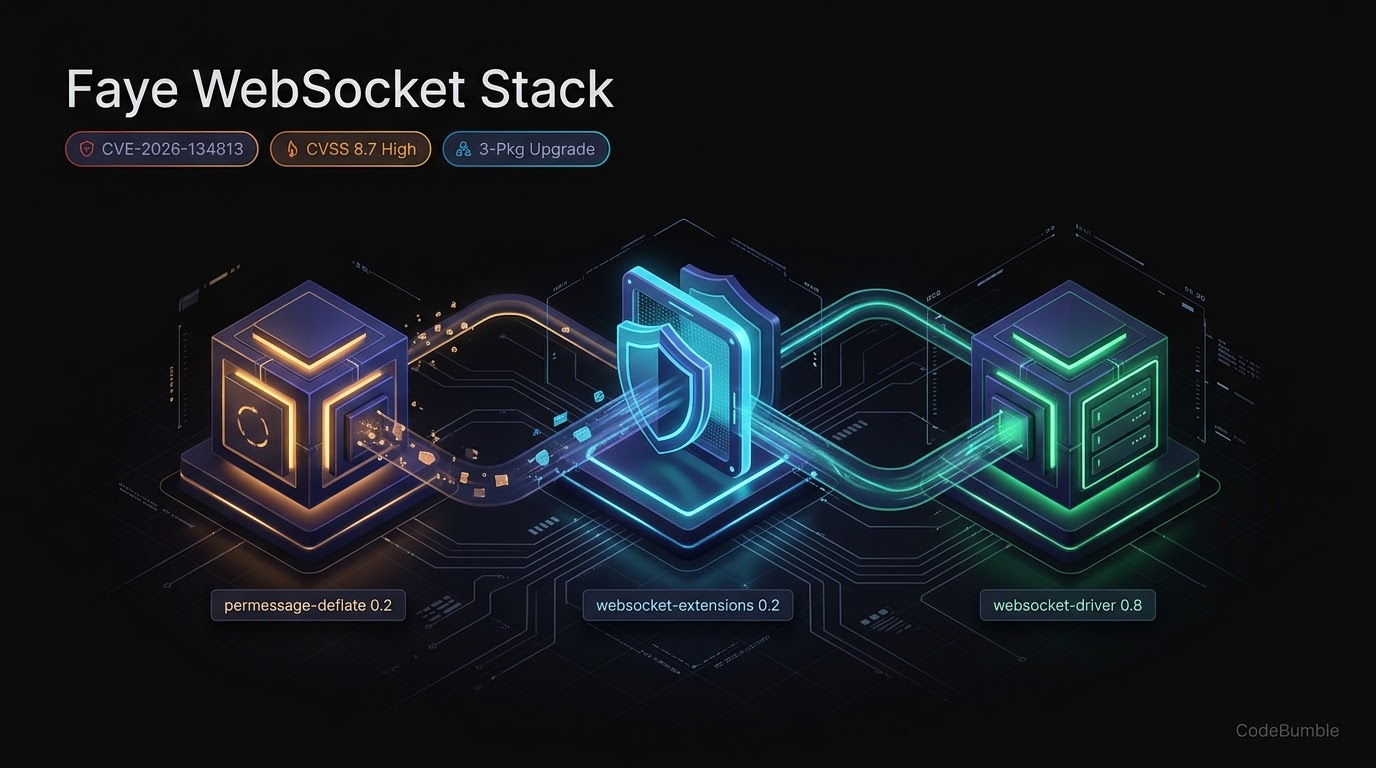
Executive Summary
On November 22, 2026, the CVE Program (with VulnCheck as CNA) and CISA-ADP published CVE-2026-134813 (CVE.org), a High-severity decompression-bomb denial-of-service vulnerability (CWE-409) affecting three tightly coupled Node.js WebSocket packages maintained by James Coglan under the Faye organization: websocket-driver, websocket-extensions, and permessage-deflate.
With 40,140,368 weekly npm downloads on websocket-driver and 37,976,104 weekly downloads on websocket-extensions verified as of November 24, 2026 (npm websocket-driver; npm websocket-extensions), this stack underpins a massive share of Node.js HTTP/TCP WebSocket servers and client libraries.
Three critical facts define this upgrade:
- Unauthenticated Memory Exhaustion (
CVSS 4.0: 8.7High /CVSS 3.1: 7.5High): When a server negotiates thepermessage-deflateextension, an unauthenticated remote client can send a small, highly compressible WebSocket message that expands insideprocessIncomingMessage()beforemaxLengthis enforced (CVE.org). Faye's advisory notes a potential memory allocation roughly 1,000 times the received frame size in its demonstration (Brandefense). - Single-Package Updates Fail: Upgrading only
permessage-deflateto0.2.0is insufficient becausewebsocket-driver(0.5.0to< 0.8.0) andwebsocket-extensions(< 0.2.0) did not forward themaxLengthlimit down to the decompression layer. All three packages must reach their patched thresholds together (Brandefense Playbook). - Zero-Downtime Configuration Mitigation: Servers that cannot immediately coordinate a three-package lockfile bump can mitigate exposure by removing
permessage-deflatefrom the server's extension configuration (Brandefense).
Adoption Telemetry & Version Changelog
The Faye WebSocket stack decouples protocol framing (websocket-driver), extension negotiation (websocket-extensions), and RFC 7692 compression (permessage-deflate) so extensions can plug into any compliant driver (npm websocket-extensions).
As verified on November 24, 2026:
| Package | Patched Threshold | Affected Range | Weekly npm Downloads | Direct Dependents | License |
|---|---|---|---|---|---|
websocket-driver |
>= 0.8.0 (published Nov 22, 2026) |
0.5.0 to < 0.8.0 |
40,140,368 (npm) |
446 (npm) |
Apache-2.0 |
websocket-extensions |
>= 0.2.0 |
< 0.2.0 |
37,976,104 (npm) |
453 (npm) |
Apache-2.0 |
permessage-deflate |
>= 0.2.0 |
< 0.2.0 |
N/A (npm page inaccessible during check) |
N/A |
Apache-2.0 (Faye stack) |
(Note: While the npm web sidebar for websocket-extensions still displayed 0.1.4 in cached metadata during our November 24 check, CVE.org and Brandefense confirm 0.2.0 as the patched threshold alongside commit 11aa734992ecef4c93e11edaeaa935e169c0b974.)
Release & Disclosure Timeline
- November 17, 2026: Faye published its security advisory (
GHSA-67p7-xj24-jfm9) detailing premature decompression inpermessage-deflate(Brandefense Playbook; CVE.org). - November 22, 2026:
websocket-driver@0.8.0published on npm alongside CVE Program publication ofCVE-2026-134813(discoverer: Zachariah Mithani, AploSec) (npm; CVE.org). - November 23, 2026: Rapid7, Brandefense, and NVD feeds confirmed no in-the-wild exploitation reported to date, while advising immediate triage for internet-facing WebSocket servers with compression enabled (Brandefense; Rapid7).
Security Patches, Breaking Changes & Internals
Why maxLength Failed Before the 3-Package Fix
By default, websocket-driver configures maxLength to 2^26 - 1 bytes (just under 64 MiB) to cap incoming frame sizes (npm websocket-driver). Many production deployments lower maxLength further (for example, to 1 MiB) to protect Node.js heap memory.
However, in the vulnerable architecture:
- An unauthenticated client negotiates
Sec-WebSocket-Extensions: permessage-deflateduring the HTTP Upgrade handshake. - When a compressed message arrives,
websocket-driverhands the frame payload towebsocket-extensions'sprocessIncomingMessage(), which invokespermessage-deflate(lib/session.js). - Because
websocket-driverandwebsocket-extensionsnever propagatedmaxLengthinto the extension session,permessage-deflateinflated the entire compressed payload in memory before returningmsgtowebsocket-driver. - Only after the full heap allocation occurred did
websocket-drivercheckmaxLengthand reject the oversized message—too late to prevent an out-of-memory crash on memory-constrained containers (CVE.org; Brandefense).
The coordinated patches across commits 19853657 (websocket-driver-node), 11aa7349 (websocket-extensions-node), and 1db8cb6f (permessage-deflate-node) wire maxLength through the extension pipeline so permessage-deflate aborts inflation as soon as decompressed output exceeds the limit (CVE.org; Brandefense).
Safe Server Configuration & Temporary Mitigation
If you use websocket-driver directly (or via faye-websocket), always set an explicit maxLength suited to your application's message size, and omit driver.addExtension(deflate) if you cannot yet verify all three patched package versions in your lockfile:
const http = require('node:http');
const websocket = require('websocket-driver');
// Only re-enable permessage-deflate after verifying:
// websocket-driver >= 0.8.0, websocket-extensions >= 0.2.0, permessage-deflate >= 0.2.0
// const deflate = require('permessage-deflate');

const server = http.createServer();

server.on('upgrade', (request, socket, body) => {
  if (!websocket.isWebSocket(request)) return;

  // Enforce a tight maxLength (e.g., 1 MiB instead of the ~64 MiB default)
  const driver = websocket.http(request, { maxLength: 1024 * 1024 });

  // Safe temporary mitigation for CVE-2026-134813: do NOT register permessage-deflate
  // until all three packages are at patched versions.
  // driver.addExtension(deflate);

  driver.io.write(body);
  socket.pipe(driver.io).pipe(socket);

  driver.messages.on('data', (message) => {
    // Handle bounded message safely
  });

  driver.start();
});
Ecosystem Comparison & Upgrade Checklist
When evaluating Node.js WebSocket stacks, teams should verify how each library handles permessage-deflate memory bounds:
| Criteria | Faye Stack (websocket-driver 0.8.0 + extensions 0.2.0 + deflate 0.2.0) |
Standalone ws / Native Server Stacks |
|---|---|---|
| Architecture | Modular 3-package pipeline decoupling protocol I/O, extension negotiation, and compression (npm) | Monolithic WebSocket server + built-in zlib inflation pipeline |
| Scale on npm | 40.14M weekly downloads (websocket-driver), 37.98M (websocket-extensions) (npm) |
Widely used across Node.js frameworks |
Default maxLength |
2^26 - 1 bytes (~64 MiB), now enforced during inflation in 0.8.0 / 0.2.0 (npm; CVE.org) |
Enforces maxPayload inside integrated zlib stream |
| Upgrade Complexity | Requires coordinated bump across all 3 packages (especially transitive trees via faye-websocket) |
Single-package version bump |
Production Upgrade & Verification Checklist
- Inspect Transitive Trees: Run
npm ls websocket-driver websocket-extensions permessage-deflateacross all services. Many apps pull these in transitively viafaye-websocketor test runners (Brandefense). - Verify All Three Thresholds Together: Confirm your resolved lockfile contains
websocket-driver >= 0.8.0,websocket-extensions >= 0.2.0, andpermessage-deflate >= 0.2.0(CVE.org). - Audit Compression Usage: Check whether your server actually calls
addExtension(deflate)or negotiatespermessage-deflate. If compression is not active, your server is not exposed toCVE-2026-134813(Brandefense). - Tighten
maxLength: Even after patching, override the ~64 MiB defaultmaxLengthinwebsocket.http(request, { maxLength })to match your real payload ceiling (npm websocket-driver). - Monitor Memory & OOM Restarts: While upgrading, watch container RSS memory and OOM-kill logs on internet-facing WebSocket endpoints (Brandefense).
Frequently Asked Questions
1. Is upgrading permessage-deflate to 0.2.0 alone enough to fix CVE-2026-134813?
No. Updating only permessage-deflate does not forward maxLength through older websocket-driver (< 0.8.0) or websocket-extensions (< 0.2.0) layers. All three packages must be upgraded together (Brandefense).
2. Does CVE-2026-134813 affect servers that do not enable permessage-deflate?
No. The vulnerability requires the permessage-deflate extension to be active and negotiated by the server (CVE.org; Brandefense).
3. Does an attacker need authentication to trigger the memory exhaustion?
No. An unauthenticated remote client can negotiate permessage-deflate during the WebSocket handshake and send a highly compressible message (CVE.org).
4. Is CVE-2026-134813 being actively exploited in the wild?
As of November 23, 2026, active exploitation in the wild has not been confirmed, though Faye published a demonstration of the premature allocation (Brandefense).
5. Is this related to Apache Tomcat's WebSocket CVE-2026-116600?
No. While both affect WebSocket availability, CVE-2026-134813 is specific to the Faye JavaScript/Ruby WebSocket package stack, whereas CVE-2026-116600 is a separate Apache Tomcat issue (Brandefense).
Sources
- CVE Program / VulnCheck CNA (Primary):
CVE-2026-134813— Fayewebsocket-driver0.5.0 before 0.8.0 Decompression Bomb viapermessage-deflate— https://www.cve.org/CVERecord?id=CVE-2026-134813 (Published November 22, 2026) - npm Registry (Primary):
websocket-driverv0.8.0 Package Page — https://www.npmjs.com/package/websocket-driver (Published November 22, 2026; accessed November 24, 2026) - npm Registry (Primary):
websocket-extensionsPackage Page — https://www.npmjs.com/package/websocket-extensions (Accessed November 24, 2026) - Brandefense (Secondary):
CVE-2026-134813: Faye WebSocket DoS, Patch Status — https://brandefense.io/knowledge-hub/vulnerabilities/cve-2026-134813/ (November 23, 2026) - Brandefense Playbook (Secondary): Faye WebSocket Decompression Patch Steps — https://brandefense.io/security-news/faye-websocket-decompression-patch-playbook/ (November 23, 2026)
- Rapid7 Vulnerability Database (Secondary):
CVE-2026-134813— https://www.rapid7.com/db/vulnerabilities/cve-2026-134813/ (November 23, 2026)