

SEO
Google AI Overviews Link Selection & CTR Impact (2026): Query Fan-Out, Grounding & Technical Fixes
Google's November 24, 2026 Attribution and Factuality specification reveals how AI Overviews and AI Mode select links via query fan-out and corroboration. Paired with Ahrefs' November 26 study showing −24.4% net CTR across 31,612 keywords, this guide breaks down the retrieval pipeline and zero-budget Search Console and snippet controls.
8 min read
Google AI Overviews Link Selection & CTR Impact (2026): Query Fan-Out, Grounding & Technical Fixes
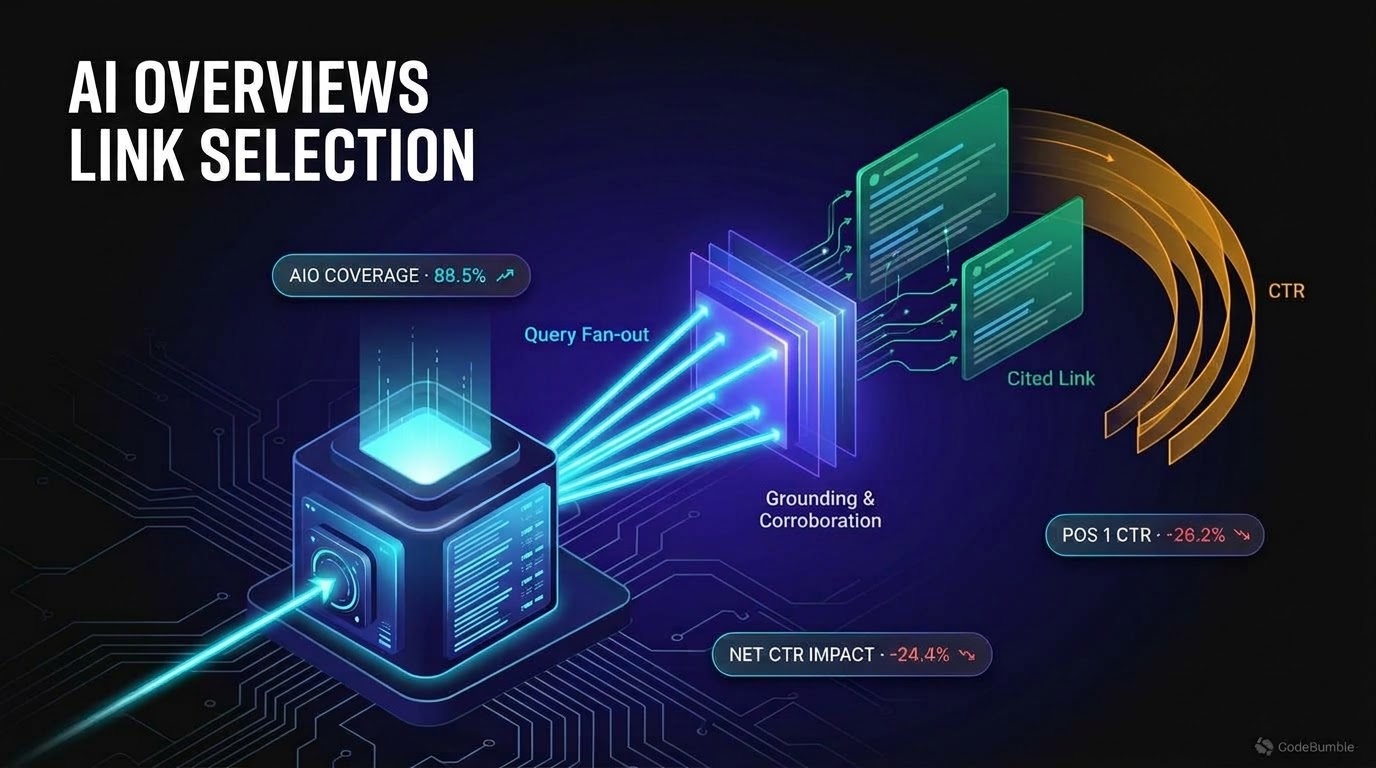
Executive Summary
On November 24–25, 2026, Google launched a unified Google Search Ranking Hub alongside a dedicated technical specification—Attribution and Factuality in Search Generative AI Features—detailing for the first time how AI Overviews and AI Mode retrieve, corroborate, and display publisher links. One day later, on November 26, 2026, Ahrefs published a three-month empirical study of 31,612 French keywords showing that AI Overviews expanded from 0% in June to 88.5% of tracked desktop keywords by November 25, cutting net organic click-through rate (CTR) by −24.4% overall and −26.2% at position 1.
For technical SEOs, developers, and lean publishing teams, the two November 2026 releases clarify both the exact retrieval pipeline and the zero-budget technical controls available today:
- Core Search ranking powers AI citations: Google confirms that Search generative AI features are integrated directly with core Search ranking and quality systems, combining top organic results with concurrent "query fan-out" searches, grounding, and automated corroboration before displaying links.
- No magic AI schema or
llms.txtshortcut: Google's AI optimization guide explicitly states that structured data is not required for generative AI search and rewriting prose specifically for AI systems is unnecessary—indexability, snippet eligibility, and text-accessible facts remain the hard prerequisites. - CTR compression hits every intent and position: Even transactional queries lose ~20% of their CTR when an AI Overview triggers, while informational and navigational queries lose ~25%, making Search Console's Generative AI performance report and snippet-control directives essential operational tools.
How the Ranking & Retrieval Signal Works
Google's Attribution and Factuality documentation (published November 24, 2026) and Search Engine Roundtable's technical breakdown (November 25, 2026) map out a four-stage retrieval and verification pipeline before any link appears in AI Overviews or AI Mode:
flowchart LR
    A[User Search Query] --> B[Core Search Index Retrieval]
    A --> C[Query Fan-Out: Concurrent Sub-Queries]
    B --> D[RAG Grounding & Synthesis]
    C --> D
    D --> E{Automated Pre-Display Checks}
    E -->|Safety / YMYL / Policy Guardrails| F[Suppress AI Response]
    E -->|Corroboration vs Web, Feeds & Knowledge Graph| G[Select Supporting Links]
    G --> H[Inline Icons · Source Cards · Carousels]
1. Core Index Retrieval + Query Fan-Out
First, Google examines ranked organic results from the crawled Search index for relevance, topicality, and freshness, feeding snippets to the model. Simultaneously, the model may issue concurrent related searches—called query fan-out—to cover distinct facets of a multi-part query. For example, a query about fixing a weedy lawn can fan out into sub-queries for herbicides, chemical-free removal, and prevention. Because Google Discover also draws on underlying web content to surface fresh topics, maintaining clean canonicals and crawlable internal links supports both classic organic rankings and fan-out retrieval.
2. Grounding, Corroboration & Automated Guardrails
The model synthesizes a response grounded in those retrieved pages and runs two automated pre-display checks:
- Safety and policy guardrails: Stricter thresholds apply to sensitive Your Money or Your Life (YMYL) topics and breaking news lacking reliable consensus; if confidence is low, the AI response is suppressed.
- Corroboration: Claims are cross-checked against web results, structured data feeds, and Google's Knowledge Graph. Before shipping model updates, Google also runs automated claim-level grounding checks, accuracy benchmark evaluations, and live A/B tests, while collecting user thumbs-up/down feedback.
3. Snippet & AI Training Controls (Technical Implementation)
Google's updated AI controls documentation (November 24, 2026) separates Search generative AI inclusion from commercial model training, and confirms support for a new shared training signal in early 2027 (user-agent: __usage_ai-training). Use standard robots.txt, meta tags, or Search Console controls depending on your goal:
<!-- Allow indexing, but cap snippet length fed to Search & AI Overviews -->
<meta name="robots" content="max-snippet:160" />

<!-- Exclude a specific pricing table or proprietary block from snippets & AI inputs -->
<div data-nosnippet>
  Proprietary benchmark dataset or paywalled analysis block.
</div>
# robots.txt: Block commercial Gemini/AI training without hurting Search ranking
User-agent: Google-Extended
Disallow: /
Note that Google-Extended does not affect Search ranking or inclusion in AI Overviews; to opt out of Search generative AI features entirely while keeping standard blue-link indexing, site owners must use the Search generative AI control inside Google Search Console or apply nosnippet/max-snippet directives. When syndicating articles to partner domains, Google also recommends asking partners to block indexing of syndicated copies so the original publisher—not the syndication partner—receives AI Overview attribution.
Empirical Telemetry: Ahrefs' 3-Month AI Overviews CTR Study
While Google's documentation explains how links are chosen, Ahrefs' November 26, 2026 study by Juliette Begue and Xibeijia Guan quantifies the traffic cost using a controlled comparison of 31,612 French desktop keywords (including 7,726 pairs of AI Overview keywords) between June 2026 (pre-rollout) and October/November 2026.
| Segment / Metric (June–Nov 2026) | Observed / Net CTR Impact | Control Group Benchmark | Key Methodology Context |
|---|---|---|---|
| AIO Keyword Coverage (France) | 0% → 88.5% | Tracked desktop keywords | July 22 launch; +35.4 pp jump in August alone |
| All AIO Keywords (Net CTR) | −24.4% net (−22.4% raw) | Non-AIO keywords +2.6% | Raw CTR fell from 2.53% to 1.964% |
| Position 1 Organic Result | −26.2% net (−21.4% raw) | Non-AIO Pos 1 rose 11.06% → 11.78% | AIO Pos 1 CTR fell from 11.06% to 8.69% |
| Informational & Navigational | ~−25% net CTR | Non-AIO grew +1% to +3% | Highest relative click compression |
| Commercial & Transactional | ~−20% net CTR | Commercial +1%, Transactional +3% | Intent softens loss by 4–5 pts, doesn't prevent it |
Two methodological details stand out for SEO forecasting:
- Control-group adjustment: Keywords without an AI Overview actually gained +2.6% CTR over the same period. Measuring only raw before/after CTR (−22.4%) understates the real opportunity cost (−24.4%) because affected queries also missed the baseline organic CTR gain.
- All SERP positions lose: Every organic position lost more than 20% of its CTR within three months of rollout—even position 1—aligning with Search Engine Roundtable's November 24 report that Google has been pushing links further down inside AI Overviews.
Actionable Playbook & Free Tool Stack
You do not need paid enterprise suites to audit AI Overview exposure or improve corroboration eligibility. Use these five zero-budget fixes built on official free tools:
- Quantify AIO exposure in Google Search Console (GSC): Open GSC's Generative AI performance report (which rolled out broadly in 2026) alongside standard Performance filters. Export your top landing pages and queries, then apply Ahrefs' heuristic: if 40% of your organic traffic comes from queries triggering an AI Overview, model an estimated ~10% organic click reduction (
40% × 25%) at constant impressions. - Audit snippet and crawl eligibility with URL Inspection &
curl: Google's Attribution doc states that only pages indexed and eligible to show a snippet can appear as supporting links. Check that key facts are rendered in plain HTML text (not trapped inside canvas/images or blocked by accidentalnosnippetrules). - Eliminate artificial date refreshes & strengthen author signals: Google's November 24 best practices explicitly warn: "Avoid changing a page's date unless the content has substantially changed." Pair accurate
dateModifiedtimestamps with clear author bios, an About page, and explicit source links to support corroboration. - Consolidate regional/duplicate inventory URLs: As Google's John Mueller advised on November 25, 2026 (Search Engine Roundtable), avoid spinning up separate pages per geographic region for identical products—show regional inventory on a single canonical product page so ranking and grounding signals are not diluted.
- Submit structured feedback on ranking anomalies: On November 24, 2026, Google added a formal Submit Feedback About Ranking Changes workflow in Search Console. If scraped content outranks your original page or an update causes misattribution, submit a report tagged with the active update hashtag (e.g.,
#NovemberCoreUpdate2026), query locale, and competing URLs.
Technical Audit & Execution Checklist
- Index & Snippet Check: Verify HTTP 200 status, canonical tag alignment, and absence of unintended
noindex,nosnippet, ordata-nosnippeton core explanatory paragraphs. - Fact & Source Grounding: Ensure primary statistics, dates, and product specs appear in clean HTML tables or
<p>text with explicit external citations. - Crawler Access: Confirm
Googlebotis allowed inrobots.txt; useGoogle-Extendedonly if you want to opt out of commercial AI training without affecting Search or AI Overviews. - Update Monitoring: Subscribe to the Google Search Status Dashboard RSS feed to track confirmed rollouts—especially with Google completing its November 2026 core update and preannouncing the December 2026 core update on November 25.
FAQ
How does Google select which links appear in AI Overviews and AI Mode? Google retrieves top-ranked pages from the core Search index alongside concurrent "query fan-out" sub-queries, grounds the synthesized answer in those snippets, and runs automated corroboration and safety checks. Links are then displayed via inline icons, source cards, or expandable carousels based on relevance, quality, and desktop/mobile layout.
Does blocking Google-Extended in robots.txt remove my site from AI Overviews?
No. According to Google's November 24, 2026 AI controls documentation, Google-Extended only limits how content is used to train and ground certain commercial generative AI products; it does not affect Search ranking or AI Overviews. To exclude content from Search generative AI features, use nosnippet/max-snippet or the Search generative AI control in Search Console.
Do I need special schema markup or llms.txt to rank in Google AI Overviews?
No. Google's AI optimization guide states that structured data is not required for generative AI search and no special schema.org markup is needed, though standard structured data remains useful for classic rich results.
How much traffic do AI Overviews cost websites on average? In Ahrefs' November 26, 2026 three-month study of 31,612 French keywords, queries displaying an AI Overview experienced a −24.4% net CTR drop overall (−26.2% at position 1), with informational queries losing ~25% and transactional queries losing ~20%.
What is the #NovemberCoreUpdate2026 feedback feature in Search Console?
Launched on November 24, 2026, Google's Ranking Hub lets verified site owners submit structured feedback directly in Search Console using the update's hashtag, query/locale details, and competing URLs. Google notes submissions are reviewed in aggregate and do not trigger manual ranking adjustments for individual URLs.
Sources
- Google Search Central — Attribution and Factuality in Search Generative AI Features (Published November 24, 2026): https://developers.google.com/search/docs/fundamentals/gen-ai-attribution-factuality
- Google Search Central — Google Search Ranking Hub, Control How Your Content Is Used for Generative AI at Google, and Submit Feedback About Ranking Changes (Published November 24, 2026): https://developers.google.com/search/docs/ranking and https://developers.google.com/search/docs/fundamentals/gen-ai-controls
- Ahrefs Blog — AI Overviews Cut CTR by −24.4% in France (3 Month Update) by Juliette Begue & Xibeijia Guan (Published November 26, 2026): https://ahrefs.com/blog/ai-overviews-ctr-france/
- Search Engine Roundtable — Google Explains How Links Are Selected & Shown In AI Overviews & AI Mode and Daily Search Forum Recap by Barry Schwartz (Published November 24–25, 2026): https://www.seroundtable.com/google-ai-overviews-ai-mode-link-selection-42617.html and https://www.seroundtable.com/recap-11-25-2026-42619.html