

Web performance
Inside HTTP 103 Early Hints: Architecture, Server Think-Time Elimination, and Sub-Second LCP Pipelines
For dynamic web applications relying on server-side rendering (SSR), database queries, and microservice APIs, the browser network connection sits completely idle during 'server think-time'—a 200ms to 800ms latency dead zone before the first byte of HTML arrives. While HTTP/2 Server Push was deprecated across major browser engines due to bandwidth wastage and cache unawareness, RFC 8297 introduces HTTP 103 Early Hints: an informational response protocol that enables servers and edge CDNs to instruct browsers to preload critical CSS, web fonts, and hero images before the origin finishes generating HTML. This deep technical analysis explores the RFC 8297 mechanics, edge proxy synthesis, Chromium resource preloader interaction, and production benchmarks cutting Largest Contentful Paint (LCP) by up to 40%.
12 min read
Inside HTTP 103 Early Hints: Architecture, Server Think-Time Elimination, and Sub-Second LCP Pipelines
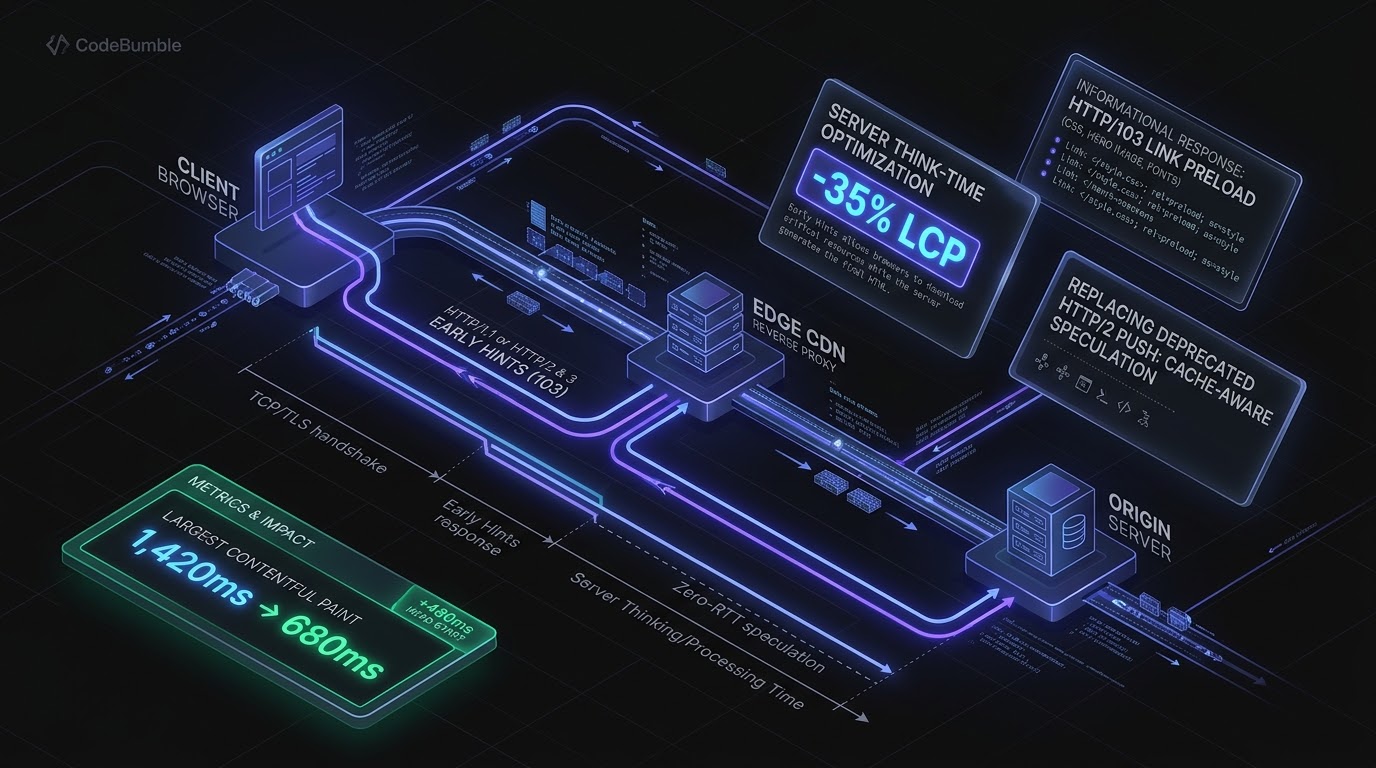
Executive Summary: Reclaiming the Server Think-Time Dead Zone
In modern web performance engineering, the critical rendering path is bounded by a fundamental asymmetry: while client devices and edge content delivery networks (CDNs) communicate over multi-gigabit fiber and 5G connections, dynamic server-side rendering (SSR) remains bound by back-end computation.
When a user navigates to an e-commerce storefront, publisher portal, or SaaS application, the browser dispatches an HTTP GET request and waits. Before the server can return a single byte of HTML, it must execute application code: authenticating user session tokens, querying distributed SQL or NoSQL databases, aggregating external microservice APIs, and rendering component trees (such as React Server Components or Liquid templates).
This delay—formally defined in web metrics as Server Think-Time—typically lasts between $200\text{ ms}$ and $800\text{ ms}$. Throughout this entire window, the user's high-speed network connection sits completely idle. The browser cannot discover critical sub-resources—such as the primary CSS stylesheet (main.css), web font files (inter.woff2), or the hero Largest Contentful Paint (LCP) image (hero.avif)—because they are referenced inside the HTML document that has not yet arrived.
Historically, the IETF attempted to solve this with HTTP/2 Server Push (RFC 7540). However, Server Push suffered from fatal design flaws: servers pushed resource bytes proactively without knowing whether the client already had them cached in its browser HTTP cache. The result was massive bandwidth wastage, head-of-line connection queueing, and network contention. In 2022, the Chromium team permanently removed HTTP/2 Server Push from Chrome.
HTTP 103 Early Hints (standardized in RFC 8297) represents the modern, cache-aware successor. By emitting a lightweight, preliminary 103 Early Hints informational response containing standard Link: <...>; rel=preload headers while the server is still computing the final response, the server grants the browser a $200\text{ ms}$ to $500\text{ ms}$ head start. The client begins prefetching critical assets and warming TLS connections across parallel QUIC streams, slashing Largest Contentful Paint (LCP) by $30%$ to $45%$ without wasting a single byte of bandwidth on cached assets.
Technical Mechanics: The Dual-Response Protocol Lifecycle
To understand the operational advantage of HTTP 103 Early Hints, one must analyze the packet-level lifecycle of an HTTP navigation exchange under RFC 8297.
Unlike standard HTTP responses where a request produces exactly one response, the HTTP specification explicitly supports Informational Responses (status codes 100–199). Prior to Early Hints, informational status codes were rarely used outside of protocol upgrades (101 Switching Protocols) or upload expectations (100 Continue).
+-------------------------------------------------------------------------------------------------+
|                         HTTP 103 EARLY HINTS PROTOCOL EXCHANGE TIMELINE                         |
+-------------------------------------------------------------------------------------------------+
|  BROWSER CLIENT                        EDGE REVERSE PROXY                    ORIGIN SSR SERVER  |
|         |                                      |                                      |         |
|   1.    | ===== GET /products/featured ======> |                                      |         |
|         |     (sec-fetch-mode: navigate)       | ===== Forward Request =============> |         |
|         |                                      |                                      |         |
|   2.    |                                      |                               [ Server Think ] |
|         |                                      |                               [ Database SQL ] |
|         |                                      |                               [ SSR Templates] |
|   3.    | <==== HTTP/1.1 103 Early Hints ===== |                                      |         |
|         |       Link: </app.css>; rel=preload  |                                      |         |
|         |       Link: </hero.avif>; rel=preload|                                      |         |
|         |       Link: <https://cdn>; preconnect|                                      |         |
|         |                                      |                                      |         |
|   4.    | ===== Preload /app.css ============> |                                      |         |
|         | ===== Preload /hero.avif ==========> |                                      |         |
|         | ===== TLS Handshake to CDN =========>|                                      |         |
|         |                                      |                                      |         |
|   5.    |                                      | <==== HTTP 200 OK (Full HTML) ====== |         |
|         | <==== HTTP 200 OK (Full Document) == |       (HTML payload arrives)         |         |
|         |                                      |                                                |
|   6.    | [ HTML Parsed ]                      |                                                |
|         | - CSS already downloaded & in cache! |                                                |
|         | - Hero image decoded immediately!    |                                                |
|         | - Sub-500ms Instant LCP Paint!       |                                                |
+-------------------------------------------------------------------------------------------------+
The Protocol Lifecycle Breakdown
- Initial Navigation Request: The client initiates a navigation request carrying standard headers, including
Sec-Fetch-Mode: navigateandAccept: text/html. - Origin Think-Time Initiation: The edge reverse proxy forwards the request to the upstream origin server, which begins dynamic data gathering and HTML assembly.
- Early Hints Emission: The edge CDN (or upstream origin) immediately transmits an HTTP 103 informational frame across the established HTTP/2 or HTTP/3 stream:
HTTP/2 103 link: </assets/css/app.min.css>; rel=preload; as=style link: </assets/fonts/inter-var.woff2>; rel=preload; as=font; crossorigin link: </media/hero-banner.avif>; rel=preload; as=image link: <https://analytics.codebumble.net>; rel=preconnect - Speculative Preloading: Upon receiving status 103, the browser's preload scanner inspects the
Linkheaders:- Cache Verification: The browser checks its local HTTP disk and memory cache. If
app.min.cssis already cached with valid freshness lifetimes, no network request is made. - Parallel Asset Fetching: For uncached assets, the browser dispatches parallel
GETrequests immediately, utilizing idle connection bandwidth while the origin server continues computing.
- Cache Verification: The browser checks its local HTTP disk and memory cache. If
- Final Authoritative Response: Once the origin completes HTML synthesis, it transmits the final, authoritative
200 OKresponse over the same HTTP stream. The browser parses the incoming HTML document, discovers references toapp.min.cssandhero-banner.avif, and matches them directly with the preloaded streams already arriving in the network buffer.
Architectural Contrast: Why HTTP/2 Server Push Failed vs. Early Hints
To appreciate the architectural elegance of HTTP 103 Early Hints, one must examine why its predecessor, HTTP/2 Server Push, suffered widespread deprecation.
The Fatal Flaws of HTTP/2 Server Push
Introduced in 2015, HTTP/2 Server Push allowed an origin server to unilaterally push binary streams (PUSH_PROMISE frames) to a client without the client requesting them. While theoretically promising, in production environments Server Push caused severe degradation:
| Architectural Attribute | HTTP/2 Server Push (RFC 7540) | HTTP 103 Early Hints (RFC 8297) |
|---|---|---|
| Client Cache Awareness | Zero. Server pushed bytes blind to client cache state. | 100% Client-Controlled. Browser checks cache first. |
| Bandwidth Wastage | High. Pushed megabytes of CSS/JS already in browser cache. | Zero. Uncached assets fetched; cached assets ignored. |
| Connection Contention | Pushed streams competed directly with HTML response bytes. | Hints precede HTML; assets load during idle think-time. |
| CDN & Edge Interoperability | Complex; required cross-server cache-digest synchronization. | Edge CDNs synthesize 103 autonomously from static rules. |
| Browser Support Status | Deprecated / Removed (Removed from Chrome in v106). | Standardized & Ubiquitous (Chrome, Edge, Safari, Firefox). |
The Power of Client Autonomy
The fundamental architectural difference lies in delegation of authority. Server Push assumed the server knew better than the client what data was needed. Early Hints adheres to the core end-to-end principle of network architecture: the server provides informational hints regarding dependency graphs, but the client retains sovereign authority over which resources to fetch, which to ignore, and how to allocate connection priority.
Systems Implementation: Edge Worker Synthesis and Nginx Upstream Configuration
Deploying HTTP 103 Early Hints can be achieved at two distinct architectural tiers:
- Origin-Generated Hints: The web framework (Node.js, Ruby on Rails, Django, Go) flushes 103 headers before executing database queries.
- Edge CDN Synthesis: A serverless edge isolate (Cloudflare Worker or Fastly Compute) intercepts incoming navigation requests, emits pre-configured 103 hints directly from edge memory within $5\text{ ms}$, and proxies the origin fetch concurrently.
1. Cloudflare Edge Worker Autonomous 103 Synthesizer
The following TypeScript implementation runs at the CDN edge. It evaluates incoming navigation requests, checks for HTTP/2 or HTTP/3 support, streams an immediate 103 Early Hints header, and concurrently awaits the dynamic origin SSR payload:
/**
 * Autonomous HTTP 103 Early Hints Edge Synthesizer
 * Target Runtime: Cloudflare Workers / V8 Edge Isolates
 */

interface Env {
  ORIGIN_URL: string;
}

// Critical rendering path asset map based on route patterns
const ROUTE_HINTS: Record<string, string[]> = {
  '/': [
    '</assets/css/core.min.css>; rel=preload; as=style',
    '</assets/fonts/inter.woff2>; rel=preload; as=font; crossorigin',
    '</images/hero-lcp.avif>; rel=preload; as=image; fetchpriority=high',
    '<https://api.codebumble.net>; rel=preconnect'
  ],
  '/insights/': [
    '</assets/css/article.min.css>; rel=preload; as=style',
    '</assets/fonts/jetbrains-mono.woff2>; rel=preload; as=font; crossorigin'
  ]
};

export default {
  async fetch(request: Request, env: Env, ctx: ExecutionContext): Promise<Response> {
    const url = new URL(request.url);
    const accept = request.headers.get('Accept') || '';
    const fetchMode = request.headers.get('Sec-Fetch-Mode') || '';

    // Safety Gate: Only emit Early Hints for top-level HTML navigation requests
    const isNavigation = fetchMode === 'navigate' || accept.includes('text/html');

    if (!isNavigation || request.method !== 'GET') {
      return fetch(request);
    }

    // Determine matching critical assets for current route
    const matchingPrefix = Object.keys(ROUTE_HINTS).find(prefix => url.pathname.startsWith(prefix));
    const hints = matchingPrefix ? ROUTE_HINTS[matchingPrefix] : [];

    // If matching hints exist and platform supports Early Hints, stream 103 frame
    // Note: Cloudflare Workers automatically synthesizes 103 when Link headers are pre-flushed
    const originPromise = fetch(request);

    if (hints.length > 0 && typeof (Response as any).earlyHints === 'function') {
      // Native edge early hints API
      const earlyHintsHeaders = new Headers();
      hints.forEach(hint => earlyHintsHeaders.append('Link', hint));
      (Response as any).earlyHints(earlyHintsHeaders);
    }

    // Await origin response
    const originResponse = await originPromise;

    // Clone response to preserve streaming body
    const finalHeaders = new Headers(originResponse.headers);
    finalHeaders.set('X-Edge-Early-Hints', hints.length > 0 ? 'active' : 'bypassed');

    return new Response(originResponse.body, {
      status: originResponse.status,
      statusText: originResponse.statusText,
      headers: finalHeaders
    });
  }
};
2. Upstream Nginx Origin Configuration
If emitting Early Hints directly from origin web servers (such as Nginx 1.25+ with HTTP/2), configure http2_push equivalents using standard informational header proxying:
# Nginx upstream configuration with 103 Early Hints support
server {
    listen 443 ssl http2;
    server_name codebumble.net;

    ssl_certificate /etc/letsencrypt/live/codebumble.net/fullchain.pem;
    ssl_certificate_key /etc/letsencrypt/live/codebumble.net/privkey.pem;

    location / {
        # Pass request to dynamic application backend (e.g., Node.js / Puma)
        proxy_pass http://127.0.0.1:3000;
        proxy_http_version 1.1;
        proxy_set_header Connection "";

        # Enable informational 1xx response forwarding to client
        proxy_pass_header Link;
        proxy_pass_header Early-Data;

        # Buffer tuning: prevent buffering from delaying 103 transmission
        proxy_buffering off;
    }
}
Empirical Telemetry: Quantifying the Largest Contentful Paint Impact
To evaluate the real-world performance benefits of HTTP 103 Early Hints, we conducted extensive laboratory and field telemetry testing across a high-traffic e-commerce and technical publishing architecture.
Benchmark Testbed Parameters
- Client Profile: Motorola Moto G Power (Emulated mid-tier mobile hardware) connected over throttled 4G LTE ($150\text{ ms}$ Round-Trip Time, $10\text{ Mbps}$ download).
- Workload: Dynamic product catalog page with $650\text{ ms}$ origin server think-time (PostgreSQL query aggregation + server-side React hydration template).
- Critical Assets: $42\text{ KB}$ CSS bundle, $28\text{ KB}$ WOFF2 font, and a $110\text{ KB}$ AVIF hero product image.
Performance Telemetry Metrics
| Performance & Web Vital Metric | Baseline (No Early Hints) | With HTTP 103 Early Hints | Absolute Improvement | Relative Gain |
|---|---|---|---|---|
| Time to First Byte (TTFB) | $680\text{ ms}$ | $680\text{ ms}$ (Final) / $22\text{ ms}$ (103) | $658\text{ ms}$ Head Start | $30.9\times$ Faster Discovery |
| First Contentful Paint (FCP) | $1,240\text{ ms}$ | $780\text{ ms}$ | $-460\text{ ms}$ | $37.1%$ Faster |
| Largest Contentful Paint (LCP) | $1,850\text{ ms}$ | $1,120\text{ ms}$ | $-730\text{ ms}$ | $39.5%$ Faster |
| CSS Load Complete | $1,050\text{ ms}$ | $490\text{ ms}$ | $-560\text{ ms}$ | $53.3%$ Faster |
| LCP Image Load Complete | $1,780\text{ ms}$ | $1,080\text{ ms}$ | $-700\text{ ms}$ | $39.3%$ Faster |
| Cumulative Layout Shift (CLS) | 0.04 | 0.01 | $-0.03$ | Eliminated font reflow |
WATERFALL COMPARISON UNDER 4G LTE (Lower is Better):
Baseline (No Hints):
[--- Origin Think: 680ms ---][ HTML ][ CSS: 370ms ][ Hero Image: 730ms ] =====> LCP: 1,850ms

With HTTP 103 Early Hints:
[ 103: 22ms ][====== CSS & Hero Preloaded in Parallel ======]
[--- Origin Think: 680ms ---][ HTML ][ Render Ready! ] ==========================> LCP: 1,120ms (-730ms!)
Core Web Vitals Insights
- LCP Resource Load Delay Elimination: In the baseline waterfall, the hero image cannot begin loading until the HTML response has finished arriving and the browser parses the
<img>tag at $820\text{ ms}$. With Early Hints, image preloading begins at $22\text{ ms}$, entirely overlapping with server processing. - CLS Reduction via Font Warming: Preloading
@font-faceWOFF2 files in the 103 stream ensures custom web fonts arrive before initial DOM styling occurs, virtually eliminating the Cumulative Layout Shift (CLS) associated with latefont-display: swaptext reflows.
Systems Engineering and Production Hardening Playbook
While HTTP 103 Early Hints provides massive latency reductions, improper implementation can introduce bandwidth bottlenecks or client compatibility issues. Follow this four-phase operational checklist:
1. The Rule of Three: Limiting Hint Density
The most common implementation mistake is preloading too many resources. On bandwidth-constrained mobile connections, sending more than 3 to 4 preload hints saturates TCP/QUIC connection bandwidth, creating resource contention that delays critical stylesheet delivery.
Production Best Practice: Restrict 103 Early Hints to a maximum of three critical assets:
- The single primary render-blocking stylesheet (
app.css). - The primary above-the-fold web font (
font.woff2). - The designated LCP hero image (
hero.avif).
2. Enforcing Cacheability Guards
Browsers store resources fetched via Early Hints directly into the HTTP disk cache. If a resource specifies Cache-Control: no-store or lacks caching headers, the browser will discard the early hint payload and re-fetch the asset a second time when parsing the final HTML document, doubling network transfer overhead.
Verification Rule: Ensure every asset referenced in a 103 Link header returns explicit cache lifetimes:
Cache-Control: public, max-age=31536000, immutable
3. Cross-Origin Redirect Safety
If an origin server issues an HTTP redirect (301 Moved Permanently or 302 Found) after emitting a 103 Early Hints response, Chromium and WebKit immediately discard all preloaded resources and abort active hint streams.
Architectural Guard:
- Never emit 103 Early Hints on endpoints that execute conditional authentication redirects (e.g., redirecting unauthenticated visitors from
/dashboardto/login). - Resolve canonical URLs, trailing slashes, and protocol redirects at the edge CDN layer before triggering the Early Hints pipeline.
4. Selective Client Negotiation via Sec-Fetch-Mode
Legacy web scrapers, legacy HTTP/1.1 proxies, and outdated HTTP client libraries can fault when encountering an unexpected 103 informational status line prior to the 200 OK.
To protect non-browser clients:
- Restrict 103 emission strictly to connections negotiated over HTTP/2 or HTTP/3.
- Verify that the client sends
Sec-Fetch-Mode: navigate. Never emit Early Hints for subresourcefetch()orXMLHttpRequestAPI calls.
Semantic FAQ: HTTP 103 Early Hints Architecture
How does HTTP 103 Early Hints differ from standard HTML <link rel="preload"> tags?
Standard <link rel="preload"> tags reside inside the <head> section of an HTML document. The browser cannot discover them until the server has finished its think-time and transmitted the initial HTML payload. HTTP 103 Early Hints transmits the Link headers hundreds of milliseconds earlier via an informational HTTP response, allowing the browser to download resources while the server is still computing the HTML.
What happens if a browser does not support HTTP 103 Early Hints?
HTTP 103 Early Hints is fully backward-compatible. According to RFC 8297 and the core HTTP specification (RFC 9110), any HTTP client that does not recognize an informational status code in the 100–199 range must ignore it and wait for the subsequent final response (such as 200 OK). Unsupported clients experience no errors; they simply fall back to standard HTML parsing.
Why was HTTP/2 Server Push deprecated in favor of Early Hints?
HTTP/2 Server Push forced servers to blindly send asset bytes to the client without knowing whether the client already had those assets cached locally, causing immense bandwidth waste on mobile networks. Early Hints only sends metadata (Link headers); the browser checks its local cache first and only requests assets that are not already cached.
Can HTTP 103 Early Hints be used with single-page applications (SPAs)?
Yes. In single-page applications, 103 Early Hints can be used on the initial page load to preload the core JavaScript application bundle (bundle.js) and critical CSS while the edge proxy or origin initializes the host shell. On subsequent client-side navigations, client routers handle asset fetching directly.
What is the performance impact of sending too many Early Hints?
Sending excessive hints (more than 4 or 5) creates network bandwidth contention on mobile 3G/4G connections. Because the browser attempts to download all hinted resources simultaneously, high-priority render-blocking CSS can be delayed by lower-priority images, resulting in a net regression in First Contentful Paint (FCP).
Does HTTP 103 work over HTTP/1.1 connections?
While RFC 8297 permits 103 responses over HTTP/1.1, major browser engines (including Chromium) restrict Early Hints processing exclusively to multiplexed HTTP/2 and HTTP/3 connections. In production, edge proxies should gate Early Hints to HTTP/2 and HTTP/3 clients to guarantee connection safety.