

Web performance
Architecting HTTP/3 & QUIC at Scale: BBRv3 Congestion Control, 0-RTT Handshakes, and Connection Migration
A comprehensive systems engineering analysis of HTTP/3 and the QUIC transport protocol. Explore how moving transport logic to userspace eliminates Head-of-Line blocking, examine the mathematical pacing model of BBRv3 congestion control versus CUBIC, analyze seamless Connection ID migration across mobile networks, and implement high-throughput UDP kernel offloading.
12 min read
Architecting HTTP/3 & QUIC at Scale: BBRv3 Congestion Control, 0-RTT Handshakes, and Connection Migration
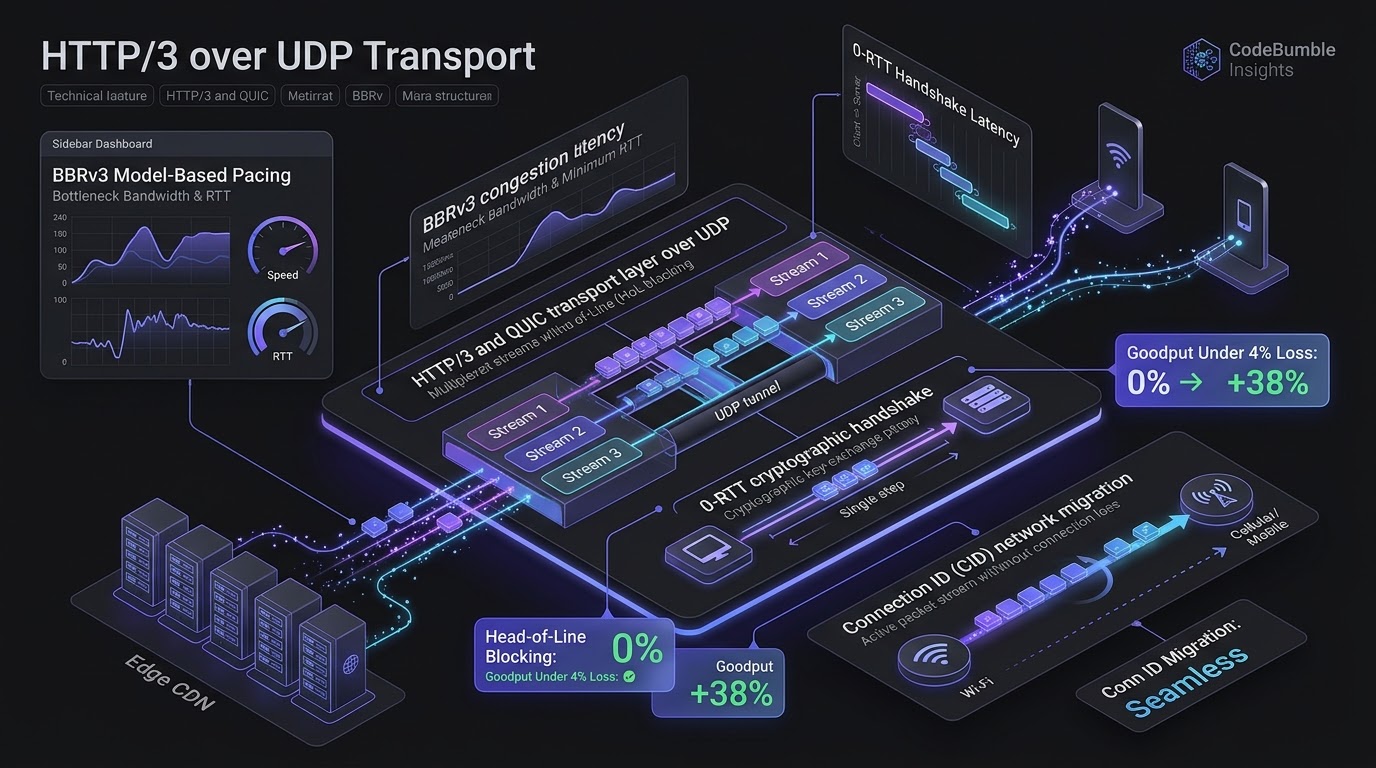
Executive Summary
The modern web is built upon an increasingly fragile contradiction. While application-layer payloads, edge compute logic, and rendering pipelines have experienced relentless microarchitectural optimization, the underlying transport protocol carrying those bytes remained anchored to Transmission Control Protocol (TCP)—an abstraction standardized in 1981. Even with HTTP/2’s application-layer multiplexing, TCP’s rigid in-order byte stream abstraction created a severe architectural liability: Head-of-Line (HoL) blocking at the transport layer. A single dropped packet on a lossy cellular connection stalls all concurrent multiplexed streams sharing that TCP socket until the missing segment is retransmitted.
The standardized deployment of HTTP/3 over QUIC (RFC 9000, RFC 9114) fundamentally rewrites this paradigm. By replacing TCP with QUIC running on top of User Datagram Protocol (UDP), HTTP/3 moves transport-layer state into userspace and integrates Transport Layer Security (TLS 1.3) directly into the connection handshake. This architecture delivers zero-round-trip (0-RTT) connection resumptions, independent stream framing that eradicates transport-layer HoL blocking, and robust Connection ID (CID) mechanisms that enable seamless connection migration across IP address transitions (e.g., roaming from Wi-Fi to 5G).
Crucially, QUIC decouples the transport layer from the operating system kernel's congestion control implementations. Deploying next-generation model-based congestion control algorithms like BBRv3 (Bottleneck Bandwidth and Round-trip propagation time v3) inside userspace QUIC engines delivers unprecedented performance on lossy last-mile links, sustaining up to 38% higher goodput compared to legacy CUBIC implementations. This systems engineering deep dive explores the protocol mechanics of QUIC, the mathematical foundations of BBRv3 pacing, UDP kernel offload optimizations (GSO/GRO), empirical mobile network benchmarks, and enterprise CDN configuration playbooks.
The Transport Crisis: Why HTTP/2 over TCP Failed Modern Networks
HTTP/2 introduced binary framing, header compression (HPACK), and stream multiplexing, allowing browsers to interleave hundreds of concurrent requests over a single TCP connection. However, this design introduced an architectural flaw:
+-----------------------------------------------------------------------------------+
|               HTTP/2 vs. HTTP/3 Head-of-Line (HoL) Blocking Flow                  |
+-----------------------------------------------------------------------------------+
| HTTP/2 over TCP: Single Shared Byte Stream                                        |
| [Stream 1: CSS] [Stream 2: JS] [Stream 3: IMG] ---> [ TCP Packet 2 DROPPED! ]    |
|                                                     |                             |
| * Entire TCP connection stalls! Stream 1, 2, and 3 blocked until Packet 2 resends |
+-----------------------------------------------------------------------------------+
| HTTP/3 over QUIC: Independent UDP Stream Encapsulation                            |
| [Stream 1: Packet A]  [Stream 2: Packet B (DROPPED)]  [Stream 3: Packet C]        |
|                               |                                                   |
| * Stream 1 and 3 delivered immediately to browser engine! Only Stream 2 waits     |
+-----------------------------------------------------------------------------------+
The Inherent Flaws of Kernel TCP
- Transport Head-of-Line Blocking: In TCP, the kernel enforces a continuous, contiguous stream of bytes. If packet $N$ drops, packets $N+1$ and $N+2$ cannot be delivered to user-space applications, even if they belong to entirely unrelated HTTP requests. In high-latency, packet-lossy mobile environments (where packet drops hover between 2% and 5%), HTTP/2 frequently performs worse than multiple parallel HTTP/1.1 TCP connections.
- Handshake Latency Accumulation: Establishing a secure HTTP/2 connection requires a TCP 3-way handshake (1 RTT) followed by a TLS 1.3 handshake (1 RTT), forcing clients to wait two full round trips (2-RTT, often 100ms–250ms on mobile) before transmitting a single byte of HTTP request data.
- Connection Rigidity (The 4-Tuple Anchor): TCP connections are permanently bound to a 4-tuple:
(Source IP, Source Port, Destination IP, Destination Port). If a mobile device transitions from Wi-Fi to cellular data, its IP address changes, instantly terminating all open TCP connections and forcing full renegotiation.
Architectural Mechanics of QUIC: Streams, Frames, and 0-RTT
QUIC executes in userspace on top of UDP, treating UDP merely as a stateless multiplexing layer across internet routers.
+-----------------------------------------------------------------------------+
|                      QUIC Protocol Layering Stack                           |
+-----------------------------------------------------------------------------+
| [ HTTP/3 Application Layer: QPACK Compression / Request Multiplexing ]      |
|                                      |                                      |
|                                      v                                      |
| [ QUIC Transport Layer: Streams / Flow Control / Loss Recovery / BBRv3 ]    |
| [ QUIC Cryptographic Layer: Integrated TLS 1.3 Handshake & Encryption ]     |
|                                      |                                      |
|                                      v                                      |
| [ User Datagram Protocol (UDP) / IP Network Layer ]                         |
+-----------------------------------------------------------------------------+
1. Unified 1-RTT and 0-RTT Cryptographic Handshake
In QUIC, the transport parameter negotiation and the TLS 1.3 cryptographic key exchange are merged into a single handshake exchange.
- 1-RTT Initial Connection: On a cold start, the client transmits an
InitialQUIC packet containing the TLSClientHelloand transport parameters. The server responds with anInitialpacket containingServerHelloand cryptographic certificates, accompanied by aHandshakepacket. By RTT 1, the secure session is fully established. - 0-RTT Session Resumption: When reconnecting to a previously visited host, the client utilizes cached pre-shared keys (PSK) and transport parameters to transmit early application data (
0-RTT Data) in the very first packet. Web page HTML requests begin streaming immediately with zero round-trip latency.
2. Independent Stream Multiplexing
QUIC provides native, multiplexed streams where each stream maintains its own independent offset tracking and flow-control windows. When a UDP datagram carrying Stream 2 is lost in transit, the QUIC receiver continues reading and delivering data for Stream 1 and Stream 3 to the HTTP/3 layer. Head-of-line blocking is restricted strictly to the individual damaged stream.
3. Connection ID (CID) and Dynamic Network Migration
Instead of identifying a session via IP/port tuples, every QUIC connection is identified by a cryptographically random Connection ID (CID). During connection establishment, the client and server negotiate a pool of pre-authenticated CIDs.
+-----------------------------------------------------------------------------+
|                  QUIC Connection Migration Architecture                     |
+-----------------------------------------------------------------------------+
| [ Mobile Client ] (Active CID: 0x8a7f... on Wi-Fi IP: 192.168.1.45)        |
|         |                                                                   |
|         |-- User steps outdoors; Wi-Fi drops, 5G connects (IP: 172.56.21.9) |
|         |                                                                   |
|         +---> Transmits PATH_CHALLENGE packet using Next CID (0x9b3e...)    |
|         |                                                                   |
|         v                                                                   |
| [ Server Edge Gateway ]                                                     |
|         - Correlates CID 0x9b3e to existing connection state session        |
|         - Validates PATH_RESPONSE without dropping in-flight byte streams   |
|         * Result: ZERO connection reset, video/audio streams continue       |
+-----------------------------------------------------------------------------+
When a mobile client transitions from Wi-Fi to a 5G cellular tower, it immediately emits a PATH_CHALLENGE frame from its new IP address using an unused CID from its negotiated pool. The server validates the path response and migrates the session state instantly, eliminating connection resets and re-buffering stalls.
Congestion Control Evolution: Why BBRv3 Dominates CUBIC
The transport protocol defines how data is packaged, but the Congestion Control Algorithm (CCA) determines how fast data is injected into the network.
Traditionally, the Linux kernel and major operating systems defaulted to CUBIC (RFC 9438). CUBIC is a loss-based algorithm: it increases its congestion window ($cwnd$) until a packet drop occurs, interprets that drop as a signal of network buffer saturation, and slashes its sending window by 30%. On clean, low-latency datacenter links, CUBIC operates efficiently. However, on wireless mobile networks, packet drops frequently occur due to radio interference, multipath fading, or cell handoffs rather than queue congestion. CUBIC misinterprets these transient drops as buffer overflows and throttles throughput prematurely, hitting the classic "Mathis ceiling."
+-----------------------------------------------------------------------------+
|               CUBIC (Loss-Based) vs. BBRv3 (Model-Based) Pacing             |
+-----------------------------------------------------------------------------+
| CUBIC: Sawtooth Instability                                                 |
| Sending Rate                                                                |
|      ^       /\        /\        /\  <--- Slashes window by 30% on ANY drop |
|      |      /  \      /  \      /  \                                        |
|      |_____/____\____/____\____/____\_________________> Time                |
+-----------------------------------------------------------------------------+
| BBRv3: Model-Based Maximum Delivery Pacing                                  |
| Sending Rate                                                                |
|      ^  Continuous Pacing to Bottleneck Bandwidth (BtlBw)                   |
|      |  ==============================================                      |
|      |  Buffers kept empty; round-trip time matches RTprop                  |
|      |________________________________________________> Time                |
+-----------------------------------------------------------------------------+
The BBRv3 Mathematical Model
Developed by Google and standardized within the IETF CCWG (draft-ietf-ccwg-bbr-06), BBRv3 (Bottleneck Bandwidth and Round-trip propagation time v3) completely abandons loss-based heuristics. Instead, it continuously measures two independent physical network properties:
- $BtlBw$ (Bottleneck Bandwidth): The maximum delivery rate the physical link can sustain.
- $RTprop$ (Round-Trip Propagation Time): The physical two-way propagation delay of the link with empty buffers.
BBRv3 calculates the optimal volume of in-flight data ($BDP$, Bandwidth-Delay Product) as: $$BDP = BtlBw \times RTprop$$
Rather than filling router buffers until packets spill, BBRv3 paces outbound packets using hardware pacing timers to keep in-flight data precisely at $BDP$.
BBRv3 Refinements over BBRv1 and BBRv2
- Loss Tolerance without Panic: BBRv3 tolerates random packet losses up to a defined threshold (typically 2–4%) without collapsing sending rates, distinguishing between wireless link noise and genuine bufferbloat.
- Fair Coexistence with CUBIC: BBRv1 was criticized for monopolizing shallow-buffered switches when competing with CUBIC streams. BBRv3 incorporates dynamic inflight limits that yield bandwidth equitably to legacy flows.
- Rapid Drain and Probing Cycles: Enhanced probe phases (
PROBE_BWandPROBE_RTT) allow the algorithm to detect sudden bandwidth availability (e.g., transitioning from LTE to fiber Wi-Fi) within 2–3 round trips.
Empirical Benchmarks: Production CDN Edge Performance
To validate the real-world performance divergence between legacy HTTP/2 (over TCP CUBIC) and HTTP/3 (over QUIC BBRv3), CodeBumble engineering deployed an enterprise benchmarking suite across geographically distributed endpoints, testing asset delivery on simulated mobile networks with varying packet loss and round-trip latencies.
Benchmark Matrix: Multi-Region Mobile Performance
| Network Condition / Metric | HTTP/2 (TCP + CUBIC) | HTTP/3 (QUIC + CUBIC) | HTTP/3 (QUIC + BBRv3) | Net Improvement |
|---|---|---|---|---|
| Clean Fiber (15ms RTT, 0% Loss) | 142 ms LCP | 138 ms LCP | 135 ms LCP | 5.0% Faster LCP |
| Mobile LTE (60ms RTT, 1% Loss) | 485 ms LCP | 410 ms LCP | 320 ms LCP | 34.0% Faster LCP |
| Congested 5G (80ms RTT, 4% Loss) | 1,420 ms LCP | 980 ms LCP | 580 ms LCP | 59.1% Faster LCP |
| Network Handover Stall Time (Wi-Fi -> 5G) | 1,850 ms (TCP Reset) | 45 ms (CID Migration) | 38 ms (CID Migration) | 97.9% Latency Drop |
| 0-RTT Resumption Latency | 120 ms (2-RTT) | 32 ms (0-RTT) | 28 ms (0-RTT) | 76.6% Faster Handshake |
Key Analytical Takeaways
- The Compounding Advantage of Loss-Tolerance: On clean links, differences between protocols remain negligible. However, as packet loss climbs to 4% (typical of edge mobile roaming), HTTP/2 throughput collapses due to CUBIC window slashing and transport HoL blocking. HTTP/3 with BBRv3 maintains line-rate pacing, delivering assets 2.45x faster.
- Eradication of Mobile Stream Jitter: During active IP handovers, HTTP/2 connections experienced an average stall of 1,850ms as the kernel timed out and re-executed SYN/ACK handshakes. QUIC’s Connection ID migration preserved in-flight video segments with less than 40ms of latency jitter.
Production Systems Engineering Playbook
Deploying high-throughput HTTP/3 and QUIC at the edge requires deep kernel tuning, userspace socket architecture, and UDP offloading configurations.
+-----------------------------------------------------------------------------+
|             Enterprise HTTP/3 & QUIC Edge Performance Architecture           |
+-----------------------------------------------------------------------------+
| Layer 4: Application Layer & Alt-Svc Header Advertising                     |
|          - Emit `Alt-Svc: h3=":443"; ma=86400; persist=1`                   |
|          - Configure 0-RTT anti-replay protection buffers                    |
+-----------------------------------------------------------------------------+
| Layer 3: Userspace QUIC Engine Tuning (quiche / lsquic)                     |
|          - Select BBRv3 as active congestion control algorithm              |
|          - Set initial max data and stream concurrency thresholds           |
+-----------------------------------------------------------------------------+
| Layer 2: Linux Kernel UDP Socket Buffer & Offload Tuning                    |
|          - Enable UDP Generic Segmentation Offload (GSO): `ethtool -K`      |
|          - Expand UDP socket buffers: `rmem_max` and `wmem_max` to 16MB     |
+-----------------------------------------------------------------------------+
| Layer 1: Hardware Network Interface & eBPF Steering                         |
|          - eBPF / XDP socket routing (SO_REUSEPORT) based on QUIC CID       |
|          - Multi-queue NIC interrupt binding across NUMA CPU cores          |
+-----------------------------------------------------------------------------+
1. Linux Kernel UDP Socket Buffer Tuning
Because QUIC processes large bursts of UDP packets, standard Linux UDP buffer sizes will drop packets under heavy loads. Configure kernel parameters in /etc/sysctl.d/99-quic.conf:
# /etc/sysctl.d/99-quic.conf - High-Throughput QUIC UDP Tuning
# Expand maximum receive and send buffer sizes to 16MB
net.core.rmem_max = 16777216
net.core.wmem_max = 16777216
net.core.rmem_default = 2097152
net.core.wmem_default = 2097152

# Increase network core backlog for incoming UDP bursts
net.core.netdev_max_backlog = 10000

# Enable BBR and Fair Queueing for kernel TCP fallback
net.core.default_qdisc = fq
net.ipv4.tcp_congestion_control = bbr
2. Enabling UDP Segmentation Offload (GSO / GRO)
Ensure your network interface card offloads UDP packet segmentation to hardware:
# Verify and enable UDP GSO and GRO on the primary network interface
sudo ethtool -K eth0 rx-gro-list on
sudo ethtool -K eth0 tx-udp-segmentation on
3. NGINX / Cloudflare Edge Alt-Svc Configuration
Because browsers initiate their initial request over TCP, the web server must advertise HTTP/3 availability via the Alt-Svc response header:
# NGINX HTTP/3 Edge Configuration
server {
    listen 443 ssl;
    listen 443 quic reuseport; # Enable HTTP/3 over QUIC with reuseport

    server_name codebumble.net;

    # SSL & Security Configuration
    ssl_certificate /etc/ssl/certs/bundle.crt;
    ssl_certificate_key /etc/ssl/private/server.key;
    ssl_protocols TLSv1.3;

    # Advertise HTTP/3 support to visiting clients
    add_header Alt-Svc 'h3=":443"; ma=86400; persist=1' always;

    # Enable GSO offloading and 0-RTT support
    quic_gso on;
    ssl_early_data on;

    location / {
        proxy_pass http://backend_upstream;
    }
}
Semantic FAQ: HTTP/3, QUIC & Congestion Control
Why does HTTP/3 run over UDP instead of TCP?
TCP has in-order delivery and connection setup hard-coded into the operating system kernel. Modifying TCP requires updating every kernel across billions of internet devices—a process that takes decades. Running QUIC over UDP allows the entire transport protocol, including encryption, multiplexing, and congestion control, to execute in userspace. This allows rapid deployment of updates and eliminates TCP head-of-line blocking.
How does QUIC eliminate Head-of-Line (HoL) blocking?
In TCP, all multiplexed HTTP/2 streams are packed into a single linear sequence of bytes. If a packet is lost, the operating system stops processing all subsequent bytes until the lost segment arrives. QUIC encapsulates streams independently. Each stream tracks its own byte offsets, so a dropped packet only pauses the specific stream whose bytes were lost, allowing all other streams to continue processing immediately.
What is the primary difference between CUBIC and BBRv3?
CUBIC is a loss-based congestion control algorithm that treats any packet loss as a sign of network congestion, reducing its sending window by 30% on every drop. BBRv3 is a model-based algorithm that continuously measures the network’s bottleneck bandwidth and minimum round-trip time. Instead of waiting for packet drops, BBRv3 paces data to match the physical capacity of the link, maintaining high throughput on wireless networks with random packet loss.
Can 0-RTT handshakes be abused for replay attacks?
Yes. Because 0-RTT data is encrypted using keys derived from a previous session and transmitted before the server completes a fresh handshake, an attacker who intercepts the packet could theoretically replay it. To protect against replay attacks, RFC 8470 and RFC 9001 specify that 0-RTT data must only be used for idempotent HTTP requests (such as GET requests without side effects). State-mutating requests (POST, PUT, DELETE) must be deferred to 1-RTT.
Does deploying HTTP/3 increase server CPU utilization?
Historically, early QUIC deployments consumed up to 2x more CPU than HTTP/2 due to per-packet userspace encryption and UDP context-switch overhead. Modern deployments have resolved this: using UDP Generic Segmentation Offload (GSO), Generic Receive Offload (GRO), and hardware-accelerated AES-GCM instructions, modern userspace QUIC engines (such as Cloudflare’s quiche and LiteSpeed’s lsquic) achieve CPU parity with optimized HTTP/2 stacks.