

Engineering
Inside Microsoft's "Code Red" Overhaul: Why >80% of M365 Gateways Failed and How Regional Partitioning Fixes It
Following a ~24-hour global Microsoft 365 outage where over 80% of networking gateways became unresponsive, internal memos reveal a company-wide 'Code Red' overhaul. Here is the post-mortem breakdown of the July defect, retry storms, and the 1-hour recovery architecture.
8 min read
Inside Microsoft's "Code Red" Overhaul: Why >80% of M365 Gateways Failed and How Regional Partitioning Fixes It
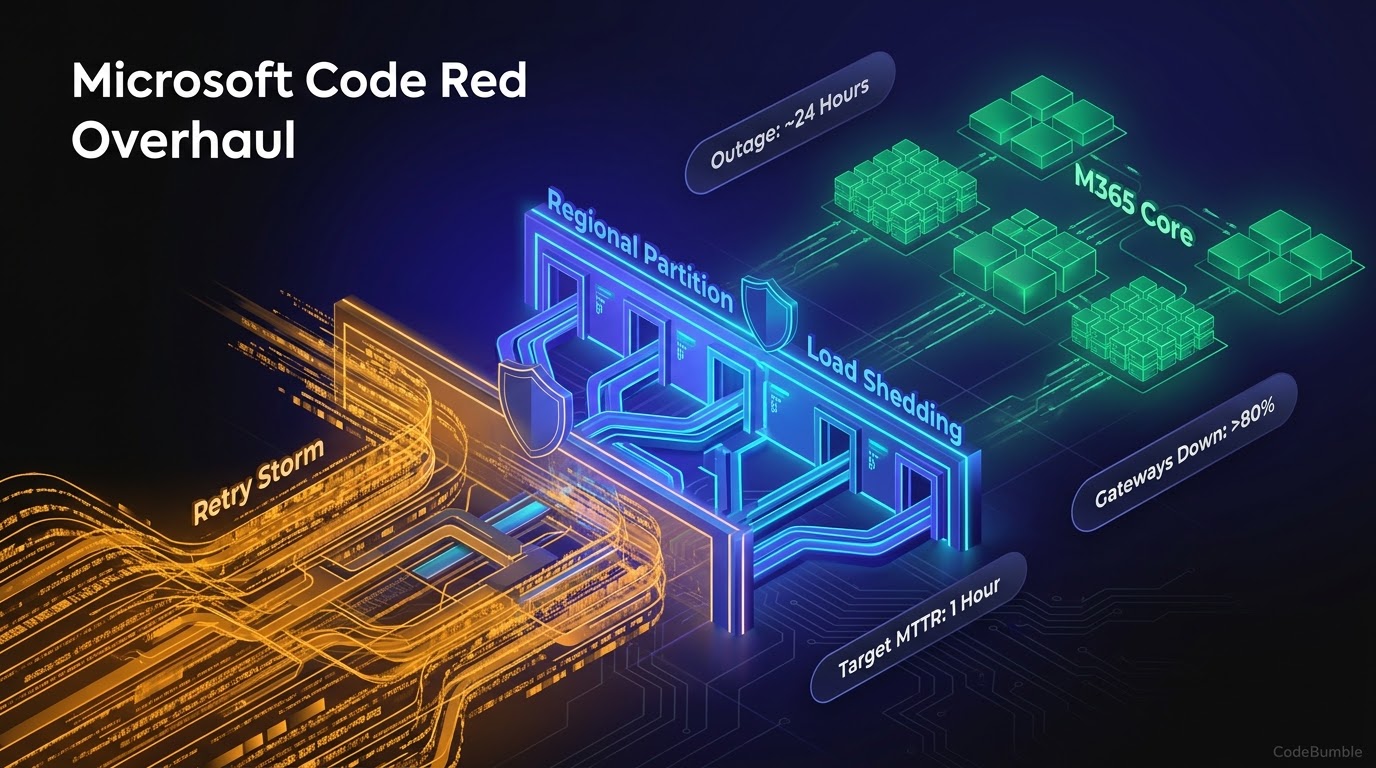
Executive Summary
On November 24–25, 2026, internal memos reviewed by Reuters revealed that Microsoft has declared a company-wide "Code Red" engineering overhaul following a roughly 24-hour global outage on November 12–13, 2026 that disrupted Exchange Online, Outlook, Teams, and Copilot across governments, trading firms, and airlines (National Technology News; DataCentral). Microsoft confirmed the incident was caused by a latent software defect introduced in July—not a cyberattack or AI agent—that left more than 80% of Microsoft 365 networking gateway servers unresponsive at the peak of the failure (Cyber Security Services / SiliconANGLE summary).
- The Core Bottleneck: Hardware-level redundancy failed because separate gateway clusters shared a common Windows resource-contention defect, while uncontrolled client retries overwhelmed recovering nodes and fragmented telemetry forced responders to send more than 11,000 messages across 11 separate Teams chats (DataCentral; National Technology News).
- The Architectural Response: Microsoft's five-workstream Code Red program prioritizes regional traffic partitioning, load shedding, faster recovery/deployment tooling (targeting 1-hour global incident resolution and 1-hour urgent fix rollout, down from 5–6 days), and AI-assisted telemetry correlation.
The Bottleneck and Scale Constraints
According to Microsoft's preliminary post-incident findings and internal memos from Microsoft 365 Core President Jason Henderson, CVP Amanda Silver, and EVP Charles Lamanna, the November 12–13 outage was triggered by three interacting constraints (DataCentral; National Technology News):
- A Latent Four-Month-Old Software Defect: A fix deployed in July 2026 for Microsoft 365's networking gateway servers introduced a Windows scalability and resource-contention bug. Under normal traffic, the defect remained dormant; under peak contention, an internal Windows process exhausted CPU and memory on the gateway hosts.
- Failover Surge Meets Reduced Capacity: A Microsoft Teams failover shifted extra traffic onto the gateway tier at the exact time a separate issue had reduced available gateway server capacity. As individual gateways stalled, remaining healthy gateways absorbed the displaced load and cascaded until over 80% were unresponsive.
- Retry Storms & Broken Rollback Assumptions: Standard rollback controls could not cleanly revert the July change because four months of subsequent releases and operational configurations had been layered on top of it. Worse, when gateway servers were restarted or brought back online, automated client retries immediately saturated them again, turning a regional capacity squeeze into a 24-hour global availability failure—consuming what Lamanna described as "roughly ten years' worth of acceptable failures" in a single component (National Technology News).
- Incident "Fog of War": Because diagnostic telemetry was scattered across separate internal tracking systems, senior engineers lacked a unified operational picture, exchanging more than 11,000 messages across 11 Teams chats just to align on hypotheses and remediation steps (National Technology News).
flowchart TD
    A["July 2026 Windows Gateway Defect<br/>(Dormant Under Normal Load)"] --> B["Teams Failover Traffic Spike<br/>+ Reduced Gateway Capacity"]
    B --> C["CPU/Memory Contention<br/>(>80% Gateways Unresponsive)"]
    C --> D["Unbounded Client Retries<br/>Overwhelm Recovering Nodes"]
    C --> E["Months-Old Embedded Bug<br/>Blocks Simple Rollback"]
    D --> F["~24-Hour Global M365 Outage<br/>(11,000+ Messages / 11 Chats)"]
    E --> F
Inside the Solution: Code Red Architecture & Five Workstreams
To close the gap between physical hardware redundancy and software-level blast-radius containment, Microsoft's Code Red directive establishes five engineering workstreams overseen by daily Substrate leadership check-ins and weekly executive reviews (National Technology News; DataCentral):
1. Geographic Traffic Partitioning (Fault-Domain Isolation)
Physical duplication protects against power loss or fiber cuts, but fails when every region shares identical control-plane software and cross-region spillover paths. Regional traffic partitioning constrains failover traffic within strict geographic cells so a traffic surge or software stall in one region cannot propagate into healthy regions (DataCentral). Crucially, as DataCentral's analysis notes, partitioning only holds if underlying authentication, management, and configuration planes are also decoupled across regions.
2. Adaptive Load Shedding (Protecting Recovery Headroom)
When available gateway capacity drops below incoming demand, accepting every request guarantees total collapse—especially when client SDKs automatically retry failed connections. Load shedding intentionally drops or defers lower-priority requests at the edge so surviving and recovering nodes can stabilize core control paths and drain queues safely (DataCentral).
At the edge proxy or API gateway layer, teams implement bounded concurrency and prioritized shedding so health checks and recovery traffic always pass:
# Example Envoy-style circuit-breaker & load-shedding thresholds (conceptual pattern)
circuit_breakers:
  thresholds:
    - priority: DEFAULT
      max_connections: 1024
      max_pending_requests: 256
      max_requests: 2048
      max_retries: 2          # Cap retries to prevent retry storms during degradation
    - priority: HIGH          # Reserve headroom for control-plane & auth traffic
      max_connections: 2048
      max_requests: 4096
3. One-Hour Global Rollout & Recovery Tooling
In an internal memo cited by Reuters, Henderson noted that a prior urgent production fix had required five to six days to reach every server worldwide—calling for an engineering target of going from detection to safe worldwide deployment of urgent fixes (and resolving future global outages) within one hour (National Technology News). Achieving 1-hour global remediation requires progressive ring-based deployment pipelines with automated health-metric canary gates rather than multi-day manual rollouts.
4. AI-Assisted Telemetry Correlation
Rather than replacing engineers, Microsoft plans to deploy AI agents to query and correlate fragmented monitoring streams during live incidents—reducing the manual cross-referencing overhead that produced 11,000+ chat messages across 11 disconnected channels (DataCentral). Human engineers remain responsible for validating hypotheses and approving production recovery actions.
Verified Results, Benchmarks & Post-Mortem Lessons
Because Microsoft has not published the internal memos publicly and the Code Red workstreams were initiated immediately after the November 12–13 outage, production before-and-after MTTR metrics are not yet available. The verified operational baseline and targets from Reuters' reporting and Microsoft's preliminary post-incident review establish the engineering scope:
| Incident / Overhaul Metric | Verified Baseline (Nov 2026) | Code Red Engineering Target | Status / Caveat |
|---|---|---|---|
| Outage Duration (Nov 12–13, 2026) | ~24 hours (Exchange Online, Outlook, Teams, Copilot) | ≤ 1 hour global resolution | Internal engineering goal, not a contractual SLA (DataCentral) |
| Peak Gateway Unresponsiveness | >80% of M365 networking gateway servers | Regional blast-radius containment | Driven by July 2026 defect + Teams failover + capacity loss (CSS / SiliconANGLE) |
| Urgent Global Fix Rollout Speed | 5–6 days (observed on prior urgent fix) | ~1 hour detection-to-worldwide deploy | Henderson memo: "Needless to say, we aren't here yet" (National Technology News) |
| Incident Coordination Overhead | >11,000 messages across 11 Teams chats | Unified telemetry + AI health correlation | Fragmented tracking systems slowed root-cause alignment (National Technology News) |
Confidence note: All figures above derive from Reuters, SiliconANGLE, DataCentral, and National Technology News reporting on Microsoft's internal memos and preliminary post-incident review as of November 24–25, 2026; Microsoft has not released a full public post-mortem or updated contractual SLA terms.
Regulatory Scrutiny & Operational Continuity Lessons
The November 12–13 disruption also triggered broader infrastructure scrutiny beyond Microsoft's internal teams. According to DataCentral, the outage prompted a ministerial statement in the UK House of Commons on November 16, 2026, highlighting public-sector exposure under the UK's Network and Information Systems (NIS) Regulations 2018 and prompting renewed calls for supplier diversification—though DataCentral notes that true operational independence requires decoupling authentication, identity, and communication dependencies rather than merely procuring multi-cloud compute. Simultaneously, Cyber Security Services warns that major cloud outages create immediate secondary risk: attackers exploit disrupted mail and Teams channels with fake "restore your mailbox" sign-in pages and fraudulent payment-change requests, making hardware security keys or authenticator apps (instead of email-based MFA) and out-of-band phone verification essential parts of any cloud continuity plan.
Practical Takeaways for Your Stack
Engineering teams running distributed services don't need Microsoft's global footprint to apply the architectural lessons from this post-mortem:
- Audit Shared Software Fault Domains Across "Redundant" Zones: Multi-AZ or multi-region hardware means little if every zone runs the exact same unpartitioned software build and shares a global failover pool. Stagger canary rings across regions with a bake window so a latent resource-leak bug cannot hit 80% of your fleet simultaneously.
- Pair Server-Side Load Shedding with Client-Side Jittered Backoff: Never allow SDKs or internal callers to retry indefinitely on HTTP
503/timeout errors during a brownout. Enforce strict retry budgets (max_retries+ exponential backoff with full jitter) on clients and priority-based load shedding on ingress gateways so recovering instances aren't crushed on boot. - Consolidate Incident Telemetry Before Scaling On-Call: If responders have to bounce between separate logging, metrics, and deployment dashboards across 11 chat threads, your MTTR is bounded by human coordination. Standardize a single incident command channel and a unified service-health view linking recent config/OS changes to gateway saturation.
- Know When NOT to Over-Engineer: Full active-active geographic cell partitioning adds significant operational complexity, cross-region data-consistency overhead, and infrastructure cost. For most mid-scale SaaS architectures, bounded retry budgets, edge rate-limiting/load shedding, and automated canary rollbacks eliminate 90% of cascading failure modes without building isolated regional control planes.
Frequently Asked Questions
What caused the November 12–13, 2026 Microsoft 365 outage?
Microsoft's preliminary post-incident review identified three interacting factors: an undetected Windows scalability/resource-contention defect introduced in July 2026 on Microsoft 365 networking gateway servers, increased gateway traffic following a Teams failover, and reduced available gateway capacity—leaving more than 80% of gateway servers unresponsive at the worst point (CSS / SiliconANGLE; DataCentral).
Was the Microsoft 365 outage caused by a cyberattack or AI agents?
No. Microsoft explicitly stated the incident was an availability failure caused by a software defect introduced in July, not cyber activity or AI agents (National Technology News; DataCentral).
Why couldn't Microsoft just roll back the buggy update immediately?
Because the Windows defect had been introduced in July 2026—four months earlier—and was embedded beneath subsequent software releases and operational configurations, conventional rollback mechanisms could not cleanly revert it without risking further disruption (DataCentral).
What are the five workstreams in Microsoft's "Code Red" initiative?
According to internal memos reviewed by Reuters, Code Red focuses on geographic traffic partitioning, load shedding, faster recovery mechanisms, AI-assisted system-health telemetry analysis, and accelerating urgent global fix deployment—targeting 1-hour worldwide incident resolution and 1-hour urgent patch rollout compared to 5–6 days previously (National Technology News).
Is Microsoft's 1-hour global recovery target a contractual SLA guarantee?
No. As DataCentral notes, Microsoft's 1-hour resolution target is an internal engineering objective under the Code Red program rather than a contractual service-level guarantee (DataCentral).
Sources
- National Technology News — Microsoft declares 'Code Red' after historic outage exposes engineering failures (Jonathan Easton, published November 25, 2026): https://nationaltechnology.co.uk/Microsoft_Declares_Code_Red_After_Historic_Outage.php
- DataCentral — Microsoft overhauls engineering practices following global outage (Published November 25, 2026): https://data-central.co.uk/microsoft-overhauls-engineering-practices-following-global-outage/
- Cyber Security Services — Microsoft's "Code Red" After the Microsoft 365 Outage: What Businesses Should Do (Summarizing Reuters & SiliconANGLE reporting, published November 24, 2026): https://cybersecurityservices.com/insights/microsoft-code-red-microsoft-365-outage/
- BNN Bloomberg / Reuters — Microsoft news: 'Code Red' declared after M365 outage (Published November 24, 2026): https://www.bnnbloomberg.ca/business/company-news/2026/11/24/microsoft-declares-code-red-after-historic-outage-internal-memos-show-reuters-exclusive/