

Automation
n8n 2.49.6 and v3.4.0 Beta: QuickJS Isolate Alignment, SSRF Hardening, and Preparing for v3.0 Breaking Changes
n8n shipped stable v2.49.6 and beta v2.50.1 on November 25, 2026, following v3.4.0 on November 24. The updates align isolate expression engines with legacy behavior, harden SSRF and redirect checks, and set the stage for December's one-way v3.0 upgrade.
8 min read
n8n 2.49.6 and v3.4.0 Beta: QuickJS Isolate Alignment, SSRF Hardening, and Preparing for v3.0 Breaking Changes
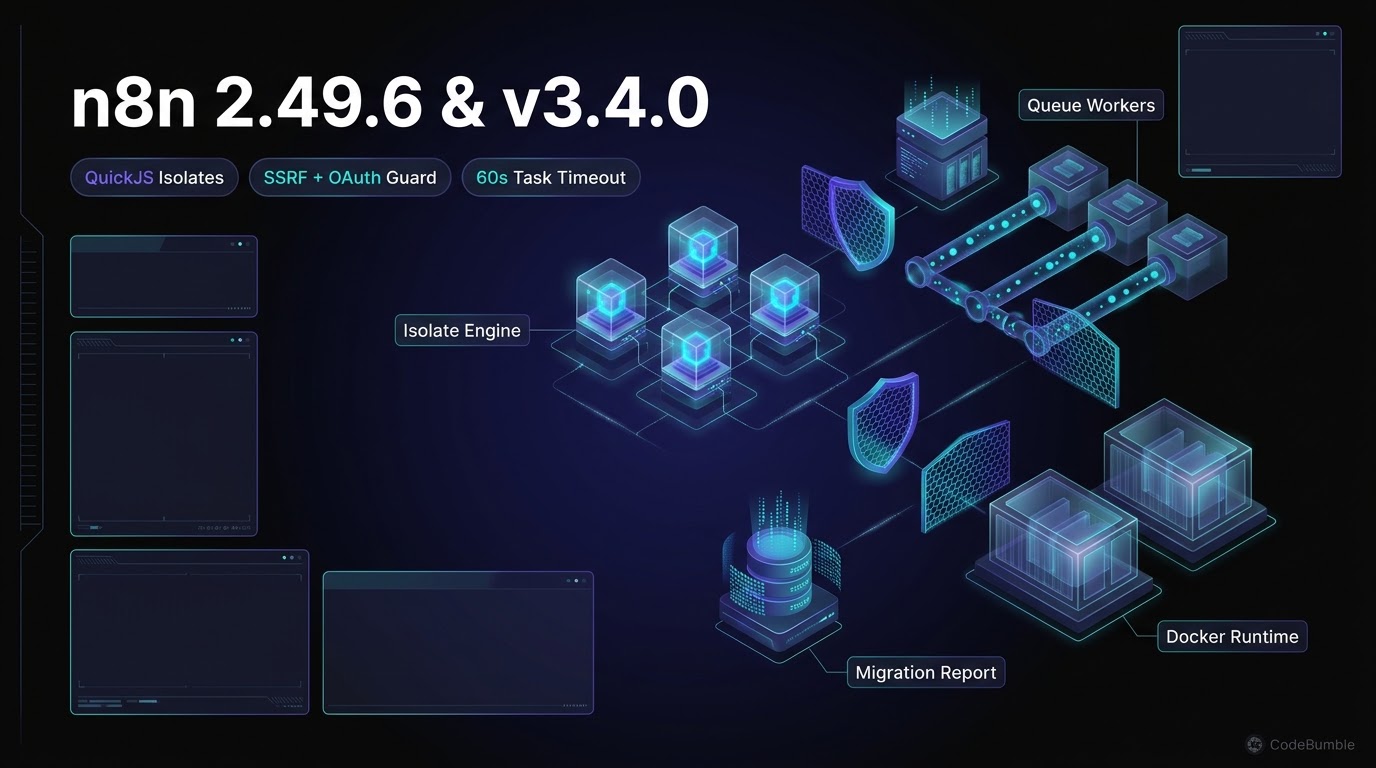
Executive Summary
- Coordinated Nov 23–25, 2026 Releases: n8n shipped stable
v2.49.6and betav2.50.1on November 25, 2026, followingv3.4.0(pre-release) andv2.50.0on November 24 andv2.48.8/v2.49.5on November 23 on GitHub Releases. - Who Is Affected: Platform and DevOps teams running self-hosted n8n instances—especially those preparing for the one-way
n8n 3.0transition targeted for early December 2026 (Ayautomate) or remediatingCVE-2026-119408(TryHackMe) in deprecated code nodes. - Core Operational Takeaway:
v2.49.6aligns the QuickJS isolate expression engine with legacybase64,urlEncode, andformatoutputs (#44969,#44995), whilev3.4.0expands default SSRF IP blocks (#38912), adds redirect approval forfetch-url(#44491), and tracks per-workflow process crashes for auto-unpublishing (#43685). - Strategic Decision: Stay on
2.x(2.49.6+) while clearing every item inSettings > Migration Report, migratingnpm/npxinstalls to Docker, and auditing60stask-runner timeouts before upgrading to3.x.
What Changed: Nov 23–25 Release Matrix and Core Mechanisms
Between November 23 and November 25, 2026, n8n maintained parallel stabilization across its 2.48.x, 2.49.x (current stable), 2.50.x (beta), and 3.4.0 (pre-release) lines on GitHub Releases:
| Release Tag | Date | Channel | Key Engineering Changes | Source |
|---|---|---|---|---|
n8n@2.49.6 |
Nov 25, 2026 | Stable | Aligns isolate base64, urlEncode, format with legacy (#44969); evaluates urlEncode, base64Decode, format natively (#44995). |
GitHub Releases |
n8n@2.50.1 |
Nov 25, 2026 | Pre-release | Same isolate expression parity (#44968, #44994); loads Assistant timeline via system agent routes (#45074); separates allowed triggers from restricted nodes (#44991). |
GitHub Releases |
n8n@3.4.0 |
Nov 24, 2026 | Pre-release | Expands default SSRF blocked IP ranges (#38912); requires approval on cross-domain fetch-url redirects (#44491); auto-unpublish crash counting (#43685); Bedrock token usage reporting (#43796). |
GitHub Releases |
n8n@2.50.0 |
Nov 24, 2026 | Pre-release | Mirrors 3.4.0 core fixes on the 2.x beta line, including QuickJS NUL-character preservation (#44528) and agent turn counting in self-hosted usage (#43386). |
GitHub Releases |
n8n@2.48.8 |
Nov 23, 2026 | Maintenance | Throws explicit error on QuickJS expression memory limit (#44687); explains last run state in Migration Report (#44282); surfaces MCP trigger activation failures (#44589). |
GitHub Releases |
Isolate Expression Engine and Sandboxed Execution
A central theme across 2.48.8, 2.49.6, and 3.4.0 is hardening n8n's QuickJS-based isolate expression engine and separating untrusted workflow JavaScript from the main Node.js control plane.
In v2.49.6, PR #44969 aligns base64, urlEncode, and format outputs inside the isolate engine with legacy behavior, while #44995 evaluates urlEncode, base64Decode, and format natively to eliminate subtle serialization mismatches. Meanwhile, v2.48.8 (#44687) ensures expressions hitting the QuickJS memory ceiling throw a deterministic error rather than silently corrupting state, and v3.4.0 (#44528) preserves NUL characters across the QuickJS bridge.
flowchart LR
    T[Webhook / Schedule Trigger] --> M[n8n Main Process]
    M -->|Redis Queue Mode| W[Dedicated Worker Process]
    W -->|Expressions| Q[QuickJS Isolate Engine]
    W -->|Code Node| R[Task Runner Sandbox]
    W -->|Outbound HTTP| G[SSRF IP & Redirect Guard]
    G -->|Blocked Ranges| X[403 / Blocked]
    G -->|Allowed| E[External API / LLM]
This isolation boundary directly addresses the risk highlighted by CVE-2026-119408 (CVSS 4.0 score 8.7 High, published via TryHackMe on November 23, 2026). On unpatched instances (below 2.42.6, 2.43.0–2.43.2, or 3.0.0), signed-in users with workflow edit permissions could use three deprecated nodes—Function, Function Item (backed by vm2 inside the main process), and LangChain Code—to execute JavaScript in the main application process and potentially access the instance encryption key. Patched builds (2.42.6+, 2.43.3+, 2.44.0+, 3.0.1+) block saving new or modified instances of those nodes by default, and n8n 3.0 removes them entirely on n8n Docs.
SSRF Hardening and Container-Only Self-Hosting in 3.0
In v3.4.0 (#38912) and the v3.0 Breaking Changes specification, n8n expands its built-in SSRF block list (when N8N_SSRF_PROTECTION_ENABLED=true and N8N_SSRF_BLOCKED_IP_RANGES includes default) by adding four ranges:
::/128(IPv6 unspecified address)100.64.0.0/10(Carrier-grade NAT shared address space)2002::/16(6to4)64:ff9b::/96(NAT64 well-known prefix)
Additionally, v3.4.0 (#44491) requires explicit approval when fetch-url redirects to another domain. For self-hosted infrastructure, n8n 3.0 also drops support for npm and npx n8n installations, requiring Docker or Kubernetes/Helm deployments because container boundaries underpin its updated task-runner and filesystem security defaults (n8n Docs).
Below is a minimal, safe docker-compose.yml environment block reflecting n8n 3.x defaults while explicitly preserving legacy limits where needed:
services:
  n8n:
    image: docker.n8n.io/n8nio/n8n:2.49.6 # Pin exact tag; test 3.x in staging first
    environment:
      - N8N_DEFAULT_BINARY_DATA_MODE=filesystem
      - N8N_RUNNERS_TASK_TIMEOUT=60          # 3.0 default drops from 300s to 60s
      - N8N_UNVERIFIED_PACKAGES_ENABLED=false # 3.0 default flips from true to false
      - N8N_SSRF_PROTECTION_ENABLED=true
      - N8N_SSRF_BLOCKED_IP_RANGES=default
      - N8N_COMPRESSION_NODE_MAX_DECOMPRESSED_SIZE_BYTES=268435456 # 256 MiB in 3.0
      - N8N_COMPRESSION_NODE_MAX_ZIP_ENTRIES=1000
    volumes:
      - n8n_storage:/home/node/.n8n/storage  # Renamed from binaryData in 3.0
Reliability, Cost, and Performance Analysis
Moving from 2.x to 3.x tightens several resource and execution guardrails that directly impact throughput, memory headroom, and failure behavior (n8n Docs):
- Task Runner Timeout (
300s->60s):N8N_RUNNERS_TASK_TIMEOUTdrops from 5 minutes to 1 minute inn8n 3.0. Long-running Code node scripts (such as batch transformations or synchronous SDK calls) will fail at 60 seconds unless the variable is raised explicitly. - Compression Node Ceilings (
2 GiB->256 MiB):N8N_COMPRESSION_NODE_MAX_DECOMPRESSED_SIZE_BYTESdrops from2147483648bytes (2 GiB) to256 MiB, andN8N_COMPRESSION_NODE_MAX_ZIP_ENTRIESdrops from5,000to1,000. - Worker Offloading in Queue Mode: In
n8n 3.0, manual executions always run on Redis-backed worker processes (OFFLOAD_MANUAL_EXECUTIONS_TO_WORKERSis removed), requiring operators to size worker memory for interactive test runs as well as background triggers. - Crash Auto-Unpublishing & Memory Guard:
v3.4.0(#43685) counts process crashes per workflow for auto-unpublishing, and#44417ends memory guard holds when a hold-limit stop frees no memory—preventing a single runaway workflow from wedging a worker pool. - Agent Budget & Turn Accounting:
v3.4.0(#43386) counts agent turns in self-hosted execution usage, whilen8n 3.3(Nov 17, 2026) clarified that Agent Builder monthly and per-session budget caps cover estimated AI model and memory costs but exclude n8n Assistant usage (Release Notes).
n8n vs. Temporal: Architectural and Operational Trade-Offs
For engineering teams deciding whether to upgrade n8n or adopt a code-first durable execution engine like Temporal, the architectural boundary remains clear (n8n vs. Temporal; Ayautomate):
| Dimension | Self-Hosted n8n (2.49.6 / 3.x) |
Self-Hosted Temporal |
|---|---|---|
| Execution Model | Visual DAG + JavaScript/Python Code nodes; Redis queue mode for horizontal workers | Code-first deterministic Workflows + Activities replayed from persistent event history |
| Connector Ecosystem | 1,000+ built-in/community nodes + MCP OAuth2 (n8nlab) |
Minimal SDK plugins; teams write & maintain custom Activities for SaaS APIs |
| AI & Agent Primitives | Native AI Agent nodes, memory, vector stores, HITL Slack/Telegram approvals | Wraps LLM calls as Activities; prompt/memory logic lives in external app code |
| Operational Overhead | Docker/Helm + PostgreSQL + Redis (single UI for logs & step-level replay) | Temporal server cluster + task queues + workers + external APM/tracing stack |
| Upgrade & Lock-In Risk | One-way 2.x -> 3.x DB migration; Sustainable Use License for core |
MIT-licensed server; language SDK upgrades require replay-compatibility discipline |
Practical Implementation and Migration Checklist
Because n8n 3.0 is a one-way upgrade (rolling back to 2.x requires restoring a full pre-upgrade database backup), and n8n 2.x continues receiving security and critical fixes for 12 months after 3.0 stable ships in early December 2026 (Octacer; Ayautomate), teams should separate immediate patching from the 3.0 cutover:
- Patch
2.xImmediately: Upgrade production2.xinstances to2.49.6(or at least2.42.6+/2.43.3+/2.44.0+) to pick upCVE-2026-119408protections and QuickJS isolate alignment. Anyone still onn8n 1.xfaces an end-of-support deadline on December 31, 2026, and must upgrade to2.xfirst because no direct1.x -> 3.xpath exists. - Clear
Settings > Migration Report: Run the built-in Migration Report on2.39+(2.48.8adds last-run state explanations;3.4.0grants custom instance roles access) to flag removed nodes (Function,Function Item,Item Lists,Cron,Interval,AI Transform, legacyAI Agentv1 modes) and removed expression helpers ($getPairedItem,$evaluateExpression()in Code nodes). - Audit Slack Credentials & Storage Paths: Add the Slack App Signing Secret to every Slack API credential before upgrading (workflows with a Slack Trigger fail to activate in
3.0without it), and rename volume mounts from~/.n8n/binaryDatato~/.n8n/storage—note thatn8n 3.0refuses to start if both directories exist (n8n Docs). - Verify SSRF Allowlists & Package Policies: If workflows call internal hosts in
100.64.0.0/10(such as Tailscale or CGNAT overlays), add them toN8N_SSRF_ALLOWED_IP_RANGES. SetN8N_UNVERIFIED_PACKAGES_ENABLED=trueonly if you depend on unverified npm community nodes.
Frequently Asked Questions
Can I roll back from n8n 3.0 to 2.x if a workflow breaks?
No. Moving from 2.x to 3.x is a one-way database migration; the only way to revert is restoring the full database and storage backup taken prior to upgrading (n8n Blog; Octacer).
Do I need to upgrade to n8n 3.0 immediately when stable ships?
No. After n8n 3.0 stable launches (targeted for early December 2026), the 2.x branch will continue receiving security and critical bug fixes for 12 months, giving teams time to clear their Migration Report in staging (n8n Blog). However, 1.x support ends December 31, 2026.
Why did n8n 3.0 drop npm and npx n8n support for self-hosting?
n8n states that new security defaults—such as task-runner isolation and filesystem boundaries—rely on a container setup. Self-hosted npm/npx users must migrate to Docker (including the one-line setup script) or Kubernetes/Helm before upgrading to 3.0 (n8n Docs).
How does CVE-2026-119408 affect existing workflows?
Patched versions (2.42.6+, 2.43.3+, 2.44.0+, 3.0.1+) block saving workflows that add or modify the deprecated Function, Function Item, or LangChain Code nodes, while allowing previously saved workflows to keep running until you migrate them to the modern Code node (TryHackMe).
When should a team choose Temporal instead of self-hosted n8n?
Choose self-hosted n8n when integration velocity across 1,000+ SaaS connectors, visual step debugging, and built-in AI Agent/MCP tooling matter most. Choose Temporal when you are building code-first backend microservices that require deterministic event-history replay across custom SDK Activities (n8n vs. Temporal).
Sources
- GitHub Releases — n8n-io/n8n (
n8n@2.49.6,n8n@2.50.1,n8n@3.4.0,n8n@2.50.0,n8n@2.49.5,n8n@2.48.8, published Nov 23–25, 2026): https://github.com/n8n-io/n8n/releases - n8n Docs — v3.0 Breaking Changes (Updated Oct 29, 2026): https://docs.n8n.io/changelog/v30-breaking-changes
- n8n Docs — Release Notes (Updated Nov 23, 2026): https://docs.n8n.io/changelog/release-notes
- TryHackMe — n8n (CVE-2026-119408): How Deprecated n8n Nodes Put Workflow Credentials at Risk (Ayomide Joseph A., published Nov 23, 2026): https://tryhackme.com/resources/blog/how-deprecated-n8n-nodes-put-workflow-credentials-at-risk
- n8n Blog — Introducing n8n 3.0 (Published Oct 27, 2026): https://blog.n8n.io/introducing-n8n-v3/
- Ayautomate — n8n 3.0 Upgrade Guide: Breaking Changes and Checklist (Adel Dahani, published Nov 10, 2026): https://www.ayautomate.com/blog/n8n-3-0-upgrade-guide
- Octacer — n8n 3.0 Upgrade Playbook: Clear the Migration Report First (Published Nov 12, 2026): https://octacer.com/playbooks/n8n-3-upgrade-migration-report-playbook
- n8n — n8n vs. Temporal: Workflow Orchestration Tools Compared: https://n8n.io/vs/temporal/