

Automation
n8n vs. Temporal for Long-Running Agentic Workflows: Architecture, Durability, and Cost Guide
Both n8n and Temporal orchestrate multi-step AI agents in 2026, yet they sit at opposite ends of the stack: visual SaaS integration versus event-sourced durable execution. This evergreen technical guide breaks down failure recovery, token-retry economics, n8n 3.0's Docker-only shift, Temporal's Replay 2026 primitives, and when to pair both.
9 min read
n8n vs. Temporal for Long-Running Agentic Workflows: Architecture, Durability, and Cost Guide
Evergreen Technical Guide (verified against 2026 platform documentation and release milestones).
Executive Summary
- Core architectural divide: n8n is a visual, fair-code workflow automation platform with 1,000+ integrations, queue-mode Redis workers, and native AI Agent nodes, whereas Temporal is a code-first durable execution engine (MIT-licensed core) that uses append-only event sourcing and deterministic replay to resume crashed workflows mid-flight (n8n Docs, Zymr).
- Why it matters for AI agents: When a multi-step agent fails on step 4 of a tool chain, Temporal retries only the failed Activity without re-executing earlier LLM calls—preserving state and avoiding duplicate token spend—while n8n relies on per-node retries and error-trigger workflows rather than deterministic state replay (Zymr).
- 2026 platform shifts: Temporal's Replay 2026 release added Serverless Workers (starting on AWS Lambda), Standalone Activities, Workflow Streams, External Payload Storage on S3, and first-class Google ADK and OpenAI Agents SDK integrations (Temporal Blog). Meanwhile, n8n's upcoming 3.0 release (beta October 27, 2026; stable planned for early December 2026) drops
npm/npxinstallations in favor of Docker-only self-hosting and lowersN8N_RUNNERS_TASK_TIMEOUTfrom300sto60s(AY Automate). - Operational verdict: Use n8n when integration breadth and rapid SaaS/webhook assembly are the bottleneck; use Temporal when workflows run for hours or days, touch money or compliance-critical state, or must survive worker restarts; and pair both (n8n at the edge, Temporal at the core) for complex enterprise stacks (Zymr).
Core Mechanism: Execution Logging vs. Deterministic Replay
Although both platforms use terms like "workflows," "retries," and "AI agents," they operate at different layers of the stack (Zymr).
How n8n Executes Workflows
n8n models automation as a directed graph of nodes authored on a visual canvas and stored as JSON in PostgreSQL (or SQLite for single-node setups) (n8n Docs, Zymr). In production queue mode, a main instance handles triggers, webhooks, and the editor UI while offloading execution jobs via Redis to stateless worker processes (n8n Docs).
Its native AI Agent node (built on LangChain) wires system prompts, model routing, memory, vector stores, and Model Context Protocol (MCP) tools directly alongside SaaS nodes, with inline JavaScript or Python via the Code node (n8n Docs, Zymr). However, n8n logs execution state to its database rather than maintaining an event-sourced replay log: if a worker dies mid-execution, you recover via node-level retries, manual re-runs from the failed node, or dedicated Error Trigger workflows (n8n Docs).
How Temporal Executes Workflows
Temporal splits application logic into two primitives compiled inside your own codebase (Go, Java, TypeScript, Python, .NET, PHP, Ruby, or the Rust SDK in Public Preview) (Zymr, Temporal Blog):
- Workflows: Deterministic orchestration functions that cannot perform direct I/O, network calls, or non-deterministic wall-clock checks.
- Activities: Non-deterministic side-effect steps—such as calling an LLM API, querying a database, or invoking an external MCP/tool endpoint—each governed by explicit timeouts, heartbeats, and exponential-backoff retry policies.
Every state transition (workflow started, activity scheduled, activity completed, timer fired, signal received) is written to an append-only Event History managed by Temporal's four backend services (Frontend gRPC gateway, History, Matching, and internal Worker) (Zymr). If a worker crashes mid-flight, a fresh worker replays the event history to reconstruct local variables and resumes at the exact failed Activity.
sequenceDiagram
    participant Client as Trigger / Webhook
    participant n8n as n8n Edge (Queue Mode)
    participant Temp as Temporal Service
    participant Worker as Temporal Worker (LLM + Tools)

    Client->>n8n: Inbound Event / SaaS Enrichment
    n8n->>Temp: Start Durable Workflow (gRPC / HTTP)
    Temp->>Worker: Dispatch LLM Reasoning Activity
    Worker-->>Temp: Activity Completed (Recorded in History)
    Temp->>Worker: Dispatch External Tool Activity
    Worker--xTemp: Transient 503 Failure
    Note over Temp,Worker: Exponential Backoff (Prior LLM call NOT re-run)
    Temp->>Worker: Retry Tool Activity Only
    Worker-->>Temp: Tool Result Persisted
    Temp-->>n8n: Webhook / Signal Completion
Below is a minimal TypeScript Temporal workflow pattern showing how an LLM step and a tool step receive independent retry policies so a flaky external API never forces an expensive LLM re-invocation:
import { proxyActivities } from '@temporalio/workflow';
import type * as activities from './activities';

const { callModel, executeTool } = proxyActivities<typeof activities>({
  startToCloseTimeout: '2 minutes',
  retry: {
    initialInterval: '2s',
    backoffCoefficient: 2,
    maximumAttempts: 5,
  },
});

export async function agenticTaskWorkflow(prompt: string): Promise<string> {
  // Persisted to Event History once completed
  const plan = await callModel({ prompt, model: 'primary-reasoning' });

  // If executeTool fails transiently, Temporal retries ONLY executeTool
  const toolResult = await executeTool(plan.toolName, plan.arguments);

  return await callModel({
    prompt: `Synthesize final answer from: ${JSON.stringify(toolResult)}`,
    model: 'fast-summarizer',
  });
}
Reliability, Cost & Performance Analysis
Side-by-Side Architectural Comparison
| Dimension | n8n | Temporal |
|---|---|---|
| Category | Visual workflow automation platform (n8n Docs) | Durable execution framework / SDK (Zymr) |
| Execution & State | Execution logging to PostgreSQL/SQLite; Redis queue mode (n8n Docs) | Append-only Event History with deterministic replay (Zymr) |
| Failure Recovery | Node-level retries, re-run from failed node, Error Trigger workflows (n8n Docs) | Automatic per-Activity exponential backoff; resumes mid-workflow on new worker (Zymr) |
| AI Agent Primitives | Built-in AI Agent node, memory, vector stores, MCP, approval gates (n8n Docs) | Google ADK & OpenAI Agents SDK integrations, Workflow Streams, S3 External Payload Storage (Temporal Blog) |
| Integrations | 1,000+ pre-built nodes + HTTP/GraphQL + community nodes (n8n Docs) | Custom Activities written in code + plugin SDK integrations (n8n Docs) |
| Infra Footprint | Single container (hundreds of MB RAM) or main + workers + Redis + Postgres (Zymr) | 4 Temporal services + Cassandra/Postgres/MySQL (+ optional Elasticsearch) or Serverless Workers (Zymr, Temporal Blog) |
| Licensing | Fair-code (Sustainable Use License) (Zymr) | Open-source core (MIT) (Zymr) |
| Managed Pricing | n8n Cloud from ~€24/mo (Starter), €60/mo (Pro), €800/mo (Business) per execution (Zymr) | Temporal Cloud from ~$100/mo (Essentials, 1M Actions; ~$50 per additional 1M) (Zymr) |
Token Economics, Scaling, and 2026 Operational Gotchas
- LLM Token Cost Under Failure: In Zymr's hands-on TypeScript and Python POCs, wrapping each LLM call and tool call as separate Temporal Activities ensured that a transient failure on a weather/calculation tool retried only that single Activity—avoiding re-running earlier LLM reasoning steps and directly cutting token waste (Zymr). In n8n, multi-step workflows count as one execution regardless of node count (making high-node-count automations very cheap on n8n Cloud), whereas Temporal Cloud bills per Action (workflow start, activity schedule/complete, timer, signal) (Zymr).
- Large Payloads and Streaming: Standard Temporal Event History enforces payload size limits, which historically forced developers to write custom blob-offloading code for large RAG chunks or multimodal inputs. Temporal's Replay 2026 release addresses this with External Payload Storage (native Amazon S3 or custom driver in Public Preview for Python and Go) and Workflow Streams for token-by-token UI streaming over Signal and Update primitives (Temporal Blog).
- High Availability & Governance: Temporal Cloud supports Multi-Region and Multi-Cloud Replication with a 20-minute Recovery Time Objective (RTO), Task Queue Priority & Fairness to prevent noisy-neighbor starvation across tenants, Worker Versioning to pin in-flight workflows to their starting code version during deploys, and Principal Attribution for audit trails (Temporal Blog).
- n8n 3.0 Self-Hosting Shifts: Teams self-hosting n8n in late 2026 must account for breaking changes in the
3.0cycle (beta released October 27, 2026;2.47.3current stable with2.xsupported for 12 months after3.0stable lands in early December 2026) (AY Automate). Notably,n8n 3.0removesnpmandnpxinstallations (requiring Docker, Compose, or Kubernetes/Helm), lowersN8N_RUNNERS_TASK_TIMEOUTfrom300sto60s, flipsN8N_UNVERIFIED_PACKAGES_ENABLEDtofalse, and consolidates legacy AI Agent v1 modes into the Tools Agent (AY Automate). Furthermore,1.xsupport ends December 31, 2026, and upgrading to3.0is one-way with no built-in rollback (AY Automate).
Practical Implementation & Trade-Offs
Decision Framework: When to Use Each (or Both)
- Choose n8n when your automation is primarily integration glue—connecting CRMs, Slack, Notion, databases, webhooks, and LLMs—where non-developers or operations engineers need visual observability, built-in credential management, and fast iteration without managing distributed backend services (n8n Docs, Zymr).
- Choose Temporal when your agentic workflow is long-running, stateful, and expensive or dangerous to restart—such as multi-hour research/coding pipelines, human-in-the-loop approvals spanning days, financial transactions, or distributed sagas requiring deterministic compensation (Zymr). Keep in mind that Temporal requires engineering discipline: workflow code must remain strictly deterministic (no direct
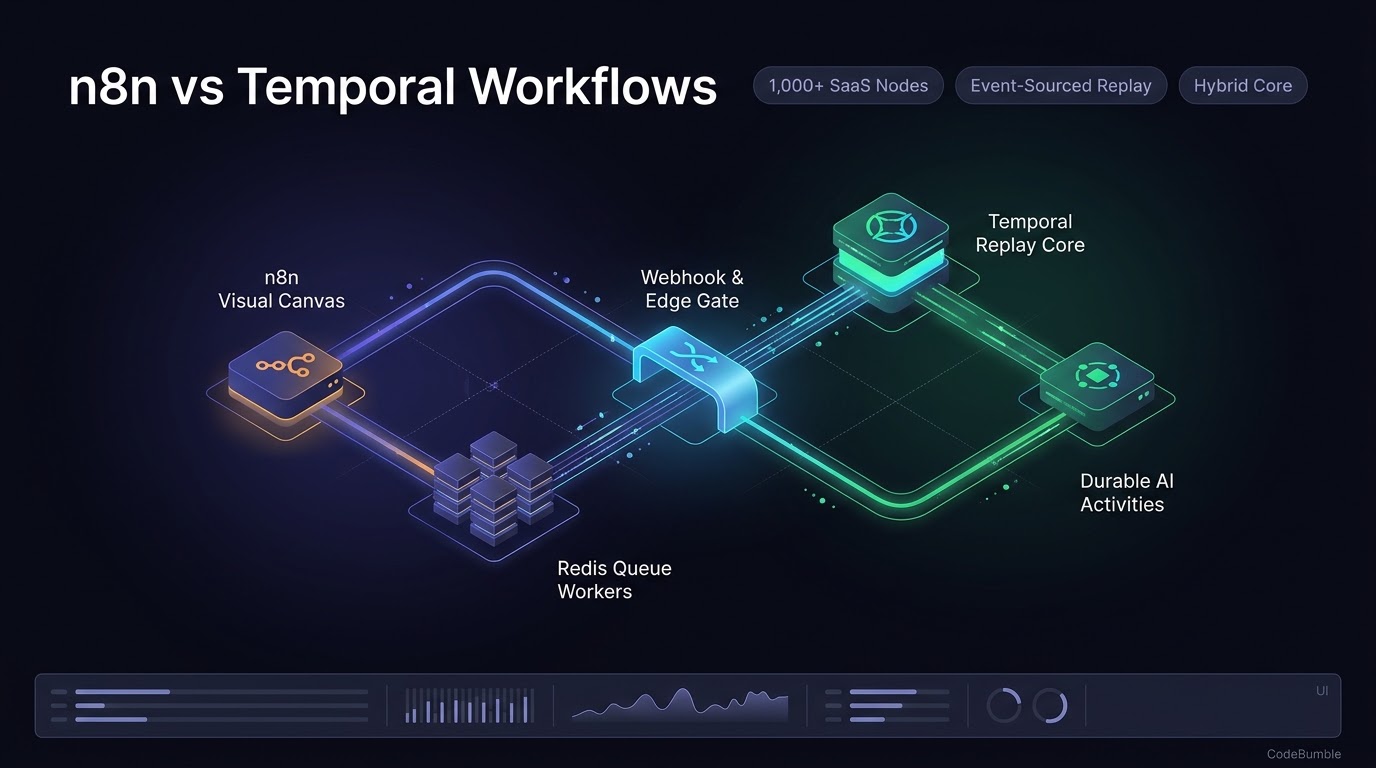
Date.now(),Math.random(), or un-wrapped HTTP calls inside workflow functions), though Serverless Workers on AWS Lambda and Standalone Activities now lower the initial cluster-ops barrier (Temporal Blog, Zymr). - Use the Hybrid Pattern (n8n at the Edge, Temporal at the Core): Let n8n act as the automation front door—catching webhooks, authenticating SaaS apps, and normalizing payloads across 1,000+ connectors—then trigger a Temporal workflow via HTTP/gRPC for the mission-critical, multi-step AI or transactional core (Zymr).
Migration & Setup Gotchas
- Self-hosted n8n before 3.0: Run
Settings > Migration Report(available on2.39+), back up both PostgreSQL and~/.n8n(including your encryption key), migrate offnpm/npxonto Docker, and explicitly setN8N_RUNNERS_TASK_TIMEOUTif Code nodes run longer than 60 seconds (AY Automate). - Temporal Action & Payload Budgeting: In Temporal Cloud, chatty agent loops with hundreds of tiny signals or heartbeats increase Action bills; batch token streams using Workflow Streams and offload large documents or embeddings to External Payload Storage (S3) (Temporal Blog, Zymr).
Frequently Asked Questions
1. Can n8n replace Temporal for long-running AI agents?
Only if your workflows can tolerate restarting or manual recovery after a worker crash. n8n provides node-level retries, queue mode, and execution logging, but it does not reconstruct in-flight execution state via event-sourced replay like Temporal (n8n Docs, Zymr).
2. How does Temporal save LLM token costs compared to standard scripts or visual workflows?
Because Temporal persists the output of each completed Activity in its Event History, a failure on a downstream tool call retries only that Activity rather than re-running earlier LLM reasoning steps (Zymr).
3. Which platform is cheaper to run in production?
n8n bills per workflow execution (regardless of step count) and runs on a single lightweight container when self-hosted, giving it a lower total cost of ownership for most business automations (Zymr). Temporal Cloud starts around $100/month for 1M Actions (~$50 per additional 1M), while self-hosting Temporal requires operating four core services plus a database—making Temporal economical when failure recovery or scale justifies the engineering investment (Zymr).
4. What changed for Temporal AI agents at Replay 2026?
Temporal introduced Serverless Workers (starting with AWS Lambda), Standalone Activities, Workflow Streams for real-time LLM token streaming, S3 External Payload Storage, and official integrations with Google ADK and the OpenAI Agents SDK (Temporal Blog).
5. Can I still self-host n8n via npm or npx in n8n 3.0?
No. Starting with n8n 3.0 (stable expected early December 2026), self-hosted n8n requires Docker, Docker Compose, or Kubernetes/Helm; npm and npx installations are no longer supported (AY Automate).
Sources
- n8n Official Documentation (Accessed November 24, 2026) — n8n vs. Temporal: Workflow Orchestration Tools Compared: https://n8n.io/vs/temporal/
- Temporal Blog (May 6, 2026) — Announcing new Temporal capabilities from Replay 2026: https://temporal.io/blog/replay-2026-product-announcements
- Zymr Engineering Blog (September 17, 2026) — Temporal vs n8n: Choosing the Right Workflow Engine: https://www.zymr.com/blog/temporal-vs-n8n
- AY Automate (November 10, 2026) — n8n 3.0 Upgrade Guide: Breaking Changes and Checklist: https://www.ayautomate.com/blog/n8n-3-0-upgrade-guide