

Engineering
NoisyTCP (CVE-2026-99288): Inside the 11-Year Linux Kernel TCP Race Condition, Kernel Fixes, and Mitigations
NoisyTCP (CVE-2026-99288) is an 11-year-old Linux kernel TCP socket lookup race that lets unauthenticated packets panic servers running Nginx, Apache, or OpenSSH. Learn how multi-queue RX widens the race window, which upstream kernels (6.12.117, 6.18.63, 7.3.4) ship the fix, and how to audit or mitigate safely.
7 min read
NoisyTCP (CVE-2026-99288): Inside the 11-Year Linux Kernel TCP Race Condition, Kernel Fixes, and Mitigations
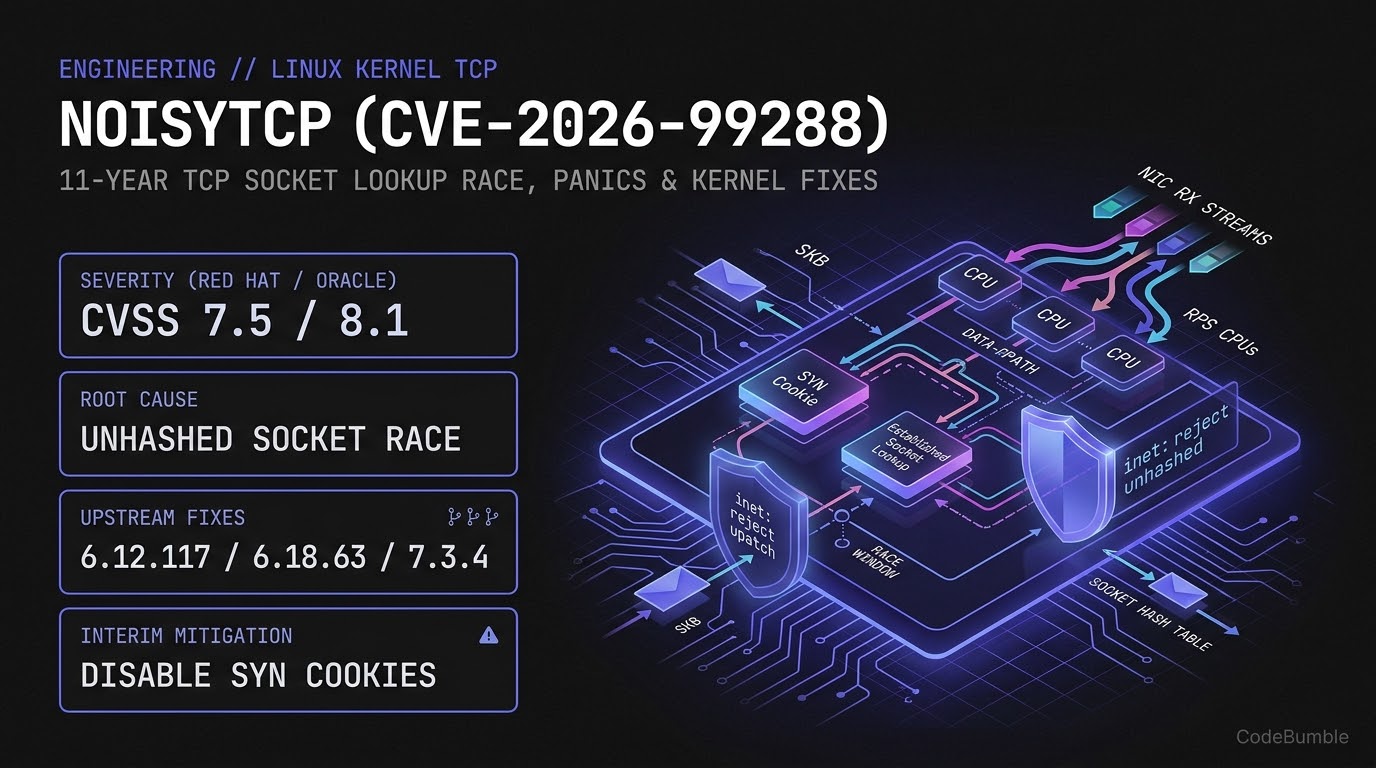
Executive Summary
On November 15, 2026, at 16:00 UTC, security researcher Hyunwoo Kim publicly disclosed NoisyTCP (CVE-2026-99288) on the oss-security mailing list following the end of the linux-distros embargo. Tracing back to a Linux kernel commit from October 3, 2015 (affecting production kernels back to Linux 4.4), the flaw is a race condition in the Linux kernel's lockless TCP established-socket lookup path that lets an unauthenticated remote attacker trigger a NULL pointer dereference and kernel panic against any reachable TCP listener—including default installations of Nginx, Apache, and OpenSSH—on multi-queue or Receive Packet Steering (RPS) systems.
Upstream Linux maintainers merged the fix—commit 4e2b3ef19e0e ("inet: reject unhashed sockets during established lookups")—into mainline on November 3, 2026, with stable backports landing in Linux 6.12.117, 6.18.63, and 7.3.4. Major distributions are actively shipping updates: AlmaLinux released patched kernels to testing for AlmaLinux 8, 9, and 10 on November 16–17, 2026, while Red Hat (CVSS 7.5, Important), Ubuntu (Medium), and Debian have published tracking advisories.
Confidence level: High for root cause, upstream commit 4e2b3ef19e0e, affected kernel history (since Linux 4.4 / Oct 3, 2015), severity ratings (Red Hat 7.5, Oracle 8.1), and interim mitigation tradeoffs, all verified against primary Linux kernel git, CVE.org, AlmaLinux, Red Hat, Ubuntu, and November 17 technical advisories. No exploitation in the wild has been reported by vendors or CISA as of disclosure; remote code execution has not been demonstrated.
Technical Mechanics and Architecture
How Multi-Queue RX and SYN Cookies Expose Unhashed Sockets
Modern cloud VMs and bare-metal servers distribute incoming network packets across multiple CPU cores using multi-queue NICs (Receive Side Scaling, RSS) or software Receive Packet Steering (RPS). As detailed in Aviatrix's November 17 Threat Research analysis and SC World, CVE-2026-99288 exploits a timing window between TCP SYN cookie handling and socket hashing across concurrent receive paths:
- When a server handles incoming TCP packets across multiple RX queues or CPUs, packet-hash differences (such as between IPv4 fragments and regular TCP segments) can route related packets to different CPU cores simultaneously.
- During lockless established-socket lookups, one CPU can observe a newly allocated socket in the lookup path before its hashing/initialization state is fully valid—or during socket reuse/teardown—returning an unhashed socket reference.
- Dereferencing fields on that unhashed socket triggers a
NULLpointer dereference (or use-after-free condition reported in some analyses), immediately causing a kernel panic and crashing the entire Linux host.
+-------------------------------------------------------------------------+
|               NOISYTCP (CVE-2026-99288) KERNEL RACE PATH                |
+-------------------------------------------------------------------------+
|                                                                         |
|  [Multi-Queue NIC / RPS]                                                |
|   |-- RX Queue / CPU A: SYN Cookie / Socket Allocation & Hashing        |
|   |-- RX Queue / CPU B: Concurrent Packet -> Lockless Established Lookup|
|   v                                                                     |
|  [Unpatched Kernel (< 6.12.117 / 6.18.63 / 7.3.4)]                      |
|   |-- Lookup returns unhashed socket during race window                 |
|   |-- NULL pointer dereference -> KERNEL PANIC (Host + Containers down) |
|                                                                         |
|  [Patched Kernel (Commit 4e2b3ef19e0e)]                                 |
|   |-- "inet: reject unhashed sockets during established lookups"        |
|   |-- Unhashed socket rejected safely -> No panic                       |
|                                                                         |
+-------------------------------------------------------------------------+
Why Containers Do Not Isolate Against NoisyTCP
Because containers (Docker, containerd, Kubernetes pods) share the underlying host Linux kernel, an unauthenticated TCP burst targeting an exposed containerized Nginx or SSH service panics the entire worker node, taking down every neighbor pod and container on that host. Testing reported by SC World showed virtual machines crashing in as little as five seconds.
Safe Read-Only Audit Script: Checking Kernel Exposure and Mitigations
Before applying patches or temporary sysctl changes, run this safe, read-only inspection script to check your running kernel version, distro changelog status, SYN cookie setting, and multi-queue RX/RPS configuration:
#!/usr/bin/env bash
# Safe, read-only audit for CVE-2026-99288 (NoisyTCP) exposure
set -euo pipefail

echo "=== 1. Running Kernel & Distro ==="
uname -a
cat /etc/os-release | grep -E '^(PRETTY_NAME|VERSION_ID)=' || true

echo "=== 2. Check TCP SYN Cookies Setting ==="
sysctl net.ipv4.tcp_syncookies

echo "=== 3. Check NIC RX Queues & RPS CPUs ==="
for iface in $(ls /sys/class/net | grep -v '^lo$'); do
  rx_count=$(ls -d /sys/class/net/"$iface"/queues/rx-* 2>/dev/null | wc -l)
  echo "Interface: $iface | RX queues: $rx_count"
  cat /sys/class/net/"$iface"/queues/rx-0/rps_cpus 2>/dev/null | sed 's/^/  rx-0 rps_cpus: /' || true
done

echo "=== 4. Check Debian/Ubuntu or RHEL/AlmaLinux Package Changelog ==="
if command -v rpm >/dev/null 2>&1; then
  rpm -q --changelog "kernel-$(uname -r)" 2>/dev/null | grep -i "CVE-2026-99288" || echo "CVE-2026-99288 not found in RPM changelog"
elif [ -f "/usr/share/doc/linux-image-$(uname -r)/changelog.Debian.gz" ]; then
  zgrep -cE "CVE-2026-99288" "/usr/share/doc/linux-image-$(uname -r)/changelog.Debian.gz" || true
fi
Evidence, Severity Ratings, and Vendor Status
Severity scoring varies across Linux vendors, reflecting differing assessments of network-attack complexity and availability impact, as documented on November 17, 2026 by Falcon Internet, AlmaLinux, and TuxCare:
| Vendor / Source | Rating / CVSS | Status as of Nov 17, 2026 | Notes |
|---|---|---|---|
| Upstream Linux | N/A (CNA: kernel.org) | Patched (6.12.117, 6.18.63, 7.3.4) |
Mainline commit 4e2b3ef19e0e (Nov 3, 2026) |
| Red Hat | Important (CVSS 7.5) | Advisory active (RHEL 8, 9, 10) | Bugzilla 2570103; check errata per minor stream |
| Oracle Linux | CVSS 8.1 | Advisory active | Higher availability/attack-vector scoring |
| Ubuntu | Medium priority | Tracking 20.04, 22.04, 24.04 LTS |
Updated Nov 17, 2026 on ubuntu.com/security |
| AlmaLinux | Important | Patched kernels in testing (8, 9, 10) |
Community testing requested before prod push |
| KernelCare (TuxCare) | Rebootless livepatch | No livepatch released yet | As of Nov 16, 2026, requires standard kernel reboot |
Notably, on November 16–17, 2026, Anza issued an urgent operational advisory to Solana Agave validators (Solana Compass), instructing staked and unstaked mainnet nodes to either install their distribution's patched kernel or temporarily disable TCP SYN cookies until a patched kernel ships—a change that takes effect without restarting the validator process.
Hardening and Mitigation Playbook
Use this six-step playbook to prioritize internet-facing hosts, apply vendor kernels cleanly, and manage interim workarounds without degrading resilience.
1. Prioritize Internet-Facing Multi-Queue Servers
Inventory every Linux host exposing TCP ports (22, 80, 443, validator/RPC ports, load balancers) directly to untrusted networks, including Kubernetes worker nodes running multi-tenant or containerized web services.
2. Install Distribution-Patched Kernels and Schedule Reboots
Because KernelCare rebootless livepatching is not yet available for CVE-2026-99288 (TuxCare), plan rolling drains and reboots into patched distro kernels (or upstream 6.12.117, 6.18.63, 7.3.4+). Do not rely on uname -r alone on RHEL/Ubuntu/Debian—verify the package changelog or security errata ID.
3. Evaluate Interim Mitigation: Disabling TCP SYN Cookies (sysctl)
If a vendor kernel is not yet available for a high-risk host, disabling TCP SYN cookies closes the SYN-cookie/socket-hashing race condition without a reboot:
# Temporary runtime mitigation (evaluate SYN flood exposure first!)
sudo sysctl -w net.ipv4.tcp_syncookies=0
Tradeoff warning: Disabling tcp_syncookies removes Linux's built-in SYN flood defense. Only use this interim setting behind an upstream DDoS/SYN-proxy firewall (such as Cloudflare, AWS Shield/NLB, or hardware SYN-proxy appliances) and increase net.ipv4.tcp_max_syn_backlog if needed.
4. Evaluate Interim Mitigation: Restricting to Single RX Queue
Alternatively, pinning NIC processing to a single RX queue (ethtool -L <iface> combined 1) eliminates multi-CPU race conditions, but severely caps network throughput on high-traffic servers—reserve this only for low-throughput bastions or staging tests.
5. Enforce Edge Ingress & Fragment Filtering
Use cloud security groups and inline IPS/WAF controls to drop unsolicited fragmented IPv4 packets targeting TCP service ports where not required, and restrict SSH (22) access to VPN/bastion CIDRs or Tailscale/WireGuard interfaces.
6. Rollback Note
If disabling tcp_syncookies=0 causes SYN backlog exhaustion under normal traffic spikes before your kernel patch lands, restore sudo sysctl -w net.ipv4.tcp_syncookies=1 immediately. Once the patched kernel is booted and verified via uname -r and package changelogs, remove any temporary /etc/sysctl.d/ overrides so net.ipv4.tcp_syncookies=1 returns to its hardened default.
Frequently Asked Questions (FAQ)
1. Does NoisyTCP (CVE-2026-99288) allow remote code execution (RCE)?
No RCE has been demonstrated. As noted by Falcon Internet and Aviatrix, the demonstrated impact is an unauthenticated remote Denial of Service (kernel panic), though researcher Hyunwoo Kim answered "Not yet" when asked about RCE.
2. Are containers or Kubernetes pods safe from CVE-2026-99288?
No. Containers share the host Linux kernel (unless isolated inside a separate guest kernel VM such as Firecracker/Nitro Sandboxes). Crashing a containerized TCP listener panics the underlying host node.
3. Which upstream Linux kernel versions fix CVE-2026-99288?
Upstream fixes landed in Linux 6.12.117, 6.18.63, and 7.3.4 via mainline commit 4e2b3ef19e0e. Distribution kernels backport this patch into their own versioned packages, so check your distro's advisory and rpm/apt changelogs.
4. Is it safe to disable net.ipv4.tcp_syncookies permanently?
No. Disabling SYN cookies is strictly a temporary mitigation while awaiting a patched kernel, because it exposes listening sockets to classic TCP SYN flood exhaustion unless mitigated upstream.
5. Is CVE-2026-99288 being actively exploited in the wild?
As of November 16–17, 2026, no vendor or CISA has reported active exploitation in the wild, though technical details and PoC research are public, making timely patching urgent.
Sources
- Linux Kernel Git (Mainline) — Commit
4e2b3ef19e0e:inet: reject unhashed sockets during established lookups(Merged November 3, 2026) - CVE.org — CVE-2026-99288 Record (CNA: kernel.org) (Published November 11, 2026)
- AlmaLinux Blog — NoisyTCP (CVE-2026-99288): Patched kernels available in testing (Published November 16–17, 2026)
- Red Hat Customer Portal — CVE-2026-99288 Security Advisory (Published November 11, 2026)
- Aviatrix Threat Research Center — NoisyTCP CVE-2026-99288: Linux Kernel Flaw Crashes Nginx, Apache & SSH Servers (Published November 17, 2026)
- Falcon Internet — CVE-2026-99288: Linux TCP race crashes servers, fixed in 6.12.117 (Published November 17, 2026)