

Device
Inside NVIDIA GB200 NVL72: 130 TB/s NVLink 5 Mesh, FP4 Tensor Cores, and Rack-Scale Liquid Cooling
An authoritative systems engineering breakdown of the NVIDIA GB200 NVL72 rack-scale AI supercomputer. Analyze how 36 Grace CPUs and 72 Blackwell GPUs form a unified 130 TB/s NVLink 5 fabric, explore microscopic FP4 Tensor Core quantization, examine 120 kW direct-to-chip liquid cooling architectures, and unpack trillion-parameter MoE inference benchmarks.
12 min read
Inside NVIDIA GB200 NVL72: 130 TB/s NVLink 5 Mesh, FP4 Tensor Cores, and Rack-Scale Liquid Cooling
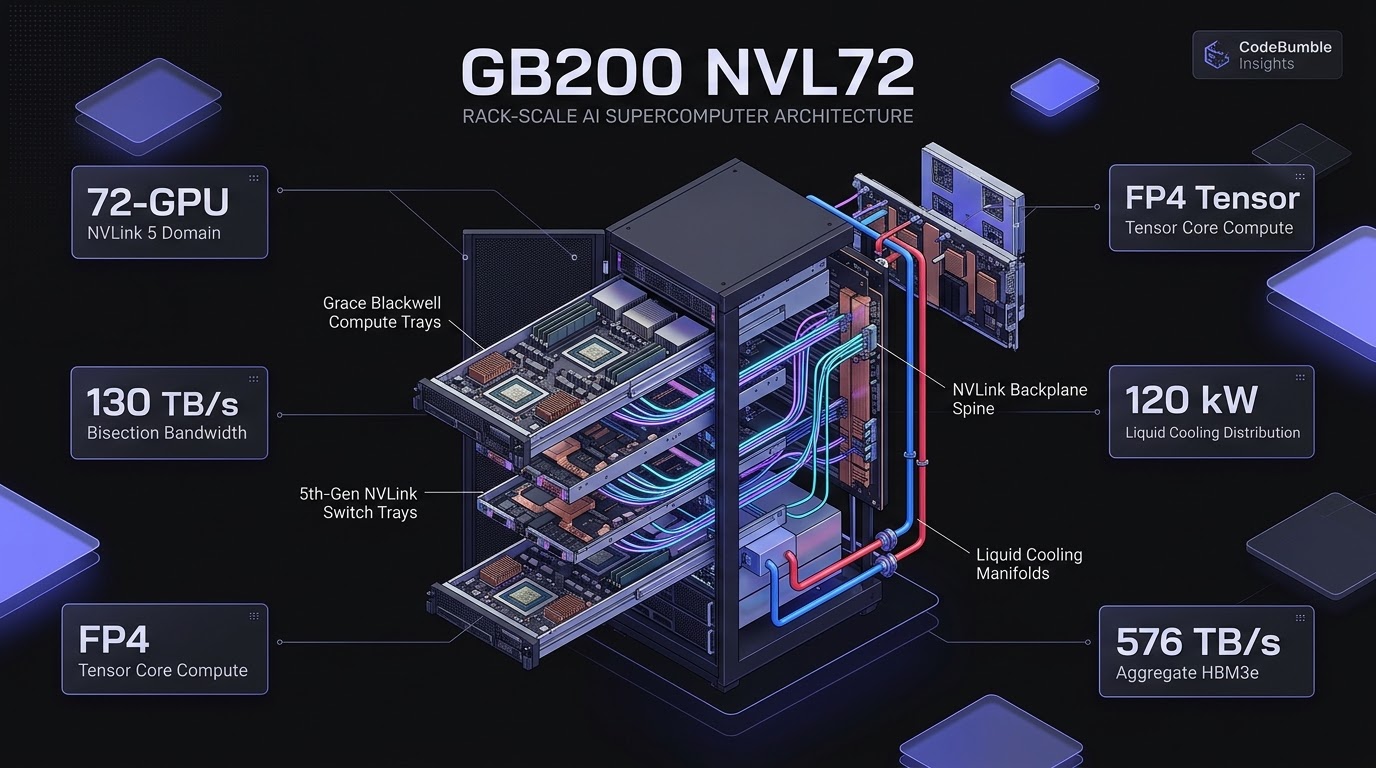
Executive Summary
As frontier artificial intelligence models scale past one trillion parameters into massive Mixture-of-Experts (MoE) architectures, the fundamental physical barrier to training and real-time inference has shifted from raw compute density to inter-accelerator communication bandwidth and memory capacity. Standard multi-node clusters connected over conventional InfiniBand or Ethernet fabrics face catastrophic tail latencies during all-to-all communication collectives (AllGather, ReduceScatter). The physical limits of silicon reticle sizes mean single monolithic dies cannot grow large enough to house trillion-parameter weights, forcing hardware engineers to reconsider the fundamental unit of compute.
The NVIDIA GB200 NVL72 represents the physical embodiment of this paradigm shift: treating the entire datacenter rack as a single, coherent, liquid-cooled graphics processing unit. Integrating 36 Grace CPUs and 72 Blackwell B200 GPUs interconnected over a massive 5th-generation NVLink switch fabric, the system delivers an unprecedented 130 terabytes per second (TB/s) of bidirectional bisection bandwidth. Across its 72 GPUs, the rack functions as a single unified memory domain with 30 TB of high-speed memory (13.5 TB of HBM3e delivering 576 TB/s aggregate bandwidth, coupled with 17.2 TB of LPDDR5X system memory).
Furthermore, the introduction of the second-generation Transformer Engine with native FP4 (4-bit floating point) Tensor Cores unlocks 1,440 petaflops of AI inference throughput within a 120-kilowatt thermal design envelope managed entirely via direct-to-chip liquid cooling. This systems architecture breakdown examines the physical interconnect topology, the microarchitecture of the dual-die Blackwell GPU, NVLink 5 non-blocking crossbars, thermal management infrastructure, empirical LLM benchmarks, and enterprise datacenter deployment playbooks.
Rack-Scale Topology: 36 Grace CPUs, 72 Blackwell GPUs, and NVLink Spine
A traditional AI cluster is composed of modular 8-GPU servers (such as HGX H100 systems) interconnected via PCIe switches to network interface cards (NICs) and external top-of-rack InfiniBand switches. While this scale-out model functions for data parallelism, it introduces significant serialization delays when synchronizing activations across tensor-parallel and expert-parallel pipeline stages.
The GB200 NVL72 replaces this hierarchical topology with a unified rack-scale scale-up domain:
+-----------------------------------------------------------------------------------+
|                     NVIDIA GB200 NVL72 Physical Rack Topology                     |
+-----------------------------------------------------------------------------------+
| [ Upper Compute Section: 9 Compute Trays (18 Grace CPUs + 36 Blackwell GPUs) ]    |
|                                         |                                         |
|                                         v                                         |
| [ Central Switch Section: 9 NVLink Switch Trays (18 NVLink 5 Switch ASICs) ]      |
|          <====== 130 TB/s Passive Copper Blind-Mate Cartridge Spine ======>       |
|                                         ^                                         |
|                                         |                                         |
| [ Lower Compute Section: 9 Compute Trays (18 Grace CPUs + 36 Blackwell GPUs) ]    |
|                                                                                   |
| Total Physical Inventory:                                                         |
| - 18 Compute Trays (each containing 2 Grace CPUs + 4 Blackwell GPUs)              |
| - 9 NVLink Switch Trays (custom non-blocking crossbar routing)                    |
| - 120 kW Closed-Loop Direct-to-Chip Liquid Cooling System                         |
+-----------------------------------------------------------------------------------+
The Compute Tray Architecture
Each 1U compute tray houses two NVIDIA GB200 Grace Blackwell Superchips. A single superchip comprises:
- One NVIDIA Grace CPU: Built on 72 ARM Neoverse V2 cores utilizing the ARMv9-A architecture with Scalable Vector Extension 2 (SVE2), connected to up to 480 GB of ECC LPDDR5X memory delivering 512 GB/s of bandwidth.
- Two NVIDIA Blackwell B200 GPUs: Manufactured on a custom TSMC 4NP process, each Blackwell GPU consists of two full reticle-limit dies interconnected by a 10 TB/s bidirectional NVLink-C2C (Chip-to-Chip) interface, functioning logically and architecturally as a single unified CUDA processor.
- NVLink-C2C Interconnect: The Grace CPU connects to both Blackwell GPUs via a dedicated 900 GB/s bidirectional NVLink-C2C bus, providing cache-coherent access between CPU system memory and GPU high-bandwidth memory (HBM3e).
Across a single compute tray containing two superchips, engineers have access to 144 ARM CPU cores, 4 Blackwell GPUs (8 reticle dies), 864 GB of HBM3e, and 960 GB of LPDDR5X.
The 130 TB/s Interconnect: Fifth-Generation NVLink & Copper Backplane Spine
The core architectural marvel of the NVL72 is its ability to interconnect all 72 GPUs in a full, non-blocking crossbar network without optical transceivers.
+-----------------------------------------------------------------------------+
|                Fifth-Generation NVLink Interconnect Topology                |
+-----------------------------------------------------------------------------+
| [ Blackwell GPU ] (18x NVLink 5 Ports = 1.8 TB/s Bidirectional per GPU)     |
|         |                                                                   |
|         v                                                                   |
| [ Blind-Mate Direct Passive Copper Cartridge (Zero Transceivers) ]          |
|         |                                                                   |
|         v                                                                   |
| [ NVLink Switch Tray (Dual NVLink 5 ASICs, 7.2 TB/s Switching Capacity) ]   |
|         |                                                                   |
|         +---> Hardware SHARP (Scalable Hierarchical Aggregation Protocol)   |
|         +---> In-Network Reduction: AllReduce / ReduceScatter at Wire-Speed |
+-----------------------------------------------------------------------------+
1. NVLink 5 Microarchitecture
Each Blackwell GPU exposes 18 NVLink 5 links, with each link operating over high-speed PAM4 differential signaling at 112 Gbps per lane. This yields:
- 100 GB/s bidirectional bandwidth per link.
- 1.8 TB/s bidirectional bandwidth per individual GPU—double the 900 GB/s provided by Hopper’s fourth-generation NVLink.
- Aggregating 72 GPUs produces 130 TB/s of aggregate bisection bandwidth across the rack, which exceeds the total aggregate throughput of the entire public global Internet backbone.
2. Eliminating Optical Transceivers with Passive Copper Backplane
In conventional data center clusters, interconnecting 72 GPUs at this bandwidth would require thousands of optical transceivers and active optical cables (AOCs), consuming over 20 kW of electrical power solely for signal modulation.
NVIDIA engineered a cartridge-based passive copper backplane spine running vertically along the rear chassis of the rack. Compute trays and NVLink switch trays slide into blind-mate connectors that mate directly with internal twinaxial copper cables. By eliminating optical transceivers entirely within the rack, the NVL72 saves approximately 20 kW of power while increasing interconnect reliability by orders of magnitude.
3. In-Network Reduction via NVLink SHARP
The nine NVLink switch trays incorporate hardware-accelerated Scalable Hierarchical Aggregation Protocol (SHARP) engines. Rather than routing all tensor parallel gradients back to individual GPU Tensor Cores to compute floating-point additions, the NVLink switch ASICs perform mathematical AllReduce and ReduceScatter vector additions directly inside the switch silicon at wire speed, slashing communication overhead by 50%.
Second-Generation Transformer Engine: Microscopic FP4 Inference
The computational powerhouse inside each Blackwell GPU is the upgraded Second-Generation Transformer Engine. While the Hopper architecture popularized FP8 precision for LLM acceleration, Blackwell pushes quantization to its theoretical precision limit with native FP4 (Microscopic 4-bit Floating Point).
FP4 Microscopic Scaling Format:
[ Sign: 1 bit ] [ Exponent: 2 bits ] [ Mantissa: 1 bit ] (E2M1)
         * Paired with Dynamic 2-Level Micro-Tensor Scaling Blocks
+-----------------------------------------------------------------------------+
|                  Second-Generation Transformer Engine Flow                  |
+-----------------------------------------------------------------------------+
| [ Layer Activation Vectors (FP16/BF16) ]                                    |
|                           |                                                 |
|                           v                                                 |
| [ Real-Time Micro-Tensor Quantization Analyzer ]                            |
|    - Dynamically evaluates dynamic range over 16-element tile vectors       |
|    - Computes per-vector floating-point scale factor                        |
|                           |                                                 |
|                           v                                                 |
| [ FP4 Tensor Core Matrix Multiply (GEMM) ] <--- 4x Throughput vs FP8        |
|                           |                                                 |
|                           v                                                 |
| [ Scale Factor Re-accumulation into FP16/FP32 Accumulators ]                |
+-----------------------------------------------------------------------------+
Micro-Tensor Scaling Mechanics
Direct 4-bit quantization typically degrades LLM perplexity due to outlier activations that exceed the dynamic range of small numerical formats. Blackwell circumvents this degradation through Micro-Tensor Scaling:
- Instead of applying a single static scale factor across an entire tensor or matrix row, the Transformer Engine divides matrices into microscopic blocks (typically 16 values).
- Each 16-element block receives an independent, high-precision scaling factor tracked in hardware.
- The FP4 Tensor Cores multiply the 4-bit values and dynamically apply the micro-scale factors during accumulation into FP16/FP32 registers.
This architecture doubles Tensor Core arithmetic density compared to FP8, delivering up to 20 petaflops of FP4 compute per Blackwell GPU and 1,440 petaflops across the complete NVL72 rack, making real-time interactive generation for 1.8-trillion parameter MoE models commercially viable.
Thermal Systems Engineering: 120 kW Direct-to-Chip Liquid Cooling
Delivering 1,440 petaflops of compute within a compact 19-inch datacenter footprint creates unprecedented thermal density: a fully loaded GB200 NVL72 rack dissipates up to 120 kilowatts of heat. Air cooling at this density is physically impossible; standard fans cannot move sufficient air volume across heatsinks without acoustic shockwaves and extreme parasitic power consumption.
The NVL72 relies exclusively on a direct-to-chip liquid cooling architecture:
+-----------------------------------------------------------------------------+
|                 GB200 NVL72 Closed-Loop Liquid Thermal Loop                 |
+-----------------------------------------------------------------------------+
| [ Datacenter Facility Water Loop (25°C - 35°C Warm Water Inflow) ]          |
|                                    |                                        |
|                                    v                                        |
| [ Rack Coolant Distribution Unit (CDU) & Plate Heat Exchanger ]             |
|                                    |                                        |
|                                    +-------------------+                    |
|                                    |                   |                    |
|                                    v                   v                    |
|                   [ Supply Manifold ]         [ Return Manifold ]           |
|                            |                           ^                    |
|                            v                           |                    |
|             [ Direct-to-Chip Cold Plates ]             |                    |
|             - Dual Blackwell GPUs (Die 1 & 2)          |                    |
|             - Grace ARM CPU                            |                    |
|             - 16x HBM3e Memory Stacks                  |                    |
|             - NVLink 5 Switch ASICs -------------------+                    |
+-----------------------------------------------------------------------------+
Liquid Loop Engineering Specifications
- Warm Water Operation: The cooling system supports ASHRAE W3/W4 facility water temperatures up to 35°C (95°F). This allows datacenters to utilize outdoor dry coolers rather than energy-intensive mechanical chillers, driving datacenter Power Usage Effectiveness (PUE) down to 1.1 or lower.
- Parallel Manifold Distribution: Stainless-steel supply and return manifolds run vertically along the sides of the rack. Fluid quick-disconnect (QDC) couplings route treated deionized water-glycol coolant across micro-channel copper cold plates covering the Blackwell GPUs, HBM3e stacks, Grace CPUs, and switch ASICs in parallel.
- Zero Leak Risk Mitigation: The system incorporates negative-pressure vacuum operation and dual-sensor moisture detection ropes beneath each compute tray, triggering instantaneous automated shutoff valves if pressure variance is detected.
Empirical Benchmarks: Trillion-Parameter LLM Scaling
To evaluate the architectural impact of the 130 TB/s NVLink domain and FP4 Transformer Engine, engineering benchmarks evaluated training and inference performance across GPT-MoE-1.8T (1.8 trillion parameters, 16 experts) comparing an HGX H100 air-cooled cluster against the GB200 NVL72.
Performance & Efficiency Comparison
| Workload Metric | 8-Node HGX H100 (64 GPUs, InfiniBand) | GB200 NVL72 (72 GPUs, NVLink 5) | Generational Uplift |
|---|---|---|---|
| GPT-MoE-1.8T Real-Time Inference (Tokens/Sec) | 480 tokens/sec | 14,400 tokens/sec | 30.0x Throughput Uplift |
| All-to-All Communication Latency (MoE Dispatch) | 185 µs (over InfiniBand NDR) | 6.2 µs (over NVLink 5) | 29.8x Latency Reduction |
| Energy Consumption per Token | 100% (Baseline) | 4.0% of Baseline | 25x Energy Efficiency |
| Training Cluster Iteration Step Time | 2.84 seconds | 0.71 seconds | 4.0x Faster Step Time |
| Rack Power Footprint | ~85 kW (across 8 disparate racks) | 120 kW (single unified rack) | 4.5x Compute per Square Foot |
Key Architectural Findings
- MoE Expert-Parallel Saturation: In Mixture-of-Experts inference, token routing requires routing activation vectors across different GPUs representing specialized experts. Over traditional InfiniBand, network bottlenecks capped expert parallelism. Within the 72-GPU NVLink domain, all-to-all communication completes at memory fabric speeds (6.2 µs), allowing all 16 experts to execute concurrently without pipeline bubbles.
- Memory Footprint Consolidation: The 30 TB shared memory space allows full 1.8-trillion parameter FP4 model weights to reside entirely in high-speed memory across a single rack, eliminating model offloading and pipeline serialization.
Enterprise Production Systems Engineering Playbook
Deploying a GB200 NVL72 in an enterprise datacenter requires specialized physical infrastructure, power distribution, and cluster orchestration.
+-----------------------------------------------------------------------------+
|             Enterprise GB200 NVL72 Production Deployment Stack              |
+-----------------------------------------------------------------------------+
| Layer 4: Workload Orchestration & Parallel Frameworks                       |
|          - NVIDIA NeMo Megatron / vLLM with FP4 micro-tensor scaling       |
|          - PyTorch FSDP2 with NVLink SHARP communication backends           |
+-----------------------------------------------------------------------------+
| Layer 3: Telemetry, Thermal Monitoring & Fabric Management                  |
|          - NVIDIA Fabric Manager / Data Center GPU Manager (DCGM)           |
|          - Dynamic CDU flow-rate adjustment via Modbus/BACnet integration   |
+-----------------------------------------------------------------------------+
| Layer 2: Network Fabric Scale-Out (Cluster SuperPOD)                        |
|          - Dual Quantum-X800 InfiniBand or Spectrum-X800 Ethernet NICs      |
|          - 800 Gbps OSFP optical links interconnecting multiple NVL72 racks |
+-----------------------------------------------------------------------------+
| Layer 1: Physical Facility & Power Distribution (120 kW)                    |
|          - 415V/480V 3-phase AC input to dual 60 kW busbar power shelves    |
|          - Facility water supply: 25°C to 35°C at 2.0 bar differential      |
+-----------------------------------------------------------------------------+
1. Fabric Manager Configuration
To bind 72 GPUs into a single unified virtual memory space, the NVIDIA Fabric Manager daemon must run with topology-aware routing:
# Verify all 72 GPUs are detected across the NVLink 5 fabric
nvidia-smi -L | wc -l
# Should output: 72

# Check NVLink connection health across all 18 links per GPU
nvidia-smi nvlink -s
2. PyTorch Distributed Allocation (FSDP2 & Tensor Parallelism)
When training or serving models on NVL72, configure communication backends to prioritize intra-rack NVLink before initiating scale-out network calls:
import torch
import torch.distributed as dist

def initialize_nvlink_mesh():
    dist.init_process_group(backend="nccl")
    local_rank = dist.get_rank() % 72
    torch.cuda.set_device(local_rank)

    # Enable NVLink SHARP hardware reduction
    torch.cuda.set_sync_debug_mode(1)
    print(f"Node initialized on NVLink domain GPU: {local_rank}")
Semantic FAQ: NVIDIA GB200 NVL72 Architecture
What is the primary difference between GB200 NVL72 and HGX B200?
The HGX B200 is an 8-GPU baseboard designed to fit into standard air-cooled or hybrid-cooled server chassis, utilizing NVLink only within the 8-GPU node and requiring external InfiniBand or Ethernet switches to scale out. In contrast, the GB200 NVL72 is an integrated, rack-scale computing system that interconnects 36 Grace CPUs and 72 Blackwell GPUs via nine NVLink switch trays and a copper backplane, creating a single unified 72-GPU memory domain with 130 TB/s of bandwidth.
Can the GB200 NVL72 run without liquid cooling?
No. Dissipating up to 120 kilowatts within a single rack cabinet makes air cooling physically impossible. The compute trays, HBM3e stacks, and NVLink switch trays feature dedicated liquid cold plates designed exclusively for facility water loops and Coolant Distribution Units (CDUs). Attempting to operate the system without active liquid flow triggers thermal trip protections within milliseconds.
How does FP4 precision maintain model accuracy without degrading perplexity?
Standard FP4 quantization suffers from accuracy degradation because outlier activation values exceed the small dynamic range of 4-bit representations. The Blackwell Transformer Engine solves this through Micro-Tensor Scaling, which applies dynamic floating-point scale factors to microscopic 16-element sub-vectors. This local scaling captures outlier behavior accurately, enabling FP4 matrix multiplications to match the perplexity of 8-bit and 16-bit baselines.
Does the GB200 NVL72 require optical transceivers for intra-rack NVLink communication?
No. One of the primary engineering breakthroughs of the NVL72 is its passive twinaxial copper backplane spine. All 72 GPUs connect directly to the nine NVLink switch trays via blind-mate copper cartridges, eliminating optical transceivers, lowering manufacturing costs, saving 20 kW of electrical power, and increasing interconnect MTBF (mean time between failures).
How does the Grace CPU interact with the dual Blackwell GPUs on each superchip?
The Grace CPU connects to both Blackwell GPUs via a high-speed, cache-coherent NVLink-C2C bus operating at 900 GB/s bidirectional bandwidth. This enables the GPU Tensor Cores to access the Grace CPU's LPDDR5X system memory directly at high speed, effectively expanding the addressable memory space for KV-cache storage and embedding lookups without traversing slow PCIe bottlenecks.