

Automation
OpenPLC Runtime Race Condition (CVE-2026-126088): How Concurrent Setup Requests Create Unauthenticated Admins
Published by CISA on November 19, 2026 under advisory ICSA-26-323-01, CVE-2026-126088 (CVSS 4.0: 9.2 Critical) is a first-user race condition in Autonomy Logic OpenPLC Runtime 4.2.4 and earlier. Learn how concurrent provisioning requests bypass the existence check to create multiple unauthenticated administrator accounts, how to isolate OT management paths, and how to verify your upgrade to 4.3.0.
7 min read
OpenPLC Runtime Race Condition (CVE-2026-126088): How Concurrent Setup Requests Create Unauthenticated Admins
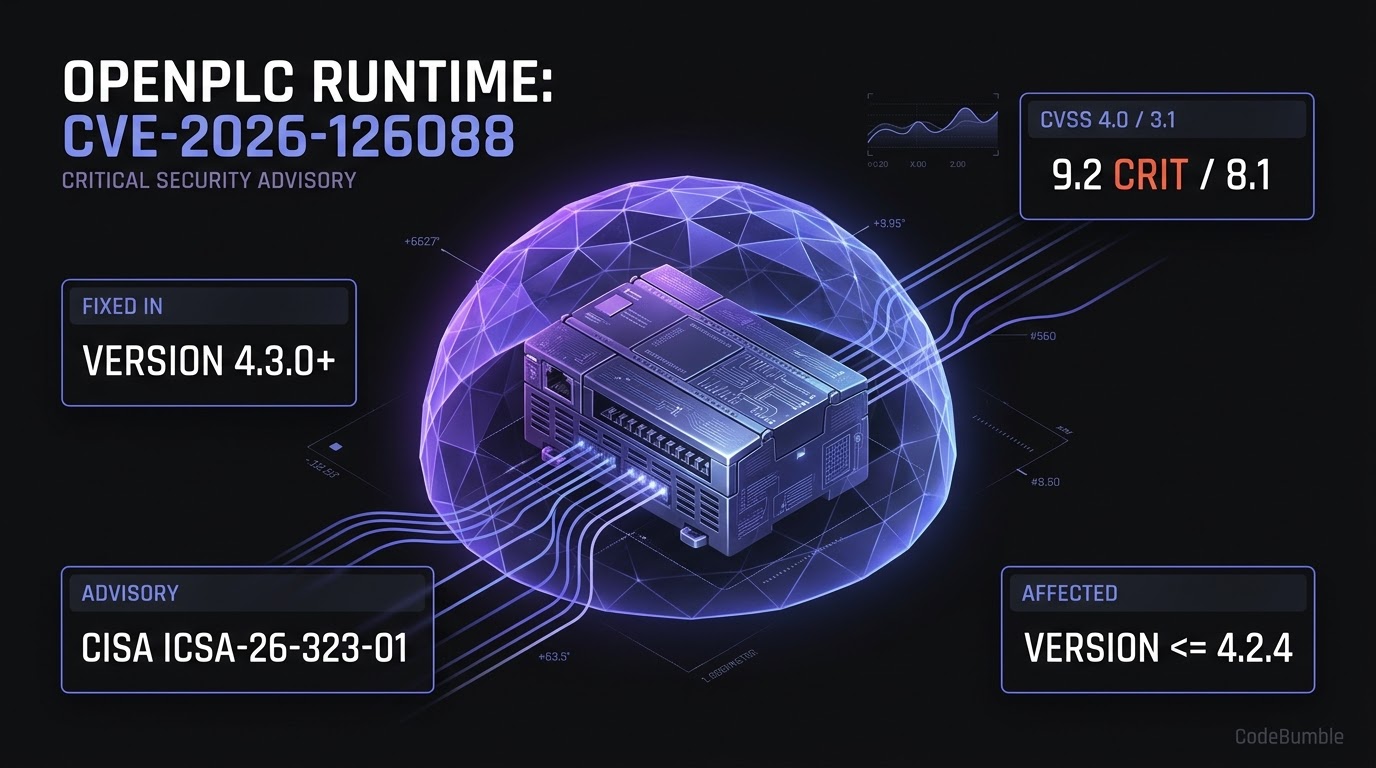
Executive Summary
On November 19, 2026, the U.S. Cybersecurity and Infrastructure Security Agency (CISA) published ICS Advisory ICSA-26-323-01 detailing CVE-2026-126088 (CWE-362: Concurrent Execution using Shared Resource with Improper Synchronization), a race condition affecting Autonomy Logic OpenPLC Runtime versions 4.2.4 and prior. Reported to CISA by researcher Noureddin Lutfi, the flaw occurs during initial first-user provisioning: multiple concurrent requests can pass the user-existence check before any account is committed to storage, resulting in several unauthenticated administrator accounts being created.
The CVE Program record assigns CVE-2026-126088 a CVSS v4.0 base score of 9.2 (Critical) and a CVSS v3.1 base score of 8.1 (High) (CVSS:3.1/AV:N/AC:H/PR:N/UI:N/S:U/C:H/I:H/A:H), reflecting a network-reachable attack path that requires no prior credentials or user interaction, though it depends on winning the provisioning race window. CISA lists Critical Manufacturing, Energy, Transportation Systems, and Water and Wastewater Systems as relevant global deployment sectors.
Autonomy Logic addressed the synchronization defect in OpenPLC Runtime 4.3.0; CISA recommends updating to 4.3.0 or later and isolating control-system management interfaces behind firewalls and updated VPNs. As of November 19, 2026, CISA reported no known public exploitation specifically targeting CVE-2026-126088, and the vulnerability was not listed in CISA's Known Exploited Vulnerabilities (KEV) catalog (version 2026.11.18).
| Attribute | Verified Value | Source |
|---|---|---|
| CVE Identifier | CVE-2026-126088 (CWE-362 Race Condition) |
CVE.org / NVD / CISA |
| CISA ICS Advisory | ICSA-26-323-01 (Released November 19, 2026) |
CISA |
| CVSS Scores | 9.2 Critical (CVSS 4.0) / 8.1 High (CVSS 3.1) | CVE.org / Brandefense / isMalicious |
| Affected Versions | Autonomy Logic OpenPLC Runtime 4.2.4 and prior |
CISA / NVD |
| Fixed Version | OpenPLC Runtime 4.3.0 or later |
CISA / Brandefense |
| Target Sectors | Critical Manufacturing, Energy, Transportation, Water & Wastewater | CISA ICSA-26-323-01 |
| Exploitation / KEV | No known public exploitation reported to CISA; not in KEV v2026.11.18 |
CISA / Rapid7 / Brandefense |
Technical Mechanics and Architecture
Why First-User Provisioning Fails Under Concurrency (CWE-362)
OpenPLC Runtime provides a web-based management interface used to upload PLC programs, configure I/O drivers, and manage runtime execution. On a newly initialized instance (<= 4.2.4), the runtime checks whether an initial administrator account already exists before allowing first-user registration.
Because that check-then-commit sequence lacks atomic synchronization (such as a database transaction lock, mutex, or unique-constraint enforcement on the initial admin bootstrap), two or more concurrent HTTP requests arriving during the provisioning window can both read "zero users exist," pass the existence check, and each commit a separate administrator account—without any authentication.
Provisioning Race & OT Containment Architecture
+-------------------------------------------------------------------------+
|              UNAUTHENTICATED CONCURRENT SETUP REQUESTS                  |
|   Request A (Legitimate Admin)       Request B (Unauthorized Caller)    |
+------------------+----------------------------------+-------------------+
                   |                                  |
                   v                                  v
+-------------------------------------------------------------------------+
|     OPENPLC RUNTIME <= 4.2.4 FIRST-USER PROVISIONING HANDLER            |
|  1. Both requests read user store concurrently -> "0 admins exist"      |
|  2. Both pass existence check before either commits (CWE-362 Race)      |
|  3. Both accounts committed -> MULTIPLE UNAUTHENTICATED ADMINS CREATED  |
+-------------------------------------------------------------------------+
                                     |
                                     v
+-------------------------------------------------------------------------+
|     DEFENSIVE FIX (OPENPLC 4.3.0+ & OT SEGMENTATION)                    |
|  - Atomic bootstrap lock / single-admin enforcement in 4.3.0+           |
|  - Isolate PLC management behind OT firewall + VPN; audit admin list    |
+-------------------------------------------------------------------------+
Defensive Provisioning & Network Audit Patterns
In industrial control environments, defenders should verify that any automated provisioning or first-user setup logic uses atomic locking—and should immediately audit network reachability to OpenPLC Runtime management ports from untrusted IT or corporate subnets.
1. Safe OT Management Boundary Check (Read-Only):
#!/usr/bin/env bash
# Read-only reachability check from a corporate/IT test host to an OpenPLC node
# Goal: Confirm CISA-recommended network isolation (should time out / be blocked)
set -euo pipefail

PLC_HOST="${1:?Usage: $0 <openplc_ip_or_host>}"
PLC_PORT="${2:-8080}"

if nc -vz -w3 "$PLC_HOST" "$PLC_PORT" 2>/dev/null; then
    echo "[ALERT] $PLC_HOST:$PLC_PORT is reachable from this non-OT segment!"
else
    echo "[OK] $PLC_HOST:$PLC_PORT is isolated from this segment."
fi
2. Defensive Atomic Bootstrap Pattern (Reference for Automation Tooling):
When building or auditing custom automation runtime provisioning scripts, never rely on a non-atomic if user_count == 0: create_user() pattern. Enforce an atomic lock or database-level unique constraint before committing:
import sqlite3

def create_initial_admin_atomic(conn: sqlite3.Connection, username: str, pw_hash: str) -> bool:
    """
    Defensive atomic first-admin creation using IMMEDIATE transaction locking
    to prevent CWE-362 concurrent bootstrap races.
    """
    conn.isolation_level = None
    cur = conn.cursor()
    try:
        cur.execute("BEGIN IMMEDIATE")
        cur.execute("SELECT COUNT(*) FROM users WHERE role = 'admin'")
        if cur.fetchone()[0] > 0:
            cur.execute("ROLLBACK")
            return False
        cur.execute(
            "INSERT INTO users (username, password_hash, role) VALUES (?, ?, 'admin')",
            (username, pw_hash),
        )
        cur.execute("COMMIT")
        return True
    except sqlite3.Error:
        cur.execute("ROLLBACK")
        raise
Evidence & Operational Impact
Why Post-Commissioning Audits Still Matter
Even if an OpenPLC Runtime <= 4.2.4 instance is already past its initial setup phase today, historical exposure during commissioning matters. If the management interface was reachable from an untrusted network or shared lab VLAN when the first administrator was created, a concurrent request could have quietly created a second administrator account that persists after commissioning.
Evidence Confidence & Source Nuances
- Exploitation Status (No Confirmed Wild Attacks): CISA's November 19, 2026 advisory states that no known public exploitation specifically targeting
CVE-2026-126088has been reported, and Rapid7 confirms it is not in CISA KEV (v2026.11.18). On November 20, 2026, Brandefense noted that its Blackhole tracker observed one dark-chat post mentioningCVE-2026-126088between August 21 and November 19, 2026—a single mention signal that does not verify active exploitation or identify any affected operator. - Sector Context vs. Confirmed Deployments: CISA's listing of Critical Manufacturing, Energy, Transportation, and Water/Wastewater reflects general ICS sector applicability rather than evidence that every operator in those sectors runs OpenPLC Runtime.
- Performance Benchmarks: Quantitative runtime scan-cycle or CPU benchmarks comparing OpenPLC Runtime
4.3.0against4.2.4are unavailable in the fetched CISA, NVD, and vendor advisories.
Hardening Playbook
Coordinate all changes with the control-system or process owner and conduct an operational impact review before modifying OT/ICS network paths or restarting runtimes:
Inventory Every OpenPLC Runtime Instance
- Catalog all production, staging, lab, and training OpenPLC Runtime deployments that can reach an operational network. Record the installed version (
<= 4.2.4is affected), service owner, network path, and initial commissioning date.
- Catalog all production, staging, lab, and training OpenPLC Runtime deployments that can reach an operational network. Record the installed version (
Isolate Management Interfaces Immediately
- Follow CISA's
ICSA-26-323-01guidance: ensure control-system devices are not accessible from the internet, place control-system networks behind firewalls separated from business/IT networks, and require updated VPNs for any authorized remote maintenance. Remove any temporary commissioning/setup rules left open after deployment.
- Follow CISA's
Audit Administrator Accounts Before Clearing Tickets
- Compare every current administrator account in OpenPLC Runtime against your approved administrator roster and commissioning records.
- If you discover an unexpected administrator account, do not assume it proves CVE-2026-126088 exploitation, but treat it as an incident investigation lead: preserve account, authentication, and network logs before modifying or deleting the account.
Upgrade to OpenPLC Runtime 4.3.0 or Later
- Schedule and apply the upgrade to OpenPLC Runtime 4.3.0+ during an approved maintenance window, then verify the running version string, expected administrator roster, and firewall isolation from a non-OT segment.
Example SIEM/firewall hunting query (Splunk/SPL-style) for unexpected HTTP access to OpenPLC management ports from outside approved engineering workstations:
index=ot_firewall OR index=ics_network
dest_ip IN ("<OPENPLC_HOST_IPS>") dest_port IN (8080, 443, 80)
NOT src_ip IN ("<APPROVED_ENGINEERING_WORKSTATIONS>")
| stats count values(dest_port) as ports min(_time) as first_seen max(_time) as last_seen by src_ip, dest_ip
Rollback & Change-Control Notes
- Back up PLC project files (
.st,.xml), runtime configuration, and user databases before upgrading to4.3.0. If an unforeseen driver or I/O compatibility issue forces a temporary rollback to4.2.4, keep the management interface strictly air-gapped or restricted to a single local engineering console until4.3.0can be re-applied.
- Back up PLC project files (
Frequently Asked Questions (FAQ)
1. Which versions of Autonomy Logic OpenPLC Runtime are affected by CVE-2026-126088?
According to CISA (ICSA-26-323-01) and NVD, OpenPLC Runtime versions 4.2.4 and prior are affected. Version 4.3.0 or later fixes the race condition.
2. Can CVE-2026-126088 be exploited after initial setup is already complete?
The vulnerability occurs during the first-user existence check before any administrator account is committed. However, if an affected <= 4.2.4 instance was reachable from an untrusted network during commissioning, an extra unauthorized admin account could have been created at that time.
3. Does finding an unexpected administrator account prove CVE-2026-126088 was exploited? No. Treat an unexpected account as an investigation lead—preserve account creation records and access logs, determine how it was created, and involve the control-system owner before deleting or altering evidence.
4. Is CVE-2026-126088 being actively exploited in the wild?
As of CISA's November 19, 2026 advisory, no known public exploitation specifically targeting CVE-2026-126088 has been reported, and it is not listed in CISA KEV (v2026.11.18).
5. What network controls does CISA recommend for OpenPLC Runtime? CISA recommends keeping control-system devices off the internet, isolating OT networks behind firewalls separate from business networks, and using updated VPNs when remote access is required.
Sources
- CISA ICS Advisory (
ICSA-26-323-01) — Autonomy Logic OpenPLC Runtime. Published: November 19, 2026. URL: https://www.cisa.gov/news-events/ics-advisories/icsa-26-323-01 - NIST National Vulnerability Database (NVD) — CVE-2026-126088 Detail. Published: November 19, 2026. URL: https://nvd.nist.gov/vuln/detail/CVE-2026-126088
- CVE Program Record — CVE-2026-126088. Published: November 20, 2026. URL: https://www.cve.org/CVERecord?id=CVE-2026-126088
- Brandefense Security News — OpenPLC Runtime Admin Creation Race: Fix Steps. Published: November 20, 2026. URL: https://brandefense.io/security-news/openplc-runtime-admin-creation-race-response/