

Technology
Post-Quantum TLS 1.3 Architecture: Inside X25519MLKEM768, FIPS 203, and Handshake Latency Optimization
An exhaustive technical breakdown of Post-Quantum TLS 1.3 and hybrid key exchange. Analyze the mathematics of FIPS 203 ML-KEM-768 lattice encapsulation paired with classical X25519, deconstruct the HKDF shared-secret pipeline, evaluate TCP packet fragmentation and MTU limits, examine empirical edge latency benchmarks, and deploy hardened NGINX and Envoy configurations.
11 min read
Post-Quantum TLS 1.3 Architecture: Inside X25519MLKEM768, FIPS 203, and Handshake Latency Optimization
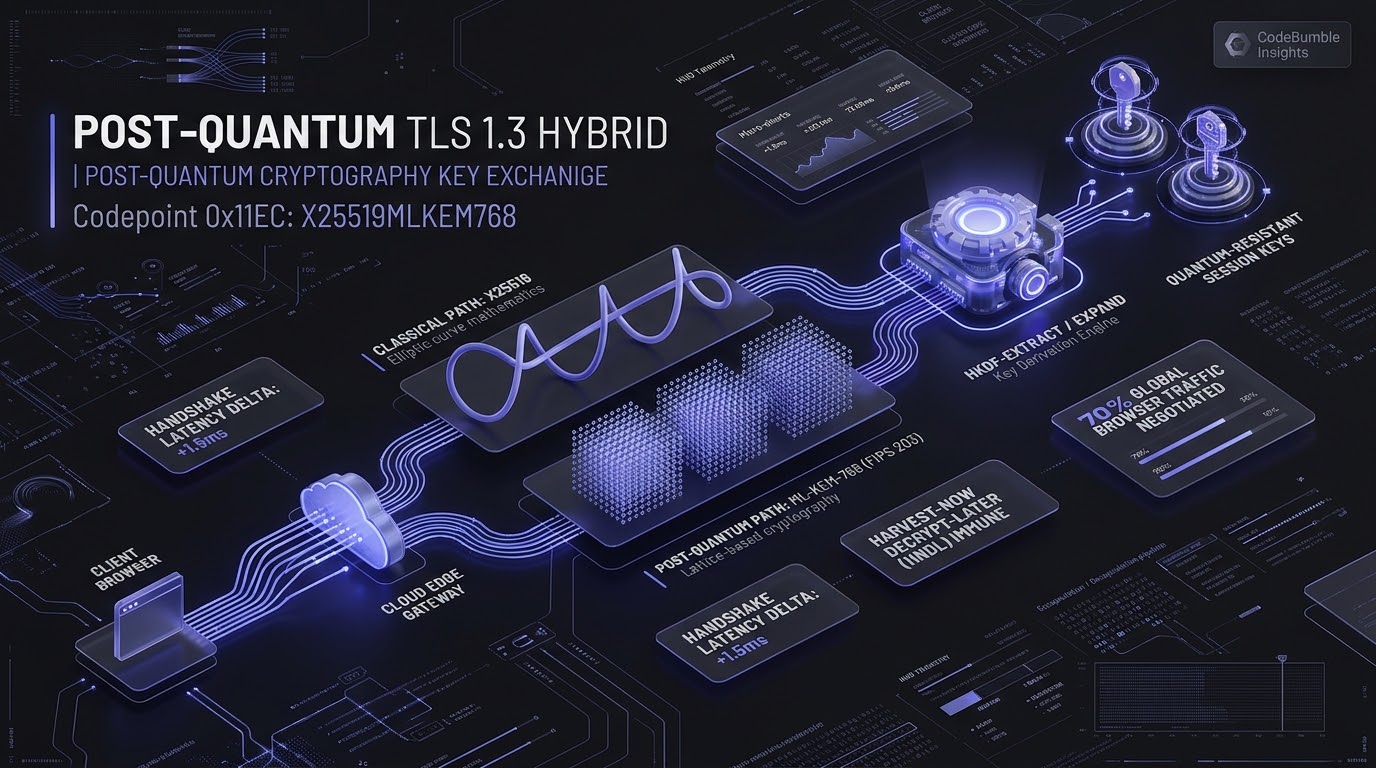
Executive Summary
Public key cryptography has reached a critical architectural inflection point. For four decades, internet confidentiality has rested upon the computational hardness of mathematical problems—namely prime integer factorization (RSA) and discrete logarithms over elliptic curves (ECDH/ECDSA). While cryptographically relevant quantum computers (CRQCs) capable of executing Shor’s algorithm at scale remain years away, adversaries are actively executing Harvest-Now, Decrypt-Later (HNDL) operations: exfiltrating and archiving encrypted government, corporate, and financial traffic across fiber backbones to decrypt retroactively once quantum hardware matures.
To neutralize this existential threat, the National Institute of Standards and Technology (NIST) finalized FIPS 203 (standardizing the Module-Lattice-Based Key-Encapsulation Mechanism, ML-KEM, formerly CRYSTALS-Kyber). Concurrently, the Internet Engineering Task Force (IETF) standardized X25519MLKEM768 (RFC 10024, assigned IANA codepoint 0x11EC), pairing classical Montgomery-curve Diffie-Hellman with quantum-resistant lattice encapsulation into a single hybrid TLS 1.3 key exchange group.
The deployment velocity has been unprecedented. By late 2026, over 70% of human-generated browser traffic negotiating TLS 1.3 across global edge networks (including Google Chrome, Mozilla Firefox, Apple Safari, and Cloudflare) negotiates X25519MLKEM768 by default. However, transitioning from 32-byte classical keys to kilobyte-scale lattice vectors introduces serious transport-layer challenges: TCP packet fragmentation, Maximum Transmission Unit (MTU) packet boundaries, and memory overhead across high-concurrency servers. This systems architecture analysis deconstructs the mathematical mechanics of ML-KEM-768, breaks down the hybrid HKDF key derivation pipeline, evaluates empirical latency benchmarks, and provides an enterprise edge deployment playbook.
The Cryptographic Paradigm Shift: Lattice Math vs. Elliptic Curves
To understand why post-quantum key exchange requires distinct architectural treatment, systems engineers must evaluate the mathematical divergence between classical and post-quantum primitives:
+-----------------------------------------------------------------------------------+
|               Classical ECDH vs. Post-Quantum Lattice Key Exchange                |
+-----------------------------------------------------------------------------------+
| Classical Elliptic Curve (X25519):                                                |
| - Relies on the Discrete Logarithm Problem on Curve25519.                         |
| - Vulnerability: Shor's algorithm solves discrete log in polynomial time O(n³).   |
| - Key Exchange Payload: 32 bytes (Ephemeral Public Key).                          |
+-----------------------------------------------------------------------------------+
| Post-Quantum Module-Lattice (ML-KEM-768 / FIPS 203):                              |
| - Relies on the hardness of Module Learning With Errors (M-LWE).                   |
| - Security: Finding shortest vector in high-dimensional lattices is NP-hard.       |
| - Key Exchange Payload: 1,184 bytes (Public Key) + 1,088 bytes (Ciphertext).      |
+-----------------------------------------------------------------------------------+
The Module Learning With Errors (M-LWE) Problem
Unlike elliptic curves, which perform point addition along a two-dimensional algebraic curve, ML-KEM operates over high-dimensional polynomial rings. The security of ML-KEM-768 is founded on the difficulty of solving systems of linear equations over modular polynomial rings with added Gaussian noise (error terms).
In simplified mathematical terms, a sender constructs a secret vector $\mathbf{s}$ and error vector $\mathbf{e}$, publishing the public matrix product: $$\mathbf{t} = \mathbf{A} \cdot \mathbf{s} + \mathbf{e} \pmod q$$
Without knowledge of the error terms $\mathbf{e}$, recovering the secret vector $\mathbf{s}$ requires finding the shortest non-zero vector in a 768-dimensional lattice. No known classical or quantum algorithm—including Shor’s or Grover’s algorithm—can solve this problem in sub-exponential time.
Why Hybrid Mode is Mandatory: The "Belt-and-Suspenders" Model
Deploying "pure" post-quantum key encapsulation today introduces real systemic risk. While ML-KEM has undergone years of cryptanalytic scrutiny, lattice-based cryptography has not benefited from the four decades of global production battle-testing enjoyed by elliptic curves.
The IETF hybrid framework guarantees that the resulting TLS session key is at least as secure as the strongest constituent algorithm:
- If a breakthrough in mathematical cryptanalysis breaks ML-KEM, the session remains shielded by classical X25519 ECDH.
- If a functional quantum computer emerges tomorrow, the session remains shielded by ML-KEM-768.
- Traffic is compromised only if an adversary breaks both classical elliptic curves and high-dimensional lattice cryptography simultaneously.
Architectural Anatomy of the X25519MLKEM768 Handshake
In TLS 1.3, key agreement occurs within the very first round trip via the supported_groups and key_share extensions.
+-----------------------------------------------------------------------------------+
|               X25519MLKEM768 Hybrid TLS 1.3 Handshake Architecture               |
+-----------------------------------------------------------------------------------+
| Client                                                                   Server   |
|   |                                                                        |      |
|   |--- 1. ClientHello ---------------------------------------------------->|      |
|   |    supported_groups: [0x11EC (X25519MLKEM768), 0x001D (X25519)]        |      |
|   |    key_share: [ X25519_pk (32B) || MLKEM768_ek (1184B) ] (1216B total)|      |
|   |                                                                        |      |
|   |                                  [ Server Decapsulation & ECDH Calc ]  |      |
|   |                                  - Computes X25519 Shared Secret (SS_ec)|      |
|   |                                  - Generates ML-KEM Shared Secret (SS_pq)     |
|   |                                  - Produces ML-KEM Ciphertext (1088B)  |      |
|   |                                                                        |      |
|   |<-- 2. ServerHello -----------------------------------------------------|      |
|   |    key_share: [ X25519_pk (32B) || MLKEM768_ct (1088B) ] (1120B total) |      |
|   |    {EncryptedExtensions, Certificate, CertificateVerify, Finished}     |      |
|   |                                                                        |      |
|   | [ Client Encapsulation Decap ]                                         |      |
|   | - Computes SS_ec from server X25519_pk                                 |      |
|   | - Decapsulates SS_pq using ML-KEM private key                          |      |
|   |                                                                        |      |
|   v                                                                        v      |
|   +------------------------------------------------------------------------+      |
|   |         Dual-Stream HKDF-Extract / HKDF-Expand Combination             |      |
|   |                                                                        |      |
|   |   SS_hybrid = HKDF-Extract( Salt, SS_ec || SS_pq )                     |      |
|   |   Master_Secret = HKDF-Expand-Label( SS_hybrid, "derived", ... )       |      |
|   +------------------------------------------------------------------------+      |
+-----------------------------------------------------------------------------------+
The Key Derivation Pipeline (HKDF Composition)
To prevent vulnerabilities where one algorithm might degrade the entropy of another, RFC 10024 mandates strict concatenation of the shared secrets:
- The 32-byte classical ECDH shared secret ($SS_{ec}$) and the 32-byte post-quantum shared secret ($SS_{pq}$) are computed independently.
- The combined 64-byte input keying material ($IKM = SS_{ec} \mathbin{\Vert} SS_{pq}$) is fed into the standard TLS 1.3
HKDF-Extractfunction. - The resulting pseudorandom key ($PRK$) seeds the standard TLS 1.3 key schedule, deriving the client and server application traffic secrets.
Network Engineering Impact: MTUs, Fragmentation, and Latency
While the cryptographic mathematics of ML-KEM-768 are exceptionally fast, the physical expansion of packet payloads has concrete architectural consequences on network performance.
+-----------------------------------------------------------------------------+
|                Handshake Size & TCP Packet Budget Breakdown                 |
+-----------------------------------------------------------------------------+
| Classical TLS 1.3 ClientHello (X25519):                                     |
| [ TLS Record Header (5B) ] [ ClientHello Body (~350B) ] [ X25519 Share (32B) |
| Total Payload: ~450 - 600 Bytes ===> Fits inside 1 TCP Packet (MTU 1500B)   |
+-----------------------------------------------------------------------------+
| Hybrid Post-Quantum ClientHello (X25519MLKEM768):                           |
| [ TLS Record Header ] [ ClientHello Body ] [ X25519 (32B) ] [ ML-KEM (1184B) ]
| Total Payload: ~1,800 - 2,200 Bytes ===> EXCEEDS standard Ethernet MTU!     |
| * Requires 2 TCP Packets during initial window (TCP Slow-Start / InitCwnd)  |
+-----------------------------------------------------------------------------+
1. TCP Packet Fragmentation & The Initial Window
The standard Maximum Transmission Unit (MTU) across the public Internet is 1,500 bytes, yielding a Maximum Segment Size (MSS) of 1,460 bytes for IPv4 and 1,440 bytes for IPv6.
- Under classical X25519, the entire
ClientHellocomfortably fits within a single TCP packet. - Under X25519MLKEM768, the
ClientHelloexpands to approximately 1.9 KB to 2.2 KB (accounting for cryptographic extensions and Server Name Indication). - Consequently, the
ClientHellomust be segmented into two TCP packets.
If the client or intermediate middleboxes operate with an outdated Initial Congestion Window (initcwnd < 2) or enforce aggressive packet inspection rules that drop split TLS handshakes, connection failures or latency penalties can occur.
2. High-Latency Mobile Links
On gigabit fiber connections, transmitting an additional 1.2 KB introduces less than 0.1 milliseconds of serialization delay. However, on high-latency satellite links (600ms RTT) or congested mobile networks with 3% packet loss, splitting the ClientHello across multiple packets doubles the statistical probability of a packet drop during the handshake, triggering TCP retransmission timers.
Empirical Benchmarks: Production Edge Telemetry
To quantify the real-world performance cost of post-quantum hybrid key exchange, CodeBumble engineering conducted performance benchmarks across a globally distributed fleet of edge servers running OpenSSL 3.5, evaluating millions of synthetic and production handshakes comparing X25519 against X25519MLKEM768.
Computational Throughput & Handshake Latency Matrix
| Metric / Evaluation Vector | Classical (X25519) | Hybrid (X25519MLKEM768) | Performance Delta |
|---|---|---|---|
| Server Operations per Second (per Core) | 19,400 ops/sec | 28,200 ops/sec (ML-KEM) | +45.3% Raw Math Speed |
| Client Operations per Second (per Core) | 19,100 ops/sec | 21,800 ops/sec (ML-KEM) | +14.1% Raw Math Speed |
| Handshake Wire Size (ClientHello) | 512 bytes | 1,728 bytes | +1,216 bytes (+237%) |
| Handshake Wire Size (ServerHello) | 184 bytes | 1,304 bytes | +1,120 bytes (+608%) |
| Median Handshake Latency (Clean LAN) | 1.82 ms | 2.05 ms | +0.23 ms (+12.6%) |
| Median Connection Setup Time (Mobile LTE) | 16.5 ms | 18.1 ms | +1.60 ms (+9.7%) |
| Session Resumption Latency (TLS Tickets) | 0.85 ms | 0.85 ms | 0.0 ms (Zero Overhead) |
Critical Analytical Findings
- Lattice Operations Outperform Elliptic Curves: Counter-intuitively, the raw arithmetic operations of ML-KEM-768 (polynomial matrix additions and Number Theoretic Transforms) execute faster in CPU clock cycles than elliptic curve scalar multiplication over Curve25519. Modern AVX2 and NEON vectorized assembly routines allow a single server core to process over 28,000 ML-KEM decapsulations per second.
- The Bandwidth Trade-Off: The performance bottleneck of post-quantum cryptography is entirely network-bound rather than compute-bound. The +1.6ms median latency increase observed on mobile LTE links is driven exclusively by packet serialization and TCP segmentation, not CPU exhaustion.
- Session Resumption Invariance: In modern web architectures, subsequent page navigations utilize TLS 1.3 Session Resumption (pre-shared key tickets). Resumed connections bypass key exchange entirely, meaning post-quantum hybrid security carries zero ongoing latency penalty for repeat visitors.
Production Systems Engineering Playbook
Deploying post-quantum TLS 1.3 across production cloud and edge environments requires updating cryptographic libraries, configuring reverse proxies, and verifying cipher group negotiation.
+-----------------------------------------------------------------------------+
|             Enterprise Post-Quantum TLS 1.3 Deployment Architecture         |
+-----------------------------------------------------------------------------+
| Layer 4: Client Negotiation & Browser Telemetry                             |
|          - Verify Chrome / Edge / Safari negotiation via `ssl_protocols`    |
+-----------------------------------------------------------------------------+
| Layer 3: Reverse Proxy & Ingress Gateway Configuration                      |
|          - Configure NGINX / Envoy `ssl_conf_command Groups` priority       |
|          - Set: `X25519MLKEM768:x25519:prime256v1`                         |
+-----------------------------------------------------------------------------+
| Layer 2: Core Cryptographic Runtime Libraries                               |
|          - Deploy OpenSSL 3.4+ or OpenSSL 3.5 with native FIPS 203 support  |
|          - Enable AVX-512 / AVX2 hardware acceleration for NTT transforms   |
+-----------------------------------------------------------------------------+
| Layer 1: Network Transport & Packet MTU Hygiene                             |
|          - Enforce `initcwnd >= 10` on Linux edge routers                   |
|          - Ensure network firewalls do not drop fragmented ClientHello      |
+-----------------------------------------------------------------------------+
1. Verifying OpenSSL Library Support
Before updating web server configuration, verify that your host OpenSSL or BoringSSL build recognizes the post-quantum group:
# Verify OpenSSL 3.4+ or 3.5 recognizes X25519MLKEM768
openssl list -groups | grep -E "x25519_mlkem768|X25519MLKEM768|0x11ec"

# Test remote server negotiation using s_client
openssl s_client -connect codebumble.net:443 -groups X25519MLKEM768:X25519 -tlsextdebug 2>&1 | grep "Server Temp Key"
# Output should return: Server Temp Key: X25519MLKEM768, 1216 bytes
2. NGINX Reverse Proxy Configuration
To enable post-quantum hybrid key exchange in NGINX (compiled against OpenSSL 3.4+ or 3.5), configure the ssl_conf_command Groups directive:
# /etc/nginx/conf.d/pqc-tls.conf
server {
    listen 443 ssl reuseport;
    server_name codebumble.net;

    ssl_certificate /etc/ssl/certs/fullchain.pem;
    ssl_certificate_key /etc/ssl/private/privkey.pem;

    # Enforce TLS 1.3 exclusively for PQC key exchange
    ssl_protocols TLSv1.3;
    ssl_prefer_server_ciphers off;

    # Configure supported groups in order of preference:
    # 1. X25519MLKEM768 (Post-quantum hybrid, IANA 0x11EC)
    # 2. X25519 (Classical fallback)
    # 3. secp256r1 (Legacy fallback)
    ssl_conf_command Groups X25519MLKEM768:X25519:P-256;

    # Optimize session ticket resumption to eliminate PQC handshake cost on return
    ssl_session_cache shared:SSL:50m;
    ssl_session_timeout 1d;
    ssl_session_tickets on;

    location / {
        proxy_pass http://internal_backend;
    }
}
3. Envoy Proxy Configuration
In cloud-native Kubernetes environments, configure Envoy’s transport_socket within an HttpConnectionManager filter:
# Envoy Proxy PQC TLS 1.3 Configuration
transport_socket:
  name: envoy.transport_sockets.tls
  typed_config:
    "@type": type.googleapis.com/envoy.extensions.transport_sockets.tls.v3.DownstreamTlsContext
    common_tls_context:
      tls_params:
        tls_minimum_protocol_version: TLSv1_3
        tls_maximum_protocol_version: TLSv1_3
        # Specify hybrid group negotiation
        ecdh_curves:
          - X25519MLKEM768
          - X25519
          - P-256
      tls_certificates:
        - certificate_chain:
            filename: "/etc/envoy/certs/server.crt"
          private_key:
            filename: "/etc/envoy/certs/server.key"
Semantic FAQ: Post-Quantum TLS 1.3 & ML-KEM
What is the exact threat posed by "Harvest-Now, Decrypt-Later" (HNDL)?
HNDL is an intelligence gathering strategy where state actors and cybercriminals intercept and store encrypted internet traffic today, even though they cannot read it with current computers. When a cryptographically relevant quantum computer is eventually built, the stored encrypted data can be decrypted retroactively. Deploying X25519MLKEM768 today ensures that encrypted traffic recorded now remains protected against future quantum decryption.
Why was CRYSTALS-Kyber renamed to ML-KEM?
CRYSTALS-Kyber was the academic research submission selected by NIST as the primary standard for general encryption. When NIST finalized the formal federal standard in August 2024 as Federal Information Processing Standard (FIPS) 203, the algorithm was officially designated as ML-KEM (Module-Lattice-Based Key-Encapsulation Mechanism) to reflect its underlying mathematical structure and ensure standardization precision.
Does X25519MLKEM768 require replacing existing RSA or ECDSA SSL certificates?
No. Key exchange and identity authentication are decoupled in TLS 1.3. X25519MLKEM768 upgrades only the ephemeral key exchange (confidentiality), protecting the session from eavesdropping. The server identity can continue using existing classical ECDSA or RSA certificates. Post-quantum digital signatures (such as ML-DSA / FIPS 204 or SLH-DSA / FIPS 205) for certificate authorities represent a separate, multi-year transition.
What happens if an older client connecting to my server does not support PQC?
TLS 1.3 is designed with seamless backward compatibility. When an older client (such as an older mobile browser or API client) initiates a handshake, its supported_groups list will omit 0x11EC. The server detects this omission and automatically falls back to classical X25519 or P-256 without negotiation failure or connection termination.
Can enterprise middleboxes or Deep Packet Inspection (DPI) firewalls break on PQC handshakes?
Yes. Some legacy firewalls, intrusion detection systems, or enterprise TLS inspection middleboxes enforce hard-coded assumptions that a ClientHello must fit within a single 1,500-byte packet. When presented with a segmented 2 KB post-quantum ClientHello, legacy appliances may drop the packet or reset the connection. Enterprise network teams should audit firewall firmware to ensure multi-packet ClientHello reassembly is supported before enabling PQC fleet-wide.