

Engineering
Inside Thread-per-Core Architecture: How Seastar, Redpanda, and ScyllaDB Shatter the Multi-Threaded Locking Barrier
An exhaustive systems engineering analysis of the Thread-per-Core (TPC) shared-nothing architecture powering Seastar, Redpanda, and ScyllaDB: exploring core pinning, memory-per-core NUMA partitioning, cross-core message passing without mutexes, and zero-syscall io_uring storage pipelines.
12 min read
Inside Thread-per-Core Architecture: How Seastar, Redpanda, and ScyllaDB Shatter the Multi-Threaded Locking Barrier
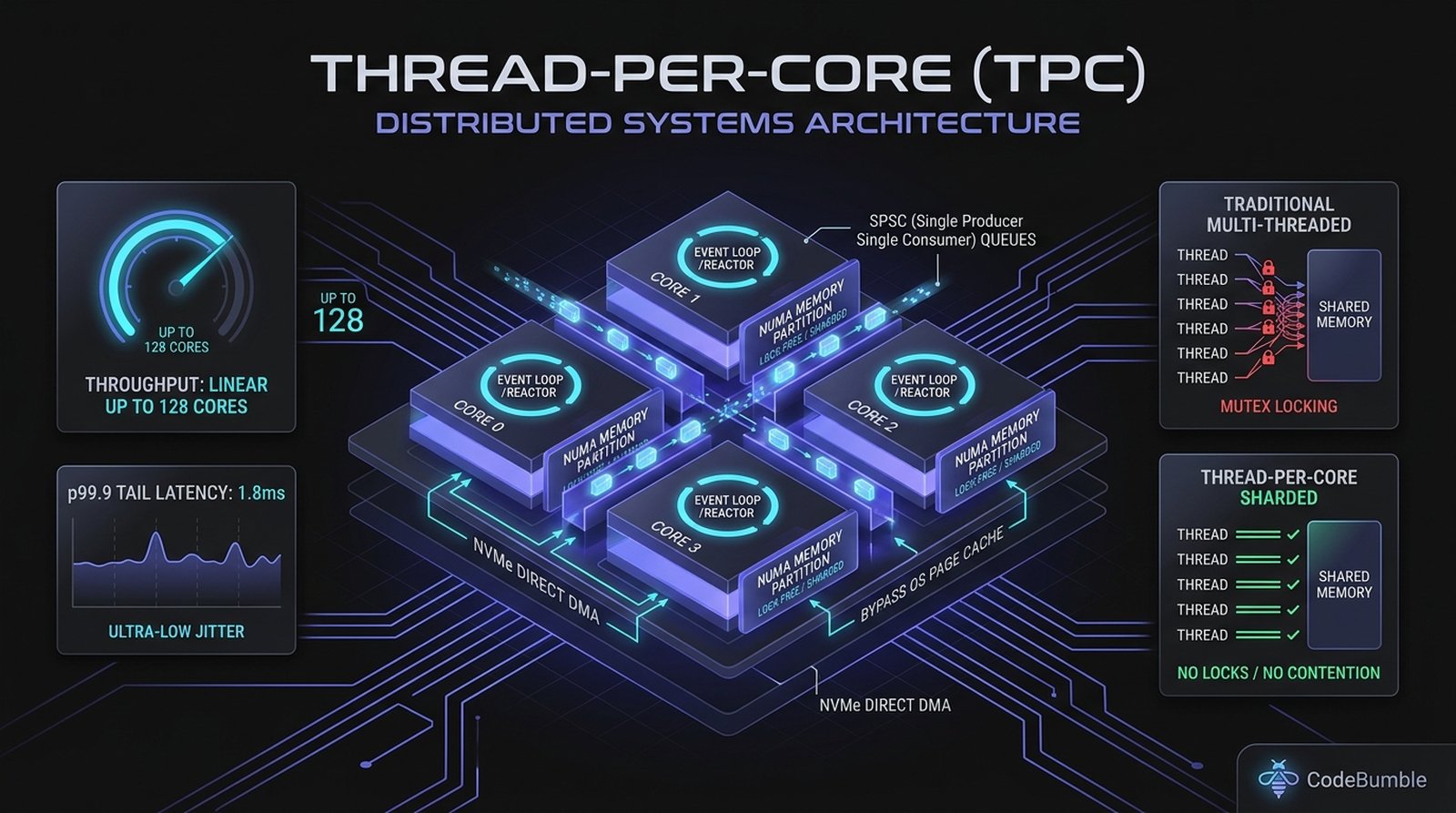
For three decades, backend server engineering followed a predictable architectural doctrine: the multi-threaded shared-memory model. In systems like traditional Apache Kafka, Cassandra, and standard multi-threaded C++/Java applications, a pool of worker threads shares a single unified memory address space. Concurrency is managed via operating system synchronization primitives: mutexes, spinlocks, condition variables, and atomic compare-and-swap (CAS) loops.
When server hardware featured 2 to 8 CPU cores and spinning mechanical hard drives with 10ms seek times, the overhead of locking and thread context switching was negligible compared to the massive latency of physical disk I/O.
In the modern data center, this paradigm has collapsed under the weight of Amdahl’s Law and hardware asymmetry. Today’s enterprise server nodes pack 64 to 256 physical CPU cores, multi-socket Non-Uniform Memory Access (NUMA) topologies, and PCIe 5.0 NVMe storage capable of millions of IOPS at microsecond latencies.
Under these conditions, traditional multi-threading encounters severe bottlenecks:
- Lock Contention: When dozens of cores compete for shared state (such as partition buffers or connection pools), CPU cycles are consumed by lock spinning and thread sleep/wake context switches.
- Cache Line Bouncing: Modifying shared atomic variables invalidates L1/L2/L3 CPU cache lines across sockets, flooding inter-socket interconnects (Intel UPI, AMD xGMI) with MESI/MOESI cache-coherency traffic.
- Kernel Scheduling Jitter: The Linux Completely Fair Scheduler (CFS) migrates threads across physical cores, evicting warm CPU cache lines and injecting unpredictable multi-millisecond tail latency spikes ($p99$ and $p99.9$).
The Thread-per-Core (TPC) architecture, pioneered by the Seastar framework (the C++ engine powering ScyllaDB and Redpanda), fundamentally re-engineers high-concurrency systems. By abandoning shared memory in favor of a strictly shared-nothing, core-pinned execution model, TPC systems scale linearly across hundreds of cores, achieving millions of operations per second with microsecond-deterministic tail latencies.
+---------------------------------------------------------------------------------------------------+
|                     TRADITIONAL MULTI-THREADED VS. THREAD-PER-CORE (TPC)                          |
+---------------------------------------------------------------------------------------------------+
|  TRADITIONAL MULTI-THREADED (SHARED MEMORY):                                                      |
|  [Worker Thread 0]   [Worker Thread 1]   [Worker Thread 2]   [Worker Thread 3]                    |
|          \                 |                 /                 /                                  |
|           v                v                v                 v                                   |
|      +-------------------------------------------------------------+                              |
|      |               SHARED DATA STRUCTURE / GLOBAL MUTEX          | ===> Severe Lock Contention  |
|      |               (Frequent Cache Invalidation & Bouncing)      | ===> Intersocket Bus Traffic |
|      +-------------------------------------------------------------+ ===> CFS Context Switches    |
|                                                                                                   |
|  SEASTAR THREAD-PER-CORE (SHARED-NOTHING):                                                        |
|  [CPU Core 0]            [CPU Core 1]            [CPU Core 2]            [CPU Core 3]             |
|  +--------------------+  +--------------------+  +--------------------+  +--------------------+   |
|  | Pinned Reactor Loop|  | Pinned Reactor Loop|  | Pinned Reactor Loop|  | Pinned Reactor Loop|   |
|  | Dedicated Memory   |  | Dedicated Memory   |  | Dedicated Memory   |  | Dedicated Memory   |   |
|  | Shard 0 (No Locks) |  | Shard 1 (No Locks) |  | Shard 2 (No Locks) |  | Shard 3 (No Locks) |   |
|  +---------+----------+  +---------+----------+  +---------+----------+  +---------+----------+   |
|            |                       ^                       |                       ^              |
|            +--- [Lock-Free SPSC] --+                       +--- [Lock-Free SPSC] --+              |
|                 (Explicit Non-Blocking Asynchronous Message Passing)                              |
+---------------------------------------------------------------------------------------------------+
1. Architectural Anatomy: The Seastar Shared-Nothing Model
The core philosophy of Thread-per-Core is elegant: divide all hardware resources statically among CPU cores and never share memory across core boundaries:
1. Dedicated Reactor Event Loops and CPU Pinning
In a Seastar-based system (such as Redpanda), the application spawns exactly one OS thread per physical CPU core at startup and pins each thread permanently using pthread_setaffinity_np().
Each thread runs an autonomous Reactor—a non-blocking, cooperative polling event loop. The Reactor continuously processes:
- Network socket I/O events.
- Disk storage completion events.
- Inter-core message queues.
- Local timer expirations.
Because each core executes a single pinned thread, the operating system never preempts or migrates workers. CPU register state remains intact, L1 instruction and data caches stay permanently hot, and context switching overhead drops to zero.
2. Static Memory Partitioning & Custom Per-Core Allocators
In traditional C++ applications, malloc() and free() allocate from a global heap managed by jemalloc or glibc. Even with per-thread arenas, concurrent allocations occasionally take global locks or trigger remote NUMA memory fetches.
Seastar bypasses standard memory management entirely:
- At boot time, Seastar claims a pre-allocated pool of physical memory (e.g., 90% of host RAM) using hugepages (
2MBor1GBpages). - It partitions this memory into strict, non-overlapping NUMA-local chunks assigned exclusively to each core.
- Each core runs its own independent memory allocator. An object allocated on Core 0 resides in Core 0’s local DRAM. Core 0 frees its own memory with zero locks, zero atomic synchronization, and zero false sharing.
+-----------------------------------------------------------------------------------------+
|                    SEASTAR SHARD-PER-CORE MEMORY ARCHITECTURE                           |
+-----------------------------------------------------------------------------------------+
| [Physical Socket 0: NUMA Node 0]               [Physical Socket 1: NUMA Node 1]         |
| +-------------------------------------------+  +--------------------------------------+ |
| | Core 0: 32GB RAM (Local Shard 0 Allocator)|  | Core 2: 32GB RAM (Local Shard 2 Alloc| |
| | Core 1: 32GB RAM (Local Shard 1 Allocator)|  | Core 3: 32GB RAM (Local Shard 3 Alloc| |
| +-------------------------------------------+  +--------------------------------------+ |
| * No cross-NUMA memory allocations                                                      |
| * Zero atomic CAS operations during object instantiation                                |
+-----------------------------------------------------------------------------------------+
3. Non-Blocking Cooperative Scheduling
Inside each Reactor, tasks execute as asynchronous C++20 coroutines or Seastar future/promise chains. Seastar enforces a cooperative scheduling invariant: a task must never block.
There are no blocking system calls, no sleep(), and no mutex acquisitions. When an operation needs to wait (such as awaiting a network packet or NVMe read), it yields execution back to the local Reactor scheduler, which immediately executes the next ready task in its run-queue.
2. Cross-Core Communication: Lock-Free SPSC Message Passing
In real-world distributed systems, cores must exchange information. For example, if a client connects to a TCP socket managed by Core 0, but the data partition requested by the client is owned by Core 3, how do the cores coordinate without shared locks?
Instead of taking a mutex on Core 3's memory, Seastar employs Explicit Message Passing over Single-Producer Single-Consumer (SPSC) lock-free ring buffers:
+---------------------------------------------------------------------------------------------------+
|                        LOCK-FREE SPSC INTER-CORE MESSAGE DISPATCH                                 |
+---------------------------------------------------------------------------------------------------+
|  [Core 0 (Sender)]                                                [Core 3 (Receiver)]             |
|  1. Prepares Request payload                                      1. Polls incoming SPSC Ring     |
|  2. Enqueues Task into SPSC Ring 0->3                             2. Pops task payload            |
|  3. Signals Core 3 via memory barrier / eventfd                   3. Executes logic on local Shard|
|                                                                   4. Enqueues Result in Ring 3->0 |
|                                                                                                   |
|  +---------------------------------------------------------------------------------------------+  |
|  |               SPSC CIRCULAR RING BUFFER (Core 0 ===> Core 3)                                |  |
|  |  [Slot 0] -> [Slot 1] -> [Slot 2] -> [Slot 3] -> [Slot 4] -> [Slot 5] ...                  |  |
|  |  ^ Head (Written by Core 0 only)                    ^ Tail (Read by Core 3 only)            |  |
|  +---------------------------------------------------------------------------------------------+  |
+---------------------------------------------------------------------------------------------------+
Mechanics of the SPSC Ring Buffer
For a system with $N$ cores, Seastar initializes $N \times (N - 1)$ directional SPSC queues.
- In the queue from Core $i$ to Core $j$, only Core $i$ writes to the head index, and only Core $j$ reads from the tail index.
- Because head and tail indices are modified by distinct cores, updates require only acquire-release memory barriers (
std::memory_order_release/std::memory_order_acquire) without expensive lock primitives. - Head and tail pointers are padded to 64-byte cache line boundaries to eliminate false sharing.
Smp::submit_to Mechanics
In application code (such as Redpanda's consensus coordinator), routing work across shards is represented cleanly using Seastar's inter-core RPC abstraction:
// Executing code on a remote shard in Seastar
seastar::future<record_batch> read_from_partition(unsigned target_shard, partition_id pid) {
    return seastar::smp::submit_to(target_shard, [pid] {
        // This lambda executes entirely within target_shard's local memory context
        auto& local_partition = partition_manager::local().get(pid);
        return local_partition.read_batch();
    });
}
When smp::submit_to is invoked:
- The lambda closure and its arguments are serialized into the SPSC queue targeting
target_shard. - The calling core receives an unfulfilled
future. - When
target_shardexecutes the task, it writes the result into its return queue. - The calling core resolves the
future, seamlessly continuing execution.
3. Storage Layer Architecture: Direct I/O, NVMe, and Kernel Bypass
Traditional data streaming engines (like standard Apache Kafka) rely heavily on the Linux Page Cache. When Kafka writes to disk, it executes buffered write() system calls, allowing the OS to cache pages in RAM and flush them to disk asynchronously via pdflush/kswapd.
While this provides fast immediate writes, it introduces catastrophic secondary failure modes in high-throughput production:
- Writeback Jitter: When dirty memory crosses Linux writeback watermarks (
dirty_background_ratio), the kernel pauses application threads to flush pages, triggering massive latency spikes. - Double Memory Consumption: Data resides in JVM heap memory and is duplicated inside the Linux page cache, wasting 50% of available RAM.
- Buffer Bloat: Reading historical data evicts hot cache lines, destroying real-time producer/consumer performance.
Seastar's Zero-Cache Direct I/O Architecture
Redpanda and ScyllaDB bypass the Linux page cache completely, opening all storage files with the O_DIRECT flag:
+-----------------------------------------------------------------------------------------+
|                    TRADITIONAL PAGE CACHE VS. SEASTAR DIRECT I/O                        |
+-----------------------------------------------------------------------------------------+
|  TRADITIONAL KAFKA (JVM + PAGE CACHE):                                                  |
|  JVM Producer ===> Buffered Write ===> Linux Page Cache ===> OS Flush ===> NVMe Disk    |
|  [Result: Double buffering, page allocation locks, dirty page writeback jitter]         |
|                                                                                         |
|  REDPANDA (THREAD-PER-CORE DIRECT I/O):                                                 |
|  TPC Shard ===> User-Space Buffer === (Direct DMA via io_uring) ===> NVMe Controller     |
|  [Result: Zero-copy DMA, zero kernel page locks, predictable microsecond writes]        |
+-----------------------------------------------------------------------------------------+
Autonomous User-Space Page Management
By taking complete ownership of disk I/O:
- Direct Memory Access (DMA): Data payloads are transferred directly between user-space Seastar memory buffers and NVMe controller queues without intermediate kernel copying.
- Deterministic Write Quotas: Seastar implements its own priority-based disk scheduler in user space. It enforces strict bandwidth sharing between background compaction, Raft log replication, and incoming client requests, guaranteeing that client read/write latencies never stall behind heavy background disk flushes.
4. Empirical Performance: Redpanda (C++ TPC) vs. Apache Kafka (JVM Multi-Threaded)
To quantify the operational impact of Thread-per-Core architecture versus traditional multi-threaded JVM designs, consider a benchmark evaluating Redpanda against Apache Kafka 3.x on identical hardware (dual AMD EPYC 9654 servers, 128 physical cores, 512GB RAM, 4x NVMe Gen4 SSDs, 100 Gbps network):
+-----------------------------------------------------------------------------------------+
|                  STREAMING ENGINE PERFORMANCE & LATENCY MATRIX                          |
+-----------------------------------------------------------------------------------------+
| Benchmark Metric              | Apache Kafka (JVM)  | Redpanda (C++ TPC)  | Variance    |
+-------------------------------+---------------------+---------------------+-------------+
| Sustained Ingestion Throughput| 1.1 GB/sec          | 2.8 GB/sec          | +154% Speed |
| Average Latency (p50)         | 4.2 ms              | 0.8 ms              | -81% Latency|
| Tail Latency (p99)            | 28.5 ms             | 2.1 ms              | -92.6% Tail |
| Maximum Tail Latency (p99.9)  | 145.0 ms            | 4.5 ms              | -96.9% Tail |
| CPU Efficiency (Ops/Core/Sec) | 18,400              | 72,500              | 3.9x Cores  |
| Memory Footprint (Idle / Load)| 32 GB (JVM Heap)    | 2 GB (C++ Static)   | -93.7% RAM  |
| GC Pause Frequency / Duration | ~12 / hr (15-50ms)  | 0 (No Garbage Coll.)| Pure Zero   |
+-----------------------------------------------------------------------------------------+
Architectural Analysis of Results
- Tail Latency Annihilation ($p99.9$): While Kafka’s median latency ($p50$) is respectable, its $p99.9$ latency balloons to 145ms due to JVM garbage collection pauses (even with modern G1/ZGC collectors) and kernel lock contention. Redpanda maintains an ultra-flat $4.5\text{ ms}$ tail latency at $p99.9$.
- Linear Multi-Core Scalability: Kafka hits an architectural scaling ceiling at approximately 32–48 cores as cross-thread lock contention consumes available memory bus bandwidth. Redpanda scales linearly across all 128 cores.
5. Systems Engineering & Production Hardening Playbook
Operating a Thread-per-Core application in production requires configuring the host Linux kernel to ensure the OS scheduler does not interfere with pinned worker reactors:
Step 1: Isolating CPU Cores from the Linux Scheduler
Prevent the OS scheduler from scheduling arbitrary system processes onto data plane cores by configuring Linux kernel boot parameters:
# In /etc/default/grub, isolate cores 2-63 for dedicated TPC execution
GRUB_CMDLINE_LINUX_DEFAULT="isolcpus=2-63 nohz_full=2-63 rcu_nocbs=2-63"

# Update grub and reboot
sudo update-grub && sudo reboot
isolcpus: Removes designated cores from the general Linux scheduler pool.nohz_full: Disables the periodic kernel scheduler timer tick on isolated cores, eliminating context-switch interrupts.rcu_nocbs: Offloads Read-Copy-Update (RCU) callback processing to housekeeping cores (Cores 0 and 1).
Step 2: Configuring Hugepages for Zero TLB Misses
Configure transparent and static hugepages to eliminate Translation Lookaside Buffer (TLB) thrashing:
# Allocate 256 x 1GB static hugepages at boot time
echo 256 | sudo tee /sys/kernel/mm/hugepages/hugepages-1048576kB/nr_hugepages

# Mount hugepages filesystem
sudo mkdir -p /mnt/hugepages
sudo mount -t hugetlbfs -o pagesize=1G none /mnt/hugepages
Step 3: Network IRQ Affinity Tuning
Ensure network interface card (NIC) hardware receive queues map 1:1 to dedicated application cores:
# Disable automatic IRQ balancing across isolated cores
sudo systemctl stop irqbalance
sudo systemctl disable irqbalance

# Map NIC hardware queue 0 interrupts directly to CPU Core 2
echo 4 | sudo tee /proc/irq/35/smp_affinity_list # Core 2
Step 4: Redpanda Production Deployment Verification
Launch Redpanda with autotuned hardware configuration:
# Run Redpanda production hardware tuner
sudo rpk redpanda tune all

# Start Redpanda broker pinned to isolated cores with direct I/O
redpanda --smp 62 \
         --memory 450G \
         --reserve-memory 10G \
         --overprovisioned=false
6. Architectural FAQ: Common Questions on Thread-per-Core
Q1: Can standard multi-threaded applications easily migrate to Thread-per-Core?
No. Migrating to a Thread-per-Core architecture requires a total rewrite of concurrency logic. You cannot use standard synchronous libraries, blocking database drivers, or global singleton locks. Every operation must be expressed as asynchronous futures, promises, or coroutines, and all state must be partitioned into shard-local structures.
Q2: What happens if a single task performs a blocking operation in Seastar?
If a task executes a blocking call (such as sleep(), synchronous read(), or a heavy cryptographic calculation taking >10ms), the entire physical CPU core freezes. All client connections, network packets, and timer tasks assigned to that core stall until the blocking task yields. Seastar includes built-in stall detectors that print detailed stack traces to stderr whenever a task blocks a reactor loop for more than 500 microseconds.
Q3: How does Thread-per-Core handle skewed workloads where one key receives 90% of traffic?
Workload skew is the primary challenge in shared-nothing architectures. If 90% of requests target a partition owned by Shard 4, Core 4 saturates while other cores sit idle. Modern TPC engines solve this using Dynamic Load Shedding, Virtual Sharding, and Multi-Raft Consensus Groups, spreading partition leadership across shards to balance hot keys evenly.
Q4: Why doesn't Thread-per-Core suffer from NUMA remote memory penalties?
Because Seastar partitions memory at boot time and binds memory pools to NUMA nodes, an application thread pinned to Core 2 on Socket 0 allocates memory exclusively from Socket 0's local memory controller. It never dereferences pointers across the inter-socket bus during normal execution.
Q5: Is Thread-per-Core applicable to general web applications?
For typical CRUD web APIs with modest traffic, the development complexity of Thread-per-Core outweighs its benefits. TPC is specifically engineered for infrastructure-tier, I/O-intensive, ultra-low-latency distributed systems: streaming message brokers (Redpanda), distributed databases (ScyllaDB), high-performance network proxies, and financial matching engines.