

Engineering
Top 10 Kaggle Alternatives for Datasets and Competitions
Kaggle is not the only place to find data, compete, or share models. Here are ten alternatives, grouped by what you actually need.
9 min read
Top 10 Kaggle Alternatives for Datasets and Competitions
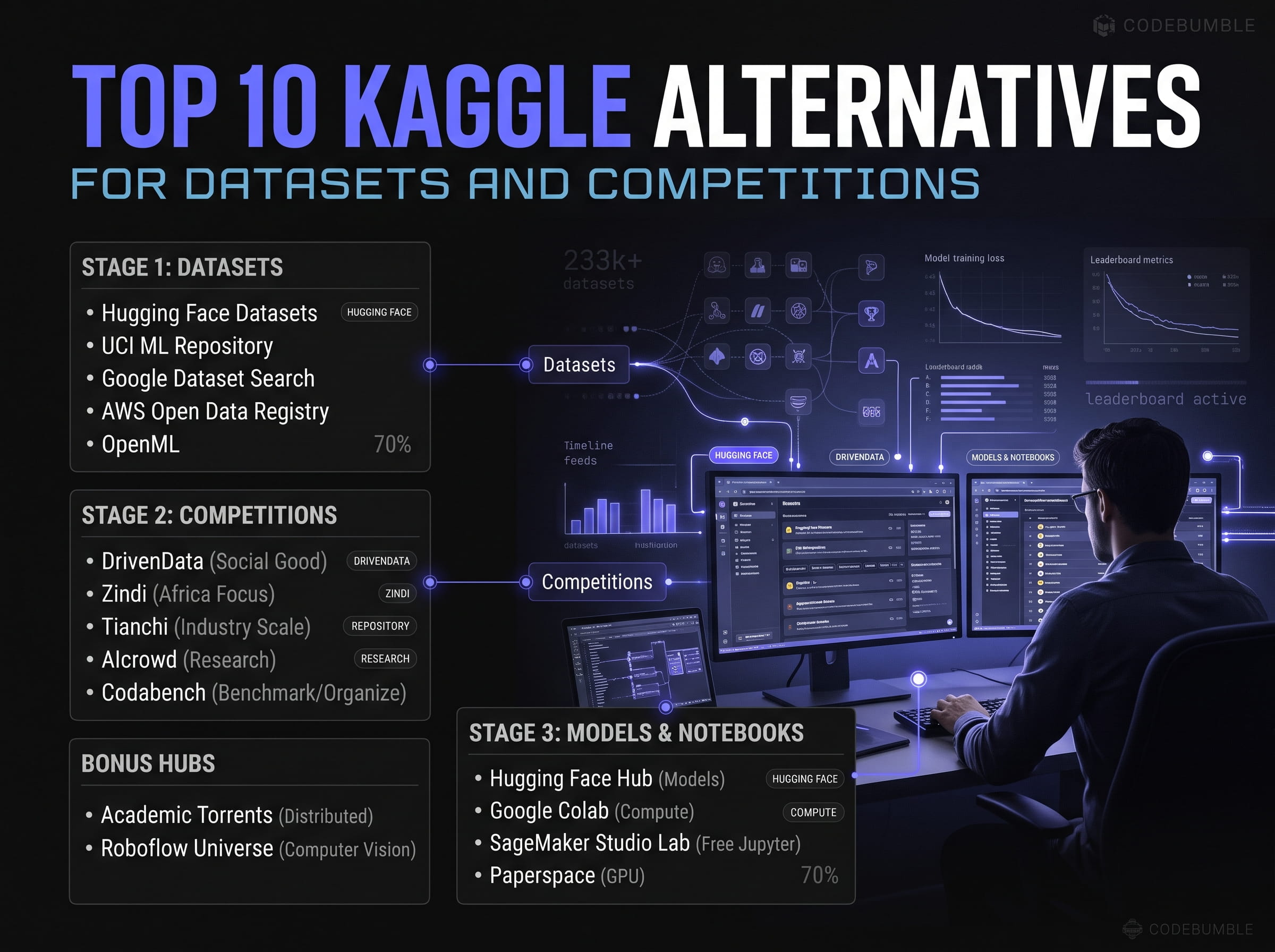
A data scientist named Rafi had a plan for the weekend. He would open Kaggle, find a dataset, enter a competition, and climb a leaderboard.
By Saturday afternoon, three things had gone wrong. The dataset he wanted didn't exist there. The competition he liked had already closed. And the GPU quota for the week was almost gone.
Rafi did not give up on machine learning. He did what many practitioners eventually do and looked beyond one platform. He found that Kaggle is a bundle of several jobs: a place to find data, a place to compete, and a place to run notebooks. Each of those jobs has strong alternatives.
This guide follows his search in three stages. It starts with datasets, moves to competitions, and ends with models and notebooks.
Why look beyond Kaggle at all?
Kaggle brings competitions, datasets, notebooks and learning material into one place, and that convenience is real. But one platform rarely fits every need.
- Some data lives only in academic archives or government portals.
- Some competitions focus on a region or a cause, such as public health or African problems.
- Some research needs reproducible benchmarks instead of prize leaderboards.
- Some teams want to publish models for reuse, which is a different job from winning a contest.
Splitting the problem into stages makes the choice much easier.
Stage 1: In terms of datasets
Rafi's first problem was data. These five sources cover most of what he needed.
1. Hugging Face Datasets
The Hugging Face Hub is the largest general-purpose alternative for ML-ready data. It hosts hundreds of thousands of public datasets across NLP, vision, audio, time series and many languages. It also lets you load a dataset with a few lines of code. It is the best first stop for modern deep learning work.
2. UCI Machine Learning Repository
This is one of the oldest and most trusted dataset collections. The datasets are small and clean, and they are heavily cited in papers. They suit teaching, baselines and quick experiments, though they are rarely large enough for modern deep learning.
3. Google Dataset Search
This is a search engine and not a host. It finds datasets published across the web, from universities, agencies and research groups. It works well when you know the topic but not the source.
4. AWS Open Data Registry
This registry lists public datasets that live on AWS infrastructure. It suits large datasets, such as satellite imagery or genomics, that you would rather process in the cloud than download.
5. OpenML
OpenML is an open-source platform for sharing datasets, analyses and machine learning experiments. Its focus is on collaboration and research. Experiments are tied to datasets and tasks, so results can be compared fairly.
A useful honourable mention is Data.gov, the US government's open data portal. It is a strong source for public-sector data.
Stage 2: In terms of competitions
With data sorted, Rafi wanted a challenge. The next five platforms host competitions, each with a different personality.
6. DrivenData
DrivenData runs competitions for social good. The problems come from areas such as public health, education, conservation and international development. If you want your model to matter beyond a leaderboard score, this is a good fit.
7. Zindi
Zindi is a data science platform focused on Africa. Its competitions tackle local problems in areas like agriculture, healthcare and finance. One point worth knowing: it has historically not provided cloud-hosted notebooks, so participants bring their own compute. Check the current setup before you plan around it.
8. Tianchi
Tianchi is run by Alibaba Cloud, and its competitions often use large industrial datasets and large prize pools. It has a strong China-based ecosystem. Expect real business problems at scale.
9. AIcrowd
AIcrowd hosts research-oriented challenges and benchmarks. Many of its tasks come from academic communities, so it suits people who want to test methods against a fixed problem.
10. Codabench
Codabench is an open-source platform for reproducible AI competitions and benchmarks. Organizers can submit tasks, datasets and evaluation metrics, and the platform ranks participants on leaderboards automatically. It is the right choice if you want to run a competition yourself.
Honourable mentions include Numerai, for financial prediction tournaments, and Solafune, for satellite and geospatial data. MachineHack is another option for hackathon-style challenges.
Bonus alternatives
Two more sources earned a place on Rafi's list. Each solves a problem the main ten don't: moving huge files, and finding labeled images.
Bonus 1: Academic Torrents
Academic Torrents is a community-maintained, distributed repository for research datasets. It shares data over the BitTorrent protocol, so downloads come from many peers at once and not from a single server.
That design suits very large files. Researchers can share a dataset at high speed without paying for the bandwidth themselves. Everyone who downloads a dataset can also act as a mirror, so the data stays available even if one host goes offline.
The catalog is large. The site says it makes over 400 TB of research data available, and it also hosts curated collections. Some well-known projects use it too. The Zenseact Open Dataset, for example, offers Academic Torrents as one of its download routes.
Best for: very large research datasets, long-term availability, and reproducible science.
Keep in mind: you need a torrent client such as Transmission or aria2c. Also check each dataset's license and source page before using it in your own work.
Bonus 2: Roboflow Universe
Roboflow Universe is a hub for computer vision datasets and pre-trained models. It focuses on tasks like object detection, instance segmentation, classification and keypoint detection.
Its scale is the main draw. The homepage describes it as the world's largest collection of open source computer vision datasets, with over a billion images, over a million datasets and over 250,000 fine-tuned models. You can browse by task or by industry, and you can search for pre-trained YOLO and RF-DETR models.
Many projects are small and practical, such as worker-safety helmet detection or license-plate detection. Those are the kind of narrow, labeled datasets that are hard to find on general platforms.
Best for: image-based projects that need labeled data, fast prototyping, and starting from a pre-trained detector.
Keep in mind: quality varies a lot, because users upload the projects. Inspect the labels and the image count before you train on anything.
| Bonus | Strength | Best use |
|---|---|---|
| Academic Torrents | Distributed hosting of huge files | Large research datasets |
| Roboflow Universe | Labeled images and vision models | Computer vision projects |
Stage 3: In terms of models and notebooks
Competitions end, but good models keep being useful. This stage covers where to publish and run your work.
- Hugging Face Hub (models): The standard place to publish pretrained models, with model cards, versioning and demo apps. It does what Kaggle Models does, with a much larger community around it.
- Google Colab: The closest notebook experience to Kaggle, with a browser-based workflow and very little setup.
- Amazon SageMaker Studio Lab: A free hosted JupyterLab-style environment that integrates with GitHub.
- Paperspace: Offers persistent GPU notebooks and longer-running experiments, though free access has varied over time.
Rafi's rule of thumb was simple: use the Hub to publish, use a notebook service to experiment, and use a competition platform to be tested.
Quick comparison
| Need | Best starting point |
|---|---|
| ML-ready datasets | Hugging Face Datasets |
| Small, clean teaching data | UCI Repository |
| Finding data across the web | Google Dataset Search |
| Very large cloud-hosted data | AWS Open Data Registry |
| Social-good competitions | DrivenData |
| Competitions focused on Africa | Zindi |
| Large industry challenges | Tianchi |
| Research benchmarks | AIcrowd |
| Hosting your own competition | Codabench |
| Publishing models | Hugging Face Hub |
How Rafi's weekend ended
By Sunday evening, Rafi had pulled a dataset from the Hugging Face Hub and a second one from OpenML. He had joined a DrivenData challenge and run his experiments in a free notebook environment. When his model improved, he published it to the Hub with a short model card.
He still opens Kaggle sometimes. But it is one tool among several now, and he picks each one for what it does best.
FAQ
Is Kaggle still worth using?
Yes. It remains a useful place to learn, compete and share notebooks. The point is to treat it as one option and not the only one.
Which alternative is best for beginners?
Start with the UCI Repository for small clean datasets and Google Colab for notebooks. Then try a DrivenData beginner competition.
Where can I run my own competition?
Codabench is open source and built for organizing reproducible competitions and benchmarks.
Are these platforms free?
Most have free tiers, but compute, prizes and policies change. Check each platform's current terms before relying on it.
Which platform is best for publishing a model?
The Hugging Face Hub is the usual choice, because it supports model cards, versioning and demos.
Is Kaggle free?
Yes, Kaggle is free to use. Its free tier covers datasets, notebooks and competitions, but compute quotas are limited.
Why would someone leave Kaggle?
There are a few common reasons:
- The data they need is not hosted there.
- They want competitions with a regional or social focus.
- They need more compute than the weekly quota allows.
- They want reproducible benchmarks instead of prize contests.
Which alternative has the most datasets?
Hugging Face Datasets is the largest general-purpose option, with hundreds of thousands of public datasets. Roboflow Universe is the biggest for images, and Academic Torrents is the biggest by raw data volume.
Can I use these datasets commercially?
Not always. Every dataset has its own license, and some allow research use only. Read the license on the dataset page before you use the data in a product.
What is the difference between a dataset hub and a competition platform?
A dataset hub stores and shares data. A competition platform sets a problem, scores submissions and ranks participants on a leaderboard. Some platforms, such as Kaggle, do both.
Do I need a torrent client for Academic Torrents?
Yes. Downloads use the BitTorrent protocol, so you need a client such as Transmission, qBittorrent or aria2c.
Is Academic Torrents legal and safe?
The site is built for sharing research data, and it is listed in the re3data registry of research repositories. As with any download, check the source and license, and verify file checksums where they are given.
Is Roboflow Universe free?
Universe is built around free, open source datasets and models. Roboflow's other tools may have paid plans, so check its current pricing.
Which platform is best for a beginner?
Start with the UCI Repository for small, clean data and Google Colab for notebooks. Then try a beginner-friendly challenge on DrivenData.
Which platform is best for computer vision?
Roboflow Universe is the first stop. It has labeled images and pre-trained detection and segmentation models.
Where can I host my own competition?
Codabench is open source and designed for reproducible competitions and benchmarks.
Where should I publish a trained model?
The Hugging Face Hub is the usual choice. It supports model cards, versioning and demo apps.
Can I get a job by competing on these platforms?
Competition results can strengthen a portfolio, but employers care most about clear write-ups and working projects. Document your approach and publish your code alongside the score.
How do I pick the right platform quickly?
Match the platform to your goal:
- Learning: UCI Repository and Google Colab.
- Impact: DrivenData and Zindi.
- Research: AIcrowd, Codabench and OpenML.
- Vision: Roboflow Universe.
- Huge files: Academic Torrents.
#Kaggle #KaggleAlternatives #DataScience #MachineLearning #Datasets #AI #DeepLearning #HuggingFace #Roboflow #AcademicTorrents #OpenData #ComputerVision #DataScienceCompetitions #MLOps #OpenSource #TechBlog