

Technology
Inside V8 Engine Architecture: Ignition Bytecode, Maglev Mid-Tier JIT, and TurboFan Sea-of-Nodes
An exhaustive systems engineering analysis of Google V8's four-tier execution pipeline: tracing JavaScript execution from streaming parsing and Ignition bytecode through Sparkplug baseline compilation, Maglev SSA optimization, and TurboFan Sea-of-Nodes machine code generation.
13 min read
Inside V8 Engine Architecture: Ignition Bytecode, Maglev Mid-Tier JIT, and TurboFan Sea-of-Nodes
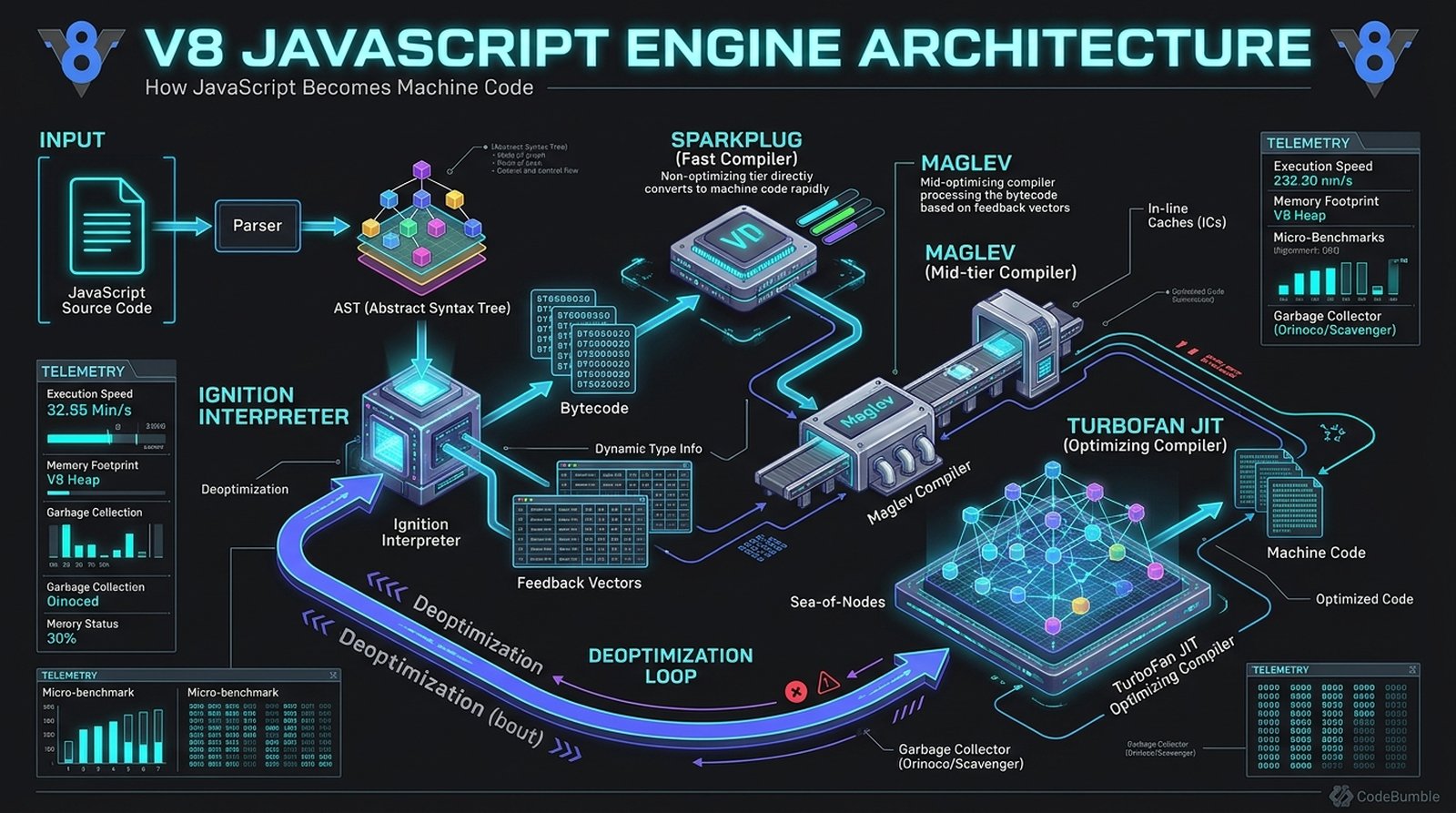
JavaScript was originally conceived in 1995 as an interpreted scripting language for lightweight browser interactions. Today, it executes complex single-page applications, distributed cloud runtimes (Node.js, Deno, Bun), and high-frequency backend services. Powering this staggering performance evolution is V8, Google's open-source, high-performance WebAssembly and JavaScript engine written in C++.
At the center of V8's design is a fundamental engineering tension: startup latency versus peak execution throughput. An engine that immediately compiles JavaScript directly to highly optimized machine code incurs prohibitive compilation latency, stalling page load times and user interactions. Conversely, an engine that relies exclusively on an interpreter suffers from sluggish execution speeds on computationally intensive, long-running loops.
To resolve this trade-off, modern V8 employs a sophisticated four-tier compilation pipeline. Rather than committing to a single execution strategy, V8 routes functions dynamically through escalating optimization tiers as they warm up:
- Ignition: A fast register-based bytecode interpreter that starts executing code almost instantly while profiling type feedback.
- Sparkplug: A non-optimizing baseline compiler that compiles Ignition bytecode into native assembly in a single linear pass with near-zero compilation overhead.
- Maglev: A fast optimizing mid-tier Just-In-Time (JIT) compiler that leverages Static Single Assignment (SSA) representations to deliver 80% of peak performance at 10x the compilation speed of TurboFan.
- TurboFan: An optimizing compiler utilizing a Sea-of-Nodes Intermediate Representation (IR) to emit hand-tuned, hardware-specific machine code.
+---------------------------------------------------------------------------------------------------+
|                        THE V8 FOUR-TIER COMPILATION AND PROFILING PIPELINE                        |
+---------------------------------------------------------------------------------------------------+
|  [JavaScript Source Code] ===> [Streaming Parser] ===> [Abstract Syntax Tree (AST)]               |
|                                                              |                                    |
|                                                              v                                    |
|  +---------------------------------------------------------------------------------------------+  |
|  | TIER 1: IGNITION INTERPRETER (Register-Based Bytecode Generation & Execution)              |  |
|  | - Immediate execution start (zero compile delay)                                            |  |
|  | - Emits Feedback Vectors tracking runtime shapes (Hidden Classes / Shapes)                 |  |
|  +---------------------------------------------------------------------------------------------+  |
|                   |                                                          ^                    |
|                   v (Function invoked > ~3 times)                            |                    |
|  +-------------------------------------------------------------+             |                    |
|  | TIER 2: SPARKPLUG BASELINE COMPILER (Linear Bytecode-to-ASM) |             |                    |
|  | - 1:1 translation from bytecode to unoptimized machine code  |             |                    |
|  | - Preserves stack frame layout without type speculation     |             |                    |
|  +-------------------------------------------------------------+             |                    |
|                   |                                                          | (Deoptimization    |
|                   v (Function becomes hot: ~100-500 invocations)             |  Bailout Path)     |
|  +-------------------------------------------------------------+             |                    |
|  | TIER 3: MAGLEV MID-TIER JIT (SSA Graph & Fast Optimization)  |             |                    |
|  | - Basic block SSA graph construction                        |             |                    |
|  | - Speculative type feedback inlining                        |-------------+                    |
|  | - Generates machine code 10x faster than TurboFan           |             |                    |
|  +-------------------------------------------------------------+             |                    |
|                   |                                                          |                    |
|                   v (Function reaches maximum peak execution)                |                    |
|  +-------------------------------------------------------------+             |                    |
|  | TIER 4: TURBOFAN OPTIMIZER (Sea-of-Nodes Graph Reduction)   |             |                    |
|  | - Combined control-flow and data-flow graph reduction       |             |                    |
|  | - Loop unrolling, escape analysis, aggressive inlining      |-------------+                    |
|  | - Emits peak SIMD/AVX vector machine code                   |                                  |
|  +-------------------------------------------------------------+                                  |
+---------------------------------------------------------------------------------------------------+
1. Front-End Parsing and Ignition: The Register-Based Bytecode Interpreter
Execution begins before a single machine instruction is generated. V8's front-end consists of a streaming scanner and parser that process UTF-8 or UTF-16 source streams into an Abstract Syntax Tree (AST):
Streaming Parsing and AST Construction
Modern web applications frequently deliver multi-megabyte JavaScript bundles. To prevent main-thread UI hitching, V8 executes Streaming Parsing on background worker threads while scripts download over the network.
V8 distinguishes between two parsing modes:
- Pre-parsing (Lazy Parsing): Skips inner function bodies that are not immediately invoked, verifying only syntax correctness without allocating memory for AST nodes.
- Full Parsing (Eager Parsing): Generates complete AST representations for top-level code and immediately invoked function expressions (IIFEs).
Ignition Architecture: The Bytecode Register Machine
The AST is handed directly to Ignition, V8's bytecode interpreter. Unlike JVM or WebAssembly stacks which operate on push/pop operand stacks, Ignition is architected as an accumulator-based register machine.
In Ignition's virtual architecture:
r0,r1,r2, ... represent local variables allocated on the stack frame.- An explicit Accumulator Register (
a) holds the inputs and results of most operations, substantially reducing bytecode instruction density and overall memory footprint.
+-----------------------------------------------------------------------+
|                    TYPICAL IGNITION BYTECODE DISPATCH FLOW            |
+-----------------------------------------------------------------------+
|  JavaScript Source:                                                   |
|    function compute(a, b) {                                           |
|      return (a.x + b.y) * 2;                                          |
|    }                                                                  |
|                                                                       |
|  Generated Ignition Bytecode Stream:                                  |
|    LdaNamedProperty a0, [0], [0]   ; Load property 'x' into Acc       |
|    Star r0                         ; Store Acc into register r0       |
|    LdaNamedProperty a1, [1], [2]   ; Load property 'y' into Acc       |
|    Add r0, [4]                     ; Add r0 to Acc; store in Acc      |
|    MulSmi [2], [5]                 ; Multiply Acc by Smi (2)          |
|    Return                          ; Return value currently in Acc    |
+-----------------------------------------------------------------------+
The Feedback Vector: Fueling Speculative JIT
The bracketed indices in the bytecode above (e.g., [0], [2], [4]) reference slots within the function's Feedback Vector.
The Feedback Vector is an array of metadata slots allocated alongside each bytecode array. As Ignition executes, it records the dynamic types of variables passing through operations—specifically tracking object Hidden Classes (Shapes) and numerical representations (Small Integer Smi vs. HeapNumber). This recorded profile data provides the empirical foundation for subsequent JIT tiers.
2. Hidden Classes (Maps) and Inline Caches (ICs)
JavaScript is a dynamically typed language without static memory layout declarations. An object { x: 1, y: 2 } can have properties added, deleted, or reassigned at runtime.
To achieve performance comparable to compiled languages like C++ or Java, V8 introduces Hidden Classes (internally called Maps) and Inline Caches (ICs):
Hidden Classes and Transition Trees
Instead of storing property names and offsets as a hash table for every object instance, V8 assigns each JavaScript object a pointer to an immutable Map.
When an object is initialized and properties are appended sequentially, V8 constructs a Transition Tree:
+-----------------------------------------------------------------------------------------+
|                        V8 HIDDEN CLASS (MAP) TRANSITION TREE                            |
+-----------------------------------------------------------------------------------------+
|                                                                                         |
|       [Empty Object {}] ===> Map 0 (Offset: 0 fields)                                   |
|              |                                                                          |
|              | obj.x = 10 (Transition: "x" added)                                       |
|              v                                                                          |
|       [Object {x: 10}] ===> Map 1 (Property "x" stored at Field Offset 0)               |
|              |                                                                          |
|              | obj.y = 20 (Transition: "y" added)                                       |
|              v                                                                          |
|       [Object {x: 10, y: 20}] ===> Map 2 ("x" at Offset 0, "y" at Offset 1)             |
|                                                                                         |
+-----------------------------------------------------------------------------------------+
If another object is created with properties added in the exact same order (obj2.x, then obj2.y), both objects share Map 2. Because property offsets are fixed within Map 2, reading obj2.y requires only a direct pointer dereference at Offset 1 rather than a hash table search.
Inline Caching: Monomorphic, Polymorphic, and Megamorphic
At every property access callsite (o.x), Ignition pairs the bytecode with an Inline Cache (IC). An IC dynamically optimizes property lookup based on historical observations:
- Monomorphic IC: The callsite has only ever encountered objects with a single
Map(e.g.,Map 2). The IC caches this Map pointer and offset directly in generated machine code. A property access reduces to a single conditional branch comparing the object's Map pointer, followed by a direct memory load. - Polymorphic IC: The callsite encounters between two and four distinct Maps (e.g.,
{x, y}and{x, z}). The IC generates a unrolled comparison loop checking candidate Maps sequentially. - Megamorphic IC: The callsite encounters more than four distinct Maps. Speculative JIT bails out, and the engine routes through a global hash table cache, incurring a 5x–10x latency penalty.
3. Sparkplug and Maglev: The Mid-Tier JIT Architecture
For years, V8 operated with only two tiers: Ignition and TurboFan. However, this created a severe optimization cliff:
- Ignition ran bytecode slowly.
- TurboFan generated blazing-fast code, but its complex graph optimization algorithms consumed substantial CPU cycles and memory.
If an application warmed up thousands of functions during startup, compiling them in TurboFan burned excessive battery and caused UI frame drops. To solve this, V8 engineered two intermediate compilers: Sparkplug and Maglev.
+-----------------------------------------------------------------------------------------+
|                       V8 COMPILATION TIER TRADE-OFF COMPARISON                          |
+-----------------------------------------------------------------------------------------+
| Compiler Tier | Compilation Speed | Peak Execution Speed | Memory Overhead | IR Used    |
+---------------+-------------------+----------------------+-----------------+------------+
| Ignition      | Instant (0 ms)    | Baseline (1x)        | Minimal (Bytec.)| Accumulator|
| Sparkplug     | Ultra-Fast (<0.1ms| Fast (2x - 3x)       | Low (Native ASM)| None (1:1) |
| Maglev        | Fast (<1.5 ms)    | High (8x - 12x)      | Moderate        | SSA Graph  |
| TurboFan      | Slow (10 - 50 ms) | Peak (12x - 16x)     | High (Full IR)  | Sea-of-Node|
+-----------------------------------------------------------------------------------------+
Sparkplug: The Linear Baseline Compiler
Introduced in V8 9.1, Sparkplug sits between Ignition and Maglev. Sparkplug does not construct an AST or an intermediate control-flow graph.
Instead, it performs a single linear pass over Ignition bytecode, emitting the corresponding native machine code for each bytecode instruction.
Because Sparkplug matches Ignition's exact stack frame layout and accumulator register model, entering and exiting Sparkplug requires zero complex frame translation overhead. It compiles at millions of lines per second, doubling execution speed with negligible CPU overhead.
Maglev: The SSA-Based Mid-Tier JIT
Introduced in Chrome 114+ (V8 11.x) and matured in modern V8, Maglev is V8's mid-tier optimizing compiler. Maglev bridges the gap between Sparkplug and TurboFan.
Maglev's architectural design goals:
- Linear-Time SSA Graph: Maglev constructs a Static Single Assignment (SSA) intermediate representation in a single forward pass over the bytecode. It avoids complex loop transformations or global graph reductions.
- Type Feedback Inlining: Maglev reads the Feedback Vector accumulated by Ignition. If a property access is monomorphic, Maglev inlines the property load and inserts a lightweight runtime Map check.
- Optimistic Native Register Allocation: Maglev implements an efficient, linear-scan register allocator, assigning physical CPU registers to hot values without iterative live-range splitting.
Maglev generates native machine code up to 10x faster than TurboFan, while delivering 80%–90% of TurboFan's peak execution performance. This enables web applications to achieve smooth 60–120 FPS performance long before TurboFan finishes compiling.
4. TurboFan: Sea-of-Nodes Graph Optimization and Deoptimization
For long-running, computationally heavy loops (such as physics simulations, video processing, or financial calculations), functions graduate to TurboFan, V8's ultimate optimizing compiler.
Sea-of-Nodes Intermediate Representation
Traditional compilers utilize separate Control Flow Graphs (CFGs) and Data Flow Graphs (DFGs). Maintaining synchronization between basic block boundaries and data dependencies imposes rigid ordering constraints that limit optimization opportunities.
TurboFan employs the Sea-of-Nodes representation (pioneered by Cliff Click). In a Sea-of-Nodes graph:
- Control edges (execution order) and Data edges (value dependencies) are represented as nodes and edges within a single, unified directed graph.
- Operations float freely without fixed execution order, constrained only by explicit data and effect dependencies.
+---------------------------------------------------------------------------------------------------+
|                        TURBOFAN SEA-OF-NODES GRAPH OPTIMIZATION PIPELINE                          |
+---------------------------------------------------------------------------------------------------+
|  [Bytecode + Feedback Vector] ===> [Graph Builder: Emits Unified Sea-of-Nodes Graph]              |
|                                                   |                                               |
|                                                   v                                               |
|  [Optimization Pass 1: Inlining]                                                                  |
|  - Inlines hot monomorphic function calls directly into the caller graph                          |
|                                                   |                                               |
|                                                   v                                               |
|  [Optimization Pass 2: Type Propagation & Dead Code Elimination]                                  |
|  - Propagates numeric ranges; eliminates redundant bounds checks                                  |
|                                                   |                                               |
|                                                   v                                               |
|  [Optimization Pass 3: Escape Analysis & Scalar Replacement]                                      |
|  - Detects temporary objects that do not escape; allocates fields to CPU registers               |
|                                                   |                                               |
|                                                   v                                               |
|  [Optimization Pass 4: Loop Invariant Code Motion (LICM)]                                         |
|  - Hoists invariant calculations and Map checks out of inner loops                                |
|                                                   |                                               |
|                                                   v                                               |
|  [Schedule & Instruction Selection] ===> Emits Hardware-Specific Machine Code (x86_64 / ARM64)    |
+---------------------------------------------------------------------------------------------------+
Key Optimization Passes
- Aggressive Inlining: Replaces function calls with the callee's body, dissolving call-overhead and exposing inter-procedural optimization opportunities.
- Escape Analysis: If an object allocated inside a function never escapes to the outer scope, TurboFan completely eliminates heap allocation, decomposing object fields directly into CPU registers (Scalar Replacement).
- Loop Peeling & Vectorization: Unrolls critical loops and utilizes SIMD (AVX2, AVX-512, Arm Neon) instructions to process array elements in parallel.
The Deoptimization Bailout Loop
Because TurboFan relies on speculative assumptions based on historical type feedback, those assumptions can be invalidated at any moment.
If a function optimized for integers suddenly receives a floating-point number or an unexpected object shape, continuing execution in TurboFan machine code would cause memory corruption or incorrect results.
When a speculative check fails:
- The CPU hits a Deopt Instruction.
- Execution pauses, and V8's runtime reconstructs the exact register and local variable state expected by Ignition's stack frame (Eager Deoptimization).
- Execution resumes seamlessly inside the Ignition interpreter.
- The Feedback Vector marks the callsite as polymorphic or megamorphic, preventing TurboFan from repeating the erroneous optimization.
5. Memory Architecture: The Orinoco & Oilpan Garbage Collection Subsystem
High JIT execution speeds are useless if application threads are paralyzed by lengthy garbage collection (GC) pauses. V8 utilizes Orinoco, an advanced, generational garbage collector designed to execute concurrently and in parallel:
+-----------------------------------------------------------------------------------------+
|                        V8 MANAGED HEAP GENERATIONAL TOPOLOGY                            |
+-----------------------------------------------------------------------------------------+
|  +----------------------------------------------------+  +----------------------------+ |
|  |                 NEW SPACE (YOUNG GENERATION)       |  |  OLD SPACE (MATURE OBJECTS)| |
|  |  +-----------------------+  +--------------------+ |  |  - Promoted from New Space | |
|  |  | Semi-Space: From-Space|  | Semi-Space: To-Space| |  |  - Mark-Sweep-Compact      | |
|  |  | (Active Allocations)  |  | (Copy Target)      | |  |  - Incremental & Concurrent| |
|  |  +-----------------------+  +--------------------+ |  |  - Large Object Space (LOS)| |
|  +----------------------------------------------------+  +----------------------------+ |
|                                  | (Survives 2 Scavenges)|                            | |
|                                  +--------------------------------------------------->+ |
+-----------------------------------------------------------------------------------------+
Generational Hypothesis: New Space vs. Old Space
V8 operates on the Weak Generational Hypothesis: most objects die young.
- New Space (Young Generation): Sized between 1MB and 64MB, divided into two contiguous semi-spaces:
From-SpaceandTo-Space. New allocations occur linearly inFrom-Space. - Scavenger Collection (Minor GC): When
From-Spacefills, the Scavenger pauses execution briefly and copies surviving objects intoTo-Space, compacting memory contiguously. Dead objects are discarded instantly without individual deallocations. Objects that survive two consecutive Scavenge cycles are promoted to Old Space. - Major GC (Full Mark-Sweep-Compact): Manages mature objects in Old Space. Rather than stopping the world for hundreds of milliseconds, Orinoco executes:
- Incremental Marking: Breaks heap tracing into 1–2ms slices interleaved with JavaScript execution.
- Concurrent Sweeping: Background worker threads free dead object memory pages while JavaScript runs unimpeded on the main thread.
6. Architectural FAQ: Common Questions on V8 JIT Internals
Q1: What triggered the introduction of Maglev in modern V8?
Before Maglev, V8 had a significant latency gap between the fast baseline compiler (Sparkplug) and the heavy optimizing compiler (TurboFan). Functions that needed moderate optimization spent too long compiling in TurboFan, burning CPU cycles on pages with short lifecycles. Maglev delivers 80%–90% of TurboFan's performance at 10x faster compilation speeds, smoothing frame rates during initial page interactions.
Q2: Why does writing polymorphic functions degrade JavaScript performance?
When a function receives objects with varying shapes (Hidden Classes), its Inline Caches transition from monomorphic to polymorphic or megamorphic. Maglev and TurboFan cannot inline direct field offsets and must insert conditional check loops or route through slow dictionary lookups, destroying JIT optimization.
Q3: What is the difference between Eager and Lazy Deoptimization?
Eager Deoptimization occurs synchronously within optimized code when a runtime speculative type check fails (e.g., passing a string to an integer-optimized math function). The CPU immediately bails out to Ignition. Lazy Deoptimization occurs asynchronously when external code alters an assumption that affects other optimized code (e.g., modifying an object prototype). The engine patches active return addresses on the stack to redirect to Ignition upon function return.
Q4: Does V8 still use Crankshaft?
No. Crankshaft was V8's early optimizing compiler, deprecated and completely removed in 2017 with V8 5.9. Crankshaft was replaced by TurboFan because Crankshaft's rigid architecture could not optimize modern ECMAScript features (such as try/catch, async/await, generators, and for-of loops).
Q5: How do hidden classes handle deleted object properties?
Deleting an object property via delete obj.prop forces the object out of fast transition trees into Dictionary Mode (slow property storage backed by a hash table). To preserve high-performance hidden classes, developers should assign null or undefined rather than using the delete operator.