

WordPress
WordPress 7.1.5 Security Release Patches 19 Vulnerabilities, Including Unauthenticated Template Part RCE Risk
WordPress 7.1.5 shipped on November 18, 2026 with fixes for 19 core vulnerabilities and one hardening change, backported all the way to WordPress 4.7. Learn how the Template Part block privilege escalation and multisite Super Admin takeover work, which branch version you need, and how to harden XML-RPC and verify updates.
9 min read
WordPress 7.1.5 Security Release Patches 19 Vulnerabilities, Including Unauthenticated Template Part RCE Risk
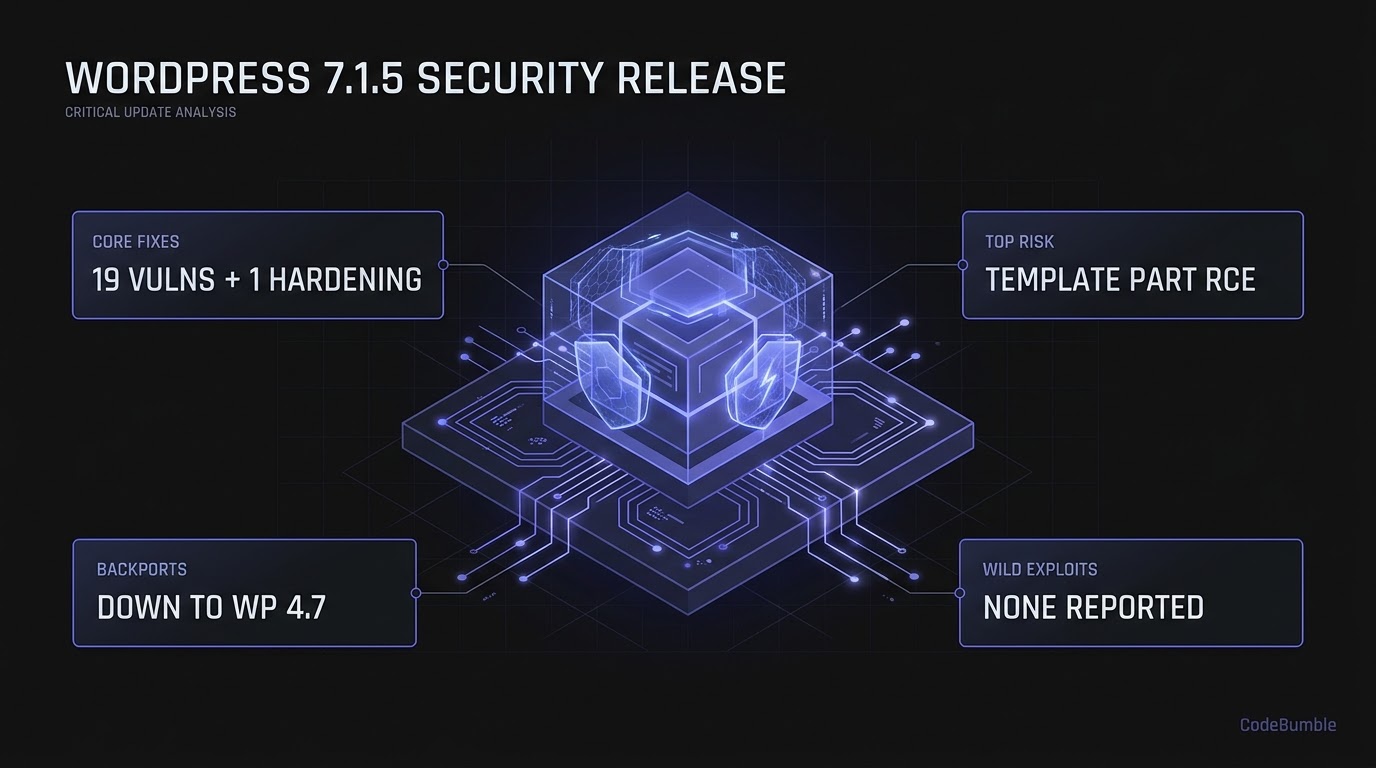
Executive Summary
On November 18, 2026, the WordPress project shipped WordPress 7.1.5, an out-of-band short-cycle security release addressing 19 distinct vulnerabilities and one core hardening change (20 total security items). Because several of the flaws require no authentication and affect core components enabled on default installations, WordPress recommends updating all sites immediately.
According to Wordfence (November 19, 2026), the 19 tracked vulnerabilities include one Critical and four High-severity issues under CVSS v3.1, with eight vulnerabilities requiring no authentication. The highest-impact issues include:
- An unauthenticated privilege escalation via Template Part block attributes (reported by Logan Homolka) that WordPress warns could lead to remote code execution (RCE) on affected sites (affecting WordPress 5.9 and later).
- A Critical multisite privilege escalation (reported by Yuval Miller, tracked as
GHSA-mwj7-xhp9-7773) allowing a site Administrator to take over a Super Admin account via Customizer menu previews on classic themes with widgets enabled. - Two SQL injection flaws, including one in
WP_Meta_Queryvia nestedrelationvalues (GHSA-xc9c-4hg4-h4jg, reported by Christiaan Swiers) and another via the front page setting in Customizer changeset previews (GHSA-mcv9-c2pg-6m4v, reported by Rudy Faile of the WordPress Security Team). - Unauthenticated stored XSS through shortcode attributes in comments (reported by Rafie Muhammad of Awesome Motive, Inc.), unauthenticated information disclosure exposing private taxonomy terms via the REST API search endpoint (
GHSA-rcr3-43fx-wqfv, reported by Anthropic), and unauthenticated denial of service via batched XML-RPC pingbacks (GHSA-56j2-5mp6-wr3x, reported by Giovanni Cintolo).
WordPress backported the applicable fixes to every security-eligible branch down to WordPress 4.7 (including 7.0.9, 6.9.12, 6.8.13, and 4.7.40), and also shipped WordPress 7.2 Release Candidate 2 (RC 2) with all fixes included. WordPress 4.6 and earlier receive no security updates. As of November 19, 2026, no public reporting indicates active exploitation in the wild, and none of the issues appear in CISA's Known Exploited Vulnerabilities (KEV) catalog (version 2026.11.18).
| Attribute | Verified Value | Source |
|---|---|---|
| Release Version & Date | WordPress 7.1.5 (Released November 18, 2026) |
WordPress.org |
| Total Security Items | 19 vulnerabilities + 1 hardening change (20 core items) | WordPress.org / Wordfence / CovertSwarm |
| Severity Breakdown | 1 Critical, 4 High (Wordfence CVSS v3.1); 8 unauthenticated | Wordfence (Nov 19, 2026) |
| CVE / Official Severity | No CVE IDs or official CVSS scores published by WordPress.org at release | CovertSwarm / WPServerGuard |
| Backported Branches | 7.0.9, 6.9.12, 6.8.13, down to 4.7.40 (4.6 and earlier EOL) |
WordPress.org / Cloudflare Radar |
| Next Major Release | WordPress 7.2 (planned December 8, 2026); 7.2 RC 2 includes fixes |
WordPress.org |
| Wild Exploitation / KEV | None reported as of Nov 19, 2026; not in CISA KEV (v2026.11.18) | Cloudflare Radar / CovertSwarm |
Technical Mechanics and Architecture
WordPress 7.1.5 spans multiple subsystems—the block editor, Customizer, REST API, WP_Meta_Query, Interactivity API, and XML-RPC. Understanding how these subsystems interact clarifies why patching Core (rather than relying solely on a single plugin rule) is necessary.
1. Template Part Block & Multisite Attack Surfaces
The Template Part block (introduced in WordPress 5.9) renders shared layout components such as headers and footers by referencing a theme name and template part slug. In the flaw reported by Logan Homolka, improper validation of Template Part block attributes allows an unauthenticated attacker to trigger privilege escalation that WordPress states could lead to remote code execution. As Cloudflare Radar noted on November 19, 2026, while the flaw requires no attacker account, exploitation in typical configurations involves an Administrator opening a crafted link while signed in.
In WordPress Multisite environments, Yuval Miller identified a Critical flaw (GHSA-mwj7-xhp9-7773) in Customizer menu previews when a site uses a classic theme with widgets enabled. A single-site Administrator can abuse this preview path to escalate privileges to Super Admin, gaining full control over the entire multisite network.
2. Query, REST API, and XML-RPC Surfaces
WP_Meta_QuerySQL Injection (GHSA-xc9c-4hg4-h4jg): Reported by Christiaan Swiers, nestedrelationvalues inWP_Meta_Querywere insufficiently sanitized. While Core alone does not expose arbitrarymeta_queryparameters to unauthenticated users, plugins and themes that pass user-controlled search or filter arrays directly intoWP_Meta_Querybecome vulnerable without a Core patch.- Customizer Changeset SQL Injection (
GHSA-mcv9-c2pg-6m4v): Reported by Rudy Faile, this path requiresmanage_options(Administrator) and allows a site Administrator on Multisite to read the shared network database, including network user tables. - REST API Private Taxonomy Disclosure (
GHSA-rcr3-43fx-wqfv): Reported by Anthropic, querying the REST API search endpoint without specifying a taxonomy caused WordPress to search all registered taxonomies—including private ones such as navigation menus. - Batched XML-RPC Pingback DoS (
GHSA-56j2-5mp6-wr3x): Reported by Giovanni Cintolo, an unauthenticated attacker can bundle numerous pingback calls inside a singlesystem.multicallXML-RPC request, forcing the server to pause and issue outbound HTTP requests for each call and exhausting PHP workers. - Root Certificate & Hardening Changes: WordPress 7.1.5 removes the Imgur block editor embed variation (whose server-side provider is defunct) and backports the removal of 1024-bit root certificates (originally introduced in WordPress 7.0) to
6.9.12and earlier.
Subsystem Exposure Diagram
+-------------------------------------------------------------------------+
|                     UNAUTHENTICATED / REMOTE REQUEST                    |
+------+---------------------------+----------------------------+---------+
       |                           |                            |
       v                           v                            v
+--------------+         +-------------------+        +-------------------+
| Comment /    |         | /wp-json/wp/v2/   |        | /xmlrpc.php       |
| Shortcodes   |         | search            |        | system.multicall  |
| (Stored XSS) |         | (Private Taxonomy |        | (Batched Pingback |
+--------------+         |  Leak: GHSA-rcr3) |        |  PHP Worker DoS)  |
                         +-------------------+        +-------------------+

+-------------------------------------------------------------------------+
|               AUTHENTICATED / ADMIN-INTERACTION SURFACES                |
+------+---------------------------+----------------------------+---------+
       |                           |                            |
       v                           v                            v
+--------------+         +-------------------+        +-------------------+
| Template Part|         | Customizer Menu & |        | WP_Meta_Query     |
| Block Attrs  |         | Changeset Preview |        | (Nested relation  |
| (PrivEsc/RCE)|         | (Multisite Admin  |        |  SQLi via plugins)|
+--------------+         |  -> Super Admin)  |        +-------------------+
                         +-------------------+
Defensive Verification and Containment Code
While upgrading Core is the primary remediation, defenders can immediately verify installed Core versions across managed fleets using WP-CLI and harden xmlrpc.php at the web server layer if no mobile publishing or Jetpack workflows depend on it.
1. Safe Fleet Version Audit via WP-CLI (Read-Only):
#!/usr/bin/env bash
# Read-only WordPress Core version & multisite audit script
# Checks whether installed core matches 7.1.5 or patched branch releases.

WP_PATH="${1:-/var/www/html}"

if ! command -v wp >/dev/null 2>&1; then
    echo "WP-CLI not found in PATH."
    exit 1
fi

CORE_VER=$(wp core version --path="$WP_PATH" --allow-root 2>/dev/null)
IS_MULTISITE=$(wp config get MULTISITE --path="$WP_PATH" --allow-root 2>/dev/null || echo "false")

echo "Path: $WP_PATH"
echo "Core Version: ${CORE_VER:-unknown}"
echo "Multisite Enabled: $IS_MULTISITE"

case "$CORE_VER" in
    7.1.5|7.0.9|6.9.12|6.8.13|4.7.40)
        echo "Status: PATCHED (matches Nov 18, 2026 security release)"
        ;;
    7.2-RC2*)
        echo "Status: PATCHED (7.2 RC 2 includes all 7.1.5 fixes)"
        ;;
    *)
        echo "Status: VERIFY AGAINST OFFICIAL 7.1.5 BRANCH TABLE OR UPGRADE"
        ;;
esac
2. Defensive Nginx Block for xmlrpc.php (If Unused):
# Block external access to xmlrpc.php to mitigate batched pingback DoS
# Verify Jetpack or mobile app dependencies before applying.
location = /xmlrpc.php {
    deny all;
    access_log off;
    log_not_found off;
}
Evidence & Operational Impact
Counting Discrepancy Across Advisories
Security teams reading multiple feeds may notice a slight count difference:
- WordPress.org, Wordify, and Brandefense refer to 20 core security issues/updates.
- Wordfence tracks 19 distinct vulnerabilities, while CovertSwarm clarifies the exact split: 19 security vulnerabilities plus 1 hardening change (removing the defunct Imgur embed variation), alongside the backport of 1024-bit root certificate removal to
6.9.12and earlier.
Why Unauthenticated & Plugin-Exposed Flaws Matter Most
- Eight Unauthenticated Vectors: Wordfence highlights that 8 of the 19 vulnerabilities require no authentication, including stored XSS via comment shortcode attributes, Openverse image metadata XSS, REST API private taxonomy disclosure, batched XML-RPC pingback DoS, and the Template Part block attribute flaw.
- Plugin Amplification of
WP_Meta_QuerySQLi: Because third-party search, WooCommerce filter, and directory plugins frequently pass query-string arrays intoWP_Meta_Query, patching WordPress Core to7.1.5(or the branch backport) neutralizes this SQL injection vector across all installed plugins simultaneously. - Multisite Blast Radius: In shared-hosting, university, or enterprise Multisite networks,
GHSA-mwj7-xhp9-7773andGHSA-mcv9-c2pg-6m4vallow a single-site Administrator to read shared network tables or escalate to Super Admin.
Benchmarks & Exploitation Telemetry
- Performance Benchmarks: Quantitative performance, memory, or latency benchmarks comparing WordPress
7.1.5against7.1.4are unavailable in the fetched vendor release notes and security advisories. - Exploitation Status: As of November 19, 2026, neither WordPress.org, Wordfence, CovertSwarm, nor Cloudflare Radar reported confirmed exploitation in the wild, and CVE identifiers had not yet been assigned at publication.
Hardening Playbook
Update WordPress Core Immediately
- Apply WordPress 7.1.5 (or the corresponding security release for your branch:
7.0.9,6.9.12,6.8.13, down to4.7.40). - Do not assume automatic background updates succeeded. Log in to Dashboard > Updates or run
wp core versionto confirm the exact version string. - Migrate any site still running WordPress 4.6 or earlier to a supported branch immediately, as 4.6 and older receive no patches.
- Apply WordPress 7.1.5 (or the corresponding security release for your branch:
Audit Multisite & Privileged Accounts
- On WordPress Multisite networks, review all Super Admin and single-site Administrator accounts, removing stale or unnecessary administrative users.
- Because several XSS and authorization flaws require Contributor, Author, or Editor roles, enforce least-privilege role assignments.
Restrict
xmlrpc.phpWhere Not Required- If your site does not use Jetpack or XML-RPC mobile/remote publishing clients, deny access to
/xmlrpc.phpat the web server or WAF layer to eliminate batched pingback resource exhaustion.
- If your site does not use Jetpack or XML-RPC mobile/remote publishing clients, deny access to
Monitor Logs & Run File Integrity Checks
- Inspect web access logs for spikes in
POST /xmlrpc.php(system.multicallabuse), anomalous/wp-json/wp/v2/searchqueries, or suspicious comment payloads containing encoded escape sequences (\x3c).
Example web-access log hunting query (Splunk/SPL-style):
index=web_access (uri_path="/xmlrpc.php" AND method="POST") OR (uri_path="/wp-json/wp/v2/search" AND status=200) | stats count values(uri_query) as queries by src_ip, uri_path | where count > 20- Inspect web access logs for spikes in
Rollback & Change-Control Notes
- Core Rollback: Take a database and
wp-content/Core snapshot before upgrading. Because 7.1.5 is a minor security release (no breaking schema overhaul), rolling back via snapshot orwp core update --version=7.1.4 --forceis straightforward if a custom plugin conflicts, though rolling back re-exposes all 19 flaws. - XML-RPC Rollback: If blocking
/xmlrpc.phpbreaks Jetpack or an external publishing integration, allowlist only the integration's documented IP ranges rather than reopeningxmlrpc.phpglobally.
- Core Rollback: Take a database and
Frequently Asked Questions (FAQ)
1. Why are no CVE numbers listed for the WordPress 7.1.5 vulnerabilities? At the time of the November 18, 2026 release, WordPress.org did not publish CVE identifiers or official CVSS scores. Security trackers such as Wordfence, Patchstack, and GitHub Security Advisories (GHSA) are tracking the flaws using their own identifiers until CVE assignments are published.
2. Is WordPress 7.1.5 being actively exploited in the wild? No. As of November 19, 2026, Wordfence, CovertSwarm, and Cloudflare Radar report no confirmed wild exploitation, and the issues are not listed in CISA's Known Exploited Vulnerabilities (KEV) catalog (version 2026.11.18).
3. Does WordPress 7.1.5 protect older sites running WordPress 6.9 or 7.0?
Yes, if you install the branch-specific security release (7.0.9 for 7.0, 6.9.12 for 6.9, 6.8.13 for 6.8, down to 4.7.40). However, WordPress notes that only the latest branch (7.1.5) is actively supported, and 4.6 and earlier are end-of-life.
4. Should I disable xmlrpc.php even after updating to WordPress 7.1.5?
Updating to 7.1.5 patches the batched pingback denial-of-service flaw (GHSA-56j2-5mp6-wr3x). However, if your site does not use Jetpack or XML-RPC publishing clients, blocking /xmlrpc.php at the web server remains a recommended defense-in-depth step.
5. Am I vulnerable to the WP_Meta_Query SQL injection if I only use WordPress Core?
WordPress Core itself does not expose raw meta_query parameters to unauthenticated visitors, but many search, filter, and e-commerce plugins pass request input into WP_Meta_Query. Updating WordPress Core to 7.1.5 fixes the underlying class behavior for all plugins at once.
Sources
- WordPress.org Official News — WordPress 7.1.5 Release (By Jeremy Felt). Published: November 18, 2026. URL: https://wordpress.org/news/2026/11/wordpress-7-1-5-release/
- Wordfence Blog — WordPress 7.1.5 Security Release Fixes 19 Vulnerabilities. Published: November 19, 2026. URL: https://www.wordfence.com/blog/2026/11/wordpress-7-1-5-security-release-fixes-19-vulnerabilities/
- Cloudflare Radar (Zero Wire) — WordPress 7.1.5: Template Part flaw can turn an administrator's click into code execution. Published: November 19, 2026. URL: https://radar.cloudflare.com/zero-wire/wordpress-7-1-5-template-part-privilege-escalation
- CovertSwarm Threat Alert — WordPress Core 7.1.5 – Multiple Vulnerabilities. Published: November 19, 2026. URL: https://www.covertswarm.com/threat-alert/wordpress-core-7-1-5-security-release