

Packages
agent-framework v1.26.0 vs. Malicious 1.26.1–1.26.2: PyPI Compromise Telemetry and Safe Pinning Guide
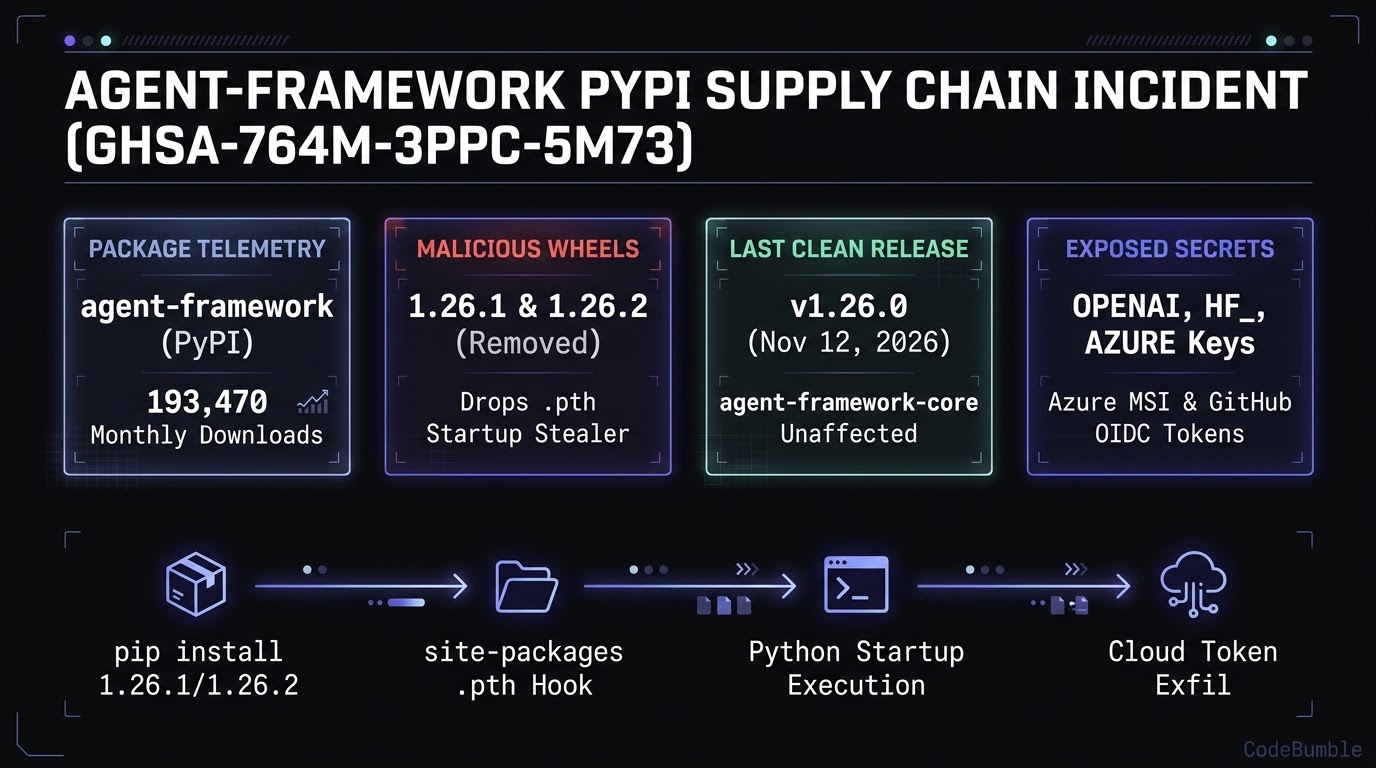
Microsoft's agent-framework PyPI package (193,470 monthly downloads) suffered a brief supply-chain compromise on November 17, 2026, when unauthorized 1.26.1 and 1.26.2 wheels dropped a Python .pth startup stealer targeting OPENAI, HF_, AZURE, and GitHub Actions OIDC tokens. PyPI removed both releases, leaving v1.26.0 (November 12, 2026) as the latest clean version. Here is the exact telemetry, SHA-256 verification, and safe pinning checklist.
6 min read
agent-framework v1.26.0 vs. Malicious 1.26.1–1.26.2: PyPI Compromise Telemetry and Safe Pinning Guide
Executive Summary
agent-framework (Python / PyPI), Microsoft's AI agent orchestration package, suffered a targeted supply-chain compromise on November 17, 2026, when unauthorized versions 1.26.1 and 1.26.2 were uploaded to PyPI (Rescana, RuntimeAI). Tracked under GHSA-764m-3ppc-5m73, PYSEC-2026-4388, and MAL-2026-20101, both malicious wheels embedded a Python .pth startup hook that exfiltrated cloud and AI credentials (OPENAI, HF_, AZURE, Azure managed identity tokens, and GitHub Actions OIDC tokens) upon any Python interpreter launch.
PyPI removed both malicious releases, and as verified against the PyPI JSON API on November 20, 2026, v1.26.0 (published November 12, 2026) is the latest clean release (Rescana). Sibling packages such as agent-framework-core were not affected. For AI engineering teams managing pyproject.toml or requirements.txt, the takeaway is immediate: verify no CI runner or developer laptop cached 1.26.1 or 1.26.2, pin agent-framework==1.26.0 with SHA-256 hashes, and rotate any exposed cloud or LLM API keys.
Confidence assessment: High confidence on version numbers, wheel SHA-256 hashes, .pth execution mechanics, advisory IDs, and download telemetry (corroborated across GitHub Advisory Database, OSV/PyPA, OpenSSF, PyPI JSON API, Elastic Security Labs, Rescana, and NeuralTrust). Partial confidence on root publishing-compromise vector: CSO Online reported that Microsoft has not publicly stated how the attacker obtained PyPI publishing access (NeuralTrust).
Adoption Telemetry & Version Changelog
agent-framework sits at the center of enterprise AI agent development, where developers routinely hold elevated cloud and LLM provider credentials in local .env files and CI runners (RuntimeAI):
- Monthly PyPI Downloads: 193,470 across all versions in the preceding 30 days (
pypistats, checked November 20, 2026) (Rescana). - Last Clean Release:
agent-framework 1.26.0(published November 12, 2026). - Incident Timeline:
- November 17, 2026, 15:35 EST: Malicious
agent-framework 1.26.1wheel published to PyPI. - November 17, 2026, 16:08 EST: Malicious
agent-framework 1.26.2wheel published (adding GitHub Actions OIDC token harvesting). - November 17, 2026, 17:12–19:31 EST: OpenSSF (
MAL-2026-20101), PyPA (PYSEC-2026-4388), and GitHub Advisory Database (GHSA-764m-3ppc-5m73) published malicious-package records. - November 18, 2026: Elastic Security Labs reported catching the PyPI compromise six minutes after publication.
- November 20, 2026 (01:44 EST check): PyPI JSON API confirms
1.26.0is the latest available version, with1.26.1and1.26.2removed andagent-framework-coreunaffected.
- November 17, 2026, 15:35 EST: Malicious
Security Patches, Breaking Changes & Internals
1. Why .pth Startup Hooks Bypass Import-Time Controls
Unlike traditional malicious packages that wait for import agent_framework, both 1.26.1 and 1.26.2 dropped a .pth file inside Python's site-packages directory (NeuralTrust). Because Python's site module automatically executes lines starting with import inside .pth files during interpreter initialization, the credential stealer ran even if application code never imported agent_framework—including during pytest, pip, or helper CLI invocations inside the same virtual environment.
+-----------------------+     pip install (Nov 17)     +-------------------------------+
|  Developer / CI Job   | ---------------------------> |  site-packages/               |
|  (Unpinned dependency)|   Pulls 1.26.1 or 1.26.2     |  Drops malicious .pth file    |
+-----------------------+                              +---------------+---------------+
                                                                       |
                                         Any python3 process starts    |
                                         (even without importing pkg)  |
                                                                       v
+-----------------------+     Exfiltrates to           +-------------------------------+
|  Attacker Endpoint    | <--------------------------- |  Startup Stealer Execution    |
|  (webhook.site)       |   OPENAI, HF_, AZURE,        |  Reads env vars, cred files,  |
|                       |   Azure MSI & GH OIDC tokens |  and cloud identity tokens    |
+-----------------------+                              +-------------------------------+
2. Verified Artifact & Hash Matrix
| Package & Version | Status | Wheel SHA-256 / Verification | Source |
|---|---|---|---|
agent-framework 1.26.0 |
Clean (latest on PyPI) | Published Nov 12, 2026 | Rescana |
agent-framework 1.26.1 |
Malicious (removed) | d27fa34414e6201d5e03e559ef634f020057554d7b3f4898dd5d7cd3e989e110 |
Rescana |
agent-framework 1.26.2 |
Malicious (removed) | 3d20a8bc91351a9a16b6db243b848ceca0206b7a8623b02d2af553a9c9f7e0a9 |
Rescana |
agent-framework-core 1.26.0 |
Unaffected | No release uploaded on/after Nov 17 | Rescana |
Safe Defensive Pinning & Verification Code
Use pip hash-checking mode (--require-hashes) or uv.lock / poetry.lock so CI pipelines reject unexpected wheel replacements even if an upstream registry token is compromised:
# pyproject.toml — pin to the verified clean release until a new vendor-signed release ships
[project]
dependencies = [
    "agent-framework==1.26.0",
]
# Audit local virtual environments, Docker layers, and pip caches for 1.26.1 / 1.26.2
python3 -m pip show agent-framework | grep -E "Name:|Version:"
find .venv /usr/local/lib -name "*.pth" -mtime -7 2>/dev/null
Ecosystem Comparison & Upgrade Checklist
AI engineering teams evaluating agent-framework SDKs face a shared reality across both Python and TypeScript ecosystems: pre-1.0 velocity and elevated credential exposure require strict lockfile hygiene.
| Package | Ecosystem | Latest Clean Version (Nov 2026) | Release / Maturity Notes | Key Operational Takeaway |
|---|---|---|---|---|
agent-framework |
Python (PyPI) | 1.26.0 (Nov 12, 2026) |
193,470 monthly downloads; 1.26.1–1.26.2 pulled |
Pin ==1.26.0 + hashes; audit CI for .pth files (Rescana) |
agent-framework-core |
Python (PyPI) | 1.26.0 |
Core package unaffected by Nov 17 incident | Prefer minimal core extras rather than broad all extras when possible (Rescana) |
openai-agents |
Python (PyPI) | 0.24.0 (Oct 15, 2026) |
Pre-1.0; minor releases can carry breaking changes | Pin exact minor version and run ScriptedModel tests on upgrade (Blaxel) |
@openai/agents |
TypeScript (npm) | 0.22.0 (Nov 12, 2026) |
MIT license; pre-1.0 | Enforce npm ci with lockfiles; sandbox agent-executed code (Blaxel) |
(Performance benchmark note: No latency or memory-footprint benchmarks comparing agent-framework 1.26.0 against openai-agents 0.24.0 are included in the fetched advisories; teams should benchmark tool-call overhead against their own LLM provider latency.)
Safe Upgrade & Incident Response Checklist
- Check pip/uv caches and CI artifacts for
agent-frameworkversions1.26.1or1.26.2, or the exact SHA-256 wheel hashes listed above. - Purge and recreate virtual environments (
pip cache purge && rm -rf .venv) on any machine that installed dependencies between November 17, 15:35 EST and PyPI removal, ensuring no rogue.pthfile remains insite-packages. - Rotate all potentially exposed secrets immediately:
OPENAIkeys,HF_Hugging Face tokens,AZUREcredentials, Azure managed identity tokens, and GitHub Actions OIDC / repo secrets (NeuralTrust). - Pin
agent-framework==1.26.0with--require-hashes(oruv.lock) and restrict CI egress so build runners cannot send outbound requests towebhook.site.
Frequently Asked Questions (FAQ)
1. Is agent-framework 1.26.0 safe to use?
Yes. According to GitHub (GHSA-764m-3ppc-5m73), PyPA (PYSEC-2026-4388), and PyPI JSON API checks on November 20, 2026, 1.26.0 (released November 12, 2026) is the last clean release; only 1.26.1 and 1.26.2 contained malicious code (Rescana).
2. Were agent-framework-core or other agent-framework-* packages compromised?
No. Rescana's November 20, 2026 check of GitHub, PyPA, OpenSSF advisories, and the PyPI JSON API confirmed that agent-framework-core and sibling agent-framework-* packages were not named in any advisory and had no releases uploaded on or after November 17 (Rescana).
3. Why did the stealer run even if my Python script didn't import agent-framework?
The malicious wheels included a .pth file in site-packages. Python automatically executes import statements inside .pth files at interpreter startup, triggering the stealer on any Python invocation (NeuralTrust).
4. Which secrets did 1.26.1 and 1.26.2 target?
GitHub Advisory GHSA-764m-3ppc-5m73 reports that 1.26.1 targeted environment variables containing OPENAI, HF_, and AZURE, credential files, and Azure managed identity tokens, while 1.26.2 added GitHub Actions OIDC tokens, exfiltrating data to a webhook.site endpoint (NeuralTrust).
5. How quickly was the compromise detected?
Elastic Security Labs reported detecting the agent-framework PyPI compromise six minutes after publication (Rescana).
Sources
- Rescana — Microsoft agent-framework PyPI Compromise (GHSA-764m-3ppc-5m73) (citing GHSA, PYSEC-2026-4388, MAL-2026-20101, PyPI JSON API, pypistats) (November 20, 2026)
- NeuralTrust — AI Coding Assistant Security: Config Files & agent-framework Analysis (November 20, 2026)
- RuntimeAI — AI Security Incidents: Week of November 20, 2026 (November 20, 2026)
- Blaxel — OpenAI Agents SDK guide to tools, handoffs, and sandboxes (
openai-agents 0.24.0/@openai/agents 0.22.0) (November 20, 2026)