

Packages
OpenAI @openai/codex 0.171.0: GPT-6.2 Sol Default, TUI Workspace, and Sandbox Hardening
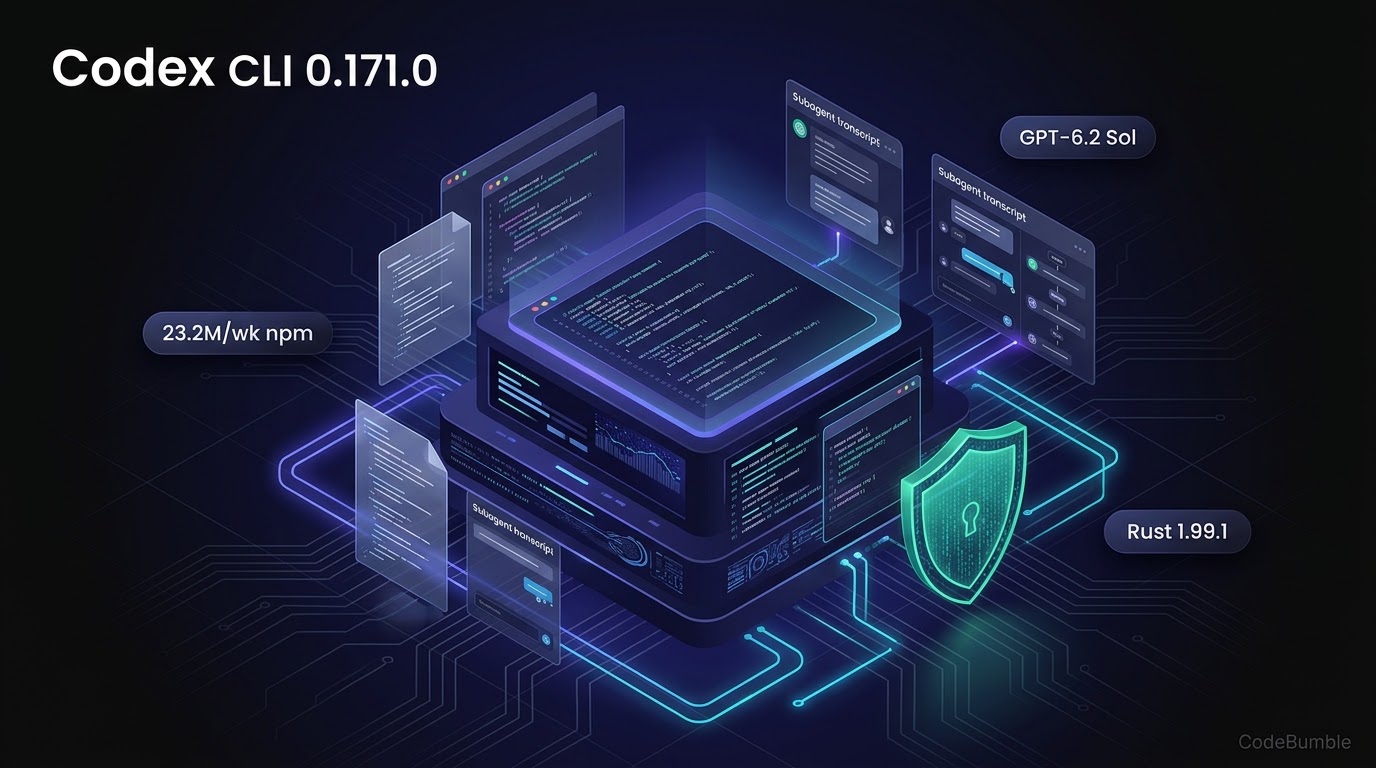
OpenAI released @openai/codex 0.171.0 on November 20, 2026, switching the default CLI model to GPT-6.2 Sol, enabling the TUI workspace with document and image previews by default, and adding remote app-server execution. Backed by 23.2 million weekly npm downloads and a Rust 1.99.1 core, the release also hardens Linux seccomp sandboxing and enterprise MCP sign-in.
8 min read
OpenAI @openai/codex 0.171.0: GPT-6.2 Sol Default, TUI Workspace, and Sandbox Hardening
Executive Summary
On November 20, 2026, OpenAI published @openai/codex 0.171.0 on npm alongside matching 0.171.0 artifacts on GitHub Releases and PyPI (openai-codex). Built primarily in Rust (97.6% of the codebase) and distributed under the Apache-2.0 license, @openai/codex is OpenAI's local terminal coding agent (codex) with a companion Python SDK and Model Context Protocol (MCP) runtime.
Version 0.171.0—documented in the ChatGPT & Codex Changelog and summarized by AI/TLDR—introduces three major workflow shifts alongside targeted security and state-persistence fixes:
- Default Model Catalog Update: Adds
GPT-6.2 SolandGPT-6.2 Astrato the model catalog, promotingGPT-6.2 Solas the default selection (#62106). - TUI Workspace Enabled by Default: Turns on the split TUI workspace view by default, surfacing searchable document previews, image previews, and subagent transcripts alongside the main conversation (
#61352,#61888,#61889). - Remote Execution & Custom MCP Status Lines: Adds
codex exec --remote <ADDR>(#61707),/rcand/remoteTUI pairing commands (#62121), and/statuslinefor custom MCP status-line providers (#61979). - Security & Toolchain Updates: Upgrades source builds to Rust 1.99.1 (
#61205), enforces Linuxseccomprestrictions onx32syscalls (#61206), blocksrequest_keyin Linux network sandbox filters (#61256), and updates XML dependencies while removing obsolete security advisory exceptions (#62068).
For teams running @openai/codex in CI or developer workstations, 0.171.0 is a high-value upgrade that resolves lost-draft bugs across session switches and fixes enterprise MCP authentication for identity providers that omit refresh tokens (#62129).
Adoption Telemetry & Version Changelog
Verified package registry and repository telemetry as of November 20–21, 2026 places @openai/codex among the highest-volume developer CLI packages in the AI agent ecosystem:
| Metric | Verified Value | Source |
|---|---|---|
| Latest Stable Version | 0.171.0 (Published Nov 20, 2026) |
ChatGPT & Codex Changelog |
| npm Weekly Downloads | 23,241,167 (at 0.171.0 publish) |
npm @openai/codex |
| GitHub Stars / Forks | 136,000 stars / 21,600 forks |
GitHub openai/codex |
| Contributors / Releases | 739 contributors / 1,313 releases |
GitHub openai/codex |
| Primary Implementation | Rust (97.6%), Python (1.9%), Starlark (0.2%) |
GitHub openai/codex |
| License | Apache-2.0 |
GitHub openai/codex |
| Rust / Node.js / Bazel | Rust 1.99.1, Node.js 24.22.1, Bazel 9.2.0 |
Changelog / GitHub |
| PyPI Provenance | openai-codex 0.171.0 GitHub Actions attestation (Nov 20, 2026) |
PyPI openai-codex |
Recent Release Cadence (0.168.0 to 0.171.0)
The openai/codex repository ships rapidly—accumulating 1,313 releases to date—and recent minor releases in November 2026 show a clear push toward multi-pane terminal collaboration, voice/media handling, and remote session orchestration (AI/TLDR):
0.168.0(Nov 13, 2026): Added side-by-side chats, audio clips, and animated GIF support in the terminal interface.0.169.0(Nov 13, 2026): Introduced side-chat tabs, task search, and collapsible turns; weekly npm downloads peaked around26,405,181during this release window (npm).0.170.0(Nov 18, 2026): Added realtime voice calls in the terminal over WebRTC.0.171.0(Nov 20, 2026): PromotedGPT-6.2 Solto default, enabled the TUI workspace by default, addedcodex exec --remote <ADDR>, introduced/rc,/remote, and/statusline, and shipped Linuxseccompand enterprise MCP fixes (ChatGPT & Codex Changelog).
Security Patches, Breaking Changes & Internals
Sandbox & Supply-Chain Hardening in 0.171.0
Because coding agents execute local shell commands, read workspace repositories, and connect to external MCP servers, sandbox boundaries and dependency hygiene are critical operational concerns (CybeDefend). Release 0.171.0 ships several concrete security and isolation improvements documented in the full changelog:
- Linux
seccompx32Syscall Enforcement (#61206): Enforces Linuxseccomprestrictions forx32ABI syscalls, closing a classic syscall-filtering bypass vector on 64-bit Linux kernels where an unblockedx32syscall number could evadex86_64seccomprules. - Kernel Keyring Filter Hardening (
#61256): Explicitly blocksrequest_keyin Linux network sandbox filters to prevent sandboxed processes from querying or manipulating kernel keyring state. - XML Dependency & Advisory Cleanup (
#62068): Updates underlying XML dependencies and removes obsolete security advisory exceptions from the Rust/Bazel dependency graph. - SPIFFE Workload Identity (
#61207): AddsSPIFFE JWT-SVIDsupport for workload identity authentication, giving platform teams a standards-based alternative to static long-lived API keys. - Git Remote Metadata Tightening (
#61488): Hardens Git remote collection and limits remote URL metadata exposed to the model context, reducing the risk of leaking embedded credentials or sensitive internal hostnames. - Enterprise MCP OAuth Fix (
#62129): Fixes enterprise MCP sign-in flows for identity providers (IdPs) that issue ID tokens without refresh tokens, alongside releasing MCP OAuth read locks prior to keyring access (#61401).
Key Behavioral Changes & Developer Ergonomics
There are no destructive CLI flag removals reported in 0.171.0, but teams should note four behavioral updates that change day-to-day workflows on upgrade (ChatGPT & Codex Changelog, AI/TLDR):
- Default Model Shift (
#62106): Unpinned sessions now default toGPT-6.2 Solinstead of prior catalog defaults. Teams requiring deterministic CI outputs or specific enterprise model allowlists (for example, on Google Cloud Agent Platform or Amazon Bedrock) should pin--modelexplicitly or configure~/.codex/config.toml. - TUI Workspace Active by Default (
#61352,#61888,#61889,#61890): Interactivecodexsessions now open the TUI workspace automatically, displaying read-only document previews in a sidebar with search, text selection, link navigation, image previews, subagent transcripts, and clickable line/column source-file targets. - Persistent Session State & Composer Undo/Redo (
#61216,#61195,#61801,#61954): Switching or resuming threads no longer discards unsent drafts, queued follow-ups, or interrupted input; permission profiles remain intact across working directory changes; late completion events no longer cancel approval prompts for a newer turn; and the non-Vim prompt composer gains configurable undo/redo shortcuts that restore attachments and large pastes. - Custom MCP Status Line Providers (
#61979,#61988,#62037,#61408–#61417): Whentui_extensions_statuslineis enabled,/statuslinelets developers select and author custom MCP-backed status lines exposing token usage totals, context window usage, thread costs, and Codex rate limits.
Installation & Updated CLI Usage
OpenAI distributes 0.171.0 across npm, Homebrew, standalone shell installers (releases.openai.com), GitHub Release binaries (musl on Linux, darwin on macOS), and PyPI (openai-codex for Python SDK consumers). Note that the npm package wraps the native Rust binary (#61221 improves signal forwarding through the npm wrapper).
# Pin the exact 0.171.0 release via npm
npm install -g @openai/codex@0.171.0

# Verify installed binary version
codex --version

# Run a noninteractive task against a remote app server (new in 0.171.0)
codex exec --remote 127.0.0.1:8080 "Run unit tests and summarize failures"

# Inside an interactive TUI session:
# /rc or /remote    -> manage local remote control & display device pairing codes
# /statusline       -> select or author custom MCP status lines (requires tui_extensions_statusline)
For environments with strict egress or supply-chain policies, the standalone installer also supports falling back directly to GitHub Releases by setting CODEX_INSTALLER_USE_RELEASES_OPENAI_COM=false, while PyPI consumers can verify the GitHub Actions build provenance attestation published on November 20, 2026 (GitHub, PyPI).
Ecosystem Comparison & Upgrade Checklist
In the terminal AI coding-agent category, @openai/codex competes directly with Anthropic's Claude Code and Google's Gemini CLI. Independent npm download telemetry compiled by Gradually AI for the September 7 – October 6, 2026 period illustrates the adoption scale across all three CLI packages, while GitHub and CybeDefend document Codex's architectural footprint:
| Package / Tool | Registry & License | Verified npm Scale | Core Runtime | Sandbox & MCP Posture |
|---|---|---|---|---|
@openai/codex (0.171.0) |
npm / PyPI / Homebrew (Apache-2.0) |
23.24M/wk (Nov 20, 2026); 88.9M (Sept 7–Oct 6, 2026) |
Rust 1.99.1 (97.6%) + Node wrapper |
read-only / auto / full-access; Linux seccomp + x32 filter; native MCP + /statusline |
| Claude Code | npm (Proprietary) | 52.9M (Sept 7–Oct 6, 2026) |
Node.js / TypeScript | Local tool permissions + MCP server support |
| Gemini CLI | npm (Apache-2.0) |
1.6M (Sept 7–Oct 6, 2026) |
Node.js / TypeScript | Local tool approvals + MCP integration |
Safe Upgrade & Pinning Checklist
Before rolling @openai/codex@0.171.0 out across developer machines or CI runners, engineering leads should verify four items:
- Pin Exact Versions in CI: Replace floating
latestinstalls with@openai/codex@0.171.0in CI scripts and container images soGPT-6.2 Solcatalog changes do not unexpectedly alter automated code-review or test-fixing pipelines. - Audit Model Catalog Policies: If your organization routes Codex through Google Cloud Agent Platform, Amazon Bedrock, or a corporate gateway with restricted model allowlists, confirm
GPT-6.2 SolandGPT-6.2 Astraare enabled—or pin an approved model in~/.codex/config.toml(Google Cloud Docs). - Keep Sandboxing Enabled: Maintain
auto(workspace-write sandbox with on-request approval) orread-onlypresets rather thandanger-full-access, and pair local runs with narrowly scoped, short-lived GitHub tokens (CybeDefend). - Test Enterprise MCP Sign-In: If your IdP issues ID tokens without refresh tokens, validate
/mcpauthentication under0.171.0to confirm#62129resolves previous login failures.
Frequently Asked Questions
What is the latest version of @openai/codex and when was it released?
Version 0.171.0 is the latest stable release, published on November 20, 2026, across npm (@openai/codex), GitHub Releases (openai/codex), and PyPI (openai-codex) (ChatGPT & Codex Changelog, PyPI).
Does upgrading to 0.171.0 change the default AI model?
Yes. Release 0.171.0 adds GPT-6.2 Sol and GPT-6.2 Astra to the model catalog and sets GPT-6.2 Sol as the default model (#62106). Existing workflows that require a prior model should specify it explicitly in configuration or CLI flags.
What security improvements are included in Codex CLI 0.171.0?
0.171.0 enforces Linux seccomp restrictions for x32 syscalls (#61206), blocks request_key in Linux network sandbox filters (#61256), adds SPIFFE JWT-SVID workload identity authentication (#61207), limits Git remote URL metadata exposure (#61488), and updates XML dependencies while removing obsolete security advisory exceptions (#62068).
How do codex exec --remote and /rc work?
codex exec --remote <ADDR> (#61707) lets you start or resume noninteractive Codex sessions against an already-running app server, while /rc and /remote (#62121) let you manage local remote control and view device pairing codes directly from the interactive TUI.
Is @openai/codex open source, and what runtime does it use?
Yes. The openai/codex repository is licensed under Apache-2.0 and is written 97.6% in Rust (compiled with Rust 1.99.1 in 0.171.0), with an npm wrapper that targets Node.js 24.22.1 in the monorepo (GitHub openai/codex).
Sources
- OpenAI ChatGPT & Codex Changelog — Codex CLI 0.171.0 Release Notes (Nov 20, 2026): https://learn.chatgpt.com/docs/changelog
- npm Registry —
@openai/codexPackage Page (v0.171.0, Weekly Downloads, License) (Nov 20, 2026): https://www.npmjs.com/package/@openai/codex - GitHub —
openai/codexRepository (Stars, License, Languages, Installation) (Checked Nov 21, 2026): https://github.com/openai/codex - PyPI —
openai-codex0.171.0 Package & GitHub Actions Provenance Attestation (Nov 19–20, 2026): https://pypi.org/project/openai-codex/ - AI/TLDR — Codex CLI 0.171.0 — GPT-6.2 Sol becomes the default, TUI workspace on (Nov 20, 2026): https://ai-tldr.dev/releases/openai-codex-cli-0-171/
- Gradually AI — OpenAI Codex Statistics 2026: Data and Facts (Nov 5, 2026): https://www.gradually.ai/en/codex-statistics/
- CybeDefend — Is OpenAI Codex Safe? Yes, With the Sandbox On (Nov 10, 2026): https://www.cybedefend.com/en/blog/openai-codex-security-risks-best-practices
- Google Cloud Documentation — Connect OpenAI Codex to Google Cloud (Accessed Nov 21, 2026): https://docs.cloud.google.com/gemini-enterprise-agent-platform/models/partner-models/openai/codex