

Technology
Agent Substrate 1.0 and gVisor Join the CNCF: Sub-500ms Actor Sandboxes, 10x Density, and 5 Production Caveats
Google donated Agent Substrate 1.0 and gVisor to the CNCF Sandbox, bringing sub-500ms Actor/WorkerPool sandboxes to Kubernetes 1.37+. Explore the architecture, zero-trust policy checks, and 5 production caveats.
8 min read
Agent Substrate 1.0 and gVisor Join the CNCF: Sub-500ms Actor Sandboxes, 10x Density, and 5 Production Caveats
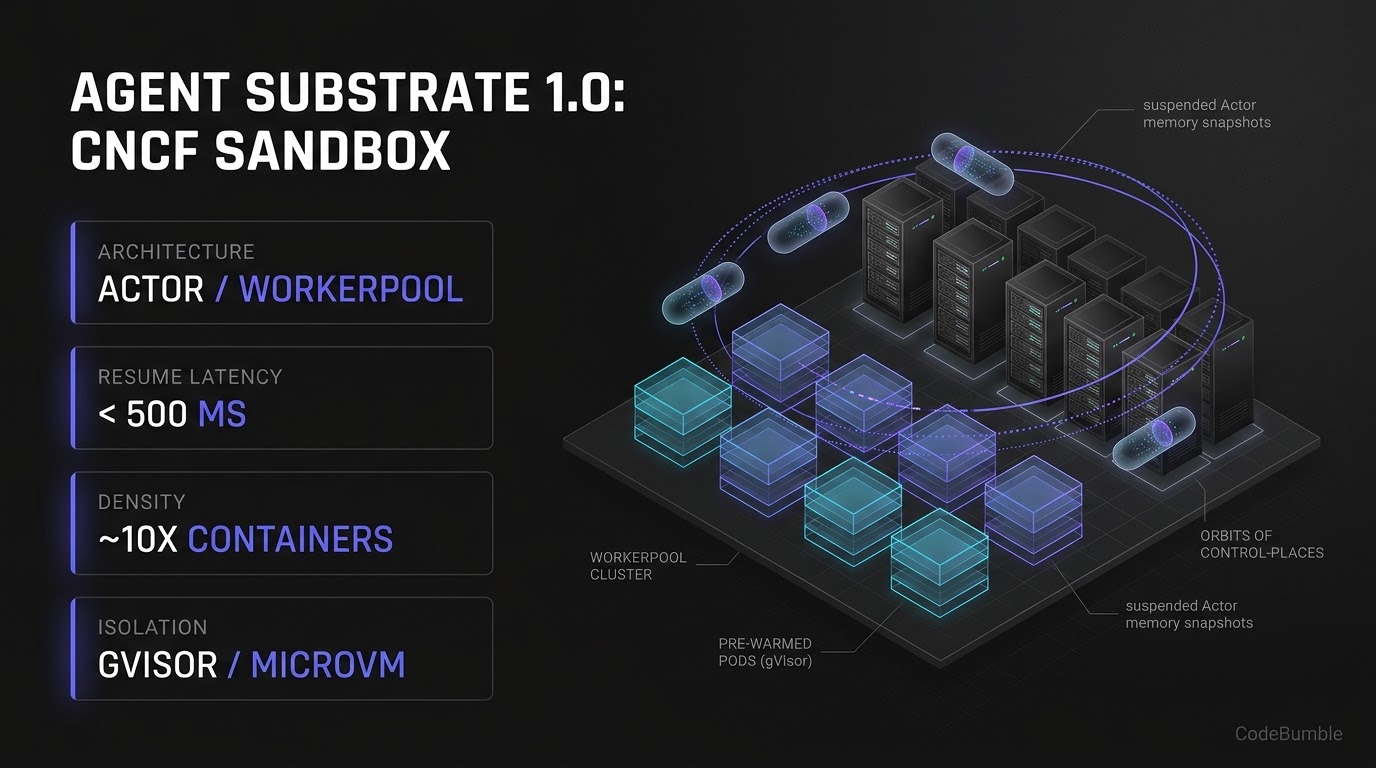
Executive Summary
At KubeCon + CloudNativeCon North America in Salt Lake City (November 2026), Google Cloud announced the release of Agent Substrate 1.0 (Apache-2.0, generally available on GKE) alongside its donation of Agent Substrate, gVisor, and OpenRL to the Cloud Native Computing Foundation (CNCF) in Sandbox status, as documented on the Google Open Source Blog and Google Cloud Blog.
Designed to solve the twin bottlenecks of AI agent infrastructure—90%–95% idle compute waste during LLM streaming or human-in-the-loop waits, and etcd / kube-apiserver control-plane overload during thousand-way evaluation bursts—Agent Substrate decouples stateful agent sessions (Actors) from pre-warmed Kubernetes compute Pods (WorkerPools). Together, the donated projects form a three-layer open stack: Layer 1: Secure Isolation (gVisor), Layer 2: Agent Runtime (Agent Substrate), and Layer 3: Training Orchestration (OpenRL). By pairing this Actor control plane with gVisor (runsc) user-space kernel checkpointing (or Cloud Hypervisor microVMs), Google reports sub-500ms suspend/resume latency, ~10x container density over dedicated Pods, and 500+ activations per second.
However, an independent November 14, 2026 technical assessment and NVIDIA's integration blog highlight five critical production caveats: APIs are still evolving, GPU passthrough and live CUDA snapshot restore are unsupported, open TCP/database connections break on suspend, nodes exceeding ~800 concurrent sandboxes require kernel tuning, and no external security audit has been published yet.
Technical Mechanics and Architecture
The Actor / WorkerPool Lifecycle & Zero-Trust Egress Model
Standard Kubernetes Pods assume continuous request serving. Interactive AI agents instead spend 90%–95% of wall-clock time blocked on model inference, external APIs, or pull-request reviews while holding live in-memory state, uncommitted Git edits, and local filesystems. Keeping dedicated Pods warm wastes compute; scaling standard containers to zero forces >20-second cold starts to re-clone repositories and reinstall packages.
Agent Substrate resolves this with a four-step turn lifecycle mediated by atenet-router and the ateapi controller:
+-----------------------------------------------------------------------------+
|        AGENT SUBSTRATE 1.0: ACTOR / WORKERPOOL & ZERO-TRUST ARCHITECTURE    |
+-----------------------------------------------------------------------------+
|                                                                             |
|  [ INCOMING TURN REQUEST ] -> [ atenet-router (L7 Proxy) ]                  |
|                                 |-- Holds request in memory (request park)  |
|                                 +-- Signals ateapi controller               |
|                                           |                                 |
|                                           v                                 |
|  [ SUB-500MS RESTORE & ISOLATION ]                                          |
|   Tiered Storage (Memory + Disk Snapshot) -> Pre-warmed Pod in WorkerPool   |
|    |-- Isolation Mode A: gVisor (runsc) user-space Go application kernel    |
|    +-- Isolation Mode B: Cloud Hypervisor microVM (hardware virtualization) |
|    (Plain Linux containers sharing host kernel are unsupported by design)   |
|                                           |                                 |
|                                           v                                 |
|  [ ZERO-TRUST EGRESS GATEWAY ]                                              |
|   Actor runs credential-free with SPIFFE X.509 identity (no default net)    |
|   -> Egress gateway injects API keys/tokens out-of-band per Actor policy    |
+-----------------------------------------------------------------------------+
Agent Substrate vs. Alternatives (Verified Comparison Matrix)
Per Google Open Source and the November 14, 2026 technical assessment:
| Runtime / Approach | Primary Target | Isolation Boundary | State & Resume Model | Key Trade-Off |
|---|---|---|---|---|
| Agent Substrate 1.0 | Kubernetes 1.37+ fleet scale | gVisor (runsc) or Cloud Hypervisor microVMs (no plain containers) |
Stateful Actors snapshotted to tiered storage; <500 ms restore onto warm WorkerPool |
Operates a second control/data plane alongside K8s; no GPU passthrough/CUDA snapshot yet |
| Kubernetes Agent Sandbox | SIG Apps standard K8s workloads | Pod-per-sandbox | Standard Pod lifecycle | Hits etcd / kube-apiserver & IP exhaustion at high churn |
| E2B | Teams wanting zero-ops hosted API | Hosted cloud microVMs | Managed per-second billing | Hosted external service rather than self-hosted K8s governance |
| Microsandbox | Single developer workstations | Local libkrun microVMs |
Workstation-local | Not designed for multi-node cluster multiplexing |
Defensive Platform-Engineering Code: Enforcing Zero-Trust Sandbox Policy Checks
Before deploying Agent Substrate or any Kubernetes-native agent sandbox into multi-tenant clusters, platform security teams should validate that every sandbox workload rejects host-kernel sharing, enforces credential-free Actor environments, and scopes egress policies. The following read-only Python validator audits a Kubernetes/Substrate sandbox specification dictionary against those zero-trust invariants:
from dataclasses import dataclass

ALLOWED_ISOLATION_MODES = {"gvisor", "cloud-hypervisor"}

@dataclass
class SandboxSpec:
    name: str
    isolation_runtime: str
    allow_plain_container: bool
    mount_raw_api_keys_in_env: bool
    default_egress_open: bool
    spiffe_identity_enabled: bool

def audit_agent_sandbox_policy(spec: SandboxSpec) -> list[str]:
    """
    Validates an agent sandbox configuration against zero-trust runtime
    invariants (isolated kernel, credential-free sandbox, default-deny egress).
    """
    violations: list[str] = []

    if spec.allow_plain_container or spec.isolation_runtime not in ALLOWED_ISOLATION_MODES:
        violations.append(
            f"{spec.name}: must use gvisor or cloud-hypervisor; plain containers are unsafe."
        )

    if spec.mount_raw_api_keys_in_env:
        violations.append(
            f"{spec.name}: raw secrets found in sandbox env; inject credentials at egress gateway."
        )

    if spec.default_egress_open:
        violations.append(
            f"{spec.name}: default egress must be denied; enforce explicit allowlist."
        )

    if not spec.spiffe_identity_enabled:
        violations.append(
            f"{spec.name}: enable per-actor SPIFFE X.509 identity for gateway auth."
        )

    return violations
Evidence: Adoption Metrics and 5 Production Caveats
Cross-checking Google's launch posts against NVIDIA's engineering post and November 14 independent analysis reveals both strong institutional backing and five concrete production caveats:
Verified Metrics & Ecosystem Adoption
- Scale & Latency (Vendor Figures): Sub-500 ms suspend/resume latency, 500+ suspend/resume activations per second, ~10x container density over dedicated Pods, and ~250 Actors multiplexed onto 8 Worker Pods in project demos.
- Repository & CNCF Status: Accepted into CNCF Sandbox on October 20, 2026 (
cncf/sandbox#523),v1.0.0released November 5, 2026, reaching 6,610 GitHub stars, 746 forks, and ~129 contributors by November 14, 2026 (Google and Solo.io cite 100+ contributors across 40+ organizations). - Ecosystem Integrations: Solo.io
kagent 1.0rebuilt its runtime on Agent Substrate (GA November 10, with OutSystems and Swissquote cited in production), Nous Research is building Hermes Enterprise on it, NVIDIA is contributing upstream around Dynamo/KAI Scheduler, and VMware demonstrated an unsupported vSphere Kubernetes Service (VKS) add-on.
The 5 Production Caveats Engineers Must Weigh
- No GPU Passthrough or Live CUDA Snapshot Restore: On GKE, GPU device passthrough into Actor containers is unsupported, and gVisor cannot snapshot live CUDA contexts; NVIDIA notes GPU support is still being rebuilt on Dynamic Resource Allocation (DRA).
- Open Network Connections Do Not Survive Suspend: Active database sessions, WebSockets, or open MCP connections inside an Actor do not persist across a suspend/restore cycle—agent tools must reconnect idempotently on resume.
- API Churn & Ecosystem Migration Friction: Despite the
1.0label, NVIDIA explicitly warns that APIs are still changing, andkagent 1.0offers no in-place upgrade from0.x(requiring a fresh install with a new database). - GKE Autopilot & Kernel Scaling Limits: GKE Autopilot clusters are unsupported (requires GKE Standard), and nodes running past ~800 concurrent sandboxes require manual Linux kernel tuning.
- No External Security Audit & Thin Independent Community Signal: As of November 14, 2026, no independent third-party security audit of Agent Substrate's control/data plane has been published, and Hacker News practitioner threads remain minimal (6 points on the November 6 donation thread).
- Confidence & Benchmark Caveat: Confidence Level: High on CNCF Sandbox status, Actor/Worker architecture, SPIFFE zero-trust model, and documented GKE limitations. Benchmark Caveat: The
<500 msresume,~10xdensity, and500+activations/sec figures are vendor/project-reported numbers; independent multi-tenant tail-latency benchmarks have not yet been published by third-party practitioners.
Deployment & Hardening Playbook
Step 1: Verify Cluster Eligibility (Kubernetes 1.37+ / GKE Standard)
Confirm your target cluster runs Kubernetes 1.37+ (or GKE Standard rather than Autopilot) and allocate a dedicated WorkerPool node group sized for gVisor (runsc) or Cloud Hypervisor microVM workloads. You can also join the #substrate-dev and #substrate-user channels on the CNCF Slack for upstream troubleshooting.
Step 2: Enforce Credential-Free Sandboxes & SPIFFE Gateway Injection
Never pass production LLM API keys, GitHub tokens, or database passwords into Actor environment variables. Configure SPIFFE X.509 Actor identities and inject credentials out-of-band at the egress gateway only for explicitly allowlisted destinations.
Step 3: Design Agent Tools for Stateless Reconnection Across Suspend/Resume
Audit any MCP client, SQL connection pool, or streaming socket inside your agent image to ensure it handles atenet-router suspend boundaries gracefully without assuming persistent TCP state across turns.
Step 4: Tune Host Kernel Limits Before Crossing ~800 Sandboxes per Node
If you plan to multiplex dense fleets (>800 concurrent sandboxes per node), benchmark inotify watches, pids/cgroup limits, and fs.file-max on staging nodes before raising WorkerPool density targets.
Step 5: Rollback & Workload Separation Notes
- GPU Workloads: Keep GPU-bound inference or CUDA compilation workloads on standard Kubernetes Jobs/Pods (or wait for DRA-backed GPU support) rather than forcing them into gVisor Actors.
- Rollback: Because Agent Substrate runs as an additive control/data plane (
ateapi+atenet-router) on Kubernetes, teams can fall back to standardWorkerPoolor SIG AppsAgent SandboxPods per namespace without re-architecting the underlying cluster.
Frequently Asked Questions
1. Does Agent Substrate 1.0 replace Kubernetes Pods?
Not for standard web services. Agent Substrate adds an Actor / WorkerPool layer on top of Kubernetes 1.37+ specifically for stateful, bursty, mostly-idle AI agent sessions—avoiding etcd churn and idle Pod billing while keeping Kubernetes as the underlying cluster substrate.
2. Why does Agent Substrate forbid plain Linux containers?
Standard Linux containers share the host OS kernel, which creates a multi-tenant kernel-exploit risk when executing untrusted, model-generated code. Agent Substrate requires either gVisor (runsc) or Cloud Hypervisor microVMs for every Actor.
3. Can Agent Substrate snapshot and resume GPU/CUDA workloads in under 500 ms?
No. As documented on GKE and in November 14 assessments, GPU device passthrough into Actor containers is currently unsupported and gVisor cannot snapshot live CUDA contexts; NVIDIA is actively working on Dynamic Resource Allocation (DRA) support.
4. How much does Agent Substrate cost?
The open-source runtime is free under the Apache-2.0 license (github.com/agent-substrate/substrate). On GKE, Agent Substrate on GKE carries no separate per-sandbox or per-activation fee beyond standard GKE Standard compute, Cloud Storage snapshot buckets, and optional Filestore volumes.
5. What happens to open database or MCP connections when an Actor suspends?
Open network connections do not survive a suspend/restore cycle. Agent code and tool wrappers should treat each turn boundary as potentially cold-networked and re-establish database or MCP connections cleanly on wakeup.
6. How do operators manage the Actor lifecycle on Kubernetes?
Platform teams can inspect and manage Actors via the kubectl ate CLI plugin, with full architecture specifications and tutorials published on ate.dev and github.com/agent-substrate/substrate.
Sources
- Google Open Source Blog: Sandboxing Untrusted AI Agents at Scale: Google Donates Agent Substrate and gVisor to the CNCF — Published November 5, 2026.
- Google Cloud Blog: Open infrastructure for autonomous agents comes to CNCF — Published November 5, 2026.
- NVIDIA Technical Blog: Agent Substrate: Advancing Kubernetes for Agents at Scale — Published November 10, 2026.
- Tom Rochette: Agent Substrate Technical Assessment — Published November 14, 2026.