

Technology
Gemini 4 Hydrogen Beats Argon at $1.50/1M Tokens: Architecture, 4 Thinking Levels, and Agentic Coding Guide
Google's Gemini 4 Hydrogen hits GA at $1.50/$7.50 per 1M tokens with a 1M context window and 4 thinking levels, beating Gemini 4 Argon on the Artificial Analysis Intelligence Index. Get benchmarks, bounded Python SDK routing code, and migration steps.
8 min read
Gemini 4 Hydrogen Beats Argon at $1.50/1M Tokens: Architecture, 4 Thinking Levels, and Agentic Coding Guide
Executive Summary
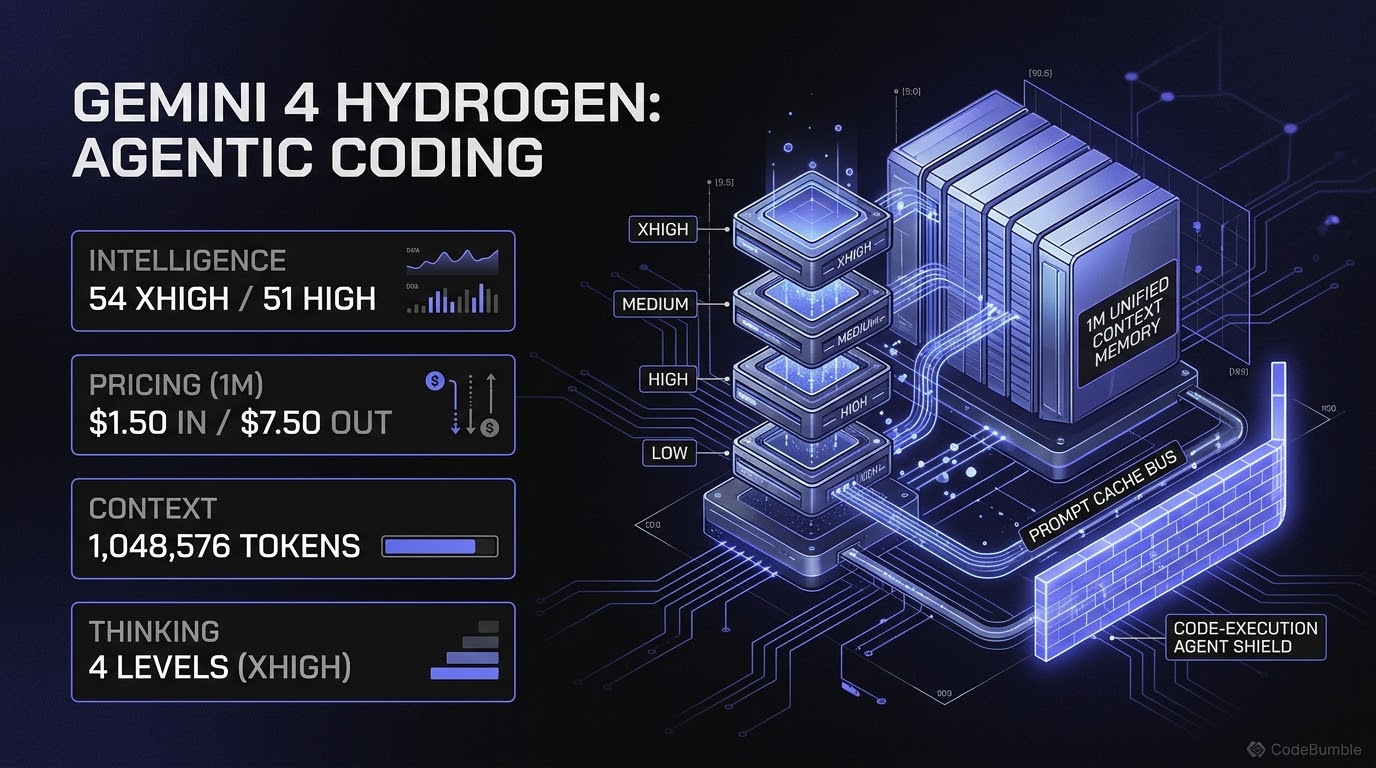
On November 12–13, 2026, Google rolled out Gemini 4 Hydrogen (gemini-4-hydrogen) to general availability across the Gemini API, Google AI Studio, Android Studio, Google Search, Google Antigravity, and GitHub Copilot. Positioned as the fast, cost-efficient execution model in the Gemini 4 family alongside frontier reasoning models Gemini 4 Carbon and Gemini 4 Argon, Hydrogen introduces a unified 1,048,576-token (1M) context window, 65,536-token (64K) default synchronous output (with up to 1M long decode via background execution or continuation), and four configurable thinking levels (low, medium, default high, and a new xhigh tier).
Crucially for production engineering teams, gemini-4-hydrogen is priced flat across its entire 1M-token window at $1.50 per million input tokens and $7.50 per million output tokens (including reasoning tokens), with implicit prompt caching at $0.075 per million input tokens and Batch/Flex tiers at $0.75 / $3.75. Despite its Flash-class pricing, Google and Artificial Analysis report that Gemini 4 Hydrogen surpasses Gemini 4 Argon on the Artificial Analysis Intelligence Index at its default high setting (51 vs. 50) and reaches 54 at xhigh.
For developers migrating from Gemini 3.8 Flash, Hydrogen is now the default model for the Antigravity agent in Gemini Managed Agents and is generally available in GitHub Copilot for multi-step tool use and repository debugging. However, engineering teams should pair its lower latency with strict thinking-level budgets and agentic security guardrails, as independent evaluators note that Hydrogen's security improvements are primarily benchmarked relative to Gemini 3.8 Flash rather than hardened frontier red-team baselines (NeuralTrust).
Gemini 4 Hydrogen Specifications & Pricing Matrix
Per the Google AI Studio Changelog, Google AI Studio Latest Models, and DataCamp's November 13 breakdown:
| Parameter / Tier | Specification | Operational Note |
|---|---|---|
| Model ID | gemini-4-hydrogen |
GA in Gemini API, AI Studio, GitHub Copilot, Databricks Unity Gateway |
| Unified Context Window | 1,048,576 tokens (1M) |
Input, thinking, and output tokens all share the 1M window |
| Max Output Tokens | 65,536 (64K) default / 1M long decode |
Synchronous responses cap at 64K; 1M decode via background/continuation |
| Thinking Levels (4) | low, medium, high (default), xhigh |
Google advises keeping most tasks on high; reserve xhigh for hard reasoning |
| Standard Pricing (1M) | $1.50 input / $7.50 output |
Flat across full 1M context; thinking tokens bill as output |
| Implicit Cache / Batch | $0.075 cache read / $0.75 in, $3.75 out |
Implicit caching only; Priority tier is $2.70 in / $13.50 out |
| Modalities | Text, image, speech, video input → Text output | Supports tool calling, structured JSON schema outputs, web search |
Technical Mechanics and Architecture
How the 4 Thinking Levels and Unified 1M Context Window Scale
Unlike fixed-compute models, gemini-4-hydrogen exposes explicit reasoning depth controls (low, medium, high, xhigh) so orchestrators can route simple classification or extraction calls to low/medium while reserving high/xhigh for multi-file refactoring and tool-calling loops:
+-----------------------------------------------------------------------------+
|         GEMINI 4 HYDROGEN: 4-TIER THINKING & UNIFIED 1M ARCHITECTURE        |
+-----------------------------------------------------------------------------+
|                                                                             |
|  [ INPUT + IMPLICIT CACHE ($0.075/1M) ]                                     |
|   Codebase / Logs / Multimodal (Text, Image, Speech, Video)                 |
|     |                                                                       |
|     +---> [ THINKING ROUTER (4 Configurable Tiers) ]                        |
|             |-- low    (Index: 27 | ~$0.29/task) -> Triage & formatting     |
|             |-- medium (Index: 41 | ~$0.80/task) -> Standard CRUD / tests   |
|             |-- high   (Index: 51 | ~$1.87/task) -> Default coding & agents |
|             +-- xhigh  (Index: 54 | ~$3.16/task) -> Deep debugging & audit  |
|                                                                             |
|  [ UNIFIED 1,048,576-TOKEN MEMORY POOL ]                                    |
|   Input Tokens + Reasoning Tokens ($7.50/1M) + Output Tokens (<= 64K sync)  |
|     +---> Tool Execution / Structured JSON -> Sandboxed Agent Runtime       |
+-----------------------------------------------------------------------------+
Because input, thinking, and output tokens share the same 1,048,576-token window and reasoning tokens are billed at the $7.50/1M output rate, leaving xhigh enabled globally on simple prompts both inflates latency ("overthinking") and increases per-task cost from roughly $1.87 (high) to $3.16 (xhigh) in Artificial Analysis benchmarks (DataCamp).
Defensive & Cost-Safe Code Pattern: Dynamic Thinking-Level Routing + Output Caps
Below is a safe Python routing helper using the official google-genai SDK pattern that dynamically selects thinking_level based on task complexity, enforces max_output_tokens to prevent runaway reasoning-token bills, and uses structured JSON outputs so downstream agent tools never execute unvalidated strings:
from enum import Enum
from pydantic import BaseModel, Field
from google import genai
from google.genai import types

class TaskComplexity(str, Enum):
    TRIAGE = "low"
    STANDARD = "medium"
    CODING = "high"
    DEEP_AUDIT = "xhigh"

class PatchProposal(BaseModel):
    target_file: str = Field(description="Relative repository path")
    summary: str = Field(description="Concise description of the fix")
    requires_human_review: bool = Field(default=True)

def run_bounded_hydrogen_agent(
    prompt: str,
    complexity: TaskComplexity = TaskComplexity.CODING,
    max_output_tokens: int = 8192,
) -> PatchProposal:
    """
    Calls gemini-4-hydrogen with explicit thinking_level routing,
    token budget caps, and strict Pydantic schema validation.
    """
    client = genai.Client()  # Uses GEMINI_API_KEY from environment

    config = types.GenerateContentConfig(
        thinking_config=types.ThinkingConfig(thinking_level=complexity.value),
        max_output_tokens=min(max_output_tokens, 65536),
        response_mime_type="application/json",
        response_schema=PatchProposal,
        temperature=0.2,
    )

    response = client.models.generate_content(
        model="gemini-4-hydrogen",
        contents=prompt,
        config=config,
    )
    return PatchProposal.model_validate_json(response.text)
Evidence: Benchmarks, Enterprise Evaluations, and Caveats
Google's November 13 announcement and independent third-party trackers provide concrete quantitative data across intelligence, latency, and cost:
| Evaluation / Metric | Reported Result | Source & Date |
|---|---|---|
| Artificial Analysis Intelligence Index | 54 (xhigh), 51 (high), 41 (medium), 27 (low) vs. 50 (Gemini 4 Argon) |
Google Blog / DataCamp (Nov 13, 2026) |
| Measured per-task cost (Artificial Analysis) | $0.29 (low), $0.80 (medium), $1.87 (high), $3.16 (xhigh) |
DataCamp / NeuralTrust (Nov 13, 2026) |
| Relative cost vs. peers (Artificial Analysis) | ~1/3 cost of Claude Sonnet 5.5 (max); ~2.5× cost of GPT-6.1 Sol (max) | DataCamp (Nov 13, 2026) |
| Enterprise partner evals (Google Blog) | Box: ~2× faster, 12% fewer tokens vs 3.8 Flash; Sheets: >30% faster; 276-run eval: 1.8× faster, 30% cleaner code | Google Blog (Nov 13, 2026) |
| Antibody safety/toxicology benchmark | 67% pass rate vs. 37% for best non-Gemini model (~13 min/task) | Google Blog (Nov 13, 2026) |
- Confidence Level: High on pricing, context window (
1,048,576tokens),64Ksynchronous cap, and Artificial Analysis Intelligence Index scores (54/51/41/27). - Benchmark & Security Caveats: As MindStudio and NeuralTrust note, while Hydrogen leads on several coding and document-reading benchmarks,
Claude Sonnet 5.5retained an edge in terminal-based coding, computer control, and certain scientific reasoning tasks in comparative tables. Furthermore, Google's published agent security comparisons are primarily framed againstGemini 3.8 Flash, so enterprises deployinggemini-4-hydrogenwith autonomous tool-calling or MCP servers should run independent prompt-injection and sandboxed execution tests before production cutover.
Adoption & Migration Playbook
Step 1: Audit Existing Gemini 3.8 Flash & Gemini 3.6 Flash Endpoints
Note that Gemini 3.6 Flash is scheduled for retirement on November 19, 2026 (with automatic redirection to Gemini 3.8 Flash on platforms such as Databricks), while Gemini 3.8 Flash is scheduled for deprecation in GitHub Copilot on December 14, 2026 in favor of Gemini 4 Hydrogen (GitHub Changelog). Inventory all model IDs in CI/CD configs and environment variables now.
Step 2: Implement Per-Task Thinking-Level Routing
Do not hardcode xhigh globally. Map lightweight tasks (log classification, PR summarization, JSON extraction) to low or medium, keep repository coding and debugging on high (default), and reserve xhigh for complex architectural reviews or multi-file root-cause analysis.
Step 3: Enforce 64K Synchronous Output & Budget Guardrails
Remember that synchronous calls cap at 65,536 output tokens and thinking tokens bill at $7.50/1M. Set explicit max_output_tokens limits on every client call and enable implicit prompt caching ($0.075/1M cache reads) by keeping static system prompts, tool schemas, and repository context prefixes stable across turns.
Step 4: Sandbox Tool Execution and Verify Agent Outputs
Because gemini-4-hydrogen is designed for multi-step tool use in GitHub Copilot and Google Antigravity, enforce strict least-privilege permissions on tool runners, require human approval for destructive file/database/IAM mutations (requires_human_review=True), and validate all structured outputs with Pydantic or JSON Schema before execution.
Step 5: Rollback Notes
If migrating from gemini-3.8-flash to gemini-4-hydrogen introduces unexpected latency spikes (due to high/xhigh reasoning depth) or schema formatting regressions, first step down thinking_level from xhigh → high → medium before rolling the model string back to gemini-3.8-flash in staging.
Frequently Asked Questions
1. What is the difference between Gemini 4 Hydrogen, Carbon, and Argon?
Gemini 4 Carbon and Gemini 4 Argon are Google's frontier deep-reasoning models for long-horizon problems, whereas Gemini 4 Hydrogen (gemini-4-hydrogen) is the fast, lower-cost execution model built for everyday coding, tool calling, and agentic workflows—yet still scores 51 (high) to 54 (xhigh) on the Artificial Analysis Intelligence Index, edging Argon's 50.
2. How much does the Gemini 4 Hydrogen API cost?
It is priced flat across its entire 1M-token context window at $1.50 per million input tokens and $7.50 per million output tokens (thinking tokens included). Implicit prompt caching costs $0.075/1M input tokens, Batch/Flex tiers cost $0.75 / $3.75, and a rate-limited free tier is available in Google AI Studio.
3. How do the 4 thinking levels affect latency and cost?
low, medium, high (default), and xhigh scale reasoning compute per request. In Artificial Analysis measurements, per-task cost rose from $0.29 (low) and $0.80 (medium) to $1.87 (high) and $3.16 (xhigh). Google recommends keeping most workloads on high and reserving xhigh for genuinely complex tasks.
4. Where is Gemini 4 Hydrogen available right now?
As of November 12–13, 2026, it is generally available in Google AI Studio, the Gemini API, Google Antigravity (for Pro/Ultra subscribers), Google Search, the Gemini app, GitHub Copilot (usage-based billing), and Databricks Unity Gateway.
5. Does Gemini 4 Hydrogen support a full 1M-token output?
Yes, with a caveat: input, thinking, and output share the 1,048,576-token window, and synchronous API calls cap at 65,536 (64K) output tokens. Generating up to 1M output tokens (long decode) requires background execution or client-side continuation.
Sources
- Google Blog: Introducing Gemini 4 Hydrogen for Agentic Workflows — Published November 13, 2026.
- Google AI Studio: Gemini API Release Notes & Gemini 4 Hydrogen Model Docs — Updated November 12–13, 2026.
- GitHub Changelog: Gemini 4 Hydrogen in GitHub Copilot — Published November 13, 2026.
- DataCamp: Gemini 4 Hydrogen Explained: Features, Benchmarks & Pricing — Published November 13, 2026.
- NeuralTrust: Gemini 4 Hydrogen: Benchmarks & Security — Published November 13, 2026.
Additional Integration Notes (Nov 13, 2026)
In addition to native Google AI Studio and Gemini API endpoints, gemini-4-hydrogen launched with Day-0 support on Databricks Unity Gateway (Foundation Model APIs) and LiteLLM, as well as OpenAI-compatible proxy endpoints. Teams migrating from Gemini 3.8 Flash should verify their SDK versions (google-genai or OpenAI-compatible adapters) and confirm that implicit prompt caching prefixes remain deterministic across multi-turn agentic loops to realize the $0.075/1M cache-read rate.