

Vulnerability
Inside CVE-2026-119618: Technical Dissection of the Apache HTTP/2 mod_http2 Race Condition and Remote Code Execution
On November 11, 2026, the Apache Software Foundation released Apache HTTP Server 2.4.71 resolving CVE-2026-119618, a critical CVSS 9.8 race condition in mod_http2 discovered by researchers at Anthropic and Google Cloud. Unauthenticated remote attackers transmitting concurrent HTTP/2 streams can corrupt heap memory and achieve code execution with httpd daemon privileges. Here is the technical root-cause analysis, heap mechanics, Suricata detection signatures, and patch playbook.
11 min read
Inside CVE-2026-119618: Technical Dissection of the Apache HTTP/2 mod_http2 Race Condition and Remote Code Execution
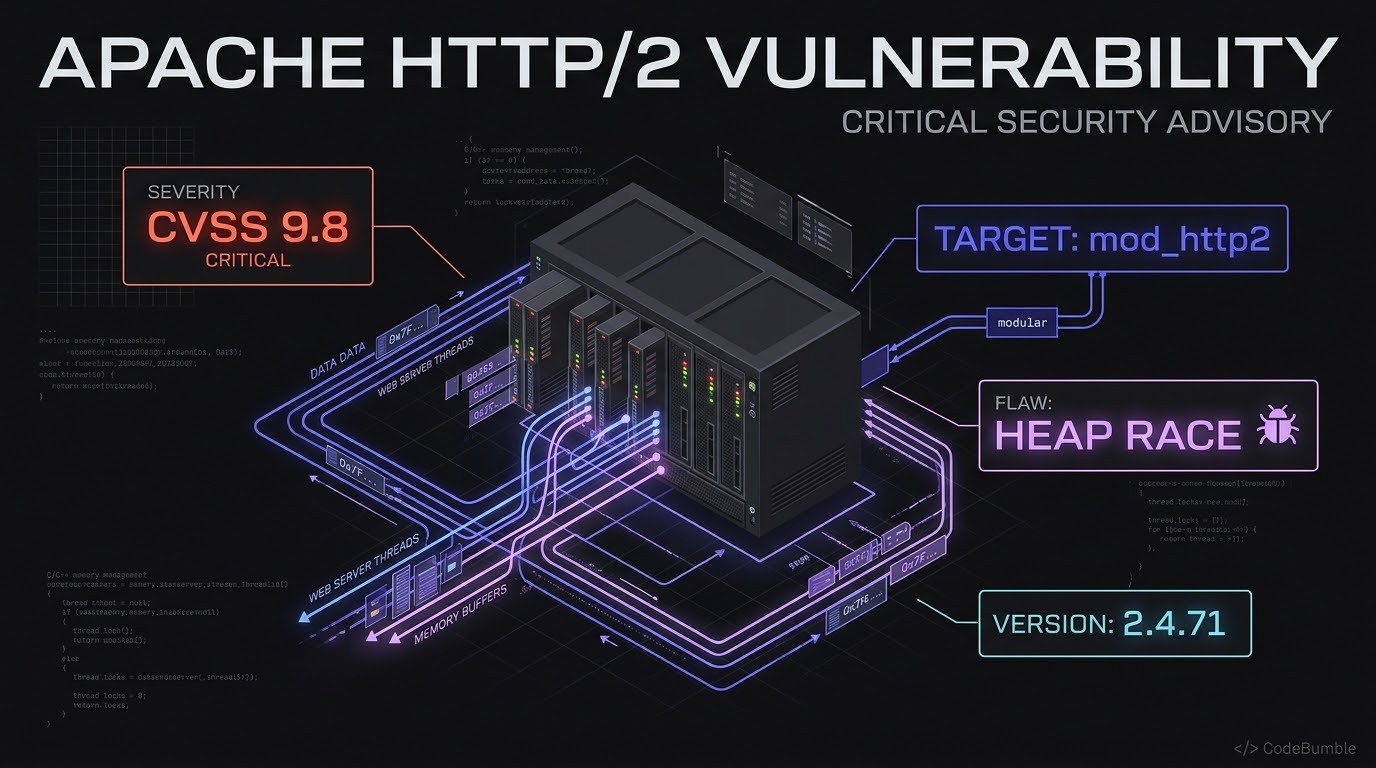
Executive Summary
On November 11, 2026, the Apache Software Foundation officially released Apache HTTP Server version 2.4.71, delivering urgent security patches for three vulnerabilities. Foremost among them is CVE-2026-119618, a maximum-severity flaw in the HTTP/2 protocol module (mod_http2). Classified as a concurrent execution race condition leading to heap memory corruption (CWE-362), the vulnerability was assigned a Common Vulnerability Scoring System (CVSS v3.1) base score of 9.8 by Red Hat and rated Critical across vendor advisories (AV:N/AC:L/PR:N/UI:N/S:U/C:H/I:H/A:H).
The vulnerability was independently discovered and reported to the Apache Security Team by two research teams:
- Anthropic OSS Scanner: Discovered autonomously via AI-driven fuzzing and static code analysis on October 26, 2026 (tracked internally as vulnerability report ANT-2026-MAPKT6MZ).
- Google Cloud Vulnerability Research: Independently analyzed and reported by security researchers Anthony Weems and Simon Scannell on November 3, 2026.
The operational blast radius of CVE-2026-119618 is extensive. It affects all Apache HTTP Server releases from 2.4.55 through 2.4.70, as well as standalone mod_h2 builds from version 2.0.8 through 2.0.42. Any web server configured with standard HTTP/2 support—specifically instances enabling the h2 (HTTP/2 over TLS) or h2c (HTTP/2 cleartext TCP) directives—is exposed to unauthenticated, remote code execution. Because exploitation occurs during protocol multiplexing before application-level authentication, a remote attacker transmitting crafted concurrent HTTP/2 stream headers can corrupt internal Apache Portable Runtime (APR) memory pools, hijack worker execution threads, and gain shell access under the privileges of the web server daemon (www-data or apache).
This technical guide provides an exhaustive dissection of the race condition inside modules/http2/h2_request.c, analyzes thread interaction between session controllers and worker pools, and outlines detection rules and emergency mitigations for enterprise infrastructure teams.
Technical Mechanics and Architecture
To understand how CVE-2026-119618 operates, one must examine the multi-threaded architecture of Apache's HTTP/2 implementation under modern Multi-Processing Modules (specifically mpm_event and mpm_worker).
+-------------------------------------------------------------------------------+
|                       UNTRUSTED CLIENT HTTP/2 CONNECTION                      |
+-------------------------------------------------------------------------------+
         |
         | [1] Multiplexed Ingress Stream Frames (HEADERS, DATA, WINDOW_UPDATE)
         v
+-------------------------------------------------------------------------------+
|                      APACHE SESSION / MASTER THREAD                           |
|                       Function: h2_session_process()                          |
|                                                                               |
|  * Manages global TCP connection & TLS session state                          |
|  * Parses HTTP/2 framing and constructs shared `req->headers` (APR table)     |
|  * Invokes `h2_request_end_headers()` to finalize inbound stream state       |
+-------------------------------------------------------------------------------+
         |                                             |
         | [2] Clones header table                     | [4] UNSYNCHRONIZED MUTATION:
         |     without mutex lock                      |     Writes Content-Length = 0
         v                                             v     into shared `req->headers`
+-----------------------------------+         +---------------------------------+
|       PER-REQUEST HEADERS         |         |     SHARED `req->headers`       |
|    Structure: `r->headers_in`     |         |     APR Memory Table Struct     |
+-----------------------------------+         +---------------------------------+
         |                                                     ^
         v                                                     |
+--------------------------------------------------------------+----------------+
|                       WORKER EXECUTION THREAD (h2_c2)                         |
|                       Function: h2_c2_process()                               |
|                                                                               |
|  * Concurrently reads `req->headers` while master thread mutates table        |
|  * APR array bucket pointers corrupted mid-read                              |
|  * Result: Heap out-of-bounds write / function pointer overwrite in memory    |
+-------------------------------------------------------------------------------+
         |
         v
+-------------------------------------------------------------------------------+
|                  REMOTE CODE EXECUTION (PRIVILEGE: httpd DAEMON)              |
+-------------------------------------------------------------------------------+
The Inherent Complexity of HTTP/2 Multiplexing in Apache
In legacy HTTP/1.1, connections process requests sequentially. A single TCP stream maps directly to one transaction handled by a single dedicated worker thread. HTTP/2 fundamentally changes this paradigm by multiplexing dozens of independent logical streams over a single persistent TCP connection.
To handle multiplexing efficiently, Apache's mod_http2 splits execution responsibilities across two distinct execution contexts:
- The Session Master Thread: Owns the primary client socket (
c1). It ingests network byte streams, decrypts TLS records, parses HTTP/2 binary frame types, manages stream flow-control windows, and reassembles request headers. - Worker Secondary Connections (
h2_c2): When an HTTP/2 stream completes its header block,mod_http2spawns or allocates a virtual secondary connection (c2) from the worker pool to execute standard Apache request processing filters (e.g., PHP execution, reverse proxying viamod_proxy, or static file serving).
The Flaw: Unsynchronized Mutation in assign_headers()
The vulnerability resides within the internal function assign_headers() located in source file modules/http2/h2_request.c.
When an HTTP/2 stream reaches the end of its header frame sequence, mod_http2 prepares the request data structure. The master thread constructs a shared header table (req->headers) using the Apache Portable Runtime (APR) array table abstraction (apr_table_t).
To bridge the request into the standard Apache request processing pipeline, assign_headers() copies the headers into the request record's r->headers_in table:
- The function performs an internal clone operation of
req->headers. - However, during specific request handling scenarios—such as processing requests with trailing headers, chunked content handoffs, or requests requiring synthetic normalization (e.g., setting or updating
Content-Length: 0)—the function subsequently writes directly into the sharedreq->headerstable. - The Race Window: This subsequent write occurs without acquiring an exclusive mutex lock on the shared table structure.
Concurrently, the assigned worker thread (h2_c2) begins execution. While the master thread is actively resizing the APR array, reallocating underlying bucket arrays, and modifying internal table elements, the worker thread simultaneously reads and dereferences those same memory pointers.
Heap Corruption to Code Execution
The APR table structure (apr_table_t) consists of an underlying apr_array_header_t containing pointer arrays, element counts, and memory pool allocations.
When concurrent read and write operations collide without atomic synchronization:
- Bucket Pointer Invalidation: The master thread's re-allocation shifts the base pointer of the table's memory block while the worker thread reads an outdated pointer offset.
- Heap Memory Corruption: The worker thread writes internal status flags or header modifications into unmapped or newly allocated adjacent heap memory blocks.
- Control Flow Hijacking: Attackers transmitting rapid, pipelined HTTP/2 stream sequences can reliably manipulate heap chunk alignments. By forcing worker threads to overwrite adjacent function pointers (such as internal stream clean-up callbacks or filter dispatch vectors), the attacker redirects execution flow to user-controlled shellcode payload buffers stored in the connection's memory pool.
Because the httpd worker process operates with direct OS-level execution rights, successful exploitation yields immediate remote shell access as the web server user.
Defensive Verification and Configuration Audit Script
To help system administrators and site reliability engineers audit their environments for vulnerable Apache HTTP/2 configurations, the following safe Python utility inspects local Apache configuration directives and tests whether active endpoints accept HTTP/2 protocol negotiation.
  // apache_http2_audit.py
  // Audits Apache configuration files and live endpoints for CVE-2026-119618 exposure
  // Verified against Apache HTTP Server 2.4.71 advisory specifications

import os
import sys
import re
import socket
import ssl

def audit_local_config(conf_path: str):
    print(f"[*] Inspecting Apache Configuration: {conf_path}")
    if not os.path.isfile(conf_path):
        print(f"[-] Configuration file not found: {conf_path}")
        return

    h2_enabled = False
    protocols_configured = False

    protocol_regex = re.compile(r'^\s*Protocols\s+(.*)$', re.IGNORECASE)
    loadmodule_regex = re.compile(r'^\s*LoadModule\s+http2_module\s+', re.IGNORECASE)

    with open(conf_path, 'r', encoding='utf-8', errors='ignore') as f:
        for line_no, line in enumerate(f, 1):
            clean = line.strip()
            if not clean or clean.startswith('#'):
                continue

            if loadmodule_regex.search(clean):
                print(f"[!] Line {line_no}: mod_http2 module is loaded: {clean}")

            match = protocol_regex.search(clean)
            if match:
                protocols_configured = True
                args = match.group(1).lower()
                if 'h2' in args or 'h2c' in args:
                    h2_enabled = True
                    print(f"[!] VULNERABLE DIRECTIVE on Line {line_no}: {clean}")

    if h2_enabled:
        print("\n[!] VERDICT: Server configuration enables HTTP/2 (h2/h2c).")
        print("    Vulnerable to CVE-2026-119618 if Apache version is 2.4.55 - 2.4.70.")
    elif protocols_configured:
        print("\n[+] VERDICT: Server explicitly limits Protocols (HTTP/2 disabled). Safe.")
    else:
        print("\n[*] Note: No explicit Protocols directive found. Check virtual host configurations.")

def test_remote_alpn(host: str, port: int = 443):
    print(f"\n[*] Probing remote endpoint {host}:{port} via TLS ALPN...")
    ctx = ssl.create_default_context()
    ctx.set_alpn_protocols(['h2', 'http/1.1'])

    try:
        with socket.create_connection((host, port), timeout=5) as sock:
            with ctx.wrap_socket(sock, server_hostname=host) as ssock:
                negotiated = ssock.selected_alpn_protocol()
                print(f"[+] Negotiated Protocol: {negotiated}")
                if negotiated == 'h2':
                    print("[!] ALERT: Remote endpoint negotiated HTTP/2 (h2). Exposed to CVE-2026-119618.")
                else:
                    print("[+] Remote endpoint did not negotiate HTTP/2. Not exposed.")
    except Exception as e:
        print(f"[-] Connection or TLS handshake failed: {e}")

if __name__ == "__main__":
    if len(sys.argv) > 2 and sys.argv[1] == "--remote":
        test_remote_alpn(sys.argv[2], int(sys.argv[3]) if len(sys.argv) > 3 else 443)
    elif len(sys.argv) > 1:
        audit_local_config(sys.argv[1])
    else:
        # Default Linux distribution paths
        candidates = ["/etc/apache2/apache2.conf", "/etc/httpd/conf/httpd.conf"]
        for p in candidates:
            if os.path.exists(p):
                audit_local_config(p)
                break
        print("\nUsage:")
        print("  Audit local config : python3 apache_http2_audit.py /path/to/httpd.conf")
        print("  Probe live server  : python3 apache_http2_audit.py --remote <hostname> [port]")
Vulnerability Evidence and Threat Exposure
The emergence of CVE-2026-119618 represents a critical operational risk due to the sheer volume of internet infrastructure powered by Apache HTTP Server.
Scope of Affected Infrastructure
According to telemetry from W3Techs and Netcraft, Apache HTTP Server powers approximately 28% to 32% of all active websites worldwide. In modern enterprise deployments, HTTP/2 is enabled by default to optimize mobile page load speeds and accelerate asset multiplexing.
Key exposure boundaries include:
- Direct Web Servers: Production web servers running Apache 2.4.55 through 2.4.70 directly terminating customer TLS traffic.
- Edge Reverse Proxies: Apache servers deployed as reverse proxies (
mod_proxy) in front of application runtimes (such as Python FastAPI/Gunicorn, Node.js, Ruby on Rails, or Java Tomcat). - Containerized Appliances: Docker and Kubernetes base images based on Ubuntu 22.04/24.04, Debian 12 (Bookworm), or Alpine that package vulnerable Apache packages without automated unattended upgrades.
Distribution and Operating System Patch Disparities
While the Apache Software Foundation tagged and released the source code for Apache 2.4.71 on November 11, 2026, downstream enterprise Linux distribution package pipelines show significant timing disparities:
- Red Hat Enterprise Linux (RHEL): Shipped security advisories RHSA-2026:98981 for RHEL 9 and RHEL 10 on November 11. Red Hat classified the flaw as Critical upstream (CVSS 9.8), but noted that in RHEL's packaging, each HTTP/2 stream utilizes segregated memory allocators, adding complexity to exploit weaponization.
- Debian Linux: Released fixed packages in Debian Unstable (Sid), while stable branches (Bookworm and Trixie) were actively building backports at disclosure.
- Ubuntu Linux: Canonical published CVE tracking data on November 12, with security updates rolling out to ESM and standard repositories.
- Amazon Linux: Published security tracking bulletins across AL2 and AL2023.
Enterprise Hardening and Incident Mitigation Playbook
Organizations operating Apache HTTP Server infrastructure must execute an immediate three-stage remediation workflow.
Phase 1: Emergency Workaround (Disabling HTTP/2)
If immediate binary upgrades to Apache 2.4.71 cannot be completed due to production maintenance windows or waiting on Linux vendor package updates, administrators can completely neutralize the vulnerability by disabling HTTP/2 protocol support.
In your global Apache configuration (httpd.conf or apache2.conf) and across all VirtualHost definitions, update the Protocols directive to enforce HTTP/1.1 only:
  // Emergency Mitigation for CVE-2026-119618
  // Restrict protocol negotiation strictly to HTTP/1.1
Protocols http/1.1
Alternatively, unload the mod_http2 module entirely:
  // On Debian / Ubuntu systems:
sudo a2dismod http2
sudo systemctl reload apache2

  // On RHEL / Rocky / AlmaLinux systems:
  // Comment out 'LoadModule http2_module modules/mod_http2.so' in /etc/httpd/conf.modules.d/00-base.conf
sudo systemctl reload httpd
Disabling HTTP/2 removes the vulnerable code path completely while maintaining full web application functionality over standard HTTP/1.1 connections.
Phase 2: Binary Upgrade to Apache 2.4.71
When vendor packages become available, upgrade the web server package immediately:
  // On Debian / Ubuntu:
sudo apt-get update
sudo apt-get install --only-upgrade apache2

  // On RHEL / AlmaLinux / Rocky Linux:
sudo dnf upgrade httpd

  // Verify installed Apache version
httpd -v
  // Output must show: Server version: Apache/2.4.71 (or patched vendor release)
Phase 3: Network Intrusion Detection Signatures
For organizations operating perimeter deep packet inspection or inline intrusion prevention systems (IPS), deploy the following Suricata network signatures to detect abnormal HTTP/2 stream multiplexing volume and malformed header mutations:
  // Suricata Rule: Detect Excessive Concurrent HTTP/2 Stream Creation targeting Apache
alert tcp $EXTERNAL_NET any -> $HTTP_SERVERS [80,443] (
    msg:"CODEBUMBLE DEFENSIVE - Potential Apache mod_http2 Race Condition Exploit Attempt (CVE-2026-119618)";
    flow:to_server,established;
    app-layer-protocol:http2;
    content:"|00 00 00 01|"; depth:4;
    threshold:type both, track by_src, count 100, seconds 1;
    reference:cve,2026-119618;
    reference:url,httpd.apache.org/security/vulnerabilities_24.html;
    classtype:attempted-admin;
    sid:202611111;
    rev:1;
)

  // Suricata Rule: Detect HTTP/2 Stream Header Injection with Rapid RST_STREAM
alert tcp $EXTERNAL_NET any -> $HTTP_SERVERS [80,443] (
    msg:"CODEBUMBLE DEFENSIVE - Rapid HTTP/2 Header Frame Reset Sequence";
    flow:to_server,established;
    app-layer-protocol:http2;
    content:"|03|"; offset:3; depth:1;
    threshold:type both, track by_src, count 50, seconds 2;
    reference:cve,2026-119618;
    reference:url,httpd.apache.org/security/vulnerabilities_24.html;
    classtype:attempted-dos;
    sid:202611112;
    rev:1;
)
Frequently Asked Questions (FAQ)
Does CVE-2026-119618 affect Apache servers configured for HTTP/1.1 only?
No. The vulnerability exists exclusively within the mod_http2 protocol parsing and stream dispatch engine. Servers that do not load mod_http2 or servers that restrict protocol negotiation to Protocols http/1.1 do not execute the vulnerable code path and are completely immune to this vulnerability.
Can web application firewalls (WAFs) block exploitation of CVE-2026-119618?
Only partially. Standard WAFs that inspect HTTP/1.1 payloads or terminate TLS before forwarding plain HTTP/1.1 to the Apache backend shield the web server. However, if the WAF operates as a pass-through reverse proxy or forwards native HTTP/2 (h2/h2c) multiplexed frames directly to Apache, standard HTTP keyword inspection cannot detect the low-level binary race condition occurring inside Apache's APR memory tables.
Why is CVE-2026-119618 rated CVSS 9.8 if no active exploitation was reported at launch?
The CVSS v3.1 specification evaluates intrinsic vulnerability characteristics rather than real-world threat telemetry. Because CVE-2026-119618 requires zero authentication (PR:N), has low attack complexity (AC:L), requires zero user interaction (UI:N), is network-accessible (AV:N), and results in complete compromise of confidentiality, integrity, and availability (C:H/I:H/A:H), the mathematical formula yields a base score of 9.8.
How did AI scanners assist in discovering this vulnerability?
Anthropic's open-source software scanner (ANT-2026-MAPKT6MZ) autonomously identified the unsynchronized pointer access in assign_headers() using large language model semantic code reasoning paired with symbolic execution. The finding was subsequently validated and submitted to Apache alongside independent reporting from Google Cloud Vulnerability Research.
Does upgrading PHP or application frameworks (like WordPress) resolve the flaw?
No. CVE-2026-119618 is an infrastructure vulnerability in the native compiled C binary of the Apache HTTP Server daemon itself. Application-level frameworks and CMS platforms running on top of Apache have no control over mod_http2 thread synchronization. Remediation must occur at the web server software or configuration layer.
Intelligence Sources and References
- Apache Software Foundation (November 11, 2026): Apache HTTP Server 2.4 Vulnerabilities Bulletin: Fixed in Apache HTTP Server 2.4.71 — Official security release advisory detailing CVE-2026-119618, CVE-2026-106023, and CVE-2026-109163.
https://httpd.apache.org/security/vulnerabilities_24.html - Red Hat Customer Portal (November 11, 2026): CVE-2026-119618: Critical Race Condition in Apache mod_http2 Leading to RCE — Red Hat security architecture impact analysis, CVSS 9.8 scoring, and RHSA-2026:98981 release data.
https://access.redhat.com/security/cve/cve-2026-119618 - NIST National Vulnerability Database (November 11, 2026): NVD Detail - CVE-2026-119618 (Apache Software Foundation) — Official vulnerability metrics, CWE-362 categorization, and affected CPE configurations.
https://nvd.nist.gov/vuln/detail/CVE-2026-119618 - SecurityWeek Analysis (November 12, 2026): Apache Patches Critical HTTP Server RCE Found by Anthropic and Google by Ionut Arghire — Technical investigation into independent vulnerability discovery by Anthropic OSS Scanner and Google Cloud Security.
https://www.securityweek.com/apache-patches-critical-http-server-rce-found-by-anthropic-google/ - Aviatrix Threat Research Center (November 13, 2026): CVE-2026-119618: Critical Apache HTTP/2 RCE Flaw - Deep Dive and Enterprise Triage — Perimeter exposure telemetry, multi-threading race conditions, and mitigation workflows.
https://aviatrix.ai/threat-research-center/critical-apache-http2-flaw-cve-2026-119618-rce-unauthenticated/