

Security
ASUS Control Center Express CVSS 10.0 Flaw (CVE-2026-114202): Hard-Coded Key Enables Unauthenticated Fleet Takeover
ASUS released Control Center Express 1.7.29 to patch CVE-2026-114202 (CVSS 10.0), a hard-coded cryptographic key flaw that lets unauthenticated remote attackers forge administrator tokens and seize control of managed PC fleets. Companion flaws CVE-2026-114204 and CVE-2026-114205, along with Enterprise/Datacenter CVE-2026-126574 and Armoury Crate CVE-2026-112115, were also addressed. Learn why you must update both the server and managed endpoint agents.
7 min read
ASUS Control Center Express CVSS 10.0 Flaw (CVE-2026-114202): Hard-Coded Key Enables Unauthenticated Fleet Takeover
Executive Summary
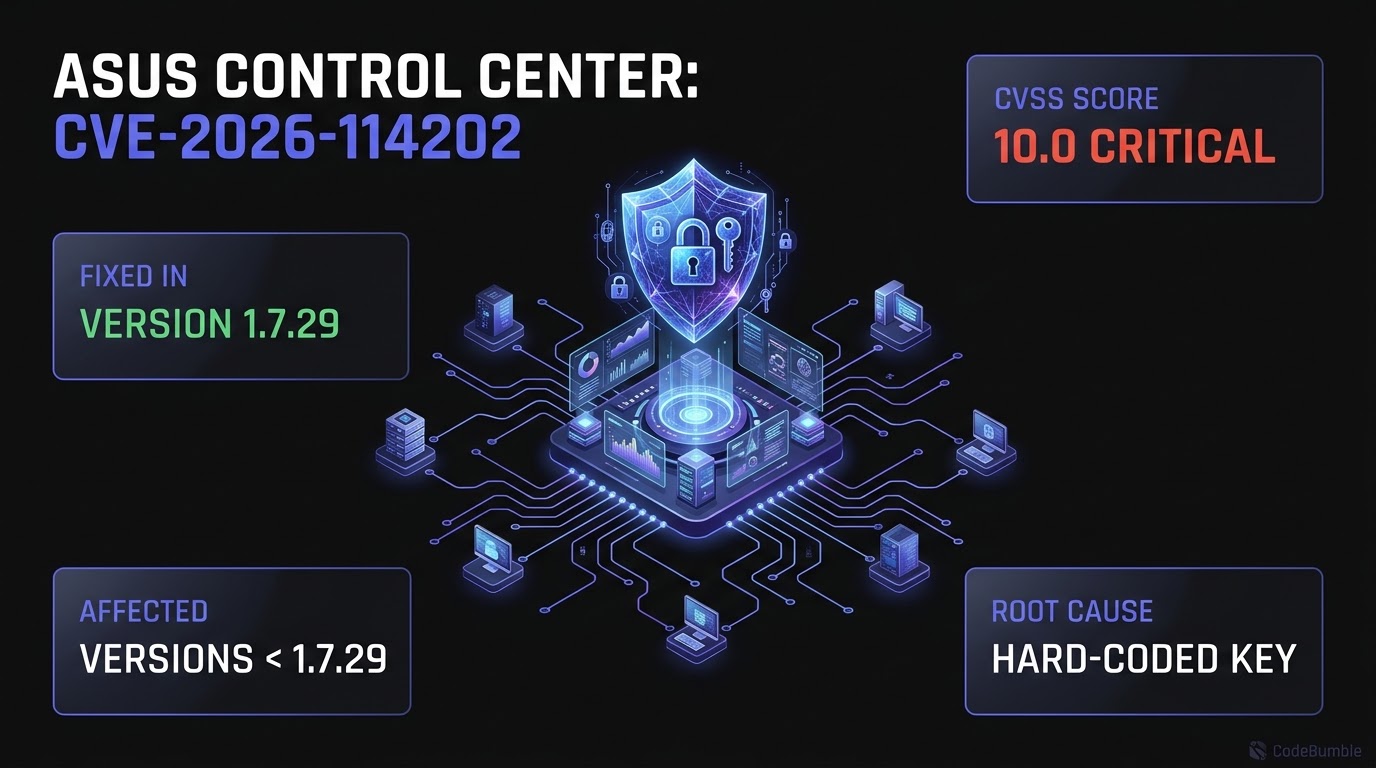
ASUS has released Control Center Express 1.7.29 to remediate three critical vulnerabilities in its centralized IT fleet management platform—led by CVE-2026-114202, a maximum-severity CVSS 10.0 flaw caused by a hard-coded cryptographic key. Any unauthenticated remote attacker who can reach an unpatched Control Center Express instance (< 1.7.29) can use the static key to forge a valid authentication token and obtain full administrator privileges with zero user interaction.
Two companion vulnerabilities in Control Center Express—CVE-2026-114204 (session token forgery via a hard-coded key for low-privileged attackers targeting recently logged-in accounts) and CVE-2026-114205 (an authorization flaw allowing a low-privileged user to create an administrator account)—are also fixed in version 1.7.29. Simultaneously, ASUS patched CVE-2026-126574 in Control Center Enterprise and Control Center Datacenter (allowing a low-privileged Viewer user to reset an administrator password) and CVE-2026-112115 in ASUS Armoury Crate (local DLL-loading privilege escalation).
According to Aviatrix Threat Research Center and MLQ.ai (November 20, 2026), organizations managing more than 200 supported ASUS business or workstation motherboard models rely on Control Center Express for remote inventory, configuration, and endpoint management. Because compromising a management console hands an attacker lateral control over every managed workstation, administrators must upgrade Control Center Express to 1.7.29, update endpoint agents on managed PCs, and isolate the management console from untrusted networks immediately.
| CVE Identifier | Product / Scope | Root Cause & Impact | Fixed Version |
|---|---|---|---|
| CVE-2026-114202 | ASUS Control Center Express (< 1.7.29) |
CVSS 10.0: Hard-coded cryptographic key -> unauthenticated admin token forgery | 1.7.29 (+ agent update) |
| CVE-2026-114204 | ASUS Control Center Express (< 1.7.29) |
Hard-coded key -> low-priv session token forgery for recently logged-in users | 1.7.29 |
| CVE-2026-114205 | ASUS Control Center Express (< 1.7.29) |
Authorization bypass -> low-priv user creates unauthorized admin account | 1.7.29 |
| CVE-2026-126574 | ASUS Control Center Enterprise / Datacenter | Authorization flaw -> Viewer role changes admin password | Patched concurrently (Nov 2026) |
| CVE-2026-112115 | ASUS Armoury Crate | High-severity local DLL-loading privilege escalation | Patched concurrently (Nov 2026) |
Technical Mechanics and Architecture
Why Hard-Coded Keys Break Fleet Management Security
Centralized IT management consoles sit at the top of enterprise trust boundaries. When an authentication or session-signing mechanism relies on a hard-coded cryptographic key embedded inside the application binary or server package, every installation worldwide shares the exact same secret. Once a researcher or threat actor extracts that static key via reverse engineering, no per-tenant randomness remains:
- Zero-Prerequisite Forgery (
CVE-2026-114202): An unauthenticated remote attacker crafts an administrator authentication token signed or encrypted with the extracted static key and submits it to the Control Center Express web/API interface, bypassing login entirely. - Session Hijacking & Account Persistence (
CVE-2026-114204,CVE-2026-114205): Low-privileged attackers can either forge session tokens for recently active accounts or invoke administrative account-creation endpoints directly. - Fleet-Wide Blast Radius: With administrator access to Control Center Express, an attacker can inspect asset inventories, read network topology and stored credentials, push configuration changes, or pivot laterally across all managed business workstations.
Management-Plane Compromise Architecture
+-------------------------------------------------------------------------+
|                    UNAUTHENTICATED REMOTE ATTACKER                      |
|  - Uses extracted static key from Control Center Express (< 1.7.29)     |
|  - Forges valid Administrator authentication token (CVE-2026-114202)    |
+------------------------------------+------------------------------------+
                                     |
                                     v
+-------------------------------------------------------------------------+
|           ASUS CONTROL CENTER EXPRESS CONSOLE (< 1.7.29)                |
|  1. Accepts forged admin token (zero user interaction required)         |
|  2. Exposes asset inventories, network topology, & stored credentials   |
|  3. Can create rogue admin accounts (compounded by CVE-2026-114205)     |
+------------------------------------+------------------------------------+
                                     |
         +---------------------------+---------------------------+
         |                           |                           |
         v                           v                           v
  [Workstation 1]             [Workstation 2]             [Workstation N]
  (200+ ASUS business/workstation motherboard models managed via agents)
Defensive Verification & Network Containment Snippets
1. Safe Windows Host Version & Service Audit (PowerShell, Read-Only):
# Read-only inventory check for ASUS Control Center Express on Windows hosts
Get-ItemProperty HKLM:\Software\Microsoft\Windows\CurrentVersion\Uninstall\*,
                 HKLM:\Software\Wow6432Node\Microsoft\Windows\CurrentVersion\Uninstall\* -ErrorAction SilentlyContinue |
    Where-Object { $_.DisplayName -like "*ASUS Control Center*" } |
    Select-Object DisplayName, DisplayVersion, InstallDate, Publisher
2. Defensive Windows Firewall / Management-Plane Isolation Example:
If an immediate maintenance window is required before upgrading to 1.7.29, restrict inbound TCP access to the Control Center Express console port strictly to authorized IT administration jump-host IPs (replace <CONSOLE_PORT> and <ADMIN_JUMP_IP> with your environment's values):
# Example Windows Defender Firewall rule restricting Control Center Express console access
New-NetFirewallRule `
    -DisplayName "Restrict ASUS Control Center Express Console" `
    -Direction Inbound `
    -Protocol TCP `
    -LocalPort <CONSOLE_PORT> `
    -RemoteAddress <ADMIN_JUMP_IP> `
    -Action Allow

New-NetFirewallRule `
    -DisplayName "Block Untrusted ASUS Control Center Express Access" `
    -Direction Inbound `
    -Protocol TCP `
    -LocalPort <CONSOLE_PORT> `
    -Action Block
Evidence & Operational Impact
Scope, Compliance, and Current Threat Landscape
- Affected Footprint: Control Center Express supports more than 200 ASUS business and workstation motherboard models, making it common in SMB, healthcare, financial, and enterprise engineering fleets.
- Compliance Implications: Aviatrix Threat Research Center notes that hard-coded cryptographic keys directly violate PCI DSS 4.0 credential-protection rules and create HIPAA 164.312 exposure in healthcare IT environments where unauthenticated admin takeover can expose endpoint data.
- Exploitation & Benchmarks:
- Wild Exploitation: As of November 20, 2026, the fetched reports (Aviatrix TRC, MLQ.ai, WindowsForum) do not report confirmed in-the-wild exploitation or a CISA KEV listing for
CVE-2026-114202, though they emphasize that hard-coded key flaws are trivial to weaponize once reverse-engineered. - Performance Benchmarks: Quantitative upgrade downtime or agent-rollout performance benchmarks for Control Center Express
1.7.29are unavailable in the fetched advisories.
- Wild Exploitation: As of November 20, 2026, the fetched reports (Aviatrix TRC, MLQ.ai, WindowsForum) do not report confirmed in-the-wild exploitation or a CISA KEV listing for
Hardening Playbook
Locate All ASUS Control Center & Armoury Crate Installations
- Query endpoint management/EDR inventories for ASUS Control Center Express (
< 1.7.29), Control Center Enterprise, Control Center Datacenter, and Armoury Crate.
- Query endpoint management/EDR inventories for ASUS Control Center Express (
Upgrade Control Center Express to
1.7.29AND Update Endpoint Agents- Install ASUS Control Center Express 1.7.29 on the management server.
- Per WindowsForum / Reddit advisory notes, update the managed endpoint agents after upgrading the server so client-server authentication aligns cleanly.
- Apply the concurrent patches for Control Center Enterprise / Datacenter (
CVE-2026-126574) and Armoury Crate (CVE-2026-112115).
Remove Internet & General-LAN Exposure
- Ensure no ASUS Control Center Express, Enterprise, or Datacenter web console is exposed to the public internet or reachable from general user VLANs. Place the management console behind VPN + MFA or a dedicated IT admin subnet.
Audit Administrator Accounts & Logs for Pre-Patch Abuse
- Review the Control Center Express user list for unauthorized administrator accounts (which could have been created via
CVE-2026-114205or forged sessions viaCVE-2026-114202). - Inspect web/application logs for anomalous login or admin-API calls from unexpected source IPs, and rotate administrative credentials after upgrading.
Example SIEM hunting query (Splunk/SPL-style) for unexpected admin-console access from outside IT admin subnets:
index=firewall OR index=edr_network dest_ip="<ASUS_CONSOLE_IP>" NOT src_ip IN ("<IT_ADMIN_SUBNETS>", "<MANAGED_AGENT_SUBNETS>") | stats count values(dest_port) as ports min(_time) as first_seen max(_time) as last_seen by src_ip- Review the Control Center Express user list for unauthorized administrator accounts (which could have been created via
Rollback & Change-Control Notes
- Snapshot the Control Center Express server VM and back up its database before upgrading to
1.7.29. If an agent-compatibility issue forces a temporary rollback, keep the management console completely disconnected from non-admin networks until1.7.29is restored.
- Snapshot the Control Center Express server VM and back up its database before upgrading to
Frequently Asked Questions (FAQ)
1. What is the CVSS score and root cause of CVE-2026-114202?
CVE-2026-114202 carries a maximum CVSS score of 10.0. It is caused by a hard-coded cryptographic key in ASUS Control Center Express (< 1.7.29) that allows an unauthenticated remote attacker to forge an administrator authentication token with zero user interaction.
2. Is upgrading the Control Center Express server to 1.7.29 enough? No. After upgrading the Control Center Express server to 1.7.29, administrators must also update the endpoint agents on managed PCs and audit existing administrator accounts for unauthorized additions.
3. Are ASUS Control Center Enterprise and Datacenter also affected? They are affected by a separate concurrent authorization flaw (CVE-2026-126574) that allows a remote user with the low-privileged Viewer role to change an administrator password and take over the account. Apply ASUS's concurrent November 2026 patches for Enterprise and Datacenter as well.
4. Is CVE-2026-114202 being actively exploited in the wild? As of November 20, 2026, the fetched advisories do not report confirmed wild exploitation, but because hard-coded keys require no user interaction or credentials, immediate patching and network isolation are critical.
5. What should we do if we cannot patch Control Center Express immediately?
Immediately block inbound access to the Control Center Express management console from the internet and general user networks using host or perimeter firewalls, allowing only trusted IT administration jump hosts until 1.7.29 is deployed.
Sources
- Aviatrix Threat Research Center — ASUS CVE-2026-114202: Critical Hard-Coded Key Flaw in Control Center Express. Published: November 20, 2026. URL: https://aviatrix.ai/threat-research-center/asus-control-center-express-cve-2026-114202-hard-coded-key-2026/
- MLQ.ai — ASUS patches a 10-rated hard-coded key flaw in Control Center Express that lets attackers forge admin tokens. Published: November 20, 2026. URL: https://mlq.ai/news/asus-patches-a-10-rated-hard-coded-key-flaw-in-control-center-express-that-lets-attackers-forge-admin-tokens/
- WindowsForum — ASUS Control Center Express 1.7.29 Fixes Critical Flaws Allowing Remote Admin Access. Published: November 20, 2026. URL: https://windowsforum.com/news/asus-control-center-express-1-7-29-fixes-critical-flaws-allowing-remote-admin-access.453271/