

Security
VMware vCenter Zero-Day (CVE-2026-123890): How ARMORY CASTLE Bypassed Login for Two Months Before VMSA-2026-0009
On November 19, 2026, Broadcom patched CVE-2026-123890 (CVSS 9.8), an authentication bypass in VMware Directory Service with no workaround. Google Threat Intelligence Group and Mandiant revealed that suspected PRC-nexus actor ARMORY CASTLE exploited the flaw as a zero-day in early September 2026 using BONESAW to steal vCenter keys and ESXi credentials. Learn which vCenter and VCF builds are fixed, why vCenter 7.0 has no published patch, and how to hunt for post-exploitation persistence.
8 min read
VMware vCenter Zero-Day (CVE-2026-123890): How ARMORY CASTLE Bypassed Login for Two Months Before VMSA-2026-0009
Executive Summary
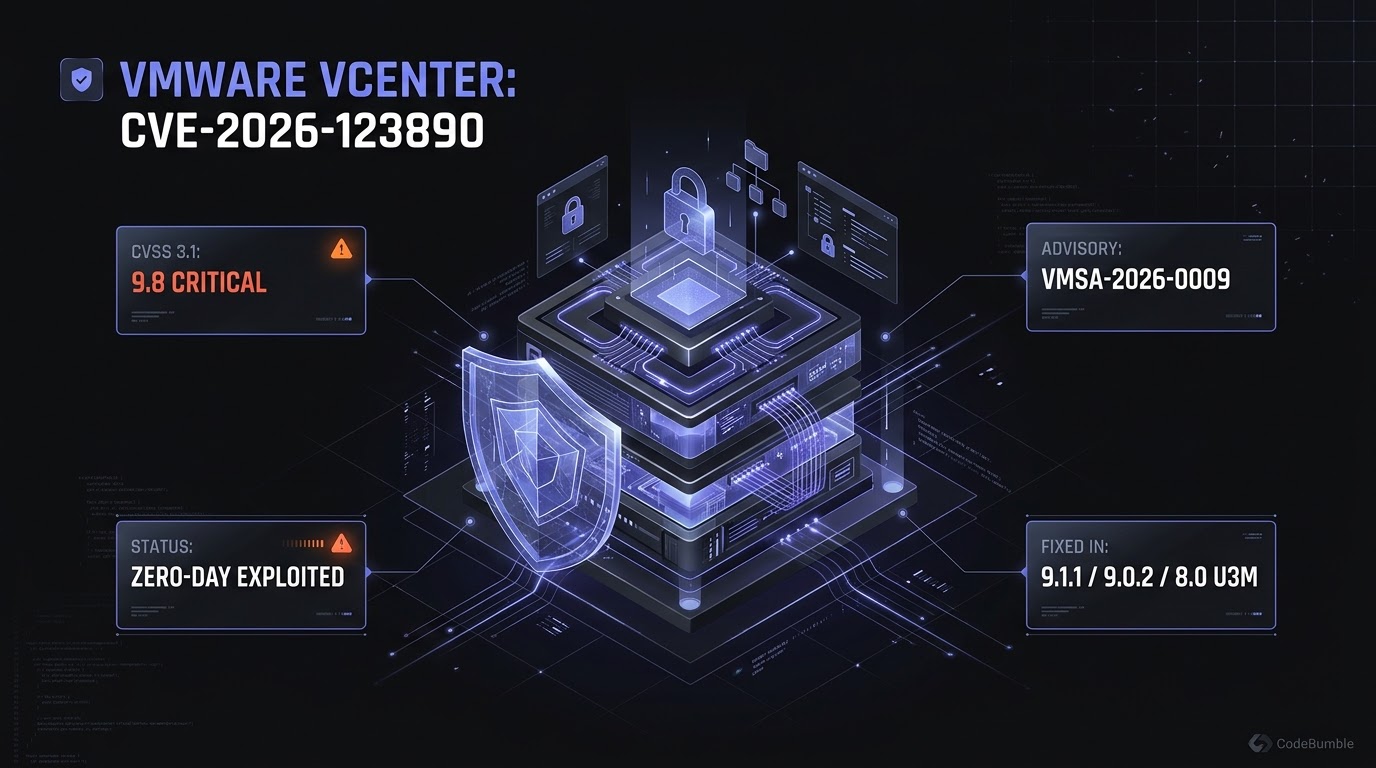
On November 19, 2026, Broadcom published security advisory VMSA-2026-0009, patching CVE-2026-123890 (CVSS v3.1 9.8 Critical, CWE-288), an authentication bypass vulnerability in the VMware Directory Service (vmdir) of VMware vCenter Server. Any attacker with network reachability to an unpatched vCenter appliance can bypass authentication without valid credentials, and Broadcom states there is no workaround.
The same day, Google Threat Intelligence Group (GTIG) and Mandiant (which discovered and reported the flaw) disclosed in their report "ARMORY CASTLE Exploits vSphere" that a suspected China-nexus espionage group tracked as ARMORY CASTLE (formerly UNC5221) exploited CVE-2026-123890 as a zero-day in early September 2026—more than two months before Broadcom's patch—using a Go-based tool named BONESAW. During the documented intrusion, the threat actor created a rogue administrator account, extracted vCenter's directory database, SAML token service signing key, master key, and PostgreSQL password file, and pivoted to ESXi hosts to copy Windows NTDS and registry files from virtual machine disks.
Fixed releases shipped on November 19, 2026 for vCenter 9.1.1.0200 (build 25901347), 9.0.2.0200 (build 25901331), 8.0 Update 3m (8.0.3.01200, build 25934264), and VMware Cloud Foundation (VCF) 5.2.5 (via asynchronous patching per Broadcom KB 88287). VMware vCenter 7.0 has no published fix; Broadcom directs 7.0 users to contact Broadcom Support. Note a key source discrepancy: Broadcom's advisory does not mention active exploitation in the wild, and CVE-2026-123890 was not listed in CISA's Known Exploited Vulnerabilities (KEV) catalog (version 2026.11.18) when checked on November 19, 2026.
| Attribute | Verified Value | Source |
|---|---|---|
| CVE Identifier | CVE-2026-123890 (CWE-288: Auth Bypass Using an Alternate Path) |
Broadcom / NVD / CVE.org |
| Broadcom Advisory | VMSA-2026-0009 (Published November 19, 2026) |
Broadcom / Rescana |
| CVSS v3.1 Base Score | 9.8 Critical | Broadcom / NVD |
| Affected Component | VMware Directory Service (vmdir) in VMware vCenter Server |
Broadcom / Mandiant |
| Fixed Versions & Builds | 9.1.1.0200 (25901347), 9.0.2.0200 (25901331), 8.0 U3m (25934264), VCF 5.2.5 |
Broadcom Release Notes (Nov 19, 2026) |
| vCenter 7.0 Status | No published fix; contact Broadcom Support | Broadcom / MLQ.ai |
| Zero-Day Exploitation | Exploited in early September 2026 by ARMORY CASTLE using BONESAW | GTIG / Mandiant (Nov 19–20, 2026) |
| CISA KEV Status | Not listed in KEV v2026.11.18 (checked Nov 19, 2026) |
Rescana / ThreatDefence |
Technical Mechanics and Architecture
How VMware Directory Service Bypass Enables Full Infrastructure Takeover
VMware Directory Service (vmdir) is the core LDAP/directory identity store inside vCenter Server, managing Single Sign-On (SSO) principals, administrator roles, and trust relationships across the vSphere environment. Because CVE-2026-123890 (CWE-288) allows an unauthenticated caller with network access to bypass authentication in vmdir, an attacker who can reach vCenter from a compromised internal server or management segment can immediately perform privileged directory operations—including provisioning a new administrator account—without valid credentials.
In GTIG's forensic investigation of ARMORY CASTLE's September 2026 campaign:
- Initial Perimeter Entry: The actor initially compromised a BeyondTrust Remote Support appliance (exploiting
CVE-2026-102764, which CISA added to KEV on October 16, 2026), pivoted to an internal Linux appliance, and reached an internal vCenter Server that was already patched against earlier July 2026 flaws (CVE-2026-59309). - Scanning & Exploit Delivery: GTIG observed ARMORY CASTLE scanning for TCP ports 443, 5480, and 2012, and using TCP 2012 (the
vmdirLDAP/directory port) to deliver the BONESAW exploit. - Credential & Key Extraction: After bypassing login and creating an administrator account, the actor extracted four high-value secrets from vCenter:
- The vCenter directory database
- The SAML token service signing key (allowing offline forging of SAML authentication tokens)
- The vCenter master key
- The PostgreSQL password file
- Hypervisor & Guest VM Pivot: With vCenter control established, the actor moved laterally to ESXi hosts and extracted Windows NTDS (
ntds.dit) and registry hives directly from virtual machine disks.
Attack & Pivot Architecture
+-------------------------------------------------------------------------+
|  PERIMETER ENTRY (GTIG Documented Chain)                                |
|  BeyondTrust Appliance (CVE-2026-102764) -> Internal Linux Appliance    |
+------------------------------------+------------------------------------+
                                     |
             Scans TCP 443, 5480,    |  Exploits TCP 2012 (vmdir)
             2012 on internal net    |  using BONESAW (CVE-2026-123890)
                                     v
+-------------------------------------------------------------------------+
|  VMWARE VCENTER SERVER (Unpatched < 9.1.1.0200 / 9.0.2.0200 / 8.0 U3m)  |
|  1. Authentication Bypass in VMware Directory Service (vmdir)           |
|  2. Creates Rogue Admin Account                                         |
|  3. Steals: Directory DB, SAML Signing Key, Master Key, Postgres Pass   |
+------------------------------------+------------------------------------+
                                     |
                                     v
+-------------------------------------------------------------------------+
|  ESXI HOSTS & VIRTUAL MACHINES                                          |
|  - Pivots to ESXi hypervisors                                           |
|  - Copies Windows NTDS (ntds.dit) & Registry files from VM disks        |
+-------------------------------------------------------------------------+
Defensive Reachability & Version Verification Snippets
As Rescana highlighted on November 20, 2026, Broadcom's advisory states only "network access to vCenter" without naming a single port, so defenders should not assume blocking TCP 2012 alone closes the vulnerability. However, testing whether non-admin server subnets can reach vCenter management and directory ports (443, 2012, 5480, 22) immediately reveals lateral-movement exposure.
1. Safe Management-Plane Reachability Check (From Non-Admin Subnets):
#!/usr/bin/env bash
# Read-only TCP reachability audit from a non-admin server segment to vCenter
# Reference: GTIG / Rescana port scope (443, 2012, 5480, 22)
set -euo pipefail

VC_HOST="${1:?Usage: $0 <vcenter_hostname_or_ip>}"

for port in 443 2012 5480 22; do
    if nc -vz -w3 "$VC_HOST" "$port" 2>/dev/null; then
        echo "[EXPOSED] $VC_HOST:$port is reachable from this segment"
    else
        echo "[BLOCKED] $VC_HOST:$port is not reachable"
    fi
done
2. Safe PowerCLI Version & Build Verification (Read-Only):
# Verify vCenter version and build against VMSA-2026-0009 fixed builds
# Fixed builds (Nov 19, 2026):
#   9.1.1.0200 -> Build 25901347
#   9.0.2.0200 -> Build 25901331
#   8.0 U3m (8.0.3.01200) -> Build 25934264

Connect-VIServer -Server "vcenter.example.internal"
$ver = $global:DefaultVIServer.Version
$bld = $global:DefaultVIServer.Build
Write-Host "Connected vCenter Version: $ver | Build: $bld"
Evidence & Operational Impact
Companion Flaws in VMSA-2026-0009
Alongside CVE-2026-123890, Broadcom's VMSA-2026-0009 advisory patches four additional vulnerabilities requiring authentication or local access (none of which have reported wild exploitation):
- CVE-2026-123891 (CVSS
8.1): SQL injection in SDDC Manager. - CVE-2026-123892 (CVSS
7.2): Authenticated command injection in SDDC Manager. - CVE-2026-123893 (CVSS
6.7): Local privilege escalation in SDDC Manager. - CVE-2026-123894 (CVSS
6.7): SAML token signature bypass in VMware Tools for Windows.
Source Discrepancies & Evidence Confidence
- Exploitation Confidence (High for Targeted Espionage; No Mass PoC Yet): GTIG and Mandiant confirmed zero-day exploitation in early September 2026 in a victim environment, though Broadcom's advisory omitted exploitation details and CISA's KEV
2026.11.18feed had not yet added the CVE as of November 19, 2026. No public PoC exploit forCVE-2026-123890was identified in the fetched reports—however, as Rescana notes, absence of a public PoC is not a safety margin when a threat actor already has a working binary (BONESAW). - Performance Benchmarks: Quantitative upgrade downtime or directory-service latency benchmarks for
9.1.1.0200,9.0.2.0200, and8.0 U3mare unavailable in the fetched advisories.
Hardening Playbook
Apply VMSA-2026-0009 Patches Immediately
- Upgrade vCenter Server to 9.1.1.0200 (build
25901347), 9.0.2.0200 (build25901331), or 8.0 U3m (8.0.3.01200, build25934264), and update VCF 5.2.5 via asynchronous patching (KB 88287). - If you still operate vCenter 7.0, contact Broadcom Support immediately and isolate the appliance behind strict jump-host ACLs.
- Upgrade vCenter Server to 9.1.1.0200 (build
Isolate vCenter Management Ports from General Server Networks
- Because ARMORY CASTLE pivoted from a compromised internal Linux appliance to vCenter, ensure TCP 443, 5480, 2012, and 22 are reachable only from dedicated, MFA-protected administrative jump hosts—never from general server VLANs or VPN user pools.
Hunt for Pre-Patch Compromise Since Early September 2026
- Patching alone does not evict an attacker who already stole your SAML signing key or created a rogue admin account. Preserve vCenter, ESXi, and firewall logs from September 2026 onward for any vCenter that was reachable from non-admin networks.
- Audit vCenter SSO /
vmdiradministrator accounts for unauthorized additions, inspect ESXi SSH/shell logs and datastore access for unexpected reads of.vmdkfiles (especially domain controller disks containingntds.dit), and rotate the SAML token signing certificate, vCenter master key, and PostgreSQL credentials if compromise is suspected.
Example SIEM hunting query (Splunk/SPL-style) for anomalous connections to
vmdir(TCP 2012) or VAMI (TCP 5480) from non-jump-host sources:index=firewall OR index=network dest_ip="<VCENTER_IP>" dest_port IN (2012, 5480, 22) NOT src_ip IN ("<ADMIN_JUMP_HOSTS>") | stats count values(dest_port) as ports min(_time) as first_seen max(_time) as last_seen by src_ipRollback & Change-Control Notes
- Take a verified file-based backup and offline snapshot (per Broadcom's vCenter snapshot rules for Enhanced Linked Mode) before applying
8.0 U3m,9.0.2.0200, or9.1.1.0200. Because there is no workaround forCVE-2026-123890, if an upgrade must be rolled back due to an integration issue, keep vCenter completely isolated from all non-jump-host networks until the patch is reapplied.
- Take a verified file-based backup and offline snapshot (per Broadcom's vCenter snapshot rules for Enhanced Linked Mode) before applying
Frequently Asked Questions (FAQ)
1. Is there a workaround for CVE-2026-123890 if we cannot patch vCenter today?
No. Broadcom's VMSA-2026-0009 advisory explicitly states there is no workaround. Restricting network access to vCenter management ports (443, 5480, 2012, 22) strictly to hardened admin jump hosts reduces lateral exposure, but patching is mandatory.
2. Is blocking TCP port 2012 enough to stop exploitation?
No. While GTIG observed ARMORY CASTLE exploiting CVE-2026-123890 over TCP 2012, Broadcom's advisory specifies "network access to vCenter" without restricting the scope to a single port. Isolate all vCenter management interfaces and patch immediately.
3. If we patch vCenter to 8.0 U3m or 9.x, are we safe from earlier intrusions? Not necessarily. GTIG's forensic findings show ARMORY CASTLE created rogue administrator accounts and stole the vCenter directory database, SAML token signing key, master key, and PostgreSQL password file—persistence mechanisms that survive a software patch.
4. Does VMware vCenter 7.0 have a patch for CVE-2026-123890? No published fix is available for vCenter 7.0 in VMSA-2026-0009; Broadcom advises vCenter 7.0 customers to contact Broadcom Support.
5. Why is CVE-2026-123890 not in the CISA KEV catalog yet?
Broadcom disclosed VMSA-2026-0009 and GTIG published its exploitation report on November 19, 2026, after CISA's November 18 KEV update (2026.11.18). Defenders should treat it as actively exploited regardless of KEV lag.
Sources
- Rescana Advisory Analysis — VMware vCenter Auth Bypass Exploited per Google (CVE-2026-123890): Patch Now (citing Broadcom VMSA-2026-0009, vCenter release notes, NVD, CVE.org, CISA KEV v2026.11.18, and GTIG/Mandiant). Published: November 20, 2026. URL: https://www.rescana.com/post/vmware-vcenter-cve-2026-123890-directory-service-auth-bypass-patch-now
- MLQ.ai — Suspected Chinese hackers exploited a VMware vCenter flaw as a zero-day for over two months before Broadcom's patch. Published: November 20, 2026. URL: https://mlq.ai/news/suspected-chinese-hackers-exploited-a-vmware-vcenter-flaw-as-a-zero-day-for-over-two-months-before-broadcoms-patch/
- ThreatDefence — VMware vCenter CVE-2026-123890 Zero-Day: Patching and Hunting. Published: November 20, 2026. URL: https://threatdefence.com/article/vmware-vcenter-cve-2026-123890-zero-day-patching-hunting
- The Hacker News — Critical VMware vCenter Zero-Day Flaw Lets Network Attackers Bypass Authentication. Published: November 19, 2026. URL: https://thehackernews.com/2026/11/critical-vmware-vcenter-flaw-cvss-98.html