

Automation
Claude Ship Beta: Three-Agent GitHub PR Review, Automated Fixes, and Policy-Driven Approvals
Launched on November 23, 2026, Anthropic's Claude Ship bundles three coordinated agents—Code Review, PR Steward, and Claude Approvals—to automate GitHub pull requests from review through policy checks. Here is how the pipeline separates fix-pushing from merge authority, what it costs in tokens, and which branch-protection settings prevent unreviewed merges.
7 min read
Claude Ship Beta: Three-Agent GitHub PR Review, Automated Fixes, and Policy-Driven Approvals
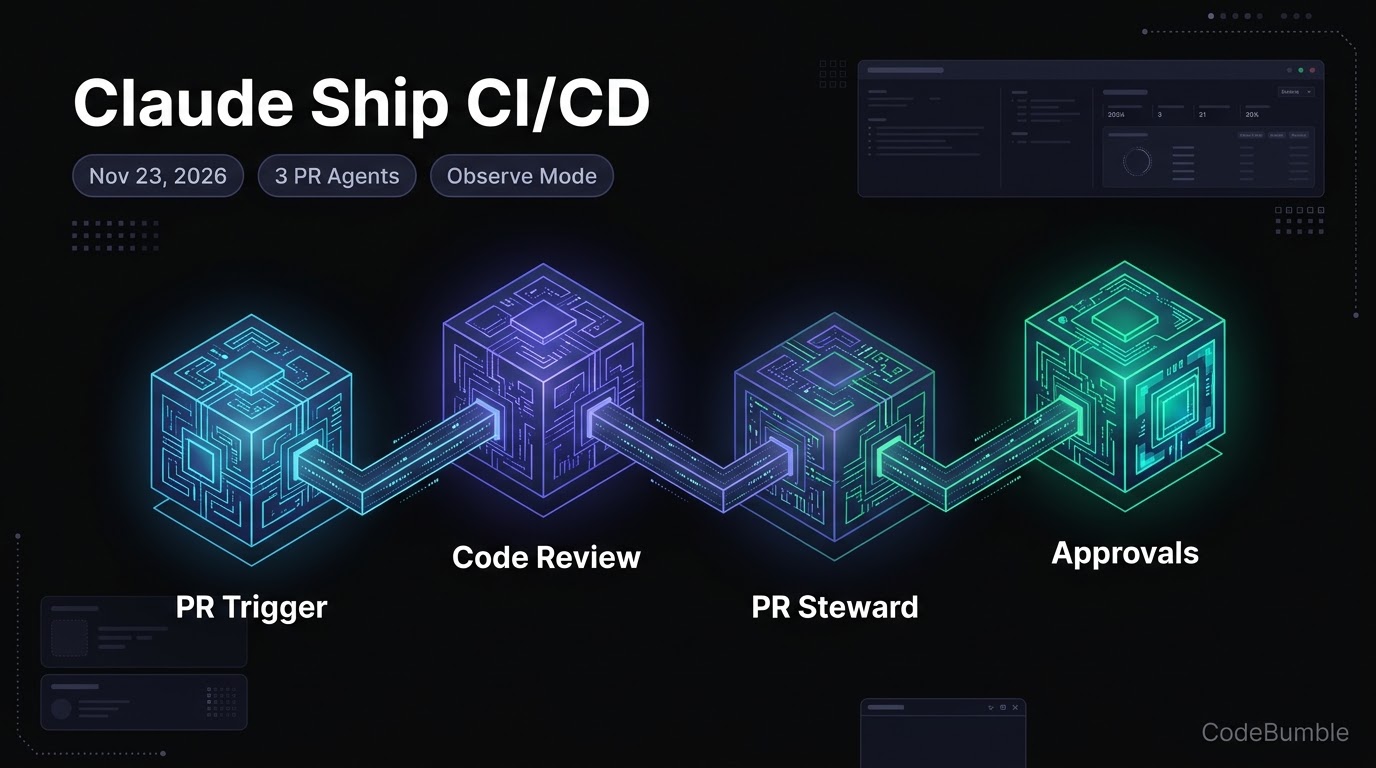
Executive Summary
- Three-Agent GitHub PR Pipeline (Anthropic, Nov 23, 2026): Anthropic launched Claude Ship in beta for Claude Team and Enterprise organizations on GitHub, combining generally available Code Review with two new public-beta agents—PR Steward and Claude Approvals.
- Separation of Duties by Design (Claude Code Docs): Code Review posts severity-ranked findings (
Important,Nit,Pre-existing) and never merges; PR Steward pushes commits to fix failing CI checks, merge conflicts, and review feedback and is designed never to approve or merge; Claude Approvals evaluates.claude/approvals.ymlpolicies to decide whether routine changes can be approved or require human sign-off. - CLI and Repository Triggers (
/shipDocs): Individual developers can invoke/shipor/stewardlocally in Claude Code v2.1.330+ (withgh2.63+ andgit2.38+), while admins can enable repository-wide automation per repo. - Token Billing, Exclusions, and Auto-Merge Risk (CellCog, Nov 23, 2026): Claude Ship is billed on tokens outside included plan usage, excludes organizations using Zero Data Retention (ZDR), HIPAA, or customer-managed encryption keys, and carries an explicit warning that combining GitHub auto-merge with a policy not requiring a human reviewer can merge code without human action.
What Changed: Three-Agent PR Architecture
As coding agents generate pull requests faster than human reviewers can clear the queue, the bottleneck in software delivery has shifted from writing code to triaging CI failures, resolving merge conflicts, and routing approvals. On November 23, 2026, Anthropic introduced Claude Ship to automate those post-PR handoffs while preserving repository-level guardrails.
flowchart LR
    A[Developer / /ship in Claude Code] -->|Opens or Updates PR| B[Code Review Agent GA]
    B -->|Important / Nit / Pre-existing Findings| C[PR Steward Agent Beta]
    D[Failing CI Checks & Merge Conflicts] --> C
    C -->|Pushes Fix Commits + Undo Instructions| E[Claude Approvals Agent Beta]
    E -->|Evaluates .claude/approvals.yml| F{Policy Met?}
    F -->|Routine Change| G[Automated Approval]
    F -->|Sensitive Path / Finding| H[Human Reviewer Sign-Off]
Role Isolation Across the Three Agents
Rather than giving a single autonomous agent unrestricted write and merge permissions, Claude Ship's documentation divides responsibilities across three specialized components:
- Code Review (Generally Available): Evaluates pull requests against the broader codebase across multiple lenses, adversarially verifies candidate issues, and posts inline comments categorized by severity (
Important,Nit, orPre-existing). Admins configure review depth per repository as Quick, Standard, or Deep (Anthropic). - PR Steward (Public Beta): Responds to failing CI checks, merge conflicts, and review comments from Code Review, third-party tools, or human teammates. After every push, PR Steward posts a comment summarizing what changed and how to revert it. Authors can steer it with
@claude <instruction>, and anyone with repository write access can halt it with@claude stop(The Defiant, Nov 24, 2026). Crucially, PR Steward is designed not to approve or merge pull requests. - Claude Approvals (Public Beta): Functions as what Claude Code team member Addy Osmani described as "a smarter CODEOWNERS" (CellCog). Teams define rules in
.claude/approvals.ymlon the default branch—specifying path-based human reviewer counts, natural-language classifiers, and whether Claude's approval satisfies branch protection.
Local CLI Invocation (/ship and /steward)
Developers who want to run the workflow on individual branches before enabling repository-wide automation can use two built-in commands in Claude Code v2.1.330 or later, provided gh (v2.63+) is authenticated and git (v2.38+) is installed (/ship Command Docs):
# Open a PR (if none exists), run Code Review, and start a PR Steward watch loop
/ship

# Skip the initial review on an already-open PR and watch for CI/review feedback
/steward
Both commands run locally in a terminal clone (they are not available in cloud sessions) and respect .claude/skills/steward/SKILL.md for repository-specific fix instructions (Troubleshooting Docs).
Reliability, Cost, and Performance Analysis
Evaluating Claude Ship for production CI/CD requires separating Anthropic's internal telemetry from independent verification, and accounting for token-based cost scaling.
Internal Telemetry vs. Independent Verification
Anthropic reports that on its own Claude Code engineering team—where Claude's review acts as one layer in a broader process—merged pull requests more than doubled between June and September 2026 while the share of reverted pull requests fell by more than 40% (Introducing Claude Ship). However, as CellCog (November 23, 2026) and Gadgets Now (November 24, 2026) both note, those figures are company-reported, Anthropic has not published raw PR counts, and independent third-party benchmarks of PR Steward and Claude Approvals have not yet been published.
Pilot customers quoted in Anthropic's announcement highlighted triage efficiency rather than hands-off merging:
- Vatsal Bhatt, Director of Engineering at TELUS Digital, stated: "We keep a human in the loop, and the human's time now goes to the changes that need it."
- Alex Devkar, SVP of Engineering and Analytics at Carvana, noted that PR Steward helps teams "spend less time working through code review feedback and more time building."
Token Billing, Credits, and Cost Triggers
| Agent / Command | Availability | Billing Model | Spend Controls & Gotchas |
|---|---|---|---|
| Code Review | Generally Available | Token-based via org usage credits (outside plan quota) | Configurable monthly spend limit; depth (Quick/Standard/Deep) drives token volume (Anthropic) |
| PR Steward | Public Beta | Token-based via org usage credits | Admin spend limits supported; no limit is enforced until explicitly set (CellCog) |
| Claude Approvals | Public Beta | No base fee; policy classifiers billed on tokens | Referencing Claude's review in .claude/approvals.yml triggers a billed Code Review even in observe mode |
/ship & /steward |
Claude Code v2.1.330+ | Counts against standard Claude Code usage | Runs locally using developer's gh and git credentials (Claude Code Docs) |
Eligible Claude Enterprise organizations can claim at least $10,000 in Claude Ship credits (valid for 30 days after claiming) through January 15, 2027 (Anthropic).
Reliability and Security Caveats
Anthropic's documentation highlights two critical reliability boundaries:
- AI Miss Rate: Anthropic's FAQ explicitly warns that "Claude Ship uses AI and may miss bugs, security vulnerabilities, or other issues" (CellCog).
- Unattended Auto-Merge Hazard: If a repository enables GitHub auto-merge or a merge queue alongside an approval policy that does not require a human reviewer, "a change can merge without anyone acting" (CellCog).
Practical Implementation and Trade-Offs
For DevOps and platform engineering teams evaluating Claude Ship against traditional deterministic CI gates (linters, CODEOWNERS, Dependabot/Renovate) or custom GitHub Actions workflows, Anthropic's recommended rollout sequence minimizes both cost surprises and merge risk:
- Start With Scoped Code Review: Enable Code Review on a single non-critical repository, set a monthly spend cap immediately, and measure average per-PR token cost before expanding across the organization (CellCog).
- Gate PR Steward in Manual Mode: Enable PR Steward in Manual mode first so it only pushes commits when a developer explicitly comments
@claude steward, preventing runaway token burn on noisy draft PRs. - Run Claude Approvals in Observe Mode: Deploy
.claude/approvals.ymlin observe-only mode so the check logs what it would approve or escalate without satisfying GitHub branch protection. Only enforce it as a required check once its decisions match your senior reviewers' judgment (Anthropic). - Decommission in Reverse Order: When turning Claude Ship off on a repository, remove Claude Approvals before Code Review, because an active
.claude/approvals.ymlpolicy that references review findings will continue triggering billed Code Review runs (CellCog).
When Not to Use Claude Ship
Claude Ship is currently not an option if your organization:
- Hosts repositories on GitLab, Bitbucket, or self-hosted Git servers outside
github.com/ GitHub Enterprise Cloud (The Defiant). - Operates under Zero Data Retention (ZDR), HIPAA configuration, or customer-managed encryption keys (CMK) (Claude Code Docs).
- Uses individual Claude Pro or Max plans rather than Claude Team or Enterprise.
Frequently Asked Questions
Can PR Steward merge pull requests on its own?
No. PR Steward is explicitly designed not to approve or merge pull requests; it only pushes fix commits for failing checks, merge conflicts, and review feedback (Anthropic). Merge decisions are governed by your repository's branch protection rules and .claude/approvals.yml policy via Claude Approvals.
How do developers stop PR Steward if it pushes unwanted changes?
Anyone with repository write access can comment @claude stop on the pull request to halt PR Steward's active work, and every PR Steward push includes a comment explaining what changed and how to undo it (Claude Code Docs, The Defiant).
What tools are required to run /ship locally?
Running /ship or /steward requires Claude Code v2.1.330+, GitHub CLI (gh) v2.63+ authenticated via gh auth login, and Git v2.38+ in a local repository clone (/ship Docs).
Does Claude Approvals cost extra if it is only in observe mode?
Claude Approvals has no base charge, but any natural-language classifiers in .claude/approvals.yml are billed on tokens, and a policy that relies on Claude's review triggers a billed Code Review run even while in observe mode (Anthropic).
Why can't Zero Data Retention or HIPAA organizations use Claude Ship?
Anthropic excludes organizations with Zero Data Retention, the HIPAA configuration, or customer-managed encryption keys from Claude Ship during the current Team and Enterprise rollout (Claude Code Docs).
Sources
- Anthropic — Introducing Claude Ship (November 23, 2026): https://claude.com/resources/articles/introducing-claude-ship
- Anthropic — Claude Ship &
/ship//stewardDocumentation (Claude Code Docs, November 23–24, 2026): https://code.claude.com/docs/en/claude-ship and https://code.claude.com/docs/en/ship-command - CellCog — Claude Ship: Anthropic's Agents Review, Fix and Approve PRs (November 23, 2026): https://cellcog.ai/blog/claude-ship/
- The Defiant — Anthropic Launches Claude Ship to Fix and Approve Code (November 24, 2026): https://thedefiant.io/frontier/ai/anthropic-launches-claude-ship-to-fix-and-approve-code
- Gadgets Now — Anthropic Gives Developers Claude Ship a Trio of AI Agents to Clear Pull Requests Faster (November 24, 2026): https://gadgetsnow.indiatimes.com/tech-news/anthropic-gives-developers-claude-ship-a-trio-of-ai-agents-to-clear-pull-requests-faster/amp_articleshow/136124743.cms