

Vulnerability
CVE-2026-103406 in Juniper Session Smart Conductor: Active Exploitation, Affected Versions & Patch Guide
CISA added CVE-2026-103406 (CVSS 9.8), an unauthenticated OS command injection vulnerability in HPE Juniper Session Smart Conductor's AutomatedProvisioner, to its Known Exploited Vulnerabilities (KEV) catalog on November 25, 2026, setting a November 28 remediation deadline. Learn which 7.0.x, 7.1.x, and 7.2.x branches are vulnerable, how the Salt minion ID vector works, and how to patch and perform forensic triage.
9 min read
CVE-2026-103406 in Juniper Session Smart Conductor: Active Exploitation, Affected Versions & Patch Guide
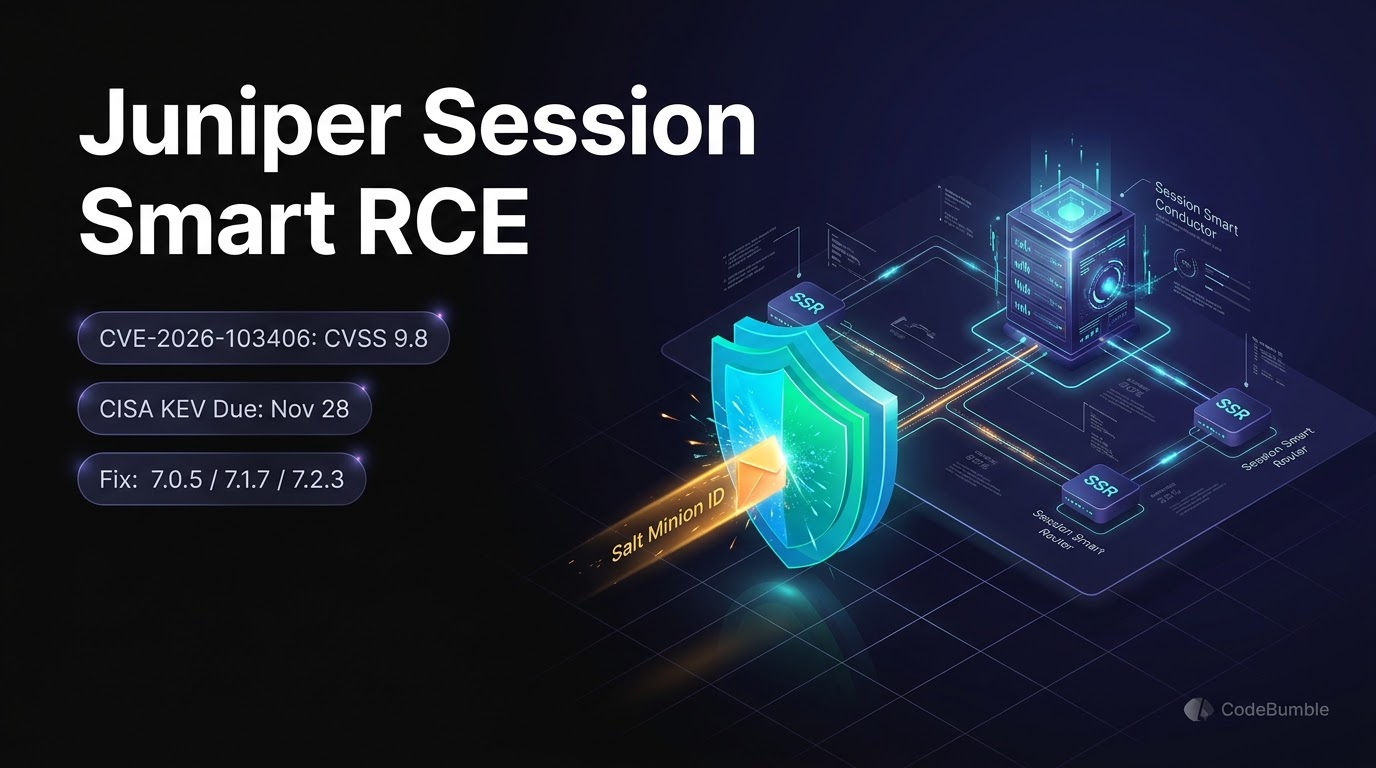
Executive Summary
On November 25, 2026, the U.S. Cybersecurity and Infrastructure Security Agency (CISA) added CVE-2026-103406—a critical, unauthenticated operating system command injection vulnerability carrying a CVSS 3.1 score of 9.8—to its Known Exploited Vulnerabilities (KEV) catalog (CISA KEV Alert, Nov 25, 2026; CISA KEV Catalog). Impacting Hewlett Packard Enterprise (HPE) Juniper Networks Session Smart Conductor (and referenced in CISA's catalog alongside Session Smart Router), the flaw resides in the AutomatedProvisioner component and allows a remote, unauthenticated attacker to execute arbitrary operating system commands as root via a specially crafted Salt minion ID (eSecurity Planet, Nov 26, 2026).
Juniper Networks originally disclosed CVE-2026-103406 on October 28, 2026, inside Security Bulletin JSA112183 alongside 17 other internally discovered vulnerabilities, and updated the advisory on November 24, 2026, after receiving at least one report of malicious in-the-wild exploitation (Juniper Security Bulletin JSA112183). Under Binding Operational Directive (BOD) 26-04, CISA mandated that Federal Civilian Executive Branch (FCEB) agencies remediate CVE-2026-103406 and perform forensic compromise checks by November 28, 2026—an aggressive three-day window reflecting the severity of unauthenticated root control over SD-WAN management planes (CISA KEV Alert). Fixed releases are 7.0.5, 7.1.7, and 7.2.3 (and subsequent supported releases), with no vendor workaround available.
Confidence & Evidence Note: Vulnerability mechanics, CVSS 3.1 rating (9.8), fixed versions (7.0.5, 7.1.7, 7.2.3), and the November 28, 2026 federal remediation deadline are confirmed directly by CISA and Juniper Networks primary advisories with high confidence. Neither Juniper nor CISA has publicly attributed the attacker or released confirmed network indicators of compromise (IOCs) for CVE-2026-103406 as of November 27, 2026 (eSecurity Planet), so hunting guidance below focuses on component-level behavioral checks rather than unverified external IP lists.
Affected Versions & Exposure Scope
A critical nuance for network defenders is separating the scope of CVE-2026-103406 itself from the broader October 28 Juniper bulletin (JSA112183). While CISA's KEV entry names both Session Smart Conductor and Session Smart Router, Juniper's specific vulnerability record identifies Session Smart Conductor (specifically its AutomatedProvisioner key-management and provisioning path) as the affected component for CVE-2026-103406 (eSecurity Planet; Juniper JSA112183). However, JSA112183 simultaneously patches 17 additional flaws across both Session Smart Conductor and Session Smart Router—including CVE-2026-103409 (CVSS 9.8), which enables unauthenticated administrative privilege escalation on Session Smart Router directly, and an encryption-key policy flaw on Session Smart Router—meaning teams should patch both Conductor and Router nodes to the fixed branches below.
| Product / Component | Vulnerable Versions | First Fixed Release | Exploitation Status | CISA BOD 26-04 Due Date |
|---|---|---|---|---|
| Session Smart Conductor (7.0.x) | All versions < 7.0.5 |
7.0.5 (and later) | Actively exploited (KEV-listed) | November 28, 2026 |
| Session Smart Conductor (7.1.x) | 7.1.0 through 7.1.6 |
7.1.7 (and later) | Actively exploited (KEV-listed) | November 28, 2026 |
| Session Smart Conductor (7.2.x) | 7.2.0 through 7.2.2 |
7.2.3 (and later) | Actively exploited (KEV-listed) | November 28, 2026 |
| Session Smart Router (7.0.x / 7.1.x / 7.2.x) | < 7.0.5, < 7.1.7, < 7.2.3 (per JSA112183) |
7.0.5, 7.1.7, 7.2.3 | Not confirmed for other 17 CVEs; listed in CISA KEV text | November 28, 2026 (treat as urgent) |
| End-of-Life (EoL / EoE) Branches | Releases past End of Engineering | No fix (upgrade to supported branch) | Unknown / Unassessed by Juniper SIRT | Discontinue or isolate per BOD 26-04 |
Context Within CISA's November 25, 2026 KEV Wave
CVE-2026-103406 was not added in isolation. On November 25, 2026, CISA added 10 actively exploited vulnerabilities to the KEV catalog in a single batch spanning enterprise unified communications, virtualization management, WAN routing, and operational technology (CISA KEV Alert; The Hacker News, Nov 26, 2026):
- Mitel MiCollab (5 CVEs):
CVE-2026-133323(CVSS10.0, command injection),CVE-2026-133303(CVSS9.0, XML injection),CVE-2026-133311(CVSS5.9),CVE-2026-133275(CVSS5.3), andCVE-2026-133324(CVSS5.3)—exploited in rapid data-theft intrusions where attackers reached root in 30 minutes and domain controllers in 32 minutes. - Vates Xen Orchestra (1 CVE):
CVE-2026-133469(CVSS9.8), an empty-JSON-object authentication bypass yielding administrative hypervisor control. - Danfoss AK-SM 800A Series (3 CVEs):
CVE-2023-25915(CVSS9.9),CVE-2023-25914(CVSS8.8), andCVE-2025-41450(CVSS8.5) affecting supermarket refrigeration and building controllers.
Across all 10 additions, CISA set November 28, 2026 as the deadline for eight flaws (including CVE-2026-103406), underscoring why internet-exposed management planes and control-plane orchestrators remain priority targets.
Root Cause & Attack Vector Analysis
In HPE Juniper's Session Smart SD-WAN architecture, Session Smart Conductor serves as the centralized management and orchestration plane that configures, provisions, and pushes security policies to distributed Session Smart Router (SSR) nodes. To automate node onboarding and key management across distributed WAN sites, Conductor's AutomatedProvisioner subsystem interacts with SaltStack-based minion registration and provisioning workflows.
How the Command Injection Vector Works
CVE-2026-103406 is an OS Command Injection flaw inside AutomatedProvisioner triggered during key management and provisioning (Juniper JSA112183; CISA KEV Catalog). When a provisioning request supplies a Salt minion ID to the Conductor, AutomatedProvisioner fails to properly neutralize shell metacharacters or special elements before passing that identifier into an underlying operating system command execution context.
flowchart LR
    A[Unauthenticated Remote Attacker] -->|1. Sends crafted provisioning / key-mgmt request| B[Session Smart Conductor AutomatedProvisioner]
    B -->|2. Parses unsanitized Salt minion ID| C{OS Command Execution Context}
    C -->|3. Injects arbitrary OS commands as root| D[Full Conductor Compromise]
    D -->|4. Tampers with policies, keys & configs| E[Managed Session Smart Routers / WAN Plane]
Four architectural factors elevate CVE-2026-103406 to a CVSS 3.1 score of 9.8 (Critical) (eSecurity Planet):
- Network Reachability (
AV:N): Any untrusted host that can reach the Conductor's exposed management or provisioning interface can send the malformed request—no physical or local access is required. - Zero Authentication (
PR:N,UI:N): Exploitation requires no valid administrator credentials, API tokens, or user interaction. - Low Attack Complexity (
AC:L): No race conditions or specialized environmental pre-positioning are needed to trigger the injection path. - Root Blast Radius (
C:H/I:H/A:H): Because Conductor processes execute withrootprivileges and centrally manage Session Smart Router fleets, compromising a single Conductor effectively hands an adversary control over encryption keys, routing policies, and configurations across the entire managed SD-WAN fabric.
Detection, Hunting & Mitigation
Because Juniper explicitly states that there are no known workarounds for CVE-2026-103406 (Juniper JSA112183), patching is mandatory. Furthermore, under BOD 26-04's "Forensics Triage Requirements," patching alone does not evict an adversary who obtained root access prior to the update (CISA KEV Alert).
1. Inventory and Verify Installed Software Versions
Immediately audit every Session Smart Conductor and Session Smart Router instance in your environment—especially Conductors reachable from the public internet, partner VPNs, or untrusted branch segments. On each Conductor node, verify the active package/software release via the administrative CLI or management UI and confirm whether it falls below 7.0.5, 7.1.7, or 7.2.3:
# Safe read-only version & package inventory checks on a Conductor host
rpm -qa | grep -iE '128T|session-smart'
# Or via the Session Smart CLI (PCLI):
# show system version
If a Conductor or Router is running an End-of-Engineering (EoE) or End-of-Life (EoL) branch prior to 7.0.x (noting Juniper SIRT does not evaluate EoL releases for these vulnerabilities), isolate the management plane immediately and migrate to a supported fixed release.
2. Upgrade to Fixed Releases and Restrict Management Exposure
- Patch Immediately: Upgrade Session Smart Conductor and Session Smart Router deployments to 7.0.5, 7.1.7, 7.2.3, or a later supported release in the corresponding branch (Juniper JSA112183).
- Enforce Management Plane Isolation: While scheduling the maintenance window (and permanently as defense-in-depth), block public internet access to Conductor management and provisioning ports using upstream firewall ACLs or a dedicated out-of-band management VPN. As eSecurity Planet notes, network restriction reduces exposure during patch staging but does not substitute for upgrading (eSecurity Planet).
3. Forensic Triage and Log Hunting (Before & After Patching)
Because CVE-2026-103406 grants root execution without authentication and fixed releases have been available since October 28, 2026, any Conductor exposed externally between late October and late November 2026 should undergo forensic review before or alongside remediation:
- Inspect Provisioning & Salt Logs: Review Conductor system,
AutomatedProvisioner, and Salt master/minion logs for malformed, unusually long, or character-laden minion IDs, unexpected minion registration attempts, or provisioning requests originating from unrecognized source IPs. - Audit Process & Shell Execution: Check system audit logs (
auditd),/var/log/secure,/var/log/messages, and shell history for unexpected child processes spawned by Conductor or Python/Salt services, newly created local users, or unauthorized SSH keys in/root/.ssh/authorized_keys. - Verify Managed Router Integrity: Inspect configuration commit histories and security policy diffs pushed from the Conductor to managed Session Smart Routers for unauthorized tunnels, route injections, or altered encryption keys.
- Rotate Credentials & Keys on Suspected Compromise: If any evidence points to pre-patch compromise, preserve a forensic disk/memory image first, rebuild the Conductor from trusted media on a patched release (
7.0.5/7.1.7/7.2.3+), and rotate all administrative credentials, API tokens, and SD-WAN peering/provisioning keys across the managed fleet.
Frequently Asked Questions
1. Does CVE-2026-103406 affect both Session Smart Conductor and Session Smart Router?
CISA's KEV catalog description lists both Session Smart Conductor and Session Smart Router, while Juniper's specific CVE record identifies Session Smart Conductor (AutomatedProvisioner) as the vulnerable component for CVE-2026-103406 (eSecurity Planet). However, Juniper's bulletin JSA112183 also patches 17 other flaws—including CVE-2026-103409 (CVSS 9.8) on Session Smart Router—so both products should be upgraded to 7.0.5, 7.1.7, or 7.2.3.
2. Is there a configuration workaround for CVE-2026-103406 if we cannot patch immediately?
No. Juniper Networks explicitly states in Security Bulletin JSA112183 that there are no known workarounds for these vulnerabilities (Juniper JSA112183). Restricting management and provisioning ports to trusted administrative IPs reduces immediate exposure while staging the upgrade, but upgrading is the only complete fix.
3. When is the CISA KEV remediation deadline for CVE-2026-103406?
CISA added CVE-2026-103406 to the KEV catalog on November 25, 2026, and set a remediation deadline of November 28, 2026 for Federal Civilian Executive Branch (FCEB) agencies under BOD 26-04 (CISA KEV Alert). Private-sector organizations are strongly advised to treat the same timeline as urgent due to confirmed active exploitation.
4. Have threat actors or public IOCs been attributed to CVE-2026-103406?
No. As of November 27, 2026, Juniper SIRT has confirmed at least one report of malicious exploitation, but neither Juniper nor CISA has publicly named the threat actor, disclosed victim counts, or published confirmed IOCs (eSecurity Planet).
5. Is upgrading to 7.0.5, 7.1.7, or 7.2.3 enough if our Conductor was internet-facing?
No. Upgrading blocks future exploitation of CVE-2026-103406 and the other 17 flaws in JSA112183, but it does not remove persistence or backdoors planted before the patch. Under CISA BOD 26-04, defenders must check provisioning logs, local root accounts, and downstream Router policies for signs of prior intrusion (CISA KEV Alert).
Sources
- CISA Adds 10 Known Exploited Vulnerabilities to Catalog — CISA (November 25, 2026) (Primary)
- Known Exploited Vulnerabilities Catalog — CISA (Accessed November 27, 2026) (Primary)
- 2026-10 On-Demand Security Bulletin: Session Smart Router and Session Smart Conductor (JSA112183) — Juniper Networks (Created October 28, 2026; Updated November 24, 2026) (Primary)
- CISA Adds Exploited Juniper Session Smart Conductor RCE to KEV — eSecurity Planet (November 26, 2026) (Secondary)
- Hackers Exploit 10 Vulnerabilities Across Mitel, Juniper, Vates, and Danfoss Products — The Hacker News (November 26, 2026) (Secondary)