

Vulnerability
CVE-2026-136716 in Drupal Core: Actively Exploited Site Takeover Flaw, Affected Versions & Patch Guide
On November 25, 2026, Drupal disclosed CVE-2026-136716 (SA-CORE-2026-019), an actively exploited access-bypass flaw affecting sites left in unusual or incomplete install states even after the Fail2Install (CVE-2026-132165) patch. Here are the affected versions, safe detection checks, and urgent mitigation steps.
8 min read
CVE-2026-136716 in Drupal Core: Actively Exploited Site Takeover Flaw, Affected Versions & Patch Guide
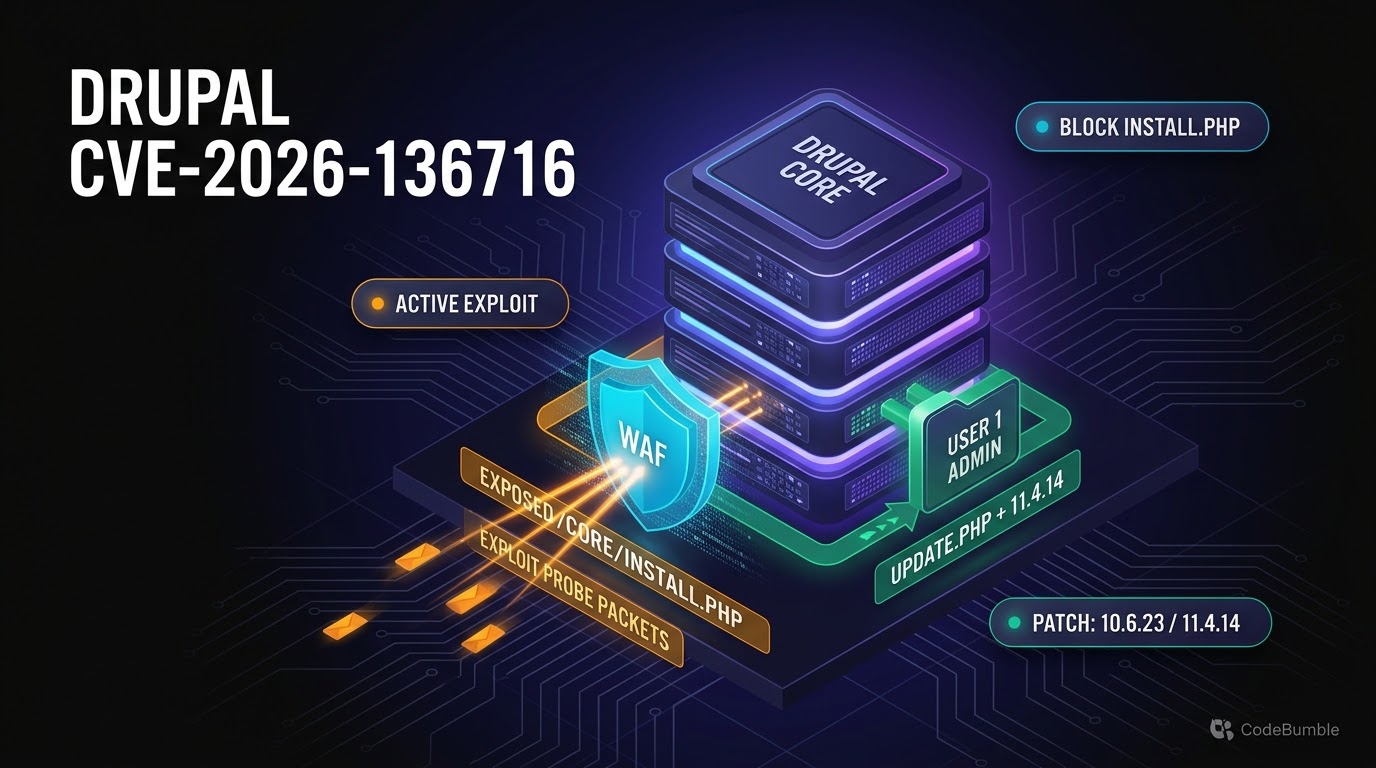
Executive Summary
On November 25, 2026, the Drupal Security Team published advisory SA-CORE-2026-019 detailing CVE-2026-136716, a Highly Critical (21/25) access-bypass vulnerability in Drupal core that is actively exploited in the wild. Tracked in NIST NVD (CVSS score: N/A as of initial publication) as an Improper Check for Unusual or Exceptional Conditions enabling forceful browsing, CVE-2026-136716 serves as an urgent follow-up to CVE-2026-132165 ("Fail2Install") (SA-CORE-2026-017, CVSS 9.8), which CISA added to its Known Exploited Vulnerabilities (KEV) catalog on November 24, 2026 with a federal remediation deadline of November 27, 2026.
- CVE IDs:
CVE-2026-136716(SA-CORE-2026-019, Nov 25, 2026) and relatedCVE-2026-132165(SA-CORE-2026-017, Nov 18, 2026). - Severity & Flaw Class: Drupal risk 21/25 (
AC:Basic/A:None/CI:All/II:All/E:Exploit/TD:Uncommon) forCVE-2026-136716; CVSS 9.8 / Drupal 20/25 forCVE-2026-132165. - Exploitation Status: Actively exploited in the wild (
CVE-2026-132165observed on live sites as early as2026-11-19 19:00 UTC;CVE-2026-136716confirmed exploited in the wild by Drupal on Nov 25, 2026 and reported by Malwarebytes on Nov 27, 2026). - Fixed Versions: Upgrade immediately to Drupal 10.6.23, 11.3.23, or 11.4.14, then run
update.phpand restrict network access to/core/install.php.
Affected Versions & Exposure Scope
Per SA-CORE-2026-019, NIST NVD, and The Hacker News (November 26, 2026), the vulnerability affects multiple supported and end-of-life (EoL) Drupal core branches:
| Drupal Core Branch | Vulnerable Versions (CVE-2026-136716) |
Fixed Release | Support & Remediation Status |
|---|---|---|---|
| Drupal 11.4.x | 11.4.0 through < 11.4.14 |
11.4.14 | Supported — upgrade and run update.php |
| Drupal 11.3.x | 11.3.0 through < 11.3.23 |
11.3.23 | Supported — upgrade and run update.php |
| Drupal 11.0.x – 11.2.x | All 11.0.x – 11.2.x releases |
None (EoL) | End-of-life — migrate to 11.3.23 or 11.4.14 |
| Drupal 10.6.x | < 10.6.23 |
10.6.23 | Supported — upgrade and run update.php |
| Drupal 10.5.x & older (8.x, 9.x) | All <= 10.5.x releases |
None (EoL) | End-of-life — unsupported; upgrade to 10.6.23+ |
Internet-Facing Exposure Telemetry
According to statistics shared by StepSecurity and cited by The Hacker News on November 26, 2026:
- Approximately 55,800 internet-facing Drupal sites were observed online.
- Roughly 31,500 of those services were running branches vulnerable to
CVE-2026-132165(the predecessor installer RCE). - Around 15,000 sites remained on end-of-life Drupal 8 and Drupal 9 branches that receive no official security patches.
Root Cause & Attack Vector Analysis
Both CVE-2026-132165 and CVE-2026-136716 center on Drupal's web-based installer script, /core/install.php, which ships with Drupal core to initialize new sites.
flowchart TD
    A[Remote Unauthenticated Request to /core/install.php] --> B{Is install.php Blocked at Web Server / WAF?}
    B -->|Yes - HTTP 403/404| C[Blocked: Site Not Vulnerable to CVE-2026-136716]
    B -->|No - Installer Reachable| D{Site State Check}
    D -->|Normal Installed State + Patched 10.6.23/11.3.23/11.4.14| E[Installer Rejects Re-install]
    D -->|Unusual / Incomplete Install State on Unpatched Core| F[Forceful Browsing Bypasses Access Check]
    F --> G[Site Takeover / Arbitrary Code Execution Risk]
Why Sites Patched for CVE-2026-132165 Remained Exposed
In SA-CORE-2026-017 (CVE-2026-132165, November 18, 2026), Drupal patched installer vulnerabilities where temporary database or system-limit failures could cause install.php to treat an existing site as uninitialized—allowing an unauthenticated attacker to attempt a reinstallation and achieve site takeover or remote code execution. According to an independent analysis by Searchlight Cyber (reported by The Hacker News), temporary database failures could produce a FAIL, FAIL, SUCCESS sequence that reopened the installer on a live site—allowing an attacker to supply PHP code as a site name into an SQLite database file and trigger execution on deployments where Apache RewriteRule path handling bypassed .htaccess protections.
Historical Context & Ransomware Risk
As Malwarebytes noted on November 27, 2026, Drupal core installer and RCE flaws remain prime targets for automated mass-exploitation because Drupal underpins government agencies, universities, media outlets, and enterprise portals. Since November 2021, CISA has flagged six Drupal vulnerabilities as actively exploited in the KEV catalog—and two of those six were used in ransomware campaigns. Because CVE-2026-136716 requires no authentication (A:None) and targets a single predictable path (/core/install.php), unpatched internet-facing instances face immediate automated scanning.
However, on November 25, 2026, Drupal maintainers warned in SA-CORE-2026-019 that certain sites in "unusual or incomplete install states" remained vulnerable to site takeover even after applying the CVE-2026-132165 fix, including live production websites. Crucially, Drupal highlighted two forensic blind spots for defenders:
- Invisible in the Admin UI: It is not apparent in Drupal's administrative user interface whether a production site is sitting in the affected incomplete install state.
- Post-Compromise State Erasure: Sites that have already been compromised via
CVE-2026-136716may no longer appear to be in the vulnerable state—meaning a clean-looking UI or even a late patch does not guarantee a site was not hijacked before patching.
Disclosure & Exploitation Timeline (November 18–27, 2026)
| Date | Milestone | Source |
|---|---|---|
| Nov 18, 2026 | Drupal releases SA-CORE-2026-017 (CVE-2026-132165, Fail2Install RCE) |
Drupal Security Team |
| Nov 19, 2026 (19:00 UTC) | Earliest reported in-the-wild exploitation of CVE-2026-132165 on live sites |
Drupal Security Team |
| Nov 24, 2026 | CISA adds CVE-2026-132165 to KEV catalog (federal deadline: Nov 27, 2026) |
CISA Alert |
| Nov 25, 2026 | Drupal publishes SA-CORE-2026-019 (CVE-2026-136716), confirming active exploitation |
Drupal Security Team |
| Nov 26, 2026 | StepSecurity reports ~55,800 internet-facing Drupal sites (31,500 on vulnerable branches) | The Hacker News |
| Nov 27, 2026 | CISA KEV remediation deadline for CVE-2026-132165; Malwarebytes & BleepingComputer warn admins |
Malwarebytes |
Detection, Hunting & Mitigation
Because CVE-2026-136716 is actively exploited in the wild and targets a remotely reachable installer endpoint, defenders should execute both software patching and perimeter hardening immediately.
1. Inventory Drupal Core Versions & install.php Exposure
Run safe local inventory checks across all web roots and container images to verify exact drupal/core versions and whether core/install.php is reachable:
# Check installed Drupal core version via Composer or Drush
composer show drupal/core | grep -E "name|versions"
drush status --field=drupal-version

# Verify whether /core/install.php returns 403/404 externally (should NOT return 200)
curl -sI https://your-drupal-site.example/core/install.php | head -n 5
2. Patch Immediately AND Run update.php
Per SA-CORE-2026-019 and Malwarebytes:
- Upgrade to Drupal 10.6.23, 11.3.23, or 11.4.14 (using
composer update "drupal/core-*" --with-all-dependencies). - Mandatory step: Run
update.php(ordrush updatedb) immediately after deploying the code update. Drupal explicitly notes that an update hook must run to remediate existing production sites that are stuck in the affected incomplete install state. - End-of-life branches: Sites still running Drupal 8, Drupal 9,
10.5.x, or11.0.x–11.2.xreceive no official patches and must migrate to a supported release immediately. - Note on Drupal Steward: Sites protected by the paid Drupal Steward service are covered against known attack vectors, but Drupal still strongly recommends upgrading.
3. Compensating Control: Block /core/install.php at the Edge / Web Server
Drupal emphasizes that site owners who have already secured install.php are not vulnerable to CVE-2026-136716. Even after patching, best practice for production sites is to deny all external HTTP access to /core/install.php:
# Nginx: Deny external access to Drupal's installer script
location ~* ^/core/install\.php$ {
    deny all;
    return 404;
}
# Apache (.htaccess or VirtualHost): Block access to install.php
<Files "install.php">
    Require all denied
</Files>
4. Hunt for Post-Exploitation & user 1 Takeover
Because patching alone does not evict an attacker who already hijacked a site, inspect logs and database state for indicators of compromise (IOCs):
- Web Server & WAF Logs: Hunt for
GETorPOSTrequests to/core/install.php(HTTP200or302responses) from untrusted external IPs since November 18–19, 2026. - Audit
user 1(Superuser Account): Check Drupal's watchdog/syslog andusers_field_datatable for unexpected modifications to or actions byuser 1(the initial administrative account created at installation). - Verify Email & Rotate Credentials: Confirm the
user 1email address belongs strictly to an authorized administrator, resetuser 1's password and active sessions, and inspect for unauthorized admin users, modifiedsettings.phpfiles, or newly added PHP/module files on disk. - Check Database &
settings.phpIntegrity: Verifysettings.phphas not been rewritten to point to a rogue SQLite or attacker-controlled database, and confirm database connection credentials and hash salts match your known-good infrastructure-as-code backups. - Incident Response & User Protection: As Malwarebytes emphasizes, a compromised site can still appear normal in the admin UI after patching. If any signs of unauthorized
install.phpaccess oruser 1tampering appear, follow Drupal's official incident-response procedure (restore from a known-clean backup prior to November 18, 2026, patch to10.6.23/11.3.23/11.4.14, runupdate.php, and rotate all database, API, and user credentials).
Frequently Asked Questions (FAQ)
What is CVE-2026-136716 in Drupal core?
CVE-2026-136716 (SA-CORE-2026-019, published November 25, 2026) is a Highly Critical (21/25) access-bypass vulnerability in Drupal core's /core/install.php installer that allows site takeover on sites left in unusual or incomplete install states—even after applying the earlier CVE-2026-132165 patch.
Is CVE-2026-136716 actively exploited in the wild?
Yes. Drupal explicitly confirmed in SA-CORE-2026-019 that CVE-2026-136716 is being exploited in the wild, following active exploitation of the related CVE-2026-132165 (Fail2Install) flaw since at least 2026-11-19 19:00 UTC.
Which Drupal versions fix CVE-2026-136716?
The vulnerability is fixed in Drupal 10.6.23, Drupal 11.3.23, and Drupal 11.4.14. Older branches (11.0.x–11.2.x and 10.5.x and below, including Drupal 8 and 9) are end-of-life and will not receive patches.
Why isn't running composer update alone enough?
After updating Drupal core to 10.6.23, 11.3.23, or 11.4.14, you must run update.php (or drush updatedb) because an update hook is required to repair existing production sites sitting in the vulnerable incomplete install state (SA-CORE-2026-019; Malwarebytes).
Am I vulnerable if /core/install.php is already blocked?
No. Drupal confirms that if you have already secured install.php against remote access, your site is not impacted by CVE-2026-136716 (SA-CORE-2026-019). However, you should still apply the core update and check logs if install.php was ever exposed prior to blocking.
Sources
- Drupal Security Team — Drupal core - Highly critical - Access bypass - SA-CORE-2026-019 (
CVE-2026-136716) (Primary advisory, published November 25, 2026) - Drupal Security Team — Drupal core - Highly critical - Remote code execution - SA-CORE-2026-017 (
CVE-2026-132165) (Primary advisory, published November 18, 2026) - NIST NVD — CVE-2026-136716 Detail (Primary vulnerability record, published November 25, 2026)
- CISA — CISA Adds Three Known Exploited Vulnerabilities to Catalog (
CVE-2026-132165) (Primary federal advisory, November 24, 2026) - The Hacker News — Drupal Warns of New Highly Critical Site Takeover Vulnerability Under Active Exploitation (Secondary reporting & StepSecurity stats, November 26, 2026)
- Malwarebytes — Drupal sites are being hijacked, and a follow-up flaw is already under attack (Secondary reporting & remediation guidance, November 27, 2026)