

Vulnerability
Inside CVE-2026-98276: Linux Kernel UDP Socket Race, SOCK_RCU_FREE Dropping, and Local Root
In November 2026, security researchers and enterprise hosting providers confirmed active in-the-wild exploitation of CVE-2026-98276 (CVSS 7.8 High)—a critical race condition in the Linux kernel networking subsystem that triggers a deterministic Use-After-Free (UAF) condition on UDP sockets. Stemming from non-atomic bitwise operations on the shared sk->sk_flags memory word, a race between bind() and ioctl(SIOCGSTAMPNS_NEW) drops the vital SOCK_RCU_FREE flag. When closed, the kernel frees the socket immediately instead of deferring release until an RCU grace period elapses, allowing concurrent lockless UDP packet lookups to dereference freed memory. This deep security analysis dissects the concurrency race mechanics, memory reclamation primitives, kernel exploitation primitives leading to local root, and livepatching mitigations.
10 min read
Inside CVE-2026-98276: Linux Kernel UDP Socket Race, SOCK_RCU_FREE Dropping, and Local Root
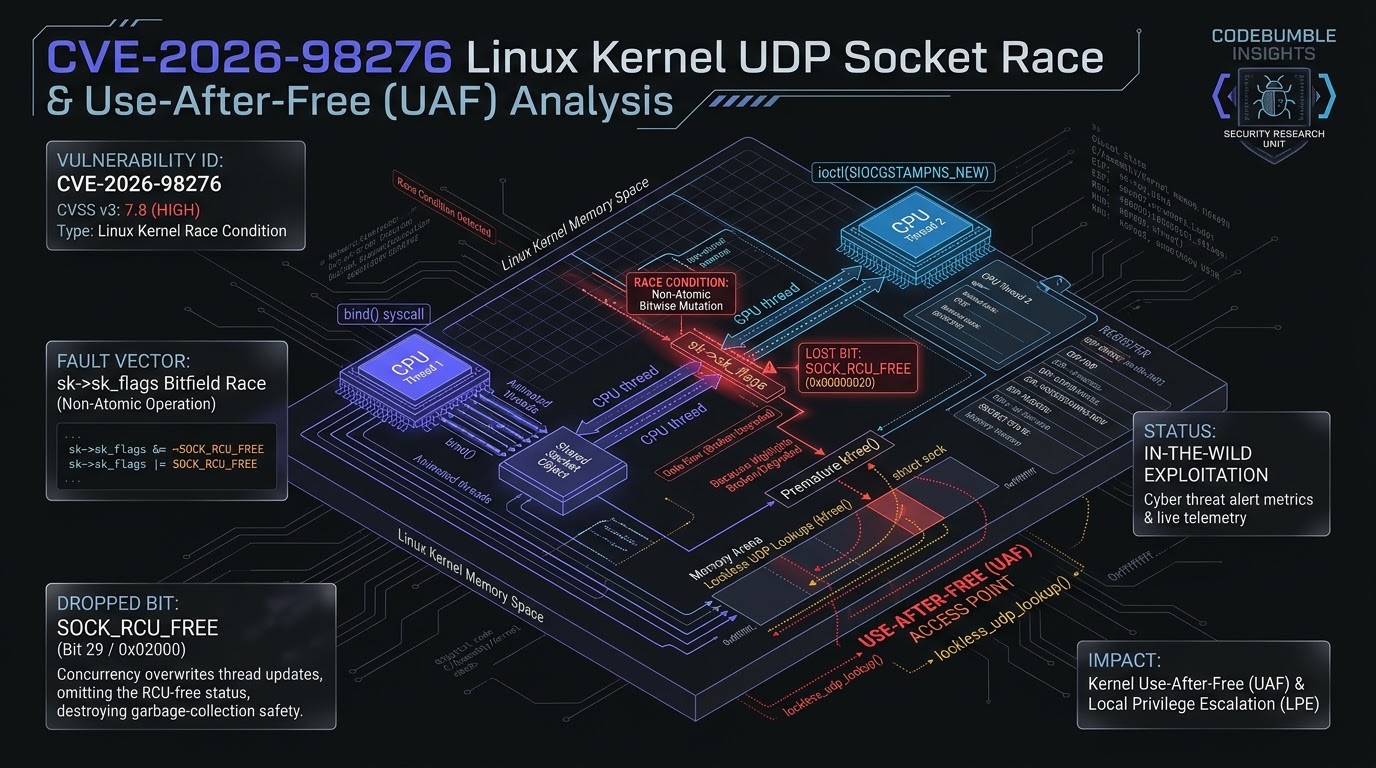
Executive Summary: The Anatomy of a High-Impact Kernel Race
On November 7, 2026, the Linux security ecosystem disclosed active in-the-wild exploitation of CVE-2026-98276 (rated CVSS 7.8 High by the Linux Kernel CVE Numbering Authority). Tracked across major enterprise distributions including Red Hat Enterprise Linux, AlmaLinux, CloudLinux, and Ubuntu, the vulnerability represents a subtle concurrency flaw in the kernel's core networking socket layer.
Unlike memory corruption bugs requiring complex heap sprays or exotic hardware interfaces, CVE-2026-98276 can be reliably triggered by an unprivileged local user executing standard POSIX system calls. On multi-tenant shared hosting platforms, Kubernetes worker nodes running unprivileged containers, and CI/CD runners, any process capable of creating a basic UDP socket (AF_INET, SOCK_DGRAM) can race two concurrent system calls: bind() and ioctl(SIOCGSTAMPNS_NEW).
The collision occurs within a single unsigned long bitfield: sk->sk_flags. Because the kernel's internal socket flag manipulation functions—sock_set_flag() and sock_reset_flag()—historically utilized non-atomic bitwise primitives (__set_bit() and __clear_bit()), concurrent read-modify-write operations across multiple CPU cores silently overwrite bit changes. Specifically, the race drops the SOCK_RCU_FREE flag.
When the socket is subsequently destroyed, the kernel omits the Read-Copy Update (RCU) grace period, immediately freeing the struct sock memory back to the SLUB allocator. Meanwhile, the kernel's high-speed, lockless UDP receive lookup path (__udp4_lib_lookup()) continues traversing the freed socket pointer, creating a classic Use-After-Free (UAF) condition that weaponizes into deterministic host crashes or local privilege escalation to root.
This technical advisory provides an exhaustive architectural post-mortem of CVE-2026-98276: dissecting the non-atomic bitfield collision, RCU lifecycle circumvention, threat vectors in production environments, and remediation procedures.
Architectural Anatomy: The UDP Socket Lifecycle and RCU Invariants
To comprehend why dropping SOCK_RCU_FREE produces a catastrophic kernel failure, one must examine how the Linux kernel achieves high-throughput UDP packet processing:
+-------------------------------------------------------------------------------------------------+
|                       LINUX KERNEL UDP SOCKET RCU SYNCHRONIZATION MODEL                         |
+-------------------------------------------------------------------------------------------------+
|                                                                                                 |
|   RECEIVE DATA PATH (Lockless Fast-Path)               CONTROL PATH (Socket Destruction)        |
|  +-------------------------------------+             +-------------------------------------+    |
|  | Network Packet Arrives at NIC       |             | User calls close(fd)                |    |
|  +-------------------------------------+             +-------------------------------------+    |
|                     |                                                   |                       |
|                     v                                                   v                       |
|  +-------------------------------------+             +-------------------------------------+    |
|  | rcu_read_lock()                     |             | sk->sk_prot->destroy(sk)            |    |
|  | Lockless hash table traversal:      |             | Removes socket from UDP hash tables |    |
|  | __udp4_lib_lookup()                 |             +-------------------------------------+    |
|  +-------------------------------------+                                |                       |
|                     |                                                   v                       |
|                     v                                +-------------------------------------+    |
|  | Reads pointer: struct sock *sk      |             | Evaluates:                          |    |
|  | Inspects: sk->sk_state, ports, etc. |             | sock_flag(sk, SOCK_RCU_FREE)?       |    |
|  +-------------------------------------+             +-------------------------------------+    |
|                     |                                      /                   \                |
|                     |                       IF TRUE (Normal):                 IF FALSE (RACE!): |
|                     |                              |                                  |         |
|                     |                              v                                  v         |
|                     |             +---------------------------------+  +----------------------+ |
|                     |             | kfree_rcu(sk, sk_rcu)           |  | kfree(sk) IMMEDIATELY| |
|                     |             | Defers free until all read-side |  | Memory returned to   | |
|                     |             | critical sections finish!       |  | SLUB kmalloc-2048!   | |
|                     |             +---------------------------------+  +----------------------+ |
|                     |                              |                                  |         |
|                     |                              |       +--------------------------+         |
|                     |                              |       |                                    |
|                     v                              v       v                                    |
|  +--------------------------------------------------------------------------------------------+ |
|  | USE-AFTER-FREE COLLISION: __udp4_lib_lookup() dereferences freed/reallocated memory!        | |
|  | Result: Kernel Panic (Null Pointer / Bad Page) or Controlled Function Pointer Hijacking!   | |
|  +--------------------------------------------------------------------------------------------+ |
|                                                                                                 |
+-------------------------------------------------------------------------------------------------+
The Read-Copy Update (RCU) Invariant
In high-concurrency Linux networking, locking an entire socket hash bucket on every incoming UDP datagram would create severe lock contention. Instead, the Linux kernel employs RCU (Read-Copy Update).
When incoming UDP datagrams are processed:
- The kernel acquires an RCU read-side lock via
rcu_read_lock(). - It traverses the global UDP socket hash table (
udp_table) without holding spinlocks or mutexes. - The socket pointer is referenced directly.
Under standard kernel operation, when a socket is closed via close(), it is unlinked from the hash table. However, concurrent CPU cores executing packet processing might still hold references to that socket pointer within their active rcu_read_lock() sections.
To guarantee safety, inet_sock_destruct() checks whether the socket has the SOCK_RCU_FREE flag enabled. If set, it invokes call_rcu() or kfree_rcu(), postponing memory deallocation until every running CPU core completes its current RCU read-side critical section.
Deep Vulnerability Mechanics: The Non-Atomic sk_flags Collision
The root cause of CVE-2026-98276 lies in the non-atomic manipulation of sk->sk_flags. In include/net/sock.h, the socket state flags share a single machine word:
struct sock {
    ...
    unsigned long       sk_flags;
    ...
};
Individual flags are manipulated using helper macros:
static inline void sock_set_flag(struct sock *sk, enum sock_flags flag)
{
    __set_bit(flag, &sk->sk_flags);
}

static inline void sock_reset_flag(struct sock *sk, enum sock_flags flag)
{
    __clear_bit(flag, &sk->sk_flags);
}
Notice the double underscore prefix: __set_bit() and __clear_bit() are non-atomic operations. On x86_64, an atomic bit set compiles to lock bts, which serializes memory bus accesses. In contrast, __set_bit() compiles to a standard non-atomic instruction sequence:
MOVmemory to register.BTSorORbit in register.MOVregister back to memory.
+-------------------------------------------------------------------------------------------------+
|                       CVE-2026-98276 CONCURRENT BITFIELD RACE TIMELINE                          |
+-------------------------------------------------------------------------------------------------+
|                                                                                                 |
|   THREAD 1: bind() Syscall                              THREAD 2: ioctl(SIOCGSTAMPNS_NEW)       |
|  (CPU Core 0)                                          (CPU Core 1)                             |
|  +---------------------------------------------+       +--------------------------------------+ |
|  | 1. udp_lib_get_port() allocates port.       |       |                                      | |
|  |                                             |       | 1. User requests timestamping.       | |
|  | 2. Calls: sock_set_flag(sk, SOCK_RCU_FREE)   |       |    Calls: sock_gettstamp()           | |
|  |    Reads sk->sk_flags (e.g. 0x00000000)      |       |                                      | |
|  |    Calculates OR (0x00000020)                |       | 2. Calls:                            | |
|  |                                             |       |    sock_set_flag(sk, SOCK_TSTAMP_NEW)| |
|  |                                             |       |    Reads sk->sk_flags (0x00000000!)  | |
|  | 3. Writes 0x00000020 to sk->sk_flags         |       |    Calculates OR (0x00000040)        | |
|  |    [SOCK_RCU_FREE is temporarily set!]       |       |                                      | |
|  |                                             |       | 3. Writes 0x00000040 to sk->sk_flags!| |
|  |                                             |       |    OVERWRITES THREAD 1'S WRITE!      | |
|  +---------------------------------------------+       +--------------------------------------+ |
|                                                                                                 |
|   FINAL STATE: sk->sk_flags = 0x00000040 (SOCK_RCU_FREE BIT 0x20 IS PERMANENTLY LOST!)         |
|                                                                                                 |
+-------------------------------------------------------------------------------------------------+
The Collision Between bind() and sock_gettstamp()
When an application binds a UDP socket to an address via bind(), the kernel invokes udp_lib_get_port(). To enable lockless RCU receive hashing, udp_lib_get_port() explicitly enables the SOCK_RCU_FREE flag:
/* net/ipv4/udp.c: Enabling RCU freeing upon port assignment */
int udp_lib_get_port(struct sock *sk, unsigned short snum, ...)
{
    ...
    if (!sock_flag(sk, SOCK_RCU_FREE))
        sock_set_flag(sk, SOCK_RCU_FREE);
    ...
}
Simultaneously, an application thread issues an ioctl() command with SIOCGSTAMP or SIOCGSTAMPNS_NEW to enable high-resolution network packet timestamping. Inside sock_gettstamp(), the kernel sets timestamping flags:
/* net/core/sock.c: sock_gettstamp() missing socket lock */
int sock_gettstamp(struct socket *sock, void __user *userstamp, ...)
{
    struct sock *sk = sock->sk;
    ...
    sock_set_flag(sk, SOCK_TSTAMP_NEW); // Non-atomic write!
    ...
}
Crucially, sock_gettstamp() modifies sk->sk_flags without holding the socket lock (lock_sock(sk)).
If Thread 1 executes sock_set_flag(sk, SOCK_RCU_FREE) on Core 0 while Thread 2 executes sock_set_flag(sk, SOCK_TSTAMP_NEW) on Core 1, Thread 2's write overwrites Thread 1's update. The SOCK_RCU_FREE bit is discarded. When the socket is closed, sk_destruct() treats the socket as a non-RCU object, calling kfree(sk) immediately while concurrent network interrupts are actively executing __udp4_lib_lookup().
Threat Vector Analysis: From Denial of Service to Root Escalation
In early November 2026, security analysts at CloudLinux and independent researchers detected in-the-wild exploitation of CVE-2026-98276 that triggered 12 consecutive kernel crashes on production enterprise servers. Shortly thereafter, security research teams demonstrated full local privilege escalation to root.
+-------------------------------------------------------------------------------------------------+
|                       CVE-2026-98276 WEAPONIZATION & EXPLOITATION STAGES                        |
+-------------------------------------------------------------------------------------------------+
|                                                                                                 |
|   STAGE 1: NON-PRIVILEGED TRIGGER                                                               |
|   - Attacker process opens unprivileged UDP socket: fd = socket(AF_INET, SOCK_DGRAM, 0).        |
|   - Spawns two racing threads executing bind() and ioctl(SIOCGSTAMPNS_NEW) in a tight loop.     |
|   - Closes fd; checks whether socket memory was reclaimed instantly without RCU delay.          |
|                                                                                                 |
|                                 |                                                               |
|                                 v                                                               |
|   STAGE 2: HEAP RECLAIM & SLUB MASSAGE                                                          |
|   - struct sock resides in the kmalloc-2048 or sock_inode_cache SLUB cache.                     |
|   - Upon premature kfree(sk), attacker sprays controlled fake objects into the same slab cache. |
|   - Overwrites function pointers (e.g., sk->sk_destruct, sk->sk_prot->recvmsg, sk->sk_error_report)
|                                                                                                 |
|                                 |                                                               |
|                                 v                                                               |
|   STAGE 3: CONTROL FLOW HIJACKING & ROOT ESCALATION                                             |
|   - Attacker triggers a UDP packet lookup from localhost or an external interface.              |
|   - The kernel dereferences the poisoned function pointer within an RCU read lock context.      |
|   - Diverts execution to userland shellcode or kernel ROP chain: commit_creds(prepare_kernel_cred(0)).
|   - Elevates process credentials to UID 0 (root).                                               |
|                                                                                                 |
+-------------------------------------------------------------------------------------------------+
Exploit Reliability Characteristics
Unlike remote TCP handshake vulnerabilities that require millisecond network synchronization, CVE-2026-98276 is an in-process local syscall race:
- Deterministic Execution: The attacker controls both racing threads on the same physical host, synchronizing them with CPU instruction barriers (
_mm_pause()or futex primitives). - Bypass of Sandboxes: The vulnerability does not require
CAP_NET_ADMINor root privileges. It executes inside unprivileged containers, Docker sandboxes, and shared cPanel hosting accounts. - Failure Modes: If heap grooming fails, the race dereferences an unmapped address, triggering a kernel panic:
BUG: unable to handle page fault for address: ffff88812a4b8028
RIP: 0010:__udp4_lib_lookup+0x142/0x2b0
Call Trace:
 <IRQ>
 udp_v4_rcv+0x12a/0xd80
 ip_protocol_deliver_rcu+0x48/0x230
 ip_local_deliver_finish+0x44/0x90
Systems Engineering and Hardening Playbook
Because CVE-2026-98276 resides in the fundamental socket handling layer of the Linux kernel, traditional perimeter defenses provide no protection.
Step 1: Upstream Kernel Source Fix
The authoritative upstream Linux kernel fix (committed by kernel maintainers across long-term support branches) replaces non-atomic flag operations with atomic bitfield operations:
/* Upstream Linux Kernel Patch: net/core/sock.c & include/net/sock.h */

- static inline void sock_set_flag(struct sock *sk, enum sock_flags flag)
- {
-     __set_bit(flag, &sk->sk_flags);
- }
+ static inline void sock_set_flag(struct sock *sk, enum sock_flags flag)
+ {
+     set_bit(flag, &sk->sk_flags); /* Atomic bit set with LOCK prefix */
+ }

- static inline void sock_reset_flag(struct sock *sk, enum sock_flags flag)
- {
-     __clear_bit(flag, &sk->sk_flags);
- }
+ static inline void sock_reset_flag(struct sock *sk, enum sock_flags flag)
+ {
+     clear_bit(flag, &sk->sk_flags); /* Atomic bit clear with LOCK prefix */
+ }
By ensuring that set_bit() and clear_bit() compile into atomic locked memory operations, concurrent modifications by bind() and sock_gettstamp() can no longer overwrite each other.
Step 2: Distribution Verification and Patch Deployment
Verify host kernel version and apply distribution security updates:
# 1. Inspect current active kernel release
uname -r

# 2. Update Linux kernel packages across distributions:

# On RHEL / AlmaLinux / Rocky Linux:
sudo dnf clean all && sudo dnf update -y kernel

# On Ubuntu / Debian:
sudo apt-get update && sudo apt-get install --only-upgrade -y linux-image-generic

# 3. Reboot into patched kernel
sudo reboot
Step 3: Zero-Downtime Livepatching via KernelCare
For mission-critical production environments where host reboots cannot be scheduled immediately, apply KernelCare livepatches:
# Verify KernelCare daemon status
kcarectl --info

# Apply emergency in-memory livepatch for CVE-2026-98276
kcarectl --update

# Verify patch registration
kcarectl --patch-info | grep -E "CVE-2026-98276"
Step 4: Defense-in-Depth Container Hardening
In multi-tenant Kubernetes and Docker environments, restrict raw socket creation permissions for unprivileged workloads:
# Kubernetes PodSecurityStandard / SecurityContext hardening
apiVersion: v1
kind: Pod
metadata:
  name: secured-tenant-app
spec:
  securityContext:
    runAsNonRoot: true
    seccompProfile:
      type: RuntimeDefault
  containers:
  - name: application
    image: company/app:v2.4
    securityContext:
      allowPrivilegeEscalation: false
      capabilities:
        drop:
        - ALL
Semantic FAQ: CVE-2026-98276 Vulnerability Analysis
What is the fundamental root cause of CVE-2026-98276?
CVE-2026-98276 is caused by non-atomic bitwise operations on the sk->sk_flags bitfield in the Linux kernel socket structure. When bind() sets SOCK_RCU_FREE concurrently with sock_gettstamp() modifying timestamping flags, the non-atomic read-modify-write cycle drops the SOCK_RCU_FREE bit, causing the kernel to free socket memory immediately upon closure instead of waiting for an RCU grace period.
Can CVE-2026-98276 be exploited remotely over the internet?
No. CVE-2026-98276 is a local privilege escalation (LPE) vulnerability requiring an attacker to execute system calls on the targeted host. However, in shared web hosting environments, cloud CI runners, or containers where an attacker has achieved basic code execution (such as via a web application vulnerability), CVE-2026-98276 can be leveraged to escape restrictions and obtain full root access.
Why do standard Linux firewalls (iptables/nftables) fail to block this attack?
Firewalls inspect and filter network packets entering or leaving physical network interfaces. CVE-2026-98276 is triggered entirely through internal Linux system calls (socket(), bind(), ioctl(), close()) within the host kernel, never traversing external network firewall filters.
Does setting sysctl toggles mitigate CVE-2026-98276?
No. There are no sysctl toggles, network namespaces, or kernel boot parameters that disable the core socket flag manipulation or sock_gettstamp() handlers. Full remediation requires updating the kernel binary or applying an in-memory kernel livepatch.
Which Linux kernel versions are affected by CVE-2026-98276?
The vulnerability affects Linux kernel branches from 4.4 through modern 6.x kernels until patched in downstream vendor updates (such as upstream 5.15.223+, 6.1.190+, 6.6.159+, and 6.12.113+).
How does the upstream patch resolve the race condition?
The upstream patch replaces non-atomic __set_bit() and __clear_bit() invocations in sock_set_flag() and sock_reset_flag() with atomic set_bit() and clear_bit() primitives. This forces CPU hardware memory bus locking, preventing concurrent threads from overwriting bitfield updates.