

Automation
GitHub Actions in November 2026: Fail-Fast Cobertura Coverage Gates, 838-Org Reliability Data, and Multi-CI Trade-Offs
On November 23, 2026, GitHub Actions' upload-code-coverage action began failing fast on non-Cobertura XML reports instead of silently dropping PR coverage. Paired with new November 2026 survey data from 838 organizations showing 63% of Actions users run a second CI/CD tool alongside it, here is what changed—and how to harden your pipelines.
7 min read
GitHub Actions in November 2026: Fail-Fast Cobertura Coverage Gates, 838-Org Reliability Data, and Multi-CI Trade-Offs
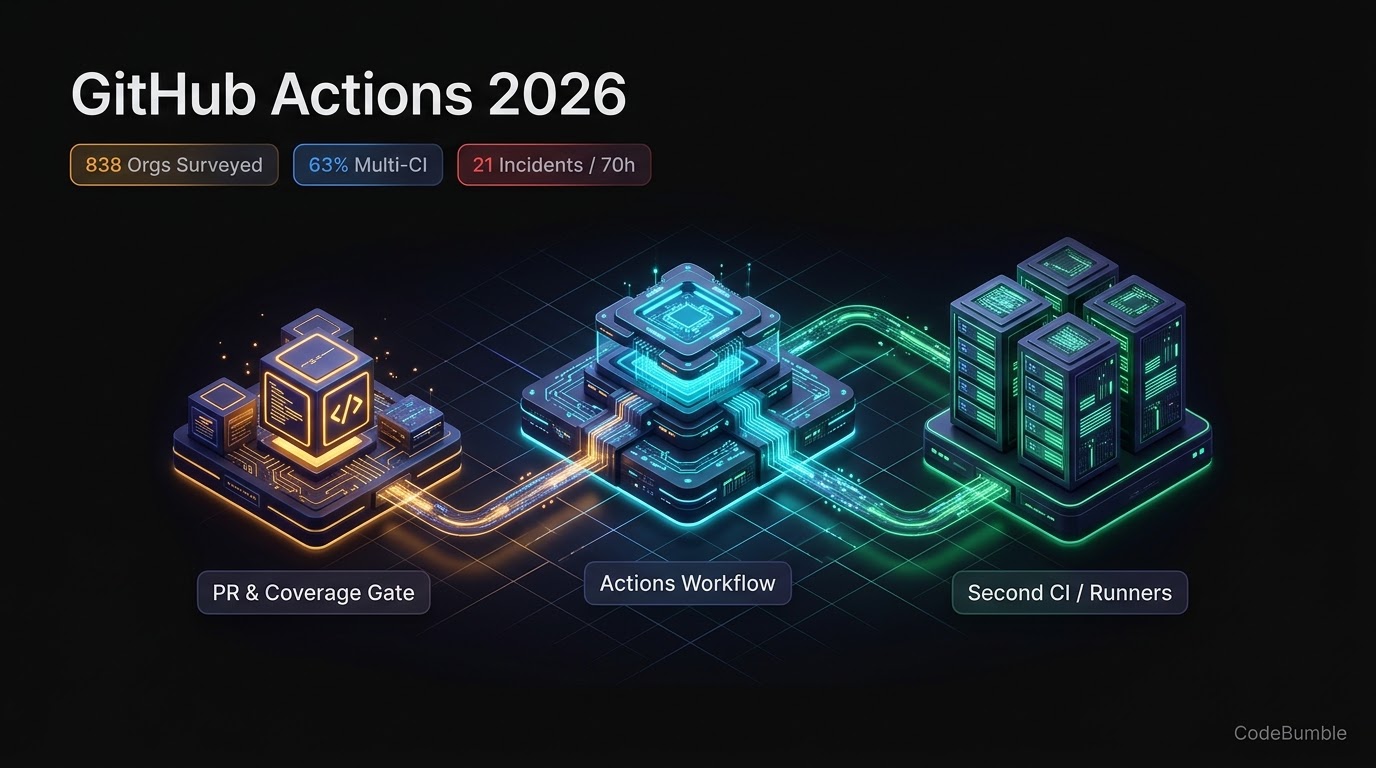
Executive Summary
- Fail-Fast Coverage Validation (Nov 23, 2026): GitHub updated the
actions/upload-code-coverageaction for GitHub Code Quality so non-Cobertura XML files (such as LCOV, raw JSON, or JaCoCo/OpenCover XML) now fail immediately with a clear log error instead of silently succeeding with missing pull request reports (GitHub Changelog). - 838-Organization CI/CD Telemetry (Nov 22, 2026): According to the JetBrains Research / TeamCity 2026 CI/CD Tools Adoption Survey, 46% of surveyed organizations use GitHub Actions—more than any other CI/CD tool—yet 63% of Actions organizations also run a second CI/CD platform alongside it (JetBrains Blog).
- Reliability & Incident Baseline: GitHub's monthly availability reports recorded 21 major incidents affecting Actions between January and October 2026—totaling roughly 70 hours of degraded service—making reliability the #1 dissatisfaction driver (
22.5%dissatisfied) among Actions-first teams (JetBrains Blog). - Runner Economics & Trade-Offs: While swapping
runs-on:to third-party runners (e.g., Depot or Sengi) can cut Linux x64 compute costs from$0.006/mindown to$0.001–$0.003/min, it does not solve GitHub control-plane outages, YAML debugging friction, or marketplace supply-chain risk (DEV Community; JetBrains Blog).
What Changed & Core Mechanism
Fail-Fast Format Gates in actions/upload-code-coverage
Previously, passing an unsupported coverage format to actions/upload-code-coverage@v1 created a silent failure mode: the workflow step exited green, yet no bot comment or coverage delta ever appeared on the pull request (GitHub Changelog).
On November 23, 2026, GitHub shipped two paired changes for GitHub Team and GitHub Enterprise Cloud (including data-residency environments, but not GitHub Enterprise Server):
- Strict Format Rejection: If the uploaded file is not Cobertura XML, the step fails fast (since
fail-on-errordefaults totrue) and logs: "This file is not a Cobertura XML report. Upload a Cobertura XML report." (GitHub Changelog; WindowsForum). - Tolerant Cobertura Parsing: Genuine Cobertura XML reports with minor structural quirks are no longer rejected outright, and individual
<line>entries missing a usable line number or hit count are skipped rather than discarding the entire file (GitHub Changelog).
Note that GitHub Code Quality calculates line coverage exclusively (covered lines divided by total lines) and ignores branch or function metrics even when present in Cobertura XML (WindowsForum).
Hardened Two-Job Coverage Workflow
To prevent third-party test dependencies from executing with code-quality: write permissions—and to block untrusted forked pull requests from triggering privileged uploads—the official actions/upload-code-coverage guidance recommends isolating test execution from the coverage upload job (actions/upload-code-coverage; WindowsForum):
name: Code Coverage
on:
  push:
    branches: [main]
  pull_request:
    branches: [main]

permissions:
  contents: read

jobs:
  test:
    runs-on: ubuntu-latest
    steps:
      - uses: actions/checkout@v6
        with:
          ref: ${{ github.event.pull_request.head.sha || github.sha }}
      - uses: actions/setup-python@v5
        with:
          python-version: "3.x"
      - name: Run tests with Cobertura XML output
        run: |
          python -m pip install pytest pytest-cov
          pytest --cov=. --cov-report=xml
      - uses: actions/upload-artifact@v4
        with:
          name: cobertura-report
          path: coverage.xml

  upload-coverage:
    needs: test
    if: github.event_name != 'pull_request' || github.event.pull_request.head.repo.full_name == github.repository
    runs-on: ubuntu-latest
    permissions:
      contents: read
      code-quality: write
    steps:
      - uses: actions/download-artifact@v4
        with:
          name: cobertura-report
      - uses: actions/upload-code-coverage@v1
        with:
          file: coverage.xml
          language: Python
          label: code-coverage/pytest
On the runner itself, actions/upload-code-coverage@v1 executes Bash and requires Python 3.9 or later on PATH (plus the GitHub CLI gh if resolving PRs from push events), with a default wait-for-processing-timeout of 160 seconds (actions/upload-code-coverage; WindowsForum).
Reliability, Cost & Performance Analysis
While GitHub Actions leads industry adoption at 46% of surveyed organizations, November 2026 telemetry highlights why engineering teams rarely treat it as a single-vendor monolith (JetBrains Blog). (Disclosure: the 838-organization CI/CD survey was conducted by JetBrains Research and TeamCity, a competing CI/CD vendor; incident counts and durations are sourced directly from GitHub's own monthly availability reports.)
2026 Reliability & Supply-Chain Exposure
- 70 Hours of Degraded Service: Across January–October 2026, 21 of GitHub's 57 major incidents affected Actions, workflow runs, or runners—including 5 incidents (24.6 hours) in July 2026 alone (featuring a 9-hour runner provisioning failure) and 14 incidents lasting two hours or more (JetBrains Blog).
- Satisfaction Gap: Among 227 teams whose primary CI/CD tool is Actions,
69.2%are satisfied with ease of use and63.4%with setup, but reliability (22.5%dissatisfied), UI (21.6%), log/error clarity (21.5%), and performance (20.7%) lag behind (JetBrains Blog). - Marketplace Tag Risk: Supply-chain incidents in 2026—including the March 19 force-push across
76of77tags ofaquasecurity/trivy-actionand the May Megalodon campaign affecting5,561repositories—underscore the risk of referencing third-party Actions by mutable tags instead of full commit SHAs (JetBrains Blog).
Runner Compute Pricing Comparison (November 2026)
Teams seeking faster or cheaper compute without rewriting YAML often swap runs-on: to third-party runner providers. Based on vendor pricing pages checked November 19–22, 2026:
| Provider | 2 vCPU Linux Rate | 4 vCPU / 8 vCPU Linux | Monthly Plan / Free Tier | Key Scope & Caveats |
|---|---|---|---|---|
| GitHub-Hosted | $0.006/min |
Scales by tier | Included minutes vary by GitHub plan | Native control plane; subject to GitHub runner provisioning incidents (JetBrains Blog) |
| Depot | $0.006/min (1x multiplier) |
$0.012/min (2x) / $0.024/min (4x) |
Developer $20/mo (2,000 mins); Startup $200/mo (20,000 mins); 7-day trial |
Includes container builds, sandboxes, and 25–250 GB cache/registry; Arm, Windows ($0.008+), macOS ($0.08/min) (DEV Community) |
| Sengi Basic | $0.001/min |
$0.002/min / $0.004/min |
3,000 free mins/mo; no base plan fee |
Ubuntu 24.04 x64 only; no Arm, macOS, Windows, or >8 vCPU (DEV Community) |
| Sengi Premium | $0.003/min |
$0.006/min / $0.012/min |
Pay-as-you-go | Faster CPU-bound Linux x64 builds; includes GHA & Docker layer cache (DEV Community) |
At 10,000 minutes/month on a 2 vCPU Linux runner, list compute totals $68 on Depot's Developer plan (including $20 base + 8,000 overage minutes), $60 on GitHub-hosted list rates (before plan-included minutes), $30 on Sengi Premium, and $10 on Sengi Basic (before its 3,000 free monthly minutes) (DEV Community). Keep in mind market churn as well: runner provider BuildJet shut down in March 2026 (JetBrains Blog).
Practical Implementation & Trade-Offs
Converting Test Suites to Cobertura XML
If your workflow now fails with This file is not a Cobertura XML report, remember that .xml alone does not guarantee Cobertura schema compatibility—JaCoCo, OpenCover, and Visual Studio .coveragexml all use different schemas (WindowsForum). Use the native flag or converter for your stack:
- Python (
pytest-cov):pytest --cov=. --cov-report=xml - JavaScript / TypeScript (
Jest/nyc):jest --coverage --coverageReporters=coberturaornyc report --reporter=cobertura - Go (
gocover-cobertura):go test -coverprofile=cover.out && gocover-cobertura < cover.out > coverage.xml - .NET (
Coverlet/MTP):dotnet test --collect:"XPlat Code Coverage"(ordotnet test -- --coverage --coverage-output-format cobertura) - Java (
JaCoCo) / Ruby (SimpleCov): Convert viacover2cover.py/ Gradle-Maven plugin for JaCoCo, or enableSimpleCov::Formatter::CoberturaFormatter(WindowsForum).
Deciding Between Runner Swaps and a Second CI
When GitHub Actions hits scaling limits, surveyed organizations (n=388 Actions users) overwhelmingly choose Path 2 (Add a Second CI) rather than a full rip-and-replace—keeping Actions for lightweight PR checks and linting while offloading heavy release builds, on-prem hardware, or long test suites to Jenkins (25.0%), GitLab CI (22.2%), Azure DevOps (13.9%), AWS CodePipeline/CodeBuild (11.3%), or TeamCity (7.0%) (JetBrains Blog).
- Swap Runners Only (
runs-on:) when your sole bottlenecks are Linux/macOS build minutes and per-minute cost, and you can tolerate GitHub's control plane. - Add a Second CI when you hit stability (
25.6%of switchers) or debugging (18.6%) limits, need on-prem/custom GPU hardware, or require predictable non-metered capacity—accepting the operational overhead of maintaining two CI systems (JetBrains Blog).
Frequently Asked Questions
1. Why did my GitHub Actions upload-code-coverage step start failing on November 23, 2026?
GitHub updated actions/upload-code-coverage to validate that the uploaded file uses the Cobertura XML schema. Previously, non-Cobertura files (like LCOV, JSON, or JaCoCo XML) exited green while silently dropping PR coverage data; now they fail fast with This file is not a Cobertura XML report (GitHub Changelog).
2. Is GitHub Code Quality coverage available on GitHub Enterprise Server?
No. The November 23, 2026 coverage validation and tolerant Cobertura parser apply to GitHub Team and GitHub Enterprise Cloud (including data-residency deployments), and are not available on GitHub Enterprise Server (GitHub Changelog).
3. Can I make upload-code-coverage warn instead of failing the workflow?
Yes. actions/upload-code-coverage@v1 sets fail-on-error: true by default, but you can set fail-on-error: false in the step's with: block during migration if you want non-blocking warnings (WindowsForum).
4. Does swapping to third-party GitHub Actions runners fix Actions outages?
No. Swapping runs-on: to providers like Depot or Sengi improves build speed and per-minute compute cost, but workflows still depend on GitHub's control plane, YAML engine, and marketplace permissions (JetBrains Blog).
5. What is the most common second CI/CD tool paired with GitHub Actions in 2026?
In JetBrains' November 2026 survey of 388 organizations using GitHub Actions, Jenkins (25.0%) and GitLab CI (22.2%) were the most common companion CI/CD platforms, followed by Azure DevOps (13.9%) and AWS CodePipeline/CodeBuild (11.3%) (JetBrains Blog).
Sources
- GitHub Changelog (Primary): "Code coverage uploads now flag invalid report formats" — https://github.blog/changelog/2026-11-23-code-coverage-uploads-now-flag-invalid-report-formats/ (November 23, 2026)
- GitHub Official Action Repository (Primary):
actions/upload-code-coverageREADME & Requirements — https://github.com/actions/upload-code-coverage (Accessed November 24, 2026) - JetBrains / TeamCity Research (Primary Survey / Secondary Analysis): "Best GitHub Actions Alternatives in 2026: What 838 Organizations Actually Use" — https://blog.jetbrains.com/teamcity/2026/11/github-actions-alternatives/ (November 22, 2026)
- WindowsForum (Secondary): "GitHub Actions Coverage Upload Now Rejects Non-Cobertura Reports: How to Fix Workflows" — https://windowsforum.com/news/github-actions-coverage-upload-now-rejects-non-cobertura-reports-how-to-fix-workflows.453773/ (November 23, 2026)
- DEV Community / Sengi Runners (Secondary Pricing Reference): "Depot pricing 2026 for GitHub Actions: plans, per-minute runner rates, labels and setup (November 2026)" — https://dev.to/sengi_runners/depot-pricing-2026-for-github-actions-plans-per-minute-runner-rates-labels-and-setup-november-2jf2 (November 23, 2026)