

Automation
GitHub Actions Shared Compute Pool & Copilot Cloud Sandbox Billing (Nov 23, 2026): Rates, Contention Risks & CI/CD Migration
Starting November 23, 2026, GitHub Copilot cloud sandboxes begin billing against the same dollar-based GitHub Actions compute entitlement that powers your CI/CD builds—at $0.000024 per vCPU-second and $0.000003 per GiB-second. Paired with Azure DevOps's November 23 macOS 14 Intel runner retirement, DevOps teams need clear budget boundaries, runner migrations, and self-hosted fallback rules.
8 min read
GitHub Actions Shared Compute Pool & Copilot Cloud Sandbox Billing (Nov 23, 2026): Rates, Contention Risks & CI/CD Migration
Executive Summary
- Billing Goes Live Today (
November 23, 2026): Per GitHub's official Changelog (updated November 19, 2026), billing for GitHub Copilot cloud sandboxes begins today, drawing directly from your account's unified, dollar-based GitHub Actions compute entitlement. - Shared Pool Contention Risk: Standard GitHub-hosted runners, Copilot cloud sandboxes, and (on Team and Enterprise Cloud) larger hosted runners now share a single monthly compute pool with no priority ordering between CI builds and AI agent sessions (GitHub Billing Docs).
- Simultaneous Runner Retirement (
November 23, 2026): Azure DevOps retires allmacos-14Intel runner images (macos-14,macos-14-large,macos-14-xlarge) after today—following GitHub Actions' November 2, 2026macos-14cutoff—causing unmigrated pipelines to terminate with errors (actions/runner-images #13518). - Operational Takeaway: Platform and DevOps teams must separate CI build governance from agentic sandbox consumption using scoped budgets, explicit
--environment-hostor Actions-runner routing, and updatedmacos-15/macos-26workflow labels.
What Changed & Core Mechanism
Historically, GitHub Actions metered included compute as a fixed bucket of standard runner minutes. Under the unified model introduced alongside GitHub's connected Copilot cloud experience, your included Actions allowance is converted into a shared, dollar-based compute pool that resets at the start of each billing cycle.
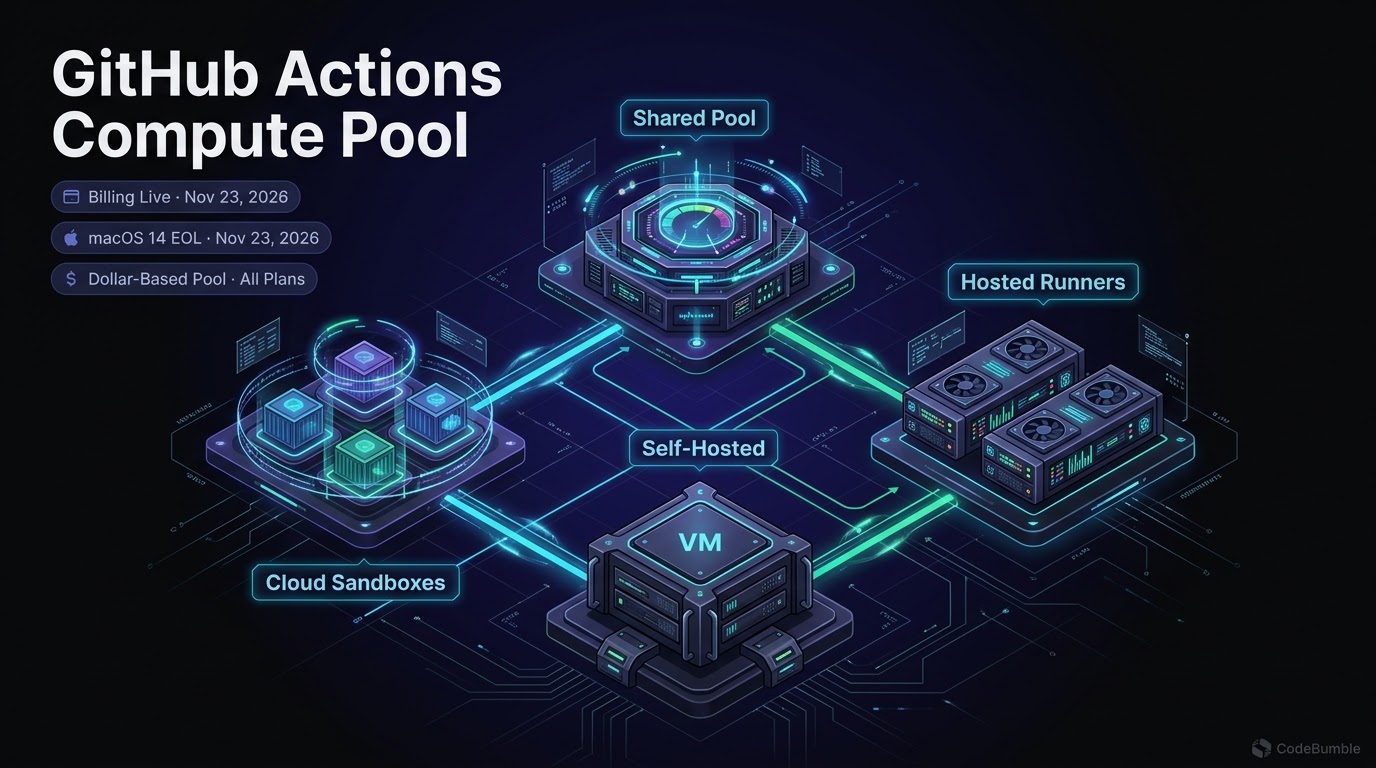
Every time a developer launches an autonomous coding session from github.com, GitHub Mobile, VS Code, the Copilot CLI, Slack, or Microsoft Teams, Copilot defaults to executing inside a GitHub-managed cloud sandbox—an ephemeral, isolated environment with no one-hour session timeout that saves a resumable snapshot when shut down. Beginning November 23, 2026, those sandbox seconds deduct from the exact same dollar pool that pays for your CI/CD runners.
flowchart TB
    Pool[Shared Dollar-Based Actions Compute Entitlement] -->|Published Runner Rate| Std[Standard GitHub-Hosted Runners]
    Pool -->|Team & Enterprise Cloud| Large[Larger Hosted Runners]
    Pool -->|$0.000024/vCPU-s + $0.000003/GiB-s| Sandbox[Copilot Cloud Sandboxes]
    Sandbox -->|Shutdown| Snapshot[Resumable Session Snapshot]
    Self[Self-Hosted / Local VM] -->|copilot --environment-host| Agent[Bypass Cloud Sandbox Metering]
    ActionsSelf[Actions Self-Hosted Runners] -->|copilot-setup-steps.yml| CI[Dedicated CI Compute]
Who Is Affected & How Attribution Works
The flexible Actions compute entitlement applies across GitHub Free, Pro, Free for organizations, Team, and Enterprise Cloud plans (with larger hosted runners drawing from the shared pool on Team and Enterprise Cloud only). According to GitHub's Cloud and Local Sandboxes billing documentation:
- Repository-Scoped Sessions: If a Copilot cloud session operates across one or more repositories sharing an owner, that owner (personal account or organization) is billed.
- Non-Repository Sessions: If a session is not tied to a repository, the user selects the billing owner (defaulting to the user's personal account if unset).
- Priority & Overages: No eligible workload has priority over another. Once the shared entitlement hits zero, usage continues under your account's existing overage rates, budgets, and payment settings.
Safe Configuration & Migration Snippets
To prevent November 2026 runner retirements from breaking CI while keeping agentic sandbox usage bounded, audit both your workflow YAML labels and your CLI environment routing:
# .github/workflows/ci-macos.yml
# Migrate off retired macos-14 labels (GitHub Actions retired Nov 2, 2026;
# Azure DevOps Intel macos-14 retires Nov 23, 2026)
jobs:
  build:
    runs-on: macos-15 # or macos-latest / macos-26
    steps:
      - uses: actions/checkout@v4
      - run: npm test
If your team wants autonomous coding sessions to run on developer workstations or dedicated internal VMs instead of metered cloud sandboxes, register a local host via the Copilot CLI:
# Register a local machine or self-managed VM as a Copilot environment
# (avoids GitHub-managed cloud sandbox compute charges)
copilot --environment-host
Reliability, Cost & Performance Analysis
Mixing synchronous CI/CD pipelines and asynchronous AI agent sandboxes in one financial bucket introduces cross-system failure modes that traditional DevOps monitoring rarely catches.
Verified Cloud Sandbox Pricing & Rate Math
GitHub publishes explicit per-second rates for Copilot cloud sandboxes in its billing documentation:
| Resource Dimension | Published Meter Rate | 10-Min (600 s) Example (2 vCPU / 4 GiB) |
|---|---|---|
| Compute (vCPU) | $0.000024 USD per vCPU-second |
1,200 vCPU-s × $0.000024 = $0.0288 USD |
| Memory (GiB) | $0.000003 USD per GiB-second |
2,400 GiB-s × $0.000003 = $0.0072 USD |
| Total Deducted | Combined per-second meter | $0.0360 USD ($0.216 / hour) |
While $0.036 for a 10-minute 2 vCPU / 4 GiB session is modest in isolation, cloud sandboxes have no one-hour total running session limit. Long-running agent loops—especially multi-repository investigations or iterative test-fix cycles—consume the shared pool continuously at each product's published rate.
Contention, Budget Alerts & Governance Limits
As QA engineering analysis from QATechTools (November 22–23, 2026) highlights, a shared compute pool creates a coupled failure mode: a runaway or poorly scoped agent session can exhaust the included Actions allowance and trigger budget-based CI blocks or unexpected overage bills even when the underlying code change is harmless.
When configuring guardrails via GitHub Budgets and Alerts, platform teams must account for two documented constraints:
- Alert Thresholds: Budgets trigger UI and email notifications to account owners and billing managers at
75%,90%, and100%of the configured amount, while included-usage alerts fire at90%and100%. - User-Scoped Alert Gap: GitHub explicitly warns that alerting for user-level budgets is not consistently available in all scenarios—meaning teams must anchor governance on cost-center, organization, or enterprise-level budgets rather than relying solely on per-user caps.
- No Priority Reservation: Because standard runners and cloud sandboxes draw from the same pool on a first-come, first-served basis, high-priority release builds cannot reserve a protected slice of the included entitlement without separate budget/environment controls.
Reliability Impact of Runner Image Retirements
On the CI/CD side, November 23, 2026 marks the final cutoff for Azure DevOps macos-14 Intel images (macos-14, macos-14-large, macos-14-xlarge), following four scheduled brownout windows between November 5 and November 20, 2026 (actions/runner-images#13518). Any Azure DevOps pipeline still referencing those labels after today fails immediately—just as GitHub Actions macos-14 and Azure DevOps arm64 jobs began failing after November 2, 2026.
Practical Implementation & Trade-Offs
Choosing where to run automated builds and AI agent tasks now requires balancing setup friction, per-second cost predictability, and organizational security policies.
| Execution Target | Best Use Case | Billing & Metering Behavior | Key Trade-Offs |
|---|---|---|---|
| Copilot Cloud Sandboxes | Async mobile/web/Slack tasks, cross-repo triage, >1-hr agent runs | $0.000024/vCPU-s + $0.000003/GiB-s; draws from shared Actions pool |
Zero local setup & resumable snapshots, but competes with CI allowance |
| Actions-Based Self-Hosted Runners | Workloads needing copilot-setup-steps.yml, private VPC access, or fixed hardware |
Uses your own infra; avoids hosted runner/sandbox per-second fees | You own OS patching, scaling, and runner isolation |
Local / VM (--environment-host) |
Interactive developer loops, sensitive local datasets, zero cloud sandbox spend | Runs on registered workstation/VM; no cloud sandbox compute charge | Requires host uptime; tied to local machine/VM resources |
| Standard / Larger Hosted Runners | Deterministic CI/CD builds, matrix tests (macos-15, ubuntu-24.04) |
Published per-minute runner rates from shared Actions pool | Predictable build steps; vulnerable to pool exhaustion if unbudgeted |
Operational Checklist for Platform & QA Teams
- Baseline & Isolate Before Scaling: Record your current Actions entitlement balance, active budgets, and payment settings before enabling organization-wide Copilot cloud sandboxes. Run a bounded test in a disposable repository and verify that billing reports separate sandbox consumption from CI runner consumption (QATechTools).
- Enforce Policy & MCP Allowlists: Cost controls do not replace authorization. Confirm that your
"Copilot in the cloud"policy, repository exclusions, SSO enforcement for organization sessions, and enterprise MCP server allowlists are active—and remember that users without write access automatically fall back to read-only Copilot mode. - Sweep Repositories for
macos-14Labels: Search all.github/workflows/*.ymlandazure-pipelines.ymlfiles formacos-14,macos-14-large, andmacos-14-xlarge, and pin them tomacos-15,macos-26, ormacos-latest. - Anchor Budgets Above User Level: Configure
75% / 90% / 100%budget alerts at the organization or cost-center level so a spike in cloud sandbox snapshots never silently stalls production deployments.
Frequently Asked Questions
1. When does GitHub Copilot cloud sandbox billing start?
Billing for Copilot cloud sandbox usage begins on November 23, 2026, as confirmed in GitHub's updated October 28, 2026 Changelog entry (editor's note added November 19, 2026).
2. How much does a Copilot cloud sandbox cost?
GitHub meters cloud sandboxes at $0.000024 USD per vCPU-second and $0.000003 USD per GiB-second. For example, a 2 vCPU / 4 GiB sandbox running for 10 minutes (600 seconds) costs $0.036 USD, deducted from your shared Actions compute entitlement (GitHub Billing Docs).
3. Can Copilot cloud sandbox usage exhaust my GitHub Actions CI/CD allowance?
Yes. Standard GitHub-hosted runners, Copilot cloud sandboxes, and larger hosted runners (on Team and Enterprise Cloud) draw from the same dollar-based Actions compute pool with no priority reservation between CI jobs and agent sessions.
4. How can I avoid cloud sandbox charges for Copilot sessions?
You can register your own workstation or VM using copilot --environment-host in the Copilot CLI, or keep workflows on Actions-based self-hosted runners if you rely on copilot-setup-steps.yml.
5. Why are my Azure DevOps macOS 14 builds failing after November 23, 2026?
Azure DevOps retired its macOS 14 Intel runner images (macos-14, macos-14-large, macos-14-xlarge) on November 23, 2026 (following GitHub Actions' and Azure DevOps arm64's November 2, 2026 retirement). Update your pipeline image labels to macos-15, macos-26, or macos-latest.
Sources
- GitHub Changelog — Work from anywhere with a new, connected Copilot cloud experience (published October 28, 2026; editor's note updated November 19, 2026): https://github.blog/changelog/2026-10-28-work-from-anywhere-with-a-new-connected-copilot-cloud-experience/
- GitHub Docs — Billing for cloud and local sandboxes for GitHub Copilot (verified November 23, 2026): https://docs.github.com/billing/concepts/product-billing/cloud-and-local-sandboxes
- GitHub Docs — Budgets and alerts (verified November 23, 2026): https://docs.github.com/en/billing/concepts/budgets-and-alerts
- GitHub (
actions/runner-images) — Issue #13518: macOS 14 Sonoma retirement: GitHub Actions and ADO arm64 on November 2; ADO Intel on November 23 (updated through November 2026): https://github.com/actions/runner-images/issues/13518 - QATechTools — Copilot Cloud Sandbox Billing: QA Checks for Shared Compute (published November 22–23, 2026): https://qatechtools.com/2026/11/22/github-copilot-cloud-sandbox-billing-qa/