

Automation
GitHub Agentic Workflows GA: What to Automate in CI/CD (And What to Keep Human)
GitHub Agentic Workflows reached general availability on October 28, 2026, bringing Markdown-defined coding agents into GitHub Actions with read-only defaults, micro-VM isolation, and safe-output gates. With 76% of developers generating AI code faster than they can verify it and GitInject demonstrating prompt injection across four AI providers, here is what to automate in CI/CD and what must stay human.
8 min read
GitHub Agentic Workflows GA: What to Automate in CI/CD (And What to Keep Human)
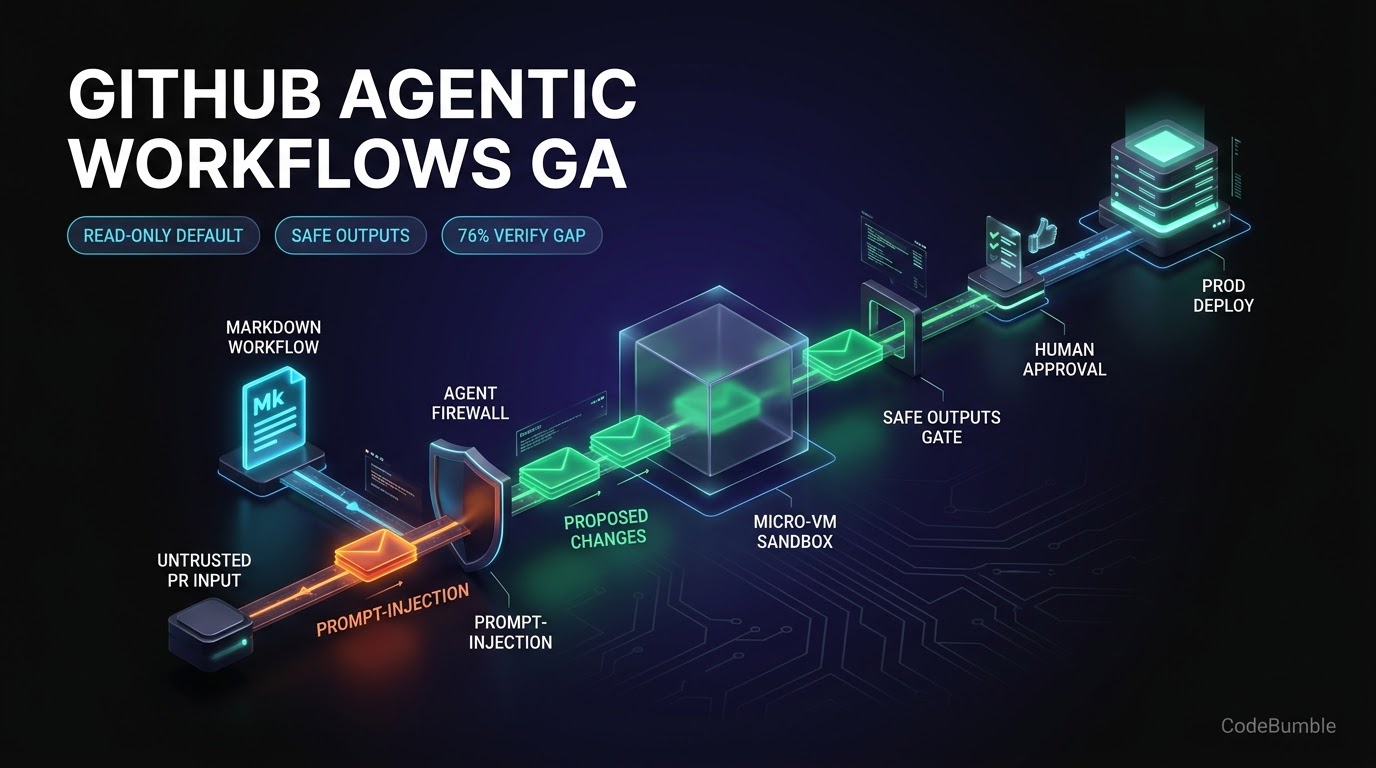
Executive Summary
- GitHub Agentic Workflows Reached GA: On October 28, 2026, GitHub Changelog announced general availability for GitHub Agentic Workflows (
gh-aw), compiling natural-language Markdown specs into standard GitHub Actions YAML across Free, Team, and Enterprise plans. - Defense-in-Depth Runtime Isolation: GA adds Actions Runner Controller (ARC) Docker-in-Docker support, Cloud Hypervisor or NVX micro-VM isolation, cross-repository enclaves, read-only default tokens, an Agent Workflow Firewall, and a mandatory "safe outputs" vetting stage.
- The Verification & Injection Gap: As TartLabs highlighted on November 21, 2026, Sonar's November 12, 2026 survey (
1,026respondents) found 76% of developers generate AI code faster than they can verify it, while GitInject (arXiv:2606.09935) proved all four tested AI providers were susceptible to at least one high-severity prompt-injection attack in default CI configurations. - Operational Takeaway: Automate reversible, read-heavy tasks (triage, CI failure summaries, draft test/doc PRs) behind safe outputs, and keep humans on production deploys, protected-branch merges, secret/IAM edits, and stateful infrastructure changes.
What Changed: Core Mechanism & Architecture
GitHub Agentic Workflows (gh-aw), developed by GitHub Next, Microsoft Research, and Azure Core Upstream, introduces Continuous AI inside GitHub Actions without replacing deterministic build, test, or release YAML pipelines. Instead of wiring complex custom scripts, engineers author intent-driven automation in Markdown files and compile them into standard Actions YAML that inherits existing runner groups, policies, and audit logs.
Key GA Capabilities (October 28, 2026)
- Pluggable Agent Engines & Model Routing: Run GitHub Copilot CLI (requires a Copilot license) or bring alternative coding agents (such as Claude Code or OpenAI Codex) with per-workflow provider selection and task-difficulty model routing.
- Micro-VM & Enclave Isolation: Execute agents inside sandboxed containers or Cloud Hypervisor / NVX micro-VMs, with enclaves preventing data leakage in cross-repository workflows.
- Self-Hosted ARC & Docker-in-Docker: Run agentic workflows on self-hosted Actions Runner Controller (ARC) clusters with Docker-in-Docker enabled.
- Non-Experimental Cost Forecasting (
gh aw forecast): Now generally available, sampling historical workflow runs via a Poisson-bootstrap Monte Carlo engine to project P10 / P50 / P90 AI Credit (AIC) consumption—including threat-detection credits. - Zero-Wildcard Credential Boundaries: Per the GitHub Agentic Workflows Connectors Reference, GitHub App tokens and OIDC JWTs are minted with literal owner/repository grants (no wildcards), and write credentials are minted only in the safe-output job, never inside the untrusted agent phase.
flowchart LR
    A[Trigger: Issue / PR / Schedule] --> B[Agent Phase: Read-Only Token]
    B --> C[Micro-VM / Container Sandbox<br/>+ Agent Workflow Firewall]
    C -->|Proposes Changes| D[Safe Outputs Staging]
    D --> E[Threat-Detection Job<br/>Scans Proposed Diffs]
    E -->|Passes| F[Scoped Write Job<br/>Mints App/OIDC Token]
    F --> G[Draft PR / Label / Comment]
    G --> H[Human Review & Merge]
Safe Minimal Workflow Pattern
When compiling or reviewing an agentic workflow, enforce read-only permissions on the agent phase and isolate write operations into explicit safe-output handlers:
# Conceptual compiled pattern reflecting gh-aw's phase separation
permissions:
  contents: read
  issues: read
  pull-requests: read

jobs:
  agent-triage:
    runs-on: ubuntu-latest
    steps:
      - name: Run sandboxed agent (read-only)
        uses: github/gh-aw-runner@<pinned-commit-sha>
        with:
          network-policy: agent-firewall
          safe-outputs: "add-label,create-comment"

  apply-safe-outputs:
    needs: agent-triage
    if: success()
    permissions:
      issues: write
    steps:
      - name: Threat-detection & scoped write
        run: echo "Validate and apply staged label/comment"
Reliability, Cost & Security Analysis
To evaluate whether CI/CD teams should adopt agentic workflows now, we have to weigh vendor-reported productivity gains against independent security benchmarks and developer verification telemetry.
1. Productivity Claims vs. Verification Reality
In GitHub's GA announcement, Accenture Strategy, Architecture & Innovation Senior Manager Ben Alton reported that rolling out agentic developer workflows saved one lead an estimated 29 hours per week, more than doubled average team velocity, raised AI-authored commits to 91%, and cut daily production errors from roughly 11,000 to under 1,000 during a migration. Note that this is a single enterprise customer vignette rather than a controlled cross-industry benchmark.
Contrast that with Sonar's 2027 State of Code Developer Survey (published November 12, 2026; 1,026 respondents), as analyzed by TartLabs:
- 65% of committed code is now generated or significantly assisted by AI.
- 76% of respondents say they generate AI code faster than they can verify it, and 76% use AI coding tools on business- or mission-critical services (up from 58% the prior year).
- 53% spend more time reviewing code than writing it (up from 18% pre-AI).
- Only 39% completely agree AI code is always checked before commit (down from 48% a year earlier), and just 6% fully trust AI code as functionally correct (94% do not fully trust it).
- Only 36% say their team actively measures AI's productivity impact.
Caveat: Sonar sells code-verification tooling and the data is self-reported rather than measured incident rates, yet the directional warning is clear: code generation speed has outpaced human and automated review capacity.
2. Prompt Injection Is a Structural CI/CD Risk
An agent inside CI/CD reads attacker-controlled strings—PR titles, issue bodies, comments, branch names, and unmerged config files—while running in an environment with repository context and tokens.
- GitInject (
arXiv:2606.09935): Researchers built an open-source evaluation harness using ephemeral repositories and live GitHub Actions runs across four AI providers, testing 11 named attack scenarios across five workflows (config-file injection, credential exfiltration, judgment manipulation, and availability). Every tested provider was susceptible to at least one high-severity attack in default configurations, primarily due to structural flaws—such as loading configuration files from unmerged fork contributions as operator-level instructions. - CSA "Comment and Control" Note (May 3, 2026): Documented how a malicious PR comment or issue can trick an insufficiently isolated coding agent into leaking API keys or
GITHUB_TOKENinto public Actions logs without maintainer interaction.
3. Cost & Operational Overhead
Unlike deterministic YAML steps that cost fractions of a cent in runner minutes, agentic workflows consume LLM tokens on every trigger plus threat-detection credits. Teams should run gh aw forecast --days 30 to establish P50/P90 monthly credit bounds before enabling repository-wide triggers on high-traffic repos, and avoid triggering full reasoning loops on trivial Dependabot or formatting commits.
Practical Implementation & Trade-Offs
GitHub's safe-outputs model and micro-VM isolation dramatically shrink the blast radius of a compromised agent, but platform guardrails do not decide which business steps are reversible.
Decision Matrix: Automate vs. Keep Human
| Pipeline Task | Agent Role | Safe-Mode Guardrail | Keep Human? |
|---|---|---|---|
| Issue & PR triage | Label, deduplicate, route | Read-only token; write via safe-outputs only |
Optional spot-check |
| CI failure analysis | Summarize logs, suggest fix | Redact secrets before log ingestion; advisory comment only | Human applies fix |
| Test & doc PRs | Draft unit tests, update READMEs | Agent opens PR; branch protection blocks self-merge | Yes (human reviews PR) |
| Dependency bumps | Summarize changelogs, open PR | Pin commit SHAs; no auto-merge on major versions | Yes (human approves) |
| Production deploys & secrets | Draft release notes / diff summary | Never grant agent write access to .github/workflows/, IAM, or prod deploy |
Mandatory Human Gate |
Recommended Four-Stage Rollout
- Month 1 — Read-Only Observers: Deploy agents solely for issue triage, flaky-test clustering, and CI log summaries with zero write permissions.
- Months 2–3 — Proposers: Allow agents to open draft PRs for test coverage and documentation under strict branch protection and mandatory human review.
- Post-Review — Gated Actors: Enable narrow safe-output actions (e.g., ticket creation or scoped labeling) only after auditing stage-two logs for prompt-injection anomalies.
- Hard Red Lines: Keep five actions permanently human-gated—production deploy approvals, merges to protected branches, edits to
.github/workflows/or IAM/secrets, stateful DB/network migrations, and customer-impacting incident rollbacks (though deterministic threshold-based rollbacks belong in plain testable code, not LLM judgment).
Frequently Asked Questions (FAQ)
1. Does GitHub Agentic Workflows replace standard GitHub Actions YAML?
No. GitHub explicitly positions Agentic Workflows ("Continuous AI") as a complement to deterministic CI/CD. Standard Actions YAML should still handle builds, unit/integration tests, artifact signing, and deployments, while Markdown-defined agentic workflows handle subjective tasks like triage, failure explanation, and draft PRs.
2. How do "safe outputs" prevent an agent from pushing malicious code?
In GitHub Agentic Workflows, the coding agent runs in a sandboxed container or micro-VM with read-only permissions by default. It cannot directly push commits or modify secrets; instead, it emits structured proposals that pass through a dedicated threat-detection job before a separate, scoped write job applies approved actions like opening a PR or adding a label.
3. Why did GitInject succeed against all four tested AI providers?
Per GitInject (arXiv:2606.09935), the most severe failures were structural rather than model-specific—for example, workflows that loaded configuration files from unmerged pull requests as trusted operator instructions or exposed broad tokens to untrusted fork inputs.
4. What does gh aw forecast measure?
Now generally available as of October 28, 2026, gh aw forecast samples historical workflow runs and uses a Monte Carlo simulation to project P10, P50, and P90 monthly AI Credit consumption, including credits consumed by the threat-detection stage.
5. What is the safest first agentic workflow for a DevOps team?
Start with a read-only CI failure summarizer or issue-triage workflow on a non-critical repository, ensure secrets are redacted from logs, pin all third-party Actions to full commit SHAs, and block triggers from untrusted public forks without maintainer approval.
Sources
- GitHub Changelog — "GitHub Agentic Workflows generally available" (October 28, 2026): https://github.blog/changelog/2026-10-28-github-agentic-workflows-generally-available/
- GitHub Agentic Workflows Documentation — "Connectors | GitHub Agentic Workflows" (2026): https://github.github.com/gh-aw/reference/connectors/
- arXiv (
2606.09935) — Jafar Isbarov, Umid Suleymanov, Ilia Shumailov, Murat Kantarcioglu, "GitInject: Real-World Prompt Injection Attacks in AI-Powered CI/CD Pipelines" (Submitted June 7, 2026; revised November 2026): https://arxiv.org/abs/2606.09935 - TartLabs — Gowtham Raj, "AI Agents in CI/CD: What to Automate and What to Keep Human" (November 21, 2026 — citing Sonar's November 12, 2026 2027 State of Code Developer Survey and CSA May 3, 2026 research): https://www.tartlabs.com/blog/ai-agents-in-ci-cd-pipelines-what-to-automate-and-what-to-keep-human