

AI
GPT-6.2 Astra vs Gemini 4 Carbon and Claude Opus 5.5: Token Cost Inversion, Code Review Noise, and Jailbreak Regressions
OpenAI launched GPT-6.2 Astra and Sol on November 17, 2026, alongside a new System Card and Codex sandbox architecture. While Astra leads Claude Opus 5.5 on Intelligence Index v5.0.1 (62.1 vs 59.1) and costs 2.5x less per task despite double the rate-card price, teams face a 272K long-prompt surcharge, noisier PR review comments, and a reported universal jailbreak regression. Here is how Astra, Sol, Gemini 4 Carbon, and Claude Opus 5.5 compare.
7 min read
GPT-6.2 Astra vs Gemini 4 Carbon and Claude Opus 5.5: Token Cost Inversion, Code Review Noise, and Jailbreak Regressions
Executive Summary
On November 17, 2026, OpenAI introduced GPT-6.2 Astra and GPT-6.2 Sol, followed by the GPT-6.2 System Card (November 18) and an architectural deep-dive into the Codex sandbox (November 19). Independent benchmarks published on November 19–20, 2026 by OrcaRouter, Emergent, CodeRabbit, and BenchLM reveal a counterintuitive economic reality for engineering teams comparing GPT-6.2 Astra, Google Gemini 4 Carbon (released October 28, 2026), and Anthropic Claude Opus 5.5 (released September 22, 2026).
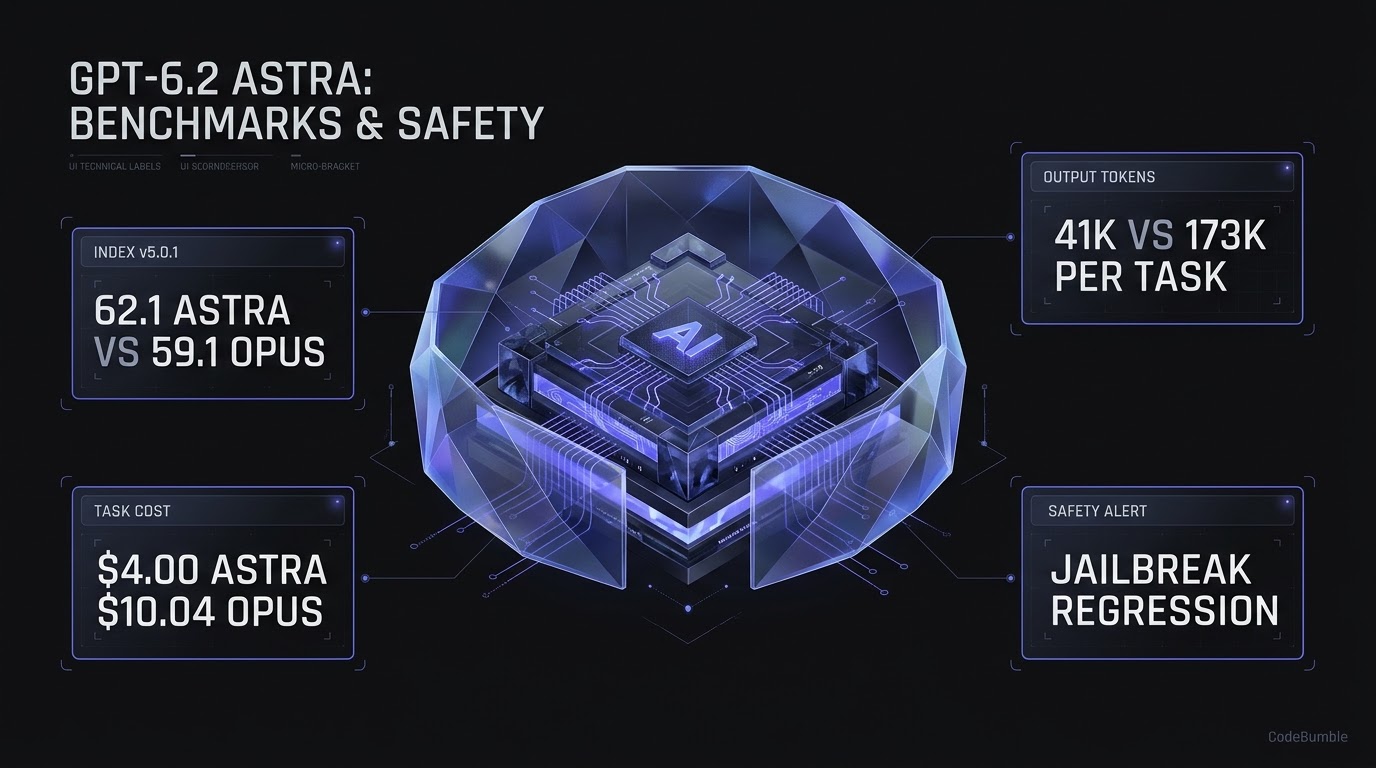
On Intelligence Index v5.0.1 (Artificial Analysis, read November 19, 2026, at maximum effort), GPT-6.2 Astra scores 62.1 against Claude Opus 5.5's 59.1—a three-point lead—while GPT-6.2 Sol (max) scores 57. Despite Astra's higher rate-card price ($8 input / $40 output per 1M tokens), a weighted finished Index task costs $4.00 on GPT-6.2 Astra compared to $10.04 on Claude Opus 5.5—2.5x cheaper—because Astra generates roughly 41,000 output tokens per task versus Opus 5.5's 173,000 output tokens.
However, adopting GPT-6.2 Astra introduces three operational caveats documented this week: (1) prompts exceeding 272K input tokens trigger a 2x input/cached and 1.5x output surcharge across the entire request (whereas Gemini 4 Carbon has no long-prompt surcharge, though its introductory $2/$10 pricing doubles to $4/$20 on December 1, 2026); (2) in CodeRabbit's November 20 PR-review evaluation, Astra more than doubled actionable comments from 253 to 589, raising signal-to-noise concerns; and (3) Aviatrix Threat Research Center's November 20 ThreatsDay bulletin flagged a universal jailbreak regression in GPT-6.2 Astra, reinforcing OpenAI's own System Card classification of Critical cybersecurity and High biological/AI self-improvement capabilities.
| Metric / Spec | GPT-6.2 Astra | GPT-6.2 Sol | Gemini 4 Carbon | Claude Opus 5.5 |
|---|---|---|---|---|
| Developer & Release | OpenAI (Nov 17, 2026) | OpenAI (Nov 17, 2026) | Google DeepMind (Oct 28, 2026) | Anthropic (Sep 22, 2026) |
| Input / 1M Tokens | $8.00 (2x > 272K) |
$2.00 |
$2.00 ($4.00 from Dec 1, 2026) |
Half Astra's rate card |
| Cached Input / 1M | $0.40 (2x > 272K) |
N/A in fetched table | $0.10 ($0.20 from Dec 1, 2026) |
N/A in fetched table |
| Output / 1M Tokens | $40.00 (1.5x > 272K) |
$10.00 |
$10.00 ($20.00 from Dec 1, 2026) |
Half Astra's rate card |
| Intelligence Index v5.0.1 | 62.1 |
57 |
N/A in fetched excerpt | 59.1 |
| Task Cost / Output Tokens | $4.00 / ~41K tokens |
~15% of GPT-6 Astra |
N/A in fetched excerpt | $10.04 / ~173K tokens |
Technical Mechanics and Architecture
1. The Rate-Card vs. Output-Token Cost Inversion
Engineering teams budgeting LLM APIs solely from per-million-token rate cards often mispredict production spend. Because reasoning-heavy frontier models vary dramatically in how many intermediate and final output tokens they emit to solve the same benchmark suite, total task cost = (input_tokens × input_rate) + (output_tokens × output_rate) dominates unit economics.
On Intelligence Index v5.0.1, GPT-6.2 Astra emitted ~41,000 output tokens per task compared to Claude Opus 5.5's ~173,000 output tokens—over 4x the verbosity for 3 points less on the index. Meanwhile, GPT-6.2 Astra carries a 1.05M token context window, but crossing 272K input tokens retroactively multiplies input and cached rates by 2x and output rates by 1.5x for the entire request.
2. Multi-Model Routing & Codex Sandbox Architecture
+-------------------------------------------------------------------------+
|                    ENTERPRISE AI GATEWAY / ROUTER                       |
+-------+---------------------------+----------------------------+--------+
        |                           |                            |
        v                           v                            v
+---------------+         +-------------------+        +------------------+
| Prompt <=272K |         | Prompt > 272K     |        | Routine / Budget |
| Hard Coding / |         | Whole-Repo / Long |        | Coding & Agents  |
| Agent Tasks   |         | Context (No Sur.) |        |                  |
| -> GPT-6.2    |         | -> Gemini 4       |        | -> GPT-6.2 Sol   |
|    Astra      |         |    Carbon         |        |    ($2 / $10)    |
+-------+-------+         +-------------------+        +------------------+
        |
        v
+-------------------------------------------------------------------------+
|  EXECUTION SANDBOX (OpenAI Codex Sandbox / Container Isolation)         |
|  - Command execution limits, network egress allowlists, read-only mounts|
|  - Required defense-in-depth due to Critical cyber & jailbreak risks    |
+-------------------------------------------------------------------------+
Defensive Cost-Guardrail & Sandbox Wrapper Code
To prevent runaway bills from 272K+ surcharge cliffs and enforce strict output-token and execution boundaries when routing between GPT-6.2 Astra, GPT-6.2 Sol, and Gemini 4 Carbon, teams can implement a deterministic pre-flight router guard:
#!/usr/bin/env python3
"""
Defensive LLM routing guard: prevents accidental 272K surcharge triggers
on GPT-6.2 Astra and enforces explicit max_output_tokens budgets.
"""
from dataclasses import dataclass

@dataclass(frozen=True)
class ModelRoute:
    model_id: str
    max_output_tokens: int
    reason: str

ASTRA_SURCHARGE_THRESHOLD = 272_000

def select_safe_route(estimated_input_tokens: int, high_complexity: bool) -> ModelRoute:
    if estimated_input_tokens > ASTRA_SURCHARGE_THRESHOLD:
        # Avoid Astra's 2x input / 1.5x output whole-request surcharge
        return ModelRoute(
            model_id="gemini-4-carbon",
            max_output_tokens=32_000,
            reason="Input exceeds 272K surcharge threshold; routed to long-context tier.",
        )
    if high_complexity:
        return ModelRoute(
            model_id="gpt-6.2-astra",
            max_output_tokens=45_000,
            reason="Hard reasoning task within <=272K prompt window.",
        )
    return ModelRoute(
        model_id="gpt-6.2-sol",
        max_output_tokens=24_000,
        reason="Routine coding/agent task routed to budget-efficient Sol tier.",
    )
Evidence & Operational Impact
Code Review Signal-to-Noise (CodeRabbit, November 20, 2026)
In CodeRabbit's November 20, 2026 evaluation of GPT-6.2 Astra and GPT-6.2 Sol on pull-request reviews:
- GPT-6.2 Astra increased regular actionable comments from the baseline's 253 to 589 (+133%). Of those 589 comments, 72 matched known issues (covering 58 distinct issues), leaving 517 additional comments requiring human triage.
- GPT-6.2 Sol (high-reasoning) increased comments from 187 to 290 (+55%), catching two additional known issues overall.
- Operational Takeaway: Higher comment volume without strict evidence filtering risks alert fatigue, causing developers to ignore valid findings alongside noise.
Safety Evaluations & Jailbreak Regression (OpenAI & Aviatrix TRC)
- OpenAI System Card (November 18, 2026): OpenAI assessed GPT-6.2 Astra and GPT-6.2 Sol as meeting its Critical threshold for cybersecurity capabilities and High thresholds for Biological/Chemical and AI Self-Improvement capabilities. OpenAI's deployment controls rely on static/multiturn jailbreak evaluations, indirect prompt injection robustness, misuse monitoring, and Trusted Access tiers, paired with Codex sandbox execution limits (November 19, 2026).
- Universal Jailbreak Regression (November 20, 2026): Aviatrix Threat Research Center reported a universal jailbreak regression discovered in GPT-6.2 Astra, underscoring that model-level safety filters cannot replace OS-level sandboxing, network egress controls, and least-privilege tool permissions.
- Unavailable Benchmarks: BenchLM (November 17, 2026) notes that GPT-6.2 Astra scores 91.1/100 (ranked #2 of 214 models), but throughput (tokens/sec) and Time to First Token (TTFT) were not measured in that dataset.
Hardening & Rollout Playbook
Enforce Token & Surcharge Routing Policies
- Route prompts under 272K tokens requiring deep reasoning to GPT-6.2 Astra (
$8/$40), routine coding/agent loops to GPT-6.2 Sol ($2/$10), and whole-repository prompts over 272K tokens to Gemini 4 Carbon (noting Carbon's introductory$2/$10pricing doubles to$4/$20on December 1, 2026).
- Route prompts under 272K tokens requiring deep reasoning to GPT-6.2 Astra (
Isolate Agentic Execution Inside Hardened Sandboxes
- Because GPT-6.2 Astra exhibits Critical cybersecurity capabilities and a reported jailbreak regression, never grant agentic coding sessions unrestricted host shell or outbound internet access. Use Codex sandbox limits or ephemeral containers with read-only source mounts and explicit egress allowlists.
Filter AI Code-Review Comments Before Developer Notification
- Require AI PR reviewers using Astra or Sol to output reproducible trigger conditions and observed failure modes before posting inline comments, preventing the 589-comment noise spike observed by CodeRabbit.
Monitor Token-Burn & Anomalous Tool Calls
- Alert on sudden spikes in output tokens per task or unexpected tool/network invocations from agentic sandboxes:
index=ai_gateway
(model="gpt-6.2-astra" AND prompt_tokens > 272000)
OR (output_tokens > 60000)
| stats count avg(prompt_tokens) as avg_in avg(output_tokens) as avg_out sum(cost_usd) as total_cost by app_id, model
Rollback & Change-Control Notes
- Pin model snapshots explicitly in production configs and maintain a tested fallback route to GPT-6.2 Sol or Gemini 4 Carbon if Astra's latency, 272K surcharge, or PR-review verbosity degrades developer workflows.
Frequently Asked Questions (FAQ)
1. Why is GPT-6.2 Astra cheaper per task than Claude Opus 5.5 if its token price is higher? On Intelligence Index v5.0.1 (Artificial Analysis, Nov 19, 2026), GPT-6.2 Astra generated ~41,000 output tokens per task versus ~173,000 on Claude Opus 5.5, resulting in a weighted task cost of $4.00 for Astra compared to $10.04 for Opus 5.5.
2. What happens when a prompt exceeds 272K tokens on GPT-6.2 Astra? OpenAI applies a long-prompt surcharge that doubles input and cached input rates (2x) and multiplies output rates by 1.5x across the entire request.
3. When does Gemini 4 Carbon's introductory pricing end?
Google DeepMind's introductory Carbon pricing ($2 input / $0.10 cached / $10 output per 1M tokens) runs through November 30, 2026, doubling to $4 input / $0.20 cached / $20 output on December 1, 2026.
4. Should teams turn on GPT-6.2 Astra for automated PR reviews right away? Test it with strict comment filtering first. CodeRabbit observed Astra more than doubling actionable comments (253 to 589), which can overwhelm developers if low-value comments are not suppressed.
5. How should teams mitigate the reported GPT-6.2 Astra jailbreak regression? Treat model-level safety as one layer only: run agentic coding workflows inside isolated sandboxes (such as OpenAI's Codex sandbox), restrict filesystem/network egress, and require human approval for destructive or privileged tool actions.
Sources
- OpenAI Deployment Safety Hub — GPT-6.2 System Card: Security Controls. Published: November 18, 2026. URL: https://deploymentsafety.openai.com/gpt-6-2-astra-sol/security-controls
- OpenAI — Inside the Codex sandbox. Published: November 19, 2026. URL: https://openai.com/index/inside-the-codex-sandbox/
- Emergent — GPT-6.2 Astra vs Gemini 4 Carbon: Which Frontier Model Wins?. Published: November 20, 2026. URL: https://emergent.sh/learn/gpt-6-2-astra-vs-gemini-4-carbon
- OrcaRouter — GPT-6.2 Astra vs Claude Opus 5.5: Time to First Token. Published: November 19, 2026. URL: https://www.orcarouter.ai/blog/gpt-6-2-astra-vs-claude-opus-5-5
- CodeRabbit — GPT-6.2 Sol and Astra review: should you switch?. Published: November 20, 2026. URL: https://www.coderabbit.ai/blog/gpt-6-2-sol-and-astra-review
- Aviatrix Threat Research Center — ThreatsDay November 2026: AI Jailbreaks, PNG Malware, Half-Billion-Dollar Ransoms. Published: November 20, 2026. URL: https://aviatrix.ai/threat-research-center/threatsday-gpt-62-jailbreak-bubbleloader-png-malware-500m-ransom-2026/