

AI
Microsoft agent-framework PyPI Hijack: How Two Malicious Releases Used .pth Hooks to Steal AI and Cloud Keys
On November 17, 2026, attackers published two malicious releases (1.26.1 and 1.26.2) of Microsoft's official agent-framework Python AI SDK on PyPI within 33 minutes. Using .pth startup hooks that fire on every Python invocation—even without importing the package—the payload harvested environment variables, /proc/*/environ secrets, and cloud/AI keys, and attempted to mint Azure DevOps, GitHub Actions OIDC, and Azure managed-identity tokens. This defensive incident breakdown covers the full timeline, SHA-256 IOCs, safe non-Python containment steps, and token revocation.
6 min read
Microsoft agent-framework PyPI Hijack: How Two Malicious Releases Used .pth Hooks to Steal AI and Cloud Keys
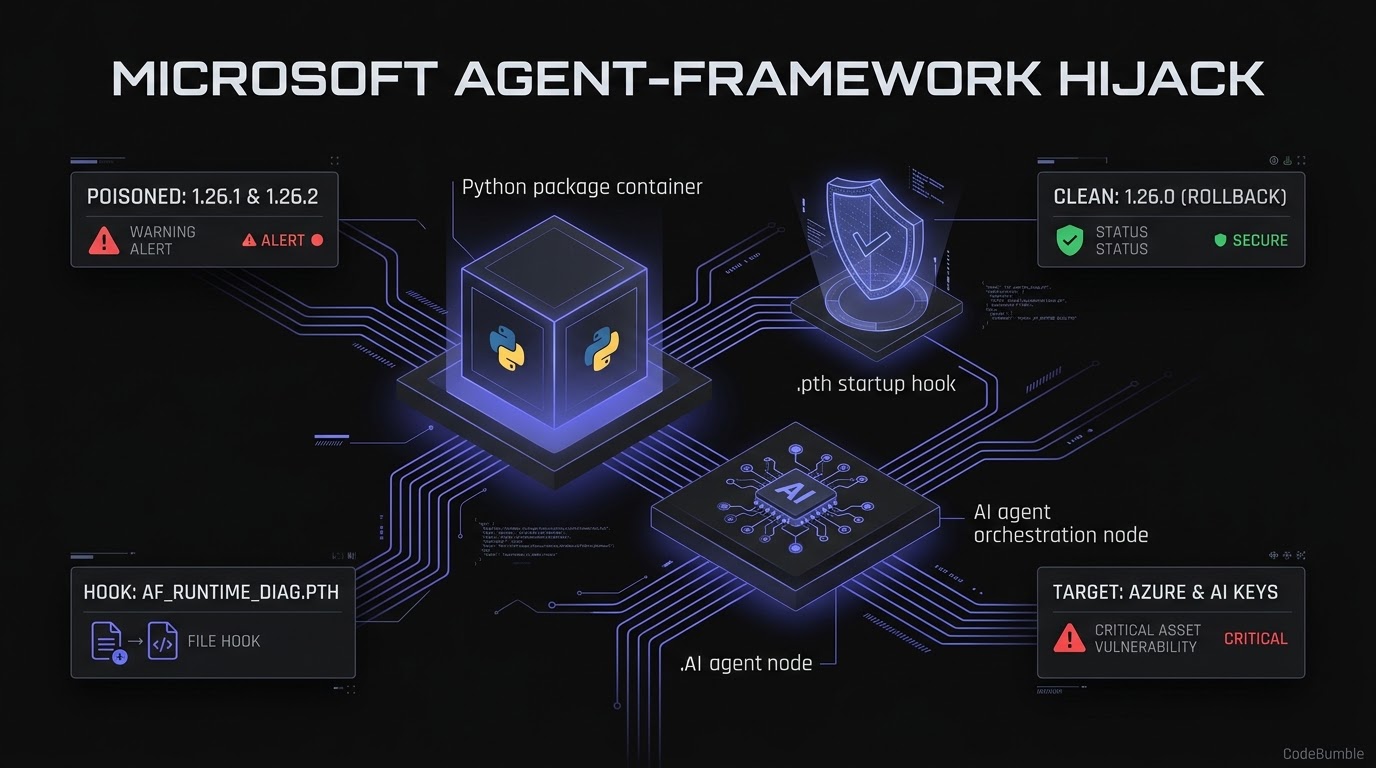
Executive Summary
On November 17, 2026, attackers compromised publishing access for Microsoft's official agent-framework Python package on PyPI—the umbrella SDK for building and orchestrating AI agents on Azure and OpenAI, averaging roughly 192,534 downloads per month (Help Net Security). Within 33 minutes, the attackers shipped two malicious wheel-only releases: 1.26.1 at 20:35:20 UTC and 1.26.2 at 21:08:39 UTC, just 2 minutes and 23 seconds after PyPI quarantined 1.26.1 (StepSecurity).
Both releases preserved the clean dependency pin (agent-framework-core[all]==1.26.0) so AI agent code continued functioning normally, while silently planting .pth startup hooks (agent_framework_meta.pth in 1.26.1 and af_runtime_diag.pth in 1.26.2) in site-packages. Because Python's site module executes import lines inside .pth files automatically at interpreter startup, any Python invocation (pip, pytest, linters, or build scripts) triggered the stealer—even if agent_framework was never imported.
PyPI quarantined both 1.26.1 and 1.26.2 by 21:16:44 UTC, leaving 1.26.0 (published November 12, 2026) as the latest clean release. However, because the payload also attempted to mint fresh Azure DevOps, GitHub Actions OIDC, and Azure Managed Identity tokens, teams that installed either version during the 45-minute window must isolate hosts before running python or pip, rotate static secrets, and audit federated identity trusts.
Confidence Level: High for timeline timestamps, .pth mechanics, SHA-256 hashes, and exfiltration endpoint (webhook.site)—corroborated across StepSecurity, Aikido Security, and Help Net Security. Note that StepSecurity cautions static analysis confirms the attempts to request OIDC/IMDS tokens, not whether every target environment successfully issued them, and the initial PyPI publishing compromise vector remains unconfirmed.
Technical Mechanics and Architecture
1. Why .pth Startup Hooks Bypass Import-Time Controls
Python wheels do not execute setup.py install scripts, making .pth files in site-packages the functional equivalent of an npm postinstall hook—with a nastier persistence property: they run on every subsequent Python interpreter launch unless -S is passed.
[pip install agent-framework==1.26.1 / 1.26.2 (20:35–21:20 UTC, Nov 17)]
        │
        ▼  Writes .pth hook into site-packages (no code runs at install)
[Next Python Launch (pytest, pip, CI script — NO import needed)]
        │
        ▼  site.py executes `import af_runtime_diag` (1.26.2)
┌─────────────────────────────────────────────────────────────────┐
│  1. Sets _AF_TEL=1 guard & forks detached child (setsid())      │
│     (Windows fallback: daemon thread)                           │
│  2. Harvests Env Vars (35 patterns: AZURE, AWS, OPENAI, HF_, …) │
│  3. Scrapes /proc/[0-9]*/environ (first 300 processes)          │
│  4. Reads up to 80 credential files (~/.azure, .env, Docker)    │
│  5. Attempts Token Minting:                                     │
│     ├─ Azure DevOps OIDC (SYSTEM_OIDCREQUESTURI)                │
│     ├─ GitHub Actions OIDC (ACTIONS_ID_TOKEN_REQUEST_URL)       │
│     └─ Azure IMDS 169.254.169.254 (12 Azure/AI resources)       │
└─────────────────────────────────────────────────────────────────┘
        │
        ▼  zlib + base64 POST (User-Agent: runtime-diagnostics/1)
[https://webhook[.]site/d381fd80-ec62-42ad-8f5c-d1b15103c9bb]
2. Evolution Between 1.26.1 and 1.26.2 in 33 Minutes
As documented by Aikido Security and StepSecurity, the attacker adapted rapidly after 1.26.1 was quarantined:
- Iteration 1 (
1.26.1): Placedagent_framework_meta.pth(import agent_framework_meta) at the wheel root, addedagent_framework_meta/_telemetry.py, and appended an 8-line loader toagent_framework_meta/__init__.py. - Iteration 2 (
1.26.2): Restoredagent_framework_meta/__init__.pyto its byte-identical1.26.0state to evade package-directory diffs, moved the payload to top-levelaf_runtime_diag.py(7,658 bytes) +af_runtime_diag.pth(23 bytes), raised the credential file cap from 60 to 80 files, added GitHub Actions OIDC token minting (api://AzureADTokenExchangeandhttps://management.azure.com/), and added/home/runner/work/_temp/*and/home/runner/.azure/*to file globs.
Safe Non-Python Containment & Audit Commands
Critical Warning: Do not start containment by running pip show, pip uninstall, or python inside a suspected environment—starting the Python interpreter will execute the .pth hook again. Use OS-level, non-Python file inspection first:
# 1. Search site-packages and container filesystems WITHOUT invoking Python
find / -type f \( -name "agent_framework_meta.pth" -o -name "af_runtime_diag.pth" \
  -o -name "af_runtime_diag.py" -o -name "_telemetry.py" \) 2>/dev/null

# 2. Inspect installed distribution METADATA without running Python
grep -rnE "^Version:\s*1\.26\.(1|2)$" /usr/local/lib/python*/site-packages/agent_framework-*.dist-info/METADATA \
  ~/.local/lib/python*/site-packages/agent_framework-*.dist-info/METADATA 2>/dev/null

# 3. Check running processes for the _AF_TEL=1 anti-recursion marker (Linux)
grep -l "_AF_TEL=1" /proc/[0-9]*/environ 2>/dev/null
Evidence: Timeline, Package Forensics, and Verified IOCs
Forensic Anomalies & Timeline (November 12–17, 2026)
- November 12, 2026 (
18:24 UTC): Cleanagent-framework==1.26.0published (both wheel and source distributionsdist, 40 seconds apart). - November 17, 2026 (
20:35:20 UTC): Maintainer accountvibiretadded; malicious1.26.1uploaded (wheel-only, uploader User-AgentRestSharp/106.13.0.0, no provenance attestation, injected files world-writablerw-rw-rw-). - November 17, 2026 (
21:06:16 UTC): PyPI quarantines1.26.1. - November 17, 2026 (
21:08:39 UTC): Attacker publishes1.26.2(wheel-only, RestSharp User-Agent, GitHub Actions OIDC targeting). - November 17, 2026 (
21:16:44 UTC): PyPI quarantines1.26.2;1.26.0restored as latest.
Verified Indicators of Compromise (IOCs)
| Indicator Type | Value | Notes |
|---|---|---|
Wheel 1.26.1 (SHA-256) |
d27fa34414e6201d5e03e559ef634f020057554d7b3f4898dd5d7cd3e989e110 |
Quarantined on PyPI |
Wheel 1.26.2 (SHA-256) |
3d20a8bc91351a9a16b6db243b848ceca0206b7a8623b02d2af553a9c9f7e0a9 |
Quarantined on PyPI |
Hook 1.26.2 (af_runtime_diag.pth) |
325e7e9f0ec94e41ad1a1b7a3f18a6b8b5bffece2e2b97b8d3369eb967452f93 |
Top-level site-packages |
Payload 1.26.2 (af_runtime_diag.py) |
54d885b7d7161c9ed96489c66364c4bfbf635929166843bba10d97d46b5a2e1f |
Top-level site-packages |
| Exfiltration Endpoint | https://webhook[.]site/d381fd80-ec62-42ad-8f5c-d1b15103c9bb?t=telemetry |
POST, application/octet-stream |
| HTTP User-Agents | af-runtime-diagnostics/1 (1.26.1), runtime-diagnostics/1 (1.26.2) |
Searchable in proxy/egress logs |
Hardening Playbook: Containment, Secret Rotation, and CI/CD Defense
Step 1: Isolate Exposed Environments Before Running Python
If any developer machine, container image, or CI runner resolved agent-framework between 20:35 UTC and 21:20 UTC on November 17, 2026 (including via loose constraints like agent-framework>=1.26 or Dependabot/Renovate PRs), isolate it from the network immediately. Do not run pip uninstall in place; inspect via find/grep and rebuild the container or virtual environment from a clean base.
Step 2: Pin Clean Versions and Purge Caches
Pin agent-framework==1.26.0 using hash-pinned lockfiles (pip-compile --generate-hashes, uv.lock, or poetry.lock). Purge local pip caches, CI dependency caches, and internal PyPI mirrors (Artifactory, Nexus, Azure Artifacts) that may still cache 1.26.1 or 1.26.2 even after PyPI quarantined them.
Step 3: Rotate Static Secrets and Audit Federated Identity
Treat every credential readable from the host or /proc/*/environ as compromised:
- Rotate Azure service principal secrets, Azure DevOps PATs, OpenAI/Azure AI Foundry/Hugging Face API keys, GitHub/PyPI/npm/Docker tokens, and
.envsecrets. - Audit Entra ID sign-in logs, GitHub Actions
id-token: writepermissions, Azure DevOps service connections, and Managed Identity role assignments. As StepSecurity notes, deleting a federated trust stops future exchanges, but may not revoke already-issued short-lived access tokens.
Step 4: Hunt Egress Logs and Enforce CI Controls
Search DNS, firewall, and proxy logs since November 17 for webhook[.]site (and specifically /d381fd80-ec62-42ad-8f5c-d1b15103c9bb), distinguishing blocked attempts from completed transfers. Going forward, enforce egress allowlisting on CI runners, ephemeral single-use runners, and a package cooldown period (e.g., 48 hours) on automated dependency updates.
Step 5: Safe Rollback Verification
After rebuilding affected environments on agent-framework==1.26.0, verify zero .pth anomalies remain in site-packages before re-attaching production AI service credentials.
Frequently Asked Questions (FAQs)
1. Am I affected if my code never imported agent_framework after pip install?
Yes. Both 1.26.1 and 1.26.2 installed .pth startup hooks in site-packages, which Python's site module executes automatically on every interpreter launch—including running pytest, pip, or any unrelated Python script in that environment.
2. Why shouldn't I run pip uninstall agent-framework to clean up an infected host?
Because pip itself is a Python process. Launching pip triggers site.py, which executes the .pth hook one more time before pip can uninstall the package. Isolate the host first and inspect or rebuild without starting Python.
3. Were satellite packages like agent-framework-openai or agent-framework-core also compromised?
According to StepSecurity's preserved investigation, agent-framework-openai, agent-framework-redis, agent-framework-postgres, agent-framework-purview, and agent-framework-tools showed no uploads after November 12 at the time of inspection, and 1.26.1/1.26.2 depended on the genuine agent-framework-core[all]==1.26.0.
4. Which version of agent-framework is safe to pin?
Version 1.26.0 (published November 12, 2026) is the last verified clean release. Always pin with SHA-256 hashes in your lockfile and clear internal PyPI proxy caches.
5. Why did the attacker release 1.26.2 33 minutes after 1.26.1?
After PyPI quarantined 1.26.1 at 21:06:16 UTC, the attacker still held publishing access and uploaded 1.26.2 at 21:08:39 UTC—restoring __init__.py to avoid directory diffs, moving the payload to af_runtime_diag.pth, and adding GitHub Actions OIDC token theft.
Sources
- StepSecurity (Primary Technical Analysis): Microsoft agent-framework PyPI Package Compromised (Published November 18, 2026)
- Aikido Security (Primary Wheel Diff & Code Analysis): Two malicious agent-framework releases hit PyPI in 33 minutes (Published November 17, 2026; Updated November 18, 2026)
- Help Net Security (Press & Expert Commentary): Credential stealer slipped into Microsoft's official Python agent framework (Published November 19, 2026)
- OX Security (Discovery Report): Microsoft agent-framework PyPI Package Hijacked (Published November 18, 2026)