

Technology
KDE Plasma 6.9: How True XWayland On-Demand Works and Why It Cuts Legacy X11 Overhead
KDE's November 14, 2026 'This Week in Plasma' update confirms a major architectural milestone for Plasma 6.9: XWayland now starts lazily on demand and stops when X11 apps close. Explore the ksmserver, kded-x11, and KWin initfd changes, plus how to audit your Wayland session for accidental XWayland triggers.
8 min read
KDE Plasma 6.9: How True XWayland On-Demand Works and Why It Cuts Legacy X11 Overhead
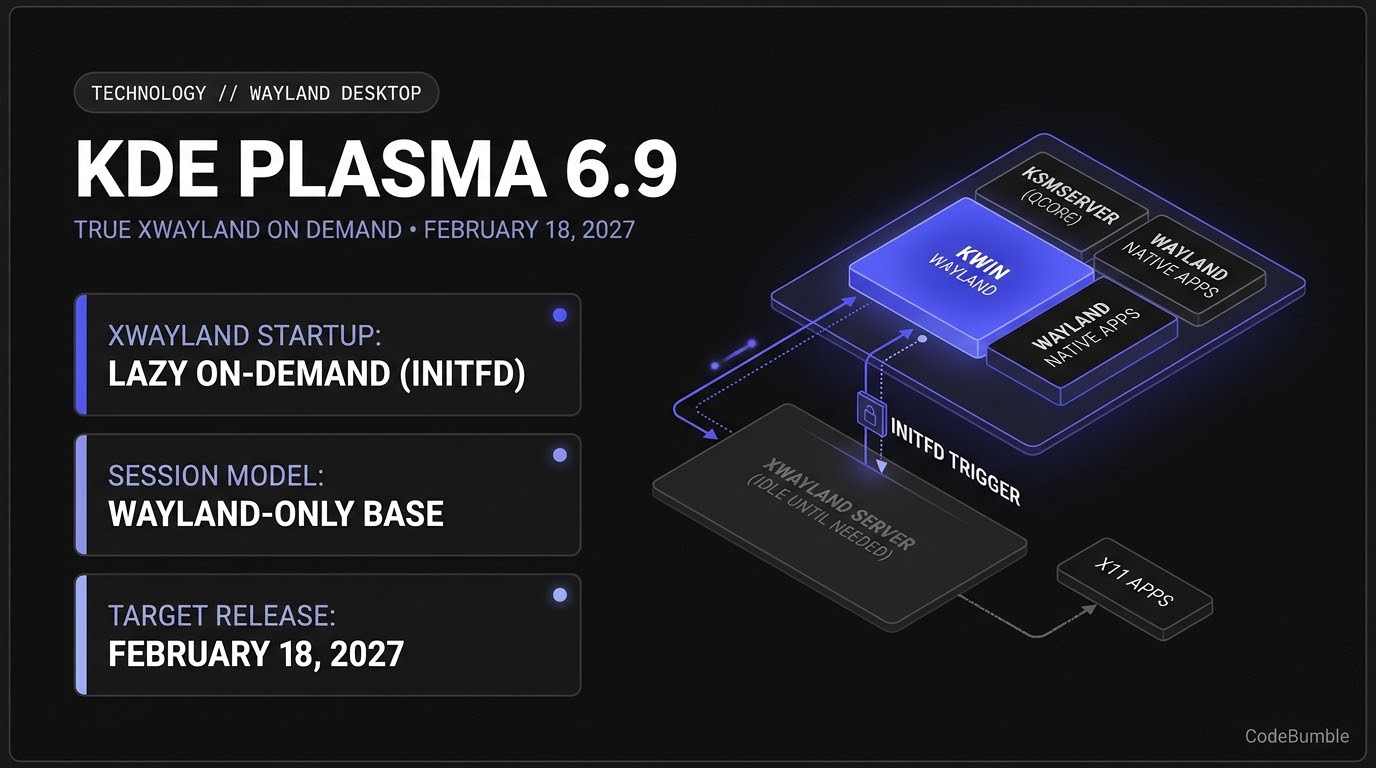
Executive Summary
On November 14, 2026, KDE developer Nate Graham published the latest This Week in Plasma: XWayland On Demand report, confirming that KDE Plasma 6.9—targeted for stable release on February 18, 2027 (Linux Compatible)—has achieved true XWayland on-demand execution. Engineered by Vlad Zahorodnii, David Edmundson, and David Redondo, the change ensures the XWayland compatibility layer no longer runs continuously in the background during a Wayland session when no X11 applications are active.
Previously, even on Wayland-only desktops where Plasma 6.8 had already removed the ability to start a standalone X11 session, background KDE services still touched legacy X11 code paths at login—forcing XWayland to stay resident in memory and hold GPU resources. By refactoring ksmserver, isolating X11-specific daemon tasks into a dedicated kded-x11 module, and adding initfd support in KWin for race-free lazy startup, Plasma 6.9 keeps XWayland stopped until an X11 client actually connects and tears it down once those apps exit.
Alongside XWayland on demand, the November 14, 2026 update introduces Spectacle startup parallelization, faster "Add Widgets" sidebar loading, QML ports for System Settings pages, a physical CPU core counter in System Monitor, and named presets (water, pudding, molasses, Nitroglycerin) for KWin's Wobbly Windows effect (Phoronix). Quantitative boot-time and RAM-savings benchmarks for Plasma 6.9 have not yet been published by KDE or Phoronix.
Why XWayland Stayed Running on Wayland Sessions
In a Wayland desktop session, XWayland acts as an embedded rootless X11 server managed by the Wayland compositor (KWin) so legacy X11 applications continue to render seamlessly. While roughly 95% of Plasma users were already running Wayland sessions prior to Plasma 6.8's removal of the X11 session (Linux Compatible), XWayland remained an "always-on" background process for two structural reasons:
- Session startup dependencies: Core session managers such as
ksmserverhistorically initialized X11 connections or relied onQGuiApplicationXCB/X11 plumbing during login, immediately triggering socket activation of XWayland. - Background daemon X11 queries: Services handling legacy GTK/X11 integration or global menu bridges queried X11 properties on startup, keeping an active X11 client connected to XWayland for the entire lifetime of the user session.
Because XWayland only shuts down when zero X11 clients remain, a single background daemon holding an X11 display connection defeated on-demand activation—wasting memory, GPU context state, and startup CPU cycles even if the user only ran native Wayland apps.
Technical Mechanics & Architecture
1. Refactoring ksmserver, kded-x11, and KWin initfd
As reported by KDE Blogs and Linux Compatible, achieving "True Xwayland on demand" required three coordinated architectural changes across Plasma 6.9:
ksmserverStripped of X11 & Ported toQCoreApplication: Legacy X11 session-management code was removed fromksmserver, recasting it as a lightweightQCoreApplicationthat no longer forces XWayland startup during login.- Dedicated
kded-x11Daemon Isolation: Remaining X11-dependent responsibilities—such as legacy GTK and menu integration—were separated into a dedicatedkded-x11module rather than running inside the primary Wayland-nativekdedprocess. - Race-Free
initfdLaunch in KWin: KWin's XWayland launcher now usesinitfdsupport, preventing the classic race condition where an X11 client attempts to connect to the display socket before the newly spawned XWayland server has finished initializing.
+-----------------------------------------------------------------------+
|                  KDE PLASMA 6.9 WAYLAND SESSION                       |
|                                                                       |
|  [ ksmserver (QCoreApplication) ]     [ Wayland-Native Apps ]         |
|     No X11 init at login                 (Qt6 / GTK4 / Firefox)       |
|                 |                                  |                  |
|                 +----------------+-----------------+                  |
|                                  v                                    |
|                 [ KWin Wayland Compositor ]                           |
|                  * Listens on X11 abstract/Unix socket                |
|                  * XWayland process: STOPPED (0 MB idle overhead)     |
+----------------------------------+------------------------------------+
                                   |
        User launches legacy X11 app (or xrandr / X11 tool)
                                   |
                                   v
+-----------------------------------------------------------------------+
|               LAZY ON-DEMAND ACTIVATION (initfd)                      |
|                                                                       |
|  1. KWin spawns XWayland with race-free initfd handshake              |
|  2. kded-x11 attaches legacy GTK / menu integration                   |
|  3. Legacy X11 app renders inside KWin rootless XWayland              |
|  4. When last X11 client exits -> XWayland terminates cleanly         |
+-----------------------------------------------------------------------+
2. Performance, Stability, and UI Polish in Plasma 6.9 & 6.8.x
Beyond lazy XWayland, the November 14, 2026 This Week in Plasma report documents a broad set of performance and reliability improvements spanning Plasma 6.8.3, 6.8.4, and 6.9:
| Release Line | Component / MR | Technical Change & Operational Impact |
|---|---|---|
| Plasma 6.9 | KWin / ksmserver |
True XWayland on-demand startup (initfd) and automatic shutdown when idle |
| Plasma 6.9 | Spectacle (MR #625, #626) |
Parallelized startup path for noticeably faster screenshot tool launches |
| Plasma 6.9 | Plasma Desktop (MR #4224) |
Faster "Add Widgets" sidebar opening and smoother animations |
| Plasma 6.9 | libplasma (MR #1629) |
Eliminates redundant Task Manager window thumbnail regeneration on pointer hover |
| Plasma 6.9 | Plasma Login Manager (MR #232) |
Adds fallback to a local terminal if the login greeter fails, preventing black-screen lockouts |
| Plasma 6.9 | ksystemstats (MR #157) |
Adds a physical CPU core sensor alongside logical-core telemetry in System Monitor |
| Plasma 6.9 | Plasma Browser Integration (#507991) |
Fixes screen-sharing breakage in Microsoft Teams |
| Plasma 6.8.4 | KWin (#528428) |
Hardens KWin against crashes when games (such as Elden Ring) send invalid HDR metadata |
| Plasma 6.8.4 | Discover (#528572, MR #1445) |
Fixes Flatpak orphaned-runtime cleanup crashes and RPM-OSTree (Fedora Kinoite / Bazzite) crashes |
| Plasma 6.8.3 | Screen Locker (#528438) |
Fixes screen-locker crash when a display disconnects during sleep (no unlock/security bypass) |
3. Ongoing QML Porting & Desktop Refinements
Plasma 6.9 continues migrating System Settings pages from legacy C++/Qt Quick KCM code into modern QML, including the Task Switching page (kwin MR #7604, now folding in Overview effect settings) and a redesigned single-page Date & Time module (plasma-desktop MR #3653). Network share setup now auto-detects protocol and encryption flags from pasted URLs (plasma-desktop MR #4216), and the Networks widget adds a direct "Forget" context action (#525852).
Additionally, Plasma 6.9 incorporates a reworked weather widget backed by Open-Meteo forecast data and a re-engineered on-screen keyboard featuring a full-size layout, Japanese flick-input support, and independent keyboard layouts no longer pinned to the system locale (Linux Compatible). For multi-monitor and fractional-scaling workflows, Plasma 6.6.8 and 6.8.x also fix jagged screencast pointers (#528423), laptop/handheld default scale factors (kwin MR #10327), and fullscreen freeze regressions when atomic modesetting is disabled (#528579).
Evidence & Operational Caveats
- Multi-Year Wayland Sunset Timeline: Plasma 6.7.7 gave the standalone X11 window manager its final sendoff, Plasma 6.8 (released mid-October 2026) removed the ability to start an X11 session, and Plasma 6.9 (targeted for February 18, 2027) completes lazy XWayland on demand (Linux Compatible).
- Accidental XWayland Wakeups: As commenters on Phoronix noted, any CLI tool or background script that calls
xrandror opens$DISPLAYwithout checking$WAYLAND_DISPLAYfirst will still trigger XWayland to spin up. Keeping XWayland idle requires auditing startup scripts, Electron/Chromium flags, and tray applets. - Benchmarks (Unavailable): While KDE notes that removing forced XWayland startup makes session startup "ridiculously fast" (Linux Compatible), exact millisecond boot deltas and MiB memory savings are not yet published.
Wayland Session Audit & Hardening Playbook
Linux desktop engineers, distro maintainers (Fedora KDE, KDE neon, Arch, Kinoite/Bazzite), and power users preparing for Plasma 6.9 can audit their current sessions today to ensure no legacy tools needlessly hold XWayland open:
- Audit Active X11 Clients in Your Wayland Session: Use
xlsclientsorpsto identify which processes currently connect to XWayland (Xwayland) during a normal boot. - Force Native Wayland Backends for Electron & Chromium Apps: Launch Electron, VS Code, Slack, Discord, and Chromium-based browsers with
--ozone-platform-hint=auto(orELECTRON_OZONE_PLATFORM_HINT=auto) so they bind towayland-0instead of waking XWayland. - Replace Legacy X11 CLI Utilities in Login Scripts: Swap
xrandr,xclip, andxdotoolin autostart scripts for Wayland-native equivalents (kscreen-doctor,wl-clipboard,ydotool) so background cron/systemd user units do not triggerinitfdXWayland launches. - Verify Plasma Login Manager Fallback (
6.9): When testing Plasma 6.9 betas, confirm the new greeter-failure terminal fallback (plasma-login-manager MR #232) works on your GPU/DRM configuration before deploying to fleet workstations. - Keep Stable Rollback Points: Pin your current Plasma 6.8.3 / 6.8.4 OSTree deployment or Btrfs snapshot before testing Plasma 6.9 development builds.
Below is a safe, read-only Python diagnostic script that inspects a live Linux Wayland session to check whether Xwayland is running, whether DISPLAY and WAYLAND_DISPLAY are set, and which active processes are holding XWayland open:
#!/usr/bin/env python3
'''Read-only audit of Wayland vs XWayland process and environment state.'''
import os
import subprocess

def main() -> None:
    wayland_disp = os.environ.get("WAYLAND_DISPLAY", "<unset>")
    x11_disp = os.environ.get("DISPLAY", "<unset>")
    ozone_hint = os.environ.get("ELECTRON_OZONE_PLATFORM_HINT", "<unset>")
    print(f"WAYLAND_DISPLAY={wayland_disp} | DISPLAY={x11_disp} | ELECTRON_OZONE_PLATFORM_HINT={ozone_hint}")

    pgrep = subprocess.run(["pgrep", "-a", "Xwayland"], capture_output=True, text=True, check=False)
    if pgrep.returncode == 0 and pgrep.stdout.strip():
        print("Xwayland active:\n" + pgrep.stdout.strip())
        clients = subprocess.run(["xlsclients", "-l"], capture_output=True, text=True, check=False)
        if clients.returncode == 0 and clients.stdout.strip():
            print("Connected X11 clients:\n" + clients.stdout.strip()[:1200])
        else:
            print("No X11 clients reported by xlsclients (or xlsclients not installed).")
    else:
        print("Xwayland is NOT running (0 MB idle XWayland overhead).")

if __name__ == "__main__":
    main()
Frequently Asked Questions (FAQ)
What does "True XWayland on demand" mean in KDE Plasma 6.9?
It means the XWayland compatibility server no longer starts automatically when you log into a Plasma Wayland session. Instead, KWin launches XWayland lazily via initfd only when an X11 app is started, and stops it again once all X11 apps close (KDE Blogs, Linux Compatible).
Why couldn't KDE Plasma load XWayland on demand earlier?
Core session services such as ksmserver and background daemons previously ran legacy X11 code paths at startup, which kept X11 connections open even when no user-facing X11 applications were running (KDE Blogs).
When is KDE Plasma 6.9 scheduled for stable release?
KDE Plasma 6.9 is slated for stable release on February 18, 2027 (Linux Compatible).
What other performance and stability fixes landed in the November 14, 2026 Plasma update?
Plasma 6.9 adds faster Spectacle launches, a faster "Add Widgets" sidebar, reduced Task Manager thumbnail regeneration, a terminal fallback for Plasma Login Manager, and Wobbly Windows presets, while Plasma 6.8.3/6.8.4 fix screen-locker, Discover, and KWin invalid-HDR crashes (KDE Blogs).
Are memory or boot-time benchmarks published for Plasma 6.9's lazy XWayland?
No. KDE notes faster startup and lower idle memory/GPU overhead, but formal quantitative benchmarks have not yet been published.
Sources
- KDE Blogs — This Week in Plasma: XWayland On Demand (November 14, 2026)
- Phoronix — KDE Plasma 6.9 Finally Allows XWayland To Run On-Demand, New Wobbly Windows Presets (November 14, 2026)
- Linux Compatible — Plasma 6.9 Adds Lazy XWayland, Wobble Window Presets, and On-Screen Keyboard Upgrades (November 14, 2026)
- Linuxiac — KDE Plasma 6.9 Will Launch XWayland Only When Needed (November 14, 2026)