

Technology
Kubernetes Python Client Gets a Modern Overhaul: Native Asyncio, SharedInformers, OpenAPI v7.20+, and v37 Migration
Google Cloud and Kubernetes SIG API Machinery are modernizing the official Kubernetes Python client (73M+ monthly PyPI downloads) for large-scale AI/ML clusters. Here is how OpenAPI Generator v7.20+, native asyncio, SharedInformers, WebSocket v5, and v37 breaking changes fix 30-second deserialization stalls.
8 min read
Kubernetes Python Client Gets a Modern Overhaul: Native Asyncio, SharedInformers, OpenAPI v7.20+, and v37 Migration
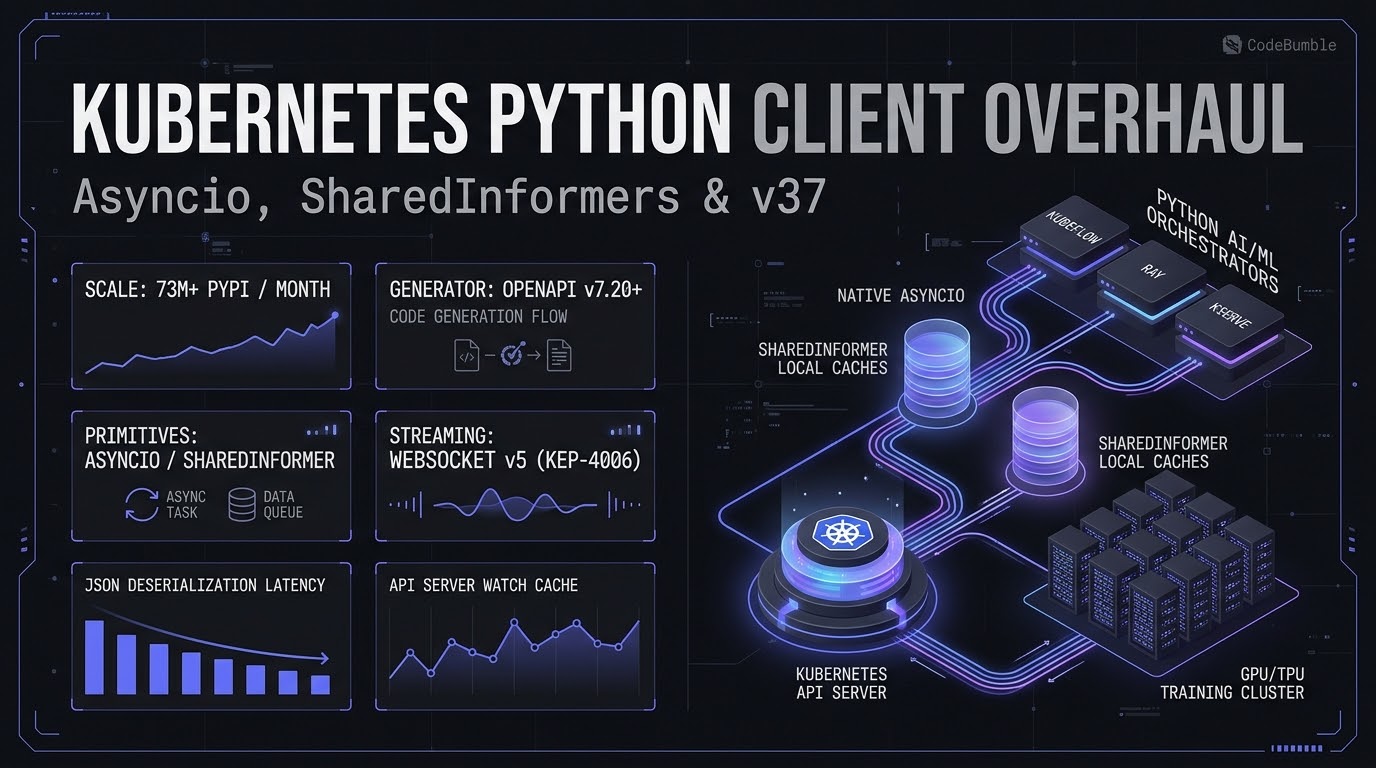
Executive Summary
On November 12, 2026, Google Cloud Kubernetes Engineering and Kubernetes SIG API Machinery announced a comprehensive architectural modernization of the official Kubernetes Python client (kubernetes-client/python). Downloaded more than 73 million times per month on PyPI (~1.7 million downloads daily) with over 7,500 GitHub stars, the Python client is second only to client-go in the Kubernetes ecosystem, serving as the control-plane bridge for Kubeflow, Ray on GKE, KServe, and Apache Airflow.
For years, however, the official client operated in low-maintenance mode, leaving AI/ML platform teams to contend with four production bottlenecks:
- Decommissioned Code Generation: Through Kubernetes 1.35, the client generated ~400,000 lines of API and model code using OpenAPI Generator v4.3.0 (
python-legacy), which was deprecated in 2020 and removed upstream in May 2022. - No Native
asyncioorSharedInformerPrimitives: Async-first orchestrators and FastAPI control planes had to rely on third-party forks (kubernetes-asyncio,kr8s,lightkube) or hammerkube-apiserverwith polling loops. - 30+ Second Deserialization Stalls: Listing tens of thousands of Pods or ReplicaSets triggered excessive
Configuration()instantiation and logger lock contention inside__deserialize_model(issue #1921, issue #2284). - Legacy SPDY / HTTP/1.1 Transport:
exec,attach, andport-forwardlacked fullv5.channel.k8s.ioWebSocket half-CLOSEsemantics (KEP-4006).
The November 12 roadmap—alongside the v37.0.0a1 / v37.0.1 release series—addresses these gaps across three pillars: Machinery (OpenAPI Generator v7.20+), Features (asyncio, SharedInformer, WebSocket v5), and Performance (deserialization overhaul).
Modernization Roadmap and v37 Architecture Matrix
Google Cloud and SIG API Machinery explicitly scoped this effort around AI/ML workload requirements rather than pursuing 1:1 parity with every internal client-go controller primitive.
| Pillar / Capability | Legacy Architecture (≤ v35 / K8s 1.35) | Modernized Architecture (v36 / v37+) | Primary Operational Impact |
|---|---|---|---|
| Code Generator | OpenAPI Generator v4.3.0 (python-legacy) |
OpenAPI Generator v7.20.0+ |
Modern type annotations; cleaner pip resolution with PyTorch/TF |
| Concurrency | Synchronous urllib3 only |
Official asyncio (kubernetes.aio) |
Non-blocking I/O for FastAPI, Ray, and async ML orchestrators |
| Watch / Cache | Raw watch.Watch() loops; no shared cache |
SharedInformer (#2515) |
Event-driven on_add/on_update/on_delete cache; lower API load |
| Streaming | Legacy SPDY / v4.channel.k8s.io |
WebSocket v5 (KEP-4006, #2486) |
Native v5.channel.k8s.io half-CLOSE for exec/attach/port-forward |
| Deserialization | Per-model Configuration() init (#1921) |
Revamped v7+ model initialization | Eliminates 30+ sec list stalls and posix.cpu_count / logger overhead |
Technical Mechanics: Why the Legacy Client Bottlenecked at Scale
To understand why the modernization matters for 50,000-node training fleets, examine the call path during a cluster-wide list or watch operation in the legacy generator versus the modernized pipeline.
+-----------------------------------------------------------------------------+
|       KUBERNETES PYTHON CLIENT: LEGACY BOTTLENECK VS. MODERN PIPELINE       |
+-----------------------------------------------------------------------------+
|                                                                             |
|  [ LEGACY CLIENT (OpenAPI v4.3.0 + Synchronous urllib3) ]                   |
|   list_namespaced_pod() ---> HTTP/1.1 JSON Response (e.g., 10k+ Pods)       |
|     +---> __deserialize_model() loops 190,000+ times:                       |
|             |-- Calls Configuration.__init__() per nested model (#1921)     |
|             |-- Calls posix.cpu_count() & logger.setLevel() (#2284)         |
|             +-- Result: 30+ sec CPU-bound stall + GIL contention            |
|                                                                             |
|  [ MODERNIZED CLIENT (OpenAPI v7.20+ + asyncio + SharedInformer) ]          |
|   SharedInformer ---> Single List-Watch Stream (Auto-Reconnect + ResourceVer|
|     +---> Local In-Memory Cache (Indexed by Namespace/Name)                 |
|     +---> Dispatches on_add / on_update / on_delete to async handlers       |
|     +---> Fast v7+ model init (no per-object Configuration() overhead)      |
|     +-- Result: Non-blocking event loop + minimal kube-apiserver load       |
+-----------------------------------------------------------------------------+
1. The #1921 / #2284 Deserialization Trap
Profiling attached to GitHub issue #1921 revealed why list_replica_set_for_all_namespaces() took 31.56 seconds in a medium-sized cluster: __deserialize_model invoked Configuration.__init__ 190,594 times, triggering 190,594 calls to posix.cpu_count() (10.8 seconds alone) and 381,195 logger.setLevel() calls (7.4 seconds). In multi-threaded Python services, those repeated logger mutations caused severe lock contention (issue #2284). Upgrading the underlying generator to OpenAPI Generator v7.20.0+ restructures model initialization and type validation so large cluster snapshots deserialize without per-object Configuration() churn.
2. SharedInformer (#2515) for Custom AI Resources
Modern AI platforms orchestrate Custom Resources such as TrainJob, RayCluster, and InferenceService across thousands of GPUs and TPUs. Without a SharedInformer, multiple Python components inside the same controller process open redundant list/watch streams against kube-apiserver. The new SharedInformer primitive maintains a single multiplexed list-watch cache with automatic resourceVersion reconnection and on_add, on_update, and on_delete callbacks.
3. Native asyncio (kubernetes.aio) and v37 Breaking Interface Changes
Per the kubernetes-client/python CHANGELOG for v37.0.0a1 and v37.0.1, migrating to the modernized transport layer introduces important interface changes that engineering teams must account for:
- New
aiohttpAsync Transport:kubernetes.aio(andkubernetes.client,kubernetes.config,kubernetes.stream,kubernetes.utils,kubernetes.watch) replaces the legacyApiClient.call_api/param_serialize/response_deserialize/RESTClientObject.requestlow-level signatures with a modernaiohttprequest/response interface. HTTP sessions are now created lazily and must be closed viaawait client.close()or anasync withcontext manager. - Validation &
ApiException.body: Settingclient_side_validation=Falseno longer disables generated model validation, andApiException.bodyis now decoded text (str) rather than rawbytes. - Deletion Return Types: Methods such as
CoreV1Api.delete_namespaceandBatchV1Api.delete_namespaced_jobnow return decoded Python dictionaries (dict) in both sync and async clients instead ofV1Statusobjects, because a successful deletion can return either the deleted resource or aStatus.
4. WebSocket v5 (KEP-4006) and v36 Transition Gotchas
As Kubernetes v1.30+ and v1.31+ moved kubectl exec, attach, cp, and port-forward to WebSocket subprotocols (v5.channel.k8s.io and v2.portforward.k8s.io), the Python client's legacy v4.channel.k8s.io default caused HTTP 400 Bad Request errors (issue #2355) and lacked the half-CLOSE signal. While PR #2486 brings v5.channel.k8s.io support, teams upgrading through v36.0.0 encountered edge regressions—including 401 Unauthorized on Azure AKS Private Link exec WebSockets using kubelogin (issue #2595, fixed in v36.0.2) and bytes prefix coercion on read_namespaced_pod_log (issue #2596).
Evidence: Scope, Adoption Metrics, and Confidence Level
- Confidence Level: High on PyPI adoption metrics, architectural bottlenecks, and
v37.0.0a1/v37.0.1interface changes (sourced directly from the Google Open Source Blog and GitHubCHANGELOG.md). - Missing Benchmarks: While Google notes that legacy list calls could take 30+ seconds and promises deserialization in a "fraction of the time," no standardized public benchmark suite comparing
v35/v36againstv37on a 50,000-node cluster has been published in the November 12 announcement. Teams should benchmark against their own cluster object counts before cutover.
Hardening & Migration Playbook: Adopting the Modernized Client Safely
Follow these steps to audit legacy bottlenecks, prepare for v37+ breaking changes, and harden Kubernetes API access in Python AI/ML workloads.
Step 1: Audit Your Current Client Version and Low-Level Hooks
Inspect installed versions and search codebases for deprecated low-level ApiClient hooks, V1Status deletion attribute access, and ApiException.body byte decoding that will break in v37+:
    # Check installed kubernetes client version and Python environment
pip show kubernetes

    # Scan codebase for v37 breaking patterns
grep -rnE "client_side_validation\s*=\s*False|\.call_api\(|\.param_serialize\(|\.response_deserialize\(|ApiException" src/
grep -rnE "delete_namespace|delete_namespaced_job" src/
Step 2: Adopt Safe async with Lifecycle Management (kubernetes.aio)
When using the modernized async client, always wrap ApiClient in an async with context manager (or explicitly await api_client.close()) so lazy aiohttp sessions do not leak file descriptors:
import asyncio
from kubernetes_asyncio import client, config  # or kubernetes.aio in v37+

async def list_training_pods(namespace: str = "ml-training") -> list[str]:
    """Safely lists running pods using an async context manager to prevent session leaks."""
    await config.load_incluster_config()  # or config.load_kube_config() locally
    async with client.ApiClient() as api_client:
        v1 = client.CoreV1Api(api_client)
        pods = await v1.list_namespaced_pod(
            namespace=namespace,
            label_selector="app.kubernetes.io/part-of=kubeflow",
            _request_timeout=15,
        )
        return [p.metadata.name for p in pods.items]
Step 3: Replace Polling Loops with Resource-Bounded Watches / Informers
Never run tight while True: list_namespaced_pod() loops from Python orchestrators against large clusters. Use server-side label/field selectors, resource_version pagination, or SharedInformer once available in your target release:
    # Defensive watch pattern: always set resource_version, label_selector, and timeout_seconds
from kubernetes import client, config, watch

def watch_ray_clusters(namespace: str = "ray-jobs") -> None:
    config.load_incluster_config()
    custom_api = client.CustomObjectsApi()
    w = watch.Watch()

    for event in w.stream(
        custom_api.list_namespaced_custom_object,
        group="ray.io",
        version="v1",
        namespace=namespace,
        plural="rayclusters",
        timeout_seconds=300,
    ):
        obj = event["object"]
        print(f"{event['type']}: {obj['metadata']['name']}")
Step 4: Verify v37 Deletion Dictionary Responses and Text ApiException.body
Update exception handlers and resource deletion callers before bumping to v37+:
from kubernetes.client.rest import ApiException

def safe_delete_job(batch_v1, name: str, namespace: str) -> str:
    try:
        # In v37+, delete_namespaced_job returns a dict (Status or deleted Job)
        resp = batch_v1.delete_namespaced_job(name=name, namespace=namespace)
        if isinstance(resp, dict):
            return resp.get("status", "Deleted")
        return getattr(resp, "status", "Deleted")
    except ApiException as exc:
        # In v37+, exc.body is str rather than bytes
        body_text = exc.body.decode("utf-8", errors="replace") if isinstance(exc.body, bytes) else exc.body
        raise RuntimeError(f"K8s API error {exc.status}: {body_text}") from exc
Step 5: Enforce Least-Privilege RBAC for AI/ML Python Controllers
Because Python ML controllers and notebooks frequently run inside clusters with service-account tokens, restrict RBAC ClusterRole / Role permissions strictly to the required API groups (ray.io, kubeflow.org) and namespaces—and avoid granting cluster-wide pods/exec or secrets list permissions unless explicitly audited.
Step 6: Rollback Notes
If upgrading to v36.0.x or v37.0.x triggers WebSocket exec authentication regressions (such as 401 Unauthorized on AKS Private Link with kubelogin) or log-stream byte-coercion issues, pin your requirements.txt or pyproject.toml back to the last verified patch (kubernetes==35.0.0 or kubernetes==36.0.2) and run CI integration tests against a staging cluster before re-attempting the upgrade.
Frequently Asked Questions
1. Why is Google overhauling the Kubernetes Python client now?
Python is the primary language for AI/ML frameworks (PyTorch, TensorFlow, Kubeflow, Ray, KServe), which now run on multi-thousand-node Kubernetes clusters. The legacy client—pinned to OpenAPI Generator v4.3.0 from 2020—suffered from 30+ second deserialization stalls, lacked native asyncio and SharedInformer primitives, and lagged on WebSocket v5 streaming.
2. Is the modernized Python client aiming for 1:1 parity with client-go?
No. Google Cloud and SIG API Machinery explicitly state they are targeting high-impact gaps needed by Python developers and AI/ML orchestrators (asyncio, SharedInformer, WebSocket v5, fast deserialization) rather than replicating every internal client-go control-plane feature.
3. What are the biggest breaking changes in kubernetes Python client v37?
Per the v37.0.0a1 / v37.0.1 changelog, low-level ApiClient and RESTClientObject interfaces migrated to a modern request/response model (aiohttp for async), ApiException.body is now str instead of bytes, client_side_validation=False no longer disables generated validation, and deletion methods like delete_namespace return decoded dict objects instead of V1Status.
4. How does SharedInformer reduce Kubernetes API server load?
Instead of each controller component polling kube-apiserver with repeated list calls, a SharedInformer maintains a single local list-watch cache per resource type and dispatches on_add, on_update, and on_delete events to subscribers.
5. Does v37 support kubectl-compatible WebSocket streaming for exec and port-forward?
Yes. Under KEP-4006 (kubernetes-client/python#2486), the client is adding native v5.channel.k8s.io WebSocket v5 streaming support, including the half-CLOSE signal required by modern Kubernetes v1.30+ / v1.31+ API servers.
Sources
- Google Open Source Blog: Kubernetes Python client gets a modern overhaul for the AI/ML era — Published November 12, 2026.
- GitHub
kubernetes-client/python: CHANGELOG.md (v37.0.0a1/v37.0.1) — Primary release changelog. - GitHub
kubernetes-client/python: Issue #1921 (Slow deserialization due to excessive Configuration init) and Issue #2355 (v5.channel.k8s.ioWebSocket subprotocol) — Primary engineering issue records. - Welcome.AI: Kubernetes Python Client Modernization Enhances Performance for AI/ML Workloads — Published November 13, 2026.