

Packages
LangChain Core 1.8.5 & Anthropic 1.7.13: Python 3.10 Removal, Supply-Chain Fixes & Upgrade Guide
LangChain shipped langchain-core==1.8.5 and langchain-anthropic==1.7.13 on November 25, 2026, alongside partner updates across text-splitters, Qdrant, Ollama, Perplexity, Hugging Face, and Fireworks. We break down PyPI adoption telemetry (38.49M weekly downloads), the Python 3.10 EOL breaking change, security relocks (pygments CVE-2026-4539, mistune, filelock, tornado), and safe upgrade steps.
8 min read
LangChain Core 1.8.5 & Anthropic 1.7.13: Python 3.10 Removal, Supply-Chain Fixes & Upgrade Guide
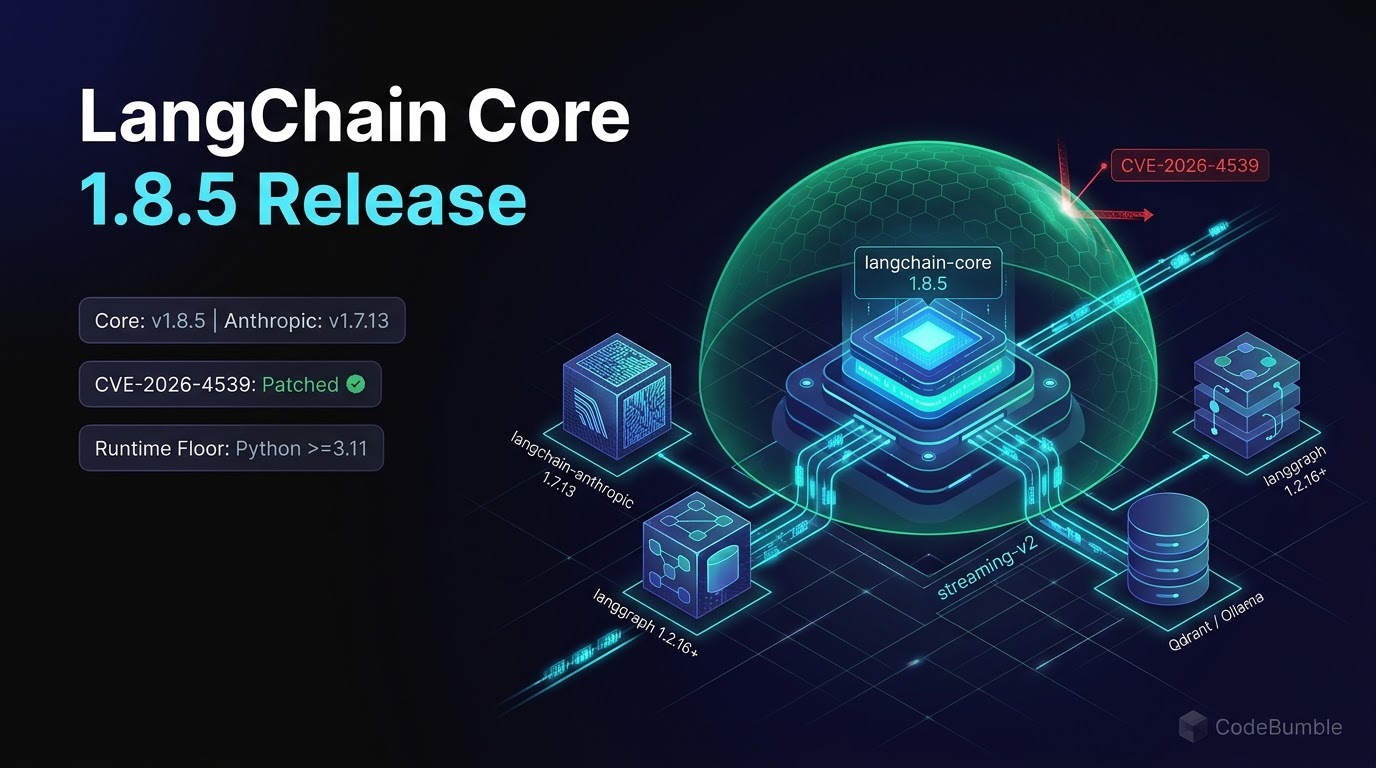
Executive Summary
On November 25, 2026, the LangChain maintainers released langchain-core==1.8.5 and langchain-anthropic==1.7.13 on PyPI and GitHub, capping a multi-package November 23–25 release wave that also updated langchain-text-splitters==1.2.0, langchain-tests==1.2.0, langchain-qdrant==1.2.0, langchain-ollama==1.2.0, langchain-perplexity==1.5.0, langchain-huggingface==1.3.0, langchain-nomic==1.1.0, and langchain-fireworks==1.8.0 (GitHub Releases, Nov 25, 2026; PyPI langchain-core).
Verified as of November 27–28, 2026, the releases matter for Python AI engineering teams for three concrete reasons:
- Breaking Runtime Floor (
Python >=3.11): Partner and core-adjacent packages (langchain-text-splitters,langchain-tests, and partner integrations) officially dropped end-of-life Python 3.10 (#41343,#41268), whilelangchain-huggingface==1.3.0andlangchain-fireworks==1.8.0bumped the minimumlanggraphfloor to>= 1.2.16(#41959). - Streaming & Custom HTTP Client Internals:
langchain-core==1.8.5fixes stream chunk identity by reusing the provider message ID on subsequent stream chunks (#42050), whilelangchain-anthropic==1.7.13adds support for passing custom HTTP and SDK clients (#42101)—essential for enterprise egress proxies, mTLS, and custom retry transports. - Supply-Chain & Dependency Hardening: Across the November release train, maintainers bumped transitive and development dependencies including
mistune(3.3.3->3.3.4),filelock(4.2.5->4.2.10),tornado(6.6->6.6.1),certifi(2026.10.19/2026.10.23),urllib3(2.7.0->2.8.0), and enforcedpygments>=2.20.0to remediateCVE-2026-4539.
Adoption Telemetry & Version Changelog
langchain-core remains one of the most heavily depended-upon foundational abstractions in the Python AI ecosystem, sitting underneath LangChain, LangGraph, and dozens of provider integrations.
| Telemetry Metric | Verified Figure | Source & Verification Window |
|---|---|---|
Weekly PyPI Downloads (langchain-core) |
38,487,297 (4,194,957 last day) |
PyPI Stats (langchain-core) |
| 30-Day PyPI Downloads | 89,757,956 (Rank #268 on PyPI Leaderboard) |
Python Package Leaderboard |
| GitHub Stars | 149.5k (FOSSA) / 127,878 (PyPILB snapshot) | FOSSA / PyPILB |
| Top-Level License | MIT (dependency tree spans ~10 distinct licenses) | FOSSA |
| Latest Core & Anthropic Versions | langchain-core==1.8.5, langchain-anthropic==1.7.13 |
GitHub Releases (Nov 25, 2026) |
(Note: Star counts vary slightly between FOSSA's November 2026 snapshot and PyPILB's cached index; both confirm massive ecosystem adoption.)
Architecture: How langchain-core==1.8.5 Connects the Partner Graph
Because langchain-core defines the base runnable, message, and streaming interfaces (Runnable, content-block-centric streaming v2 #36834, and tool-call delta consumers #41246), every partner integration inherits its execution contract:
flowchart LR
    A[Application / Agent Code] --> B[langchain-core==1.8.5]
    B -->|Custom HTTP/SDK Client #42101| C[langchain-anthropic==1.7.13]
    B -->|langgraph>=1.2.16 #41959| D[LangGraph State & Tool Loops]
    B -->|Provider ID Reuse #42050| E[Stream Consumers & Telemetry]
    B -->|Python >=3.11 Floor #41268| F[Qdrant / Ollama / HF / Fireworks]
Key Milestones in the November 23–25, 2026 Release Train
langchain-core==1.8.5(Nov 25, 2026): Reuses provider message IDs on later stream chunks (#42050), clarifies v3 runtime warning behavior (#42040) and supported streaming event APIs (#42038), and bumpsmistunefrom3.3.3to3.3.4(#41968). Built atop recent1.xmilestones including content-block-centric streaming v2 (#36834) andread tool-call-delta in stream consumers(#41246).langchain-anthropic==1.7.13(Nov 25, 2026): Adds support for custom HTTP and Anthropic SDK clients (#42101) and refreshes model profile metadata (#42085,#42062).langchain-text-splitters==1.2.0&langchain-tests==1.2.0(Nov 23, 2026): Drops EOL Python 3.10 (#41343), constrainssetuptoolsto patched releases (#41485), updatesvcrpy(8.3.0->8.5.0),anyio(4.14.2->4.15.1),urllib3(2.7.0->2.8.0),certifi(2026.10.19), andnbconvert(7.17.1->7.17.2).- Partner Packages (Nov 23, 2026):
langchain-qdrant==1.2.0,langchain-ollama==1.2.0,langchain-perplexity==1.5.0,langchain-nomic==1.1.0,langchain-huggingface==1.3.0, andlangchain-fireworks==1.8.0all drop Python 3.10 (#41268), standardize onlangchain-tests==1.2.0, and tightenlanggraph>=1.2.16where applicable (#41959).langchain-huggingface==1.3.0also fixes forced tool choice and streaming token counts (#42043).
Security Patches, Breaking Changes & Internals
1. Supply-Chain & CVE Remediation (CVE-2026-4539 & Lockfile Bumps)
While langchain-core==1.8.5 itself is not a single-CVE emergency patch, the November 23–25 release train consolidates several supply-chain and vulnerability fixes across the monorepo (GitHub Releases):
- Pygments
CVE-2026-4539(pygments>=2.20.0): Across partner and core packages, LangChain enforcespygments>=2.20.0(#36385). Tracked as CWE-400 (Regular Expression Denial of Service inAdlLexerinsidepygments/lexers/archetype.pyaffecting versions<= 2.19.2, CVSS 3.1 base score3.3Low), the flaw allows local crafted input to trigger catastrophic regex backtracking (NVD CVE-2026-4539; GitHub Advisory GHSA-5239-wwwm-4pmq). - Parser, Lock & Network Hygiene:
mistune(3.3.3->3.3.4),filelock(4.2.5->4.2.10),tornado(6.6->6.6.1),urllib3(2.7.0->2.8.0),certifi(2026.10.19/2026.10.23), andsetuptoolsconstraints (#41485) close out stale transitive alerts inuv.lockand CI environments. - Why Dependency Hygiene Matters at 38M+ Weekly Downloads: High-velocity AI packages carry outsized blast radius when transitive dependencies or serialization paths lag. In December 2025, for example,
langchain-core0.3.81and1.2.5had to ship emergency serialization fixes (wrapping"lc"dicts and disablingsecrets_from_envby default) to prevent prompt-driven environment variable exfiltration, alongside parallel hardening in LangChainJS (CVE-2025-68665) (News4Hackers, Dec 26, 2025). That history explains why LangChain's November 2026 release train aggressively pairs feature releases with automateduv.locksecurity relocks, Dependabot bound preservation (#37510), andpygments>=2.20.0/mistune>=3.3.4/filelock>=4.2.10/tornado>=6.6.1floors.
2. Breaking Changes & Runtime Floor Shifts
- End of Python 3.10 Support: Teams still running Python 3.10 in legacy Docker images or Lambda layers will hit resolver conflicts when upgrading
langchain-text-splitters==1.2.0or partner packages (1.2.0+/1.3.0+/1.8.0+). Upgrade base images to Python 3.11, 3.12, or 3.13 before bumping minor versions. - LangGraph Floor (
>= 1.2.16): Packages integrating with LangGraph now requirelanggraph>=1.2.16(#41959). Pinning olderlanggraphreleases alongside November 2026 partner updates will fail dependency resolution. - Stream Chunk Message ID Reuse (
#42050): Downstream log parsers or UI token aggregators that previously generated synthetic IDs per chunk or assumed empty IDs on trailing chunks inlangchain-coreshould verify that reusing the provider's message ID across chunks behaves cleanly in deduplication logic.
3. Updated Usage: Custom HTTP & SDK Clients in langchain-anthropic==1.7.13
A practical win in langchain-anthropic==1.7.13 (#42101) is first-class support for injecting a custom httpx or Anthropic SDK client—useful when routing agent traffic through corporate egress proxies or enforcing custom timeouts and TLS roots:
import httpx
import anthropic
from langchain_anthropic import ChatAnthropic

# Enforce strict timeouts and custom corporate proxy/CA settings
custom_http_client = httpx.Client(
    timeout=httpx.Timeout(30.0, connect=5.0),
    verify=True,
)
sdk_client = anthropic.Anthropic(http_client=custom_http_client)

# Supported in langchain-anthropic==1.7.13 (#42101)
llm = ChatAnthropic(
    model="claude-sonnet-4-5",
    client=sdk_client,
)
Ecosystem Comparison & Upgrade Checklist
The table below summarizes the November 23–25, 2026 LangChain package releases alongside key dependency and compatibility shifts:
| Package | Latest Version | Release Date | Key Change / Fix | Compatibility / Floor Note |
|---|---|---|---|---|
langchain-core |
1.8.5 |
Nov 25, 2026 | Stream chunk provider ID reuse (#42050), mistune 3.3.4 |
MIT; 38.49M weekly PyPI DLs |
langchain-anthropic |
1.7.13 |
Nov 25, 2026 | Custom HTTP & SDK client support (#42101), model profiles |
Requires anthropic, langchain-core, pydantic |
langchain-text-splitters |
1.2.0 |
Nov 23, 2026 | mistune 3.3.4, setuptools & certifi security bumps |
Drops Python 3.10 (>=3.11) |
langchain-huggingface |
1.3.0 |
Nov 23, 2026 | Forced tool choice & streaming token count fixes (#42043) |
Drops Python 3.10; langgraph>=1.2.16 |
langchain-qdrant / ollama |
1.2.0 |
Nov 23, 2026 | filelock 4.2.10, urllib3 2.8.0, anyio 4.14.2 |
Drops Python 3.10 (>=3.11) |
langchain-fireworks |
1.8.0 |
Nov 23, 2026 | Retired serverless test model replacement, langgraph>=1.2.16 |
Drops Python 3.10 (>=3.11) |
Transitive Dependency & Ecosystem Trade-Offs
Adopting langchain-core==1.8.5 alongside partner packages (langchain-anthropic==1.7.13, langchain-qdrant==1.2.0, langchain-huggingface==1.3.0) optimizes for provider portability and shared streaming abstractions: swapping between Anthropic, Ollama, Perplexity, Fireworks, or Hugging Face endpoints requires minimal application rewrites because all providers implement Runnable and content-block streaming v2 (#36834). The trade-off is a heavier dependency graph compared to calling the raw anthropic Python SDK directly: partner packages pull in langchain-core, pydantic, langgraph>=1.2.16, and vector-store clients (fastembed, pillow, pyarrow in embedding/partner extras), which means teams must actively track monorepo security relocks and Python runtime floors. For single-provider applications with zero orchestration needs, the lightweight anthropic SDK avoids that surface area; for multi-provider agents, RAG pipelines, and LangGraph state machines, the 1.8.5 / 1.7.13 release train delivers cleaner HTTP client injection (#42101) and tighter supply-chain hygiene.
Safe Upgrade & Pinning Checklist
- Audit Python Runtime First: Run
python --versionin CI and production containers; if any worker still runs Python 3.10, upgrade to Python3.11+before bumpinglangchain-text-splittersor partner packages to1.2.0+. - Pin Coordinated Minor Versions: Update
pyproject.tomlorrequirements.txtin lockstep (langchain-core>=1.8.5,langchain-anthropic>=1.7.13,langgraph>=1.2.16) and regenerate your lockfile (uv lockorpip-compile) so transitive fixes (mistune>=3.3.4,filelock>=4.2.10,pygments>=2.20.0) take effect. - Test Streaming Consumers: Run integration tests covering tool-call deltas and multi-chunk streams to confirm provider message ID reuse (
#42050) works with your telemetry and UI state reducers. - Validate CI Test Suites on
langchain-tests==1.2.0: If you maintain custom or internal LangChain partner integrations, upgrade your test harness tolangchain-tests==1.2.0, which adds tool-call chunk validation during streaming (#34707), sandbox integration tests for offloading large execution results (#38537), andvcrpy 8.5.0cassette serialization fixes (#37963). Ensure your CI matrix drops Python 3.10 runners and tests against Python 3.11, 3.12, or 3.13. - Audit Transitive Licenses & SBOMs: Because
langchain-coredeclares an MIT top-level license while its full dependency tree spans roughly 10 distinct licenses (FOSSA), regenerate your CycloneDX or SPDX Software Bill of Materials (SBOM) after upgrading to1.8.5and1.7.13to confirm compliance and verify thatpygments>=2.20.0is resolved in your lockfile.
Frequently Asked Questions
1. What is new in langchain-core==1.8.5?
Released November 25, 2026, langchain-core==1.8.5 reuses the provider message ID across subsequent stream chunks (#42050), clarifies v3 runtime warning and streaming event API documentation (#42040, #42038), and bumps mistune to 3.3.4 (#41968) (GitHub Releases).
2. Why did November 2026 LangChain partner packages fail to install on Python 3.10?
In PRs #41343 and #41268, LangChain removed support for end-of-life Python 3.10 across langchain-text-splitters==1.2.0, langchain-tests==1.2.0, and partner integrations (langchain-qdrant, langchain-ollama, langchain-perplexity, langchain-huggingface, langchain-fireworks, langchain-nomic) (GitHub Releases).
3. How does langchain-anthropic==1.7.13 help enterprise deployments?
PR #42101 allows developers to pass custom HTTP and Anthropic SDK clients directly into langchain-anthropic, making it straightforward to enforce corporate egress proxies, custom TLS certificates, and strict timeout policies (GitHub Releases).
4. What is CVE-2026-4539 referenced in LangChain's dependency updates?
CVE-2026-4539 is a Low-severity (CVSS 3.1 3.3, CWE-400) Regular Expression Denial of Service flaw in pygments <= 2.19.2 (AdlLexer), resolved by requiring pygments>=2.20.0 across LangChain packages (#36385) (NVD CVE-2026-4539).
5. How widely used is langchain-core on PyPI?
As of late November 2026, PyPI Stats reports 38,487,297 downloads in the last week (4,194,957 in the last day), and the Python Package Leaderboard records 89,757,956 downloads in the latest 30-day window (PyPI Stats; PyPILB).
Sources
- Releases · langchain-ai/langchain — GitHub (November 25, 2026) (Primary)
- langchain-core · PyPI Stats (Accessed November 27, 2026) (Primary)
- NVD - CVE-2026-4539 Detail — NIST (Published March 21, 2026) (Primary)
- langchain-core — FOSSA Package Intelligence (November 2026) (Secondary)
- Critical LangChain Serialization & Deserialization Context — News4Hackers (December 26, 2025) (Secondary)