

Packages
uv 0.13.10: GHSA-vjvj-3m3f-fgmm Wheel Fix, Lockfile Checks, and Managed CPython Updates
Astral's uv 0.13.10 release patches GHSA-vjvj-3m3f-fgmm against ZIP compressed-size mismatches in Python wheels, tightens uv.lock validation, and updates managed CPython 3.11–3.16 builds.
8 min read
uv 0.13.10: GHSA-vjvj-3m3f-fgmm Wheel Fix, Lockfile Checks, and Managed CPython Updates
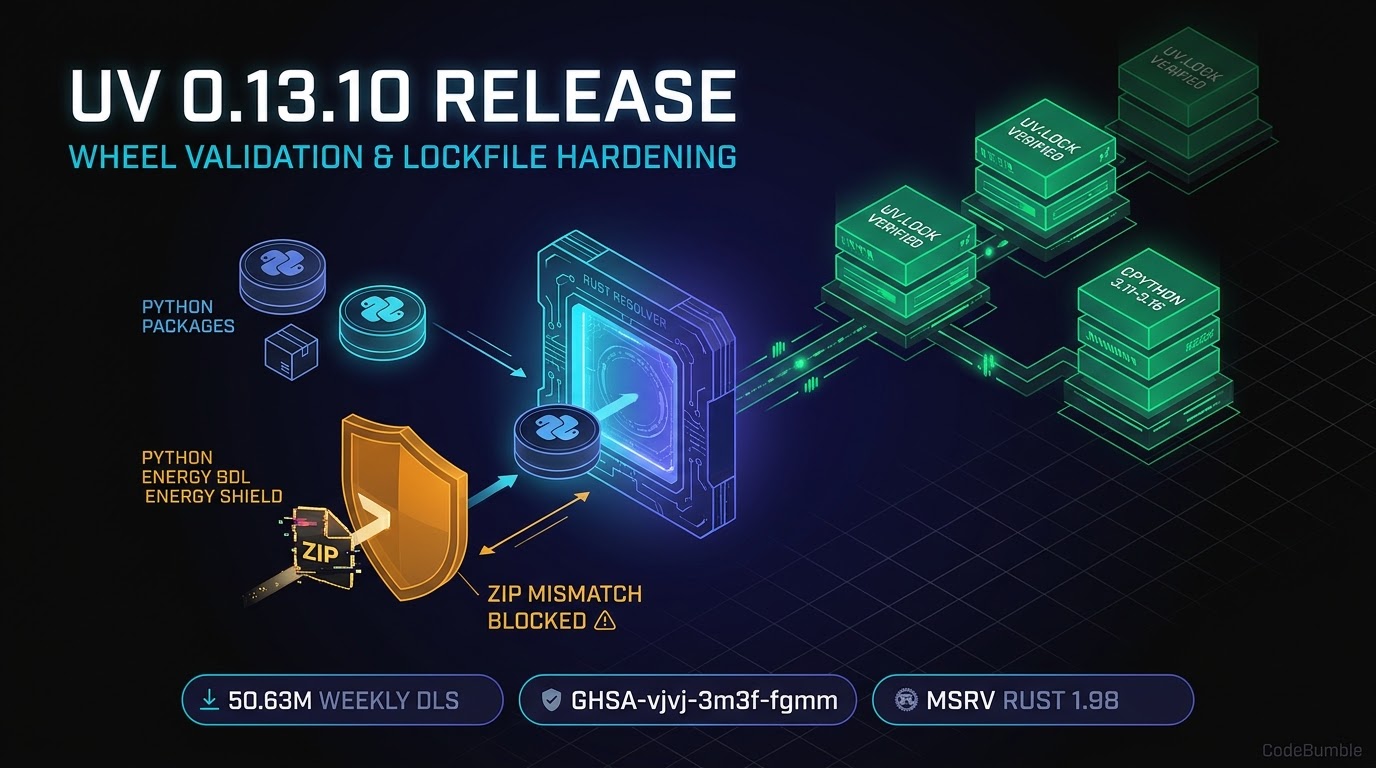
Astral released uv 0.13.10 on November 24, 2026 (with downstream Linux distribution advisories such as Fedora 46 FEDORA-2026-10aca0e7e1 landing on November 25, 2026), delivering a targeted security fix for GHSA-vjvj-3m3f-fgmm, stricter uv.lock consistency checks, and refreshed managed CPython builds across 3.11.18 through 3.16.0a2. Coming one week after 0.13.9 raised the minimum supported Rust version (MSRV) to 1.98 and added PEP 832 .venv redirect file support, the 0.13.10 release tightens supply-chain verification for Python and AI engineering teams running uv in CI/CD pipelines.
Executive Summary
- Featured package and version:
uv(v0.13.10, Python / PyPI & Rust CLI, dual MIT/Apache-2.0 licensed, verified November 28, 2026 via Astral's GitHub Releases). - Security patch (
GHSA-vjvj-3m3f-fgmm): Rejects Python.whl(ZIP) distributions whose ZIP data descriptor and central directory disagree on compressed file size (#23332), closing a ZIP payload obfuscation differential documented in Astral's GitHub Security Advisories. - Lockfile and proxy-index hardening: Validates that dependency requirements inside
uv.lockmatch locked package versions (#23238), explains why--lockedrejects stale lockfiles (#23251), and adds preview support for reversible upstream artifact URLs when resolving through proxy indexes (#20790,#23276). - AI and runtime relevance: With
uvhandling roughly50.63Mweekly PyPI downloads as of November 24, 2026 and serving as the default environment manager in modern LLM/agent repositories, upgrading to0.13.10protects build runners while updating managed CPython (3.11.18–3.16.0a2) andwebpki-root-certs 1.0.12.
Adoption Telemetry and Version Changelog
According to Tally Catalog's PyPI telemetry, uv recorded 50.63 million weekly PyPI downloads as of November 24, 2026 (following 51.16 million the week of November 21, 2026). Independent ecosystem tracking by Python Resources (published November 14, 2026) places uv at roughly 180 million monthly PyPI downloads, roughly four times Poetry's 45 million monthly downloads over the same period.
Survey adoption still trails download volume because legacy CI images and system installs default to pip: in the 2026 Stack Overflow Developer Survey cited by CommandLinux's November 14, 2026 package manager report, 42.1% of respondents reported using pip compared with 23.3% using uv, though uv earned a 60.9% "admired" rating versus 38.0% for pip.
Recent 0.13.x Release Cadence
uv 0.13.4(October 20, 2026) &0.13.5(October 21, 2026): AddressedGHSA-hq85-5cpj-mr62(High severity) by removing compromised eMudhra/emSign intermediate CA certificates viarustls-webpki 0.103.16, updated managed CPython builds (3.13.17,3.14.9,3.15.1) withcertifi 2026.10.19, and ended Docker image publication for EOL Python3.9and3.10(#22773).uv 0.13.8(November 12, 2026): AddedCPython 3.16.0a2, updatedpip 26.3,zlib 1.4, andExpat 2.10.0inside managed builds (#23211), restricted Unix plaintext credential files to owner-only permissions (#23209), and added hardware wheel-variant detection for x86-64 microarchitecture levels, AArch64 versions, and Google TPUs.uv 0.13.9(November 17, 2026): Added preview support forPEP 832.venvredirect files (#21822) andhttp2-keep-alivefor unresponsive HTTP/2 index connections (#23236), reduced lockfile size via environment-marker factoring (#23184), and raised the Minimum Supported Rust Version (MSRV) to Rust 1.98 (#23263).uv 0.13.10(November 24, 2026): PatchedGHSA-vjvj-3m3f-fgmm, addeduv.lockrequirement-to-version validation (#23238), updatedwebpki-root-certsto1.0.12, refreshed managed CPython3.11.18,3.12.16,3.13.18,3.14.10,3.15.2,3.16.0a2, and updated GraalPy3.13.0to build25.6.5.
Security Patches, Breaking Changes, and Internals
The headline security fix in 0.13.10 is GHSA-vjvj-3m3f-fgmm ("ZIP payload obfuscation through conflicting compressed sizes", rated Low severity on GitHub Security Advisories and flagged in Tenable / Fedora 46 advisories alongside rust-astral_async_zip and python-uv-build).
How ZIP Parsing Differentials Affect Python Wheels
Because Python .whl archives are standard ZIP files, security scanners and package installers both parse the archive's headers—often with different ZIP libraries. A crafted wheel can record one compressed size in a local file entry's ZIP data descriptor and a different compressed size in the central directory at the end of the archive. When a static scanner reads one header while an installer extracts from the other, malicious payloads can evade inspection or cause inconsistent extraction behavior.
In uv 0.13.10 (#23332), uv now explicitly rejects any wheel whose ZIP data descriptor and central directory disagree on the compressed size. This builds on Astral's broader archive-hardening track record (GHSA-8qf3-x8v5-2pj8, GHSA-pqhf-p39g-3x64, and Windows wheel path-traversal fix GHSA-2cv4-cqwr-gwf7).
Lockfile Validation and Proxy-Index Portability
Beyond archive validation, 0.13.10 fixes subtle CI/CD failure modes in uv.lock and enterprise artifact proxies:
- Strict
uv.lockintegrity (#23238,#23251,#23304):uvnow verifies that dependency requirements recorded inuv.lockmatch the locked package versions, flags dependencies whose package entries are missing fromuv.lock, and prints explicit diagnostics explaining whyuv.lockfailed--lockedverification. - Reversible proxy-index URLs (
#20790,#23276): Teams behind corporate Artifactory or Nexus PyPI mirrors can now resolve through proxy indexes while writing reversible upstream artifact URLs intouv.lock, keeping lockfiles portable across developer laptops and CI runners without leaking internal mirror hostnames. - Runtime floor and breaking notes: Teams compiling
uvfrom source (or packagingpython-uv-buildfor Linux distributions) must use Rust 1.98+ as of0.13.9. Meanwhile, teams relying on officialuvDocker images must ensure their base images target Python3.11+, since3.9and3.10Docker tags were retired in0.13.5.
[project]
name = "agent-service"
version = "0.1.0"
requires-python = ">=3.11"
dependencies = [
    "anthropic>=2.14.0",
    "pydantic>=2.10.0",
]

[tool.uv]
required-version = ">=0.13.10"
uv sync --locked --no-install-package local-debug-helper
gh attestation verify uv-x86_64-unknown-linux-gnu.tar.gz --repo astral-sh/uv
Notice the two commands above: uv sync --locked now pairs cleanly with --no-install-package (#23338) to skip packages lacking a compatible distribution without breaking the lockfile check, and Astral ships GitHub Artifact Attestations (gh attestation verify) for every 0.13.10 binary release.
Performance, Audit Deduplication, and Interpreter Cache Fixes
Across the 0.13.6–0.13.10 cycle, Astral also shipped targeted reliability and memory optimizations for monorepos and CI runners:
- Workspace and resolution memory (
0.13.6, October 26, 2026): Reduced peak memory usage when resolving large workspaces (#22860–#22870) and locking or upgrading multi-package projects (#22833,#22834), while reusing cached or active environments for PEP 723 scripts without dependencies (#21458). - Cleaner vulnerability auditing (
0.13.7, November 3, 2026):uv auditnow reports aliased OSV vulnerability records as a single entry (#22990) rather than duplicating alerts across CVE/GHSA aliases, and0.13.8ensured quarantined packages are still flagged even when index URLs differ only in redacted query parameters (#23129). - Safer universal lockfiles and interpreter caching (
0.13.10, November 24, 2026):uv pip compile --universalavoids reusing yanked pins with unsatisfiable markers (#23394), unreachable wheels are ignored before requiringuv.lockhashes (#23312), and cached interpreter metadata automatically refreshes whenlibc, the macOS version, orpyvenv.cfgchanges (#23214,#23215,#23216).
At the ecosystem level, CommandLinux's analysis of Sonatype's 2026 State of the Software Supply Chain report notes that PyPI handled 804.97 billion downloads in 2025 (up 50.64% year over year) and 2.56 trillion requests across 1.92 exabytes of traffic—with more than 50,000 projects now using PyPI Trusted Publishing. Against that volume, uv's combination of deterministic lockfiles, archive header validation, and GitHub Artifact Attestations directly targets the highest-frequency CI/CD supply-chain risks.
Ecosystem Comparison and Upgrade Checklist
When evaluating Python environment and dependency managers in late 2026, uv, pip, and Poetry occupy distinct operational niches:
| Feature / Metric | uv (v0.13.10) |
pip (26.3 bundled) |
Poetry (2.5.2) |
|---|---|---|---|
| Implementation & Speed | Rust CLI; parallel downloads + hardlink cache (2x–8x uncached, up to ~100x warm cache per KbWen benchmarks) | Python CLI; sequential default | Python CLI; lockfile resolver |
| PyPI Adoption (Nov 2026) | ~180M monthly / 50.63M weekly downloads | Default in CPython; 42.1% dev survey usage | ~45M monthly downloads |
| Universal Cross-Platform Lockfile | uv.lock + PEP 751 pylock.toml export |
No native universal lockfile (pip freeze) |
poetry.lock |
| Managed Python & Tools | Built-in (CPython 3.11–3.16, GraalPy, uvx) |
None (requires external pyenv / OS Python) |
None |
| Latest Security & Supply-Chain Controls | GHSA-vjvj-3m3f-fgmm ZIP check, uv audit, GitHub Attestations, exclude-newer |
Hash-checking mode (--require-hashes) |
Hash check before sdist build (2.5.2) |
| License & Runtime Floor | MIT / Apache-2.0; Rust 1.98+ to build |
MIT | MIT |
Safe Upgrade and Pinning Checklist
- Upgrade local and CI binaries: Run
uv self update(for standalone installs) or updateastral-sh/setup-uvin GitHub Actions—ideally enablingsetup-uv v10.4.0's newrequire-checksums: trueinput with a pinnedversion: "0.13.10"so unverified binary downloads fail closed. - Refresh managed Python interpreters: Run
uv python upgradeafter updating to0.13.10to pull the3.11.18,3.12.16,3.13.18,3.14.10,3.15.2, or3.16.0a2builds with updatedcertifiandwebpki-root-certs 1.0.12. - Verify existing lockfiles: Run
uv lock --check(oruv sync --locked) across active repositories; if#23238flags a mismatch betweenpyproject.tomlconstraints anduv.lock, regenerate the lockfile and review the diff. - Harden CI credentials: If your pipelines authenticate to private PyPI indexes on Unix runners, ensure you are on
0.13.8+so plaintext credential files are restricted to owner-only permissions (#23209).
Frequently Asked Questions
What does GHSA-vjvj-3m3f-fgmm affect in uv, and do I need to upgrade immediately?
GHSA-vjvj-3m3f-fgmm is a Low-severity ZIP payload obfuscation issue where conflicting compressed sizes between a wheel's data descriptor and central directory could cause parser differentials. Teams installing third-party wheels from public or untrusted indexes in CI should upgrade to uv 0.13.10 (and python-uv-build 0.13.10 where packaged) so malformed wheels are rejected automatically.
Does upgrading to uv 0.13.10 automatically upgrade my existing virtual environments' Python patch version?
No. As Astral notes in its release documentation, existing virtual environments pinned to an older Python patch release do not switch automatically. After upgrading uv, run uv python upgrade and recreate or re-sync virtual environments as needed.
Why did uv 0.13.9 raise the Minimum Supported Rust Version (MSRV) to 1.98?
Raising the MSRV to Rust 1.98 affects contributors compiling uv from source and Linux distro packagers (such as Fedora 46). End users installing prebuilt uv binaries via the standalone installer, pip, pipx, or brew do not need a Rust toolchain installed.
Can uv 0.13.10 work with corporate PyPI mirrors without breaking uv.lock for external contributors?
Yes, via the preview proxy-index support (#20790, #23276) introduced in 0.13.10. It allows uv to fetch artifacts through an internal proxy index while recording reversible upstream artifact URLs in uv.lock.
How does uv compare to pip and Poetry in 2026?
In late 2026, uv leads on execution speed, unified Python/tool management (uvx, managed CPython), and monthly PyPI download velocity (~180M vs. Poetry's ~45M), while pip remains the built-in default across standard CPython installations (used by 42.1% of developers in the 2026 Stack Overflow survey).
Sources
- astral-sh/uv GitHub Releases (v0.13.1–v0.13.10) —
v0.13.10released November 24, 2026 - astral-sh/uv GitHub Security Advisories (
GHSA-vjvj-3m3f-fgmm,GHSA-hq85-5cpj-mr62) — Accessed November 28, 2026 - Fedora 46 Security Update
FEDORA-2026-10aca0e7e1(uv-0.13.10) — Published November 25, 2026 - uv Weekly PyPI Downloads — Tally Catalog — Data as of November 24, 2026 (
50.63Mweekly downloads) - The Most Popular Python Packages in 2026 — Python Resources — Published November 14, 2026
- Package Manager Downloads: npm, PyPI and Cargo Totals For 2026 — CommandLinux — Published November 14, 2026