

Technology
Microsoft Picks Intel EMIB for Future Azure Silicon: EMIB-T Architecture, CXL Gains, and the ABF Bottleneck
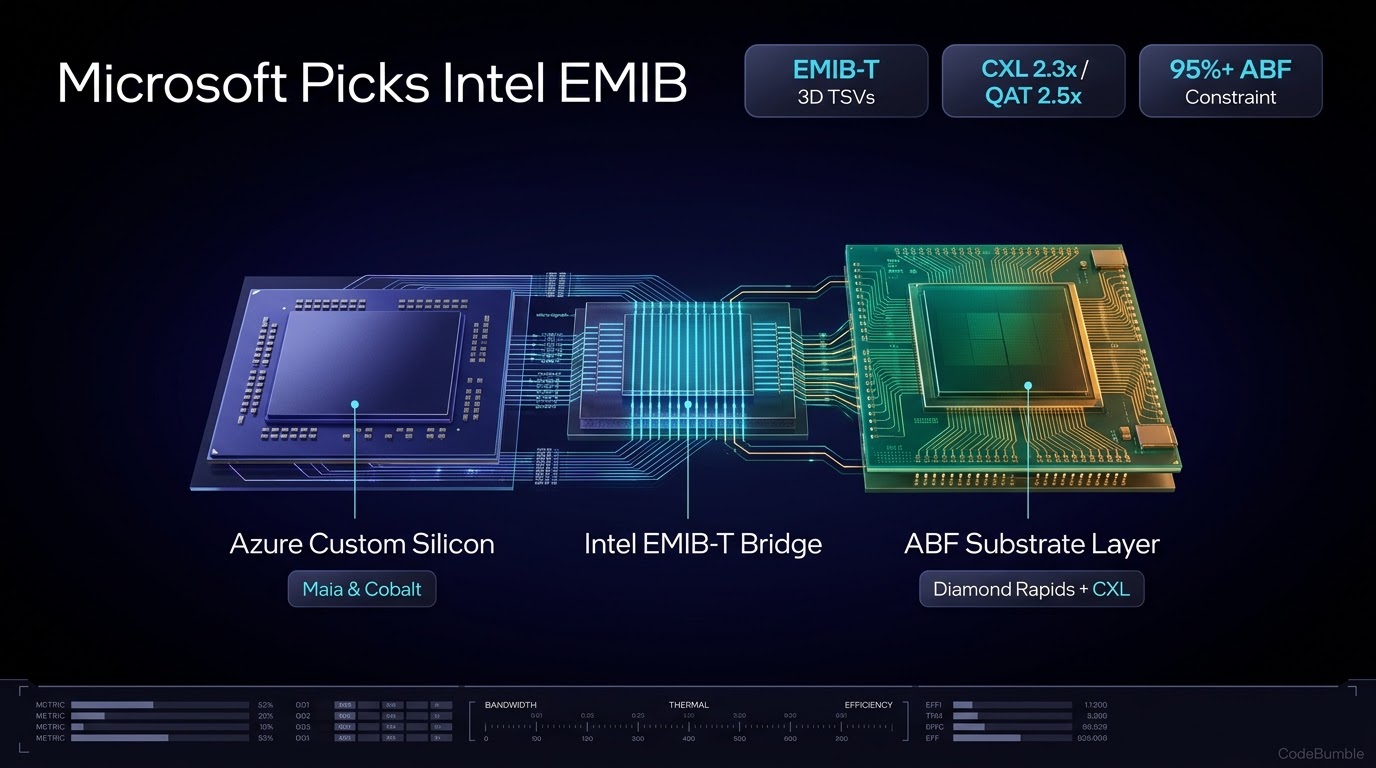
Microsoft became the first publicly named customer for Intel Foundry's EMIB advanced packaging—including EMIB-T with vertical power through-silicon vias—for future Azure silicon, alongside a multi-year Xeon and Diamond Rapids supply deal. While the partnership expands CXL memory and QAT acceleration, analysts warn delivery hinges on Ajinomoto Build-up Film (ABF), where a single supplier controls 95%+ of global capacity.
6 min read
Microsoft Picks Intel EMIB for Future Azure Silicon: EMIB-T Architecture, CXL Gains, and the ABF Bottleneck
Executive Summary
- What changed: Under a long-term agreement announced on November 18, 2026 (with supply-chain and analyst evaluations published November 23–24, 2026), Microsoft became the first publicly named customer for Intel Foundry's EMIB (Embedded Multi-die Interconnect Bridge) advanced packaging—specifically EMIB-T with through-silicon vias (TSVs) for vertical power delivery—for future Azure first-party silicon (Portal ERP, TechPowerUp).
- Systems & Xeon commitments: The deal locks in multi-year Intel Xeon server supply—including next-generation Diamond Rapids (
Xeon 7) CPUs—and deepens co-engineering on Compute Express Link (CXL) memory pooling (up to 2.3x performance in Azure M-series v4 VMs), Intel QuickAssist Technology (QAT) (up to 2.5x faster SQL backups), and Intel Trust Domain Extensions (TDX) confidential VM live migration (Portal ERP, TechPowerUp). - The supply-chain catch: While EMIB gives Microsoft a second-source alternative to TSMC's capacity-constrained CoWoS packaging, analysts caution that scaling EMIB depends on Ajinomoto Build-up Film (ABF)—a substrate material where Japan's Ajinomoto Co. holds 95%+ global market share, ran at full capacity in Q2 2026, and raised prices by roughly 30% in May 2026 (TheStreet, BigGo Finance).
How EMIB-T Packaging Works and Why Hyperscalers Want a CoWoS Alternative
Modern AI accelerators and cloud server processors are no longer monolithic dies; they are multi-chiplet systems that require ultra-dense, low-latency interconnects between compute dies, I/O tiles, and high-bandwidth memory.
EMIB vs. CoWoS: Localized Silicon Bridges vs. Full Interposers
In TSMC's CoWoS (Chip-on-Wafer-on-Substrate) approach, every die sits atop a single large silicon interposer—a design whose capacity has been stretched for two years by surging AI accelerator demand (GadgetsNow, DigiTimes). Intel's EMIB eliminates the full-area silicon interposer. Instead, tiny silicon slivers (bridges) are embedded directly inside the organic package substrate only where two adjacent dies need high-density routing (TechPowerUp, TheStreet).
Crucially, Microsoft is adopting EMIB-T, which adds through-silicon vias (TSVs) inside the embedded bridge to support vertical power delivery across stacked 3D silicon modules at the package level (TechPowerUp). While Microsoft has not publicly named the exact chip generations headed to Intel Foundry, its current first-party Azure fleet includes Maia 200 inference accelerators and Cobalt 200 CPUs for agentic workloads, meaning next-generation successors are primary candidates (TechPowerUp, BigGo Finance).
flowchart TB
    subgraph Package["Intel EMIB-T Advanced Package"]
        DieA["Azure Compute / AI Die<br/>(Next-Gen Maia / Cobalt)"]
        DieB["HBM / I/O Chiplet"]
        Bridge["Embedded EMIB-T Silicon Bridge<br/>(High-Density Routing + Vertical Power TSVs)"]
        Substrate["ABF Organic Substrate<br/>(Ajinomoto Build-up Film Insulator)"]
        DieA <--> Bridge
        DieB <--> Bridge
        Bridge --> Substrate
    end
    Substrate --> Board["Azure Server System Board<br/>(Diamond Rapids Xeon + CXL + QAT + TDX)"]
Azure System-Level Optimizations: CXL, QAT, and TDX
Beyond custom packaging, the expanded Microsoft–Intel agreement targets three production data-center bottlenecks (Portal ERP):
- Memory bandwidth & pooling (CXL): Combining Xeon 6 processors, Compute Express Link (CXL) memory, and Intel Flat Memory Mode delivers up to 2.3x greater performance and memory flexibility in Azure M-series v4 virtual machines.
- Storage & compression offload (Intel QAT): Using Intel QuickAssist Technology in Azure VMs yields up to 2.5x faster SQL backups by offloading cryptographic and compression operations from general-purpose CPU cores.
- Confidential computing mobility (Intel TDX): Encrypting VM memory and CPU register state via Intel Trust Domain Extensions allows confidential VMs to live-migrate between physical hosts without exposing plaintext state.
Evidence, Foundry Financials, and the ABF Supply Bottleneck
While the partnership gives Intel Foundry its highest-profile named packaging customer, November 23, 2026 financial and supply-chain reporting underscores that neither deal terms nor immediate revenue impact are disclosed—and physical material constraints remain (TheStreet, BigGo Finance).
Intel Foundry External Revenue Context (Q3 2026)
| Intel Foundry Metric | Q3 2026 | Q2 2026 | Year-Earlier Quarter | Notes |
|---|---|---|---|---|
| Total Foundry Revenue | $6.7 billion | Not disclosed | Not disclosed | Up 58% YoY; largely internal Intel products (BigGo Finance) |
| External Customer Revenue | $411 million | $293 million | $32 million | ~6% of Q3 foundry sales; Q3 jump tied to non-recurring program (BigGo Finance) |
| Foundry Operating Loss | $1.9 billion | ~$2.14 billion (derived) | ~$2.37 billion (derived) | CFO David Zinsner noted "considerable work ahead" for profitability (BigGo Finance) |
Why Ajinomoto Build-up Film (ABF) Is the Choke Point
Wedbush analyst Matt Bryson called the Microsoft EMIB deal a "positive step" while cautioning that financial significance remains unclear and that the real test is how Intel scales packaging "amidst ABF constraints" (TheStreet).
- Single-supplier concentration: Ajinomoto Build-up Film (ABF) forms the insulating, wired resin layer inside organic substrates that connect silicon dies—and embedded EMIB bridges—to server circuit boards. Ajinomoto Co. controls 95% or more of the global ABF market (TheStreet, BigGo Finance).
- Capacity and pricing pressure: Ajinomoto's ABF production ran at full load in Q2 2026, and in May 2026 the company notified substrate makers of a roughly 30% price increase (TheStreet).
- Market reaction: Intel shares slipped roughly 1% on November 18 when the deal was announced and traded near
$51on November 20 (more than 60% below their June 22 record close of$140.94following a 29% drop on October 30 after Q4 revenue guidance of$15B–$16B) (BigGo Finance).
Practical Guidance: What Cloud Architects and Hardware Teams Should Watch
- Multi-sourcing packaging reduces single-foundry risk—partially: Hyperscalers like Microsoft (and reportedly Google, per DigiTimes) adopting Intel EMIB alongside TSMC CoWoS diversifies foundry packaging queues, but both ecosystems still converge on tight ABF substrate supply (DigiTimes, TheStreet). Capacity planners should not assume EMIB eliminates lead-time volatility for custom AI accelerators.
- Immediate Azure workload wins are available today: While EMIB-T custom silicon and Diamond Rapids (
Xeon 7) instances are forward-looking, Azure teams can already evaluate M-series v4 CXL Flat Memory Mode VMs (for memory-bound analytics/in-memory DBs), Intel QAT-enabled VMs for compressed SQL backup pipelines, and Intel TDX for confidential VM migration (Portal ERP). - Key disclosure milestones to track: Watch Intel's next quarterly earnings for explicit ABF substrate allocation commentary and watch whether Microsoft names the specific
MaiaorCobaltgeneration entering Intel's EMIB-T line (TheStreet, TechPowerUp).
Frequently Asked Questions
1. What is Intel EMIB-T and how does it differ from TSMC CoWoS?
EMIB (Embedded Multi-die Interconnect Bridge) embeds small silicon bridges inside the organic substrate only where chiplets meet, avoiding TSMC CoWoS's large full-area silicon interposer. EMIB-T adds through-silicon vias (TSVs) to deliver vertical power across 3D stacked modules (TechPowerUp, GadgetsNow).
2. Which Microsoft Azure chips will use Intel EMIB?
Microsoft has only stated that EMIB will package future generations of its custom first-party Azure silicon without naming specific models. TechPowerUp notes that Microsoft's current custom fleet includes Maia 200 inference chips and Cobalt 200 CPUs, making their successors the primary candidates (TechPowerUp, BigGo Finance).
3. Why is Ajinomoto Build-up Film (ABF) a bottleneck for Intel's packaging deal?
ABF is the insulating, wired substrate film that houses EMIB bridges and connects silicon dies to circuit boards. Ajinomoto Co. controls 95%+ of global ABF supply, ran at full capacity in Q2 2026, and raised prices ~30% in May 2026 (TheStreet).
4. What performance gains did Microsoft and Intel report for Azure CXL and QAT?
Microsoft and Intel reported up to 2.3x greater performance and memory flexibility in Azure M-series v4 VMs using CXL memory and Intel Flat Memory Mode on Xeon 6, and up to 2.5x faster SQL backups on Azure VMs using Intel QuickAssist Technology (QAT) (Portal ERP).
5. Does this deal make Intel Foundry profitable?
Not immediately. In Q3 2026, Intel Foundry reported $6.7 billion in total revenue, $411 million (~6%) in external customer revenue, and a $1.9 billion operating loss, and financial terms of the Microsoft agreement were not disclosed (BigGo Finance).
Sources
- Portal ERP (November 23, 2026) — Microsoft and Intel deepen collaboration to deliver differentiated Azure infrastructure: https://portalerp.com/news/microsoft-and-intel-deepen-collaboration-to-deliver-differentiated-azure-infrastructure
- TechPowerUp (November 18, 2026) — Microsoft to Use Intel's EMIB Advanced Packaging Technology: https://www.techpowerup.com/354994/microsoft-to-use-intels-emib-advanced-packaging-technology
- TheStreet (November 23, 2026) — Intel landed Microsoft, but now it needs something it can't make: https://www.thestreet.com/technology/intel-microsoft-emib-deal-ajinomoto-bottleneck
- BigGo Finance (November 23, 2026) — Intel Wins Microsoft for EMIB Packaging, but a Japanese Seasoning Maker Holds the Key: https://finance.biggo.com/news/9661cb9e-82aa-4c16-8fc6-aa3874b88eed
- DigiTimes (November 23, 2026) — Microsoft, Google turn to Intel EMIB as CSPs seek alternatives to TSMC CoWoS: https://www.digitimes.com/news/a20261123PD209/intel-microsoft-cowos-google-tsmc.html