

Packages
Muru 0.1.0a34 & muructl: Graham Dumpleton's Rust-Backed Python WSGI/ASGI Server With MCP Deployment Tools
Graham Dumpleton, creator of mod_wsgi, released Muru 0.1.0a34 (muru and muructl on PyPI), an Apache-2.0 Rust HTTP edge, control plane, and Python worker runtime for WSGI and ASGI apps. Highlighted by Simon Willison on November 21, 2026, Muru replaces restart-based reloads with immutable side-by-side releases, weighted canaries, and muructl mcp serve tools for coding agents.
10 min read
Muru 0.1.0a34 & muructl: Graham Dumpleton's Rust-Backed Python WSGI/ASGI Server With MCP Deployment Tools
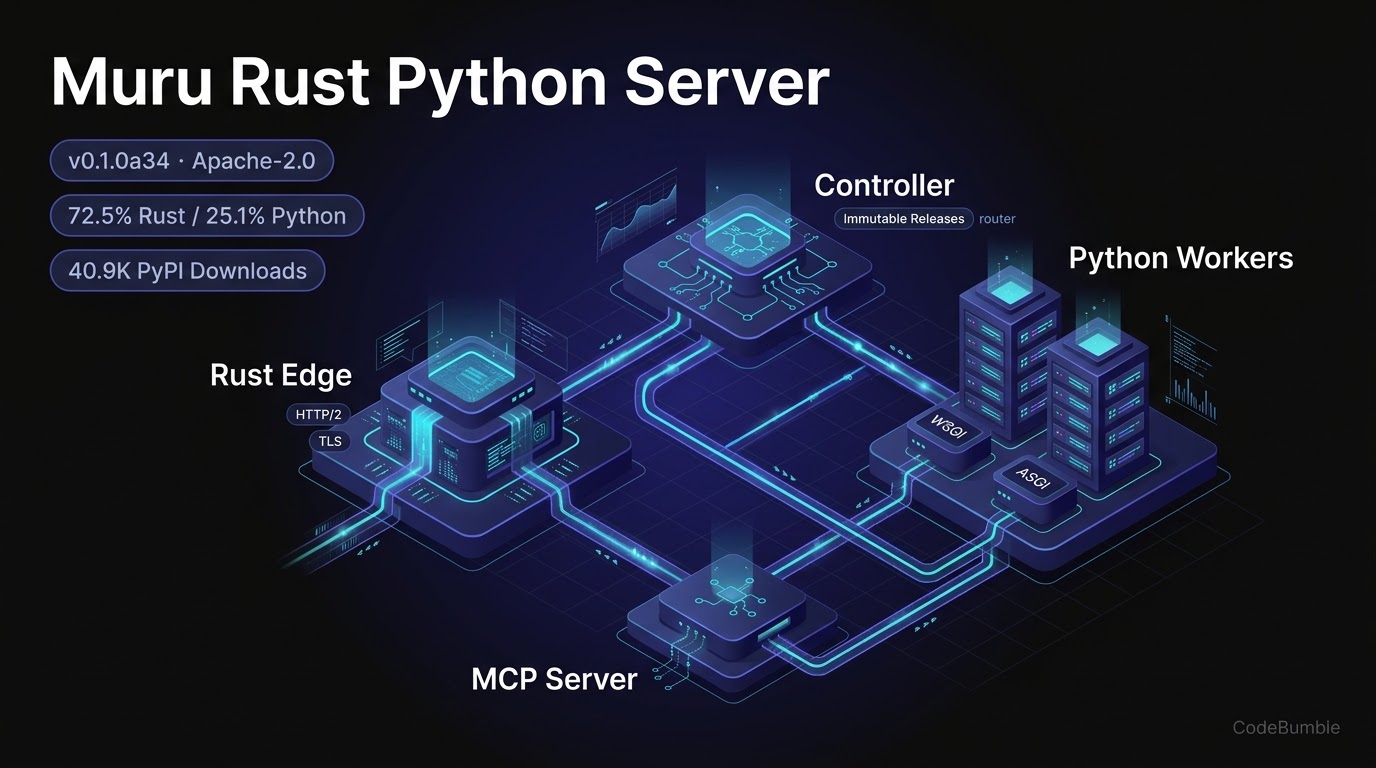
Executive Summary
Graham Dumpleton—the creator and maintainer of mod_wsgi for two decades—has released Muru 0.1.0a34 (muru and muructl on PyPI, verified November 23, 2026) under the Apache-2.0 license via muruhq/muru. Surfaced by Simon Willison's Weblog on November 21, 2026, and covered across technical outlets on November 22–23, 2026, Muru is an alpha-stage routing edge, release control plane, and Python worker runtime designed to serve both WSGI and ASGI applications from a single toolchain.
Unlike traditional Python deployment stacks that stitch together Nginx, Gunicorn or Uvicorn, Supervisord, and custom reload scripts, Muru collapses client-facing HTTP/1.1, HTTP/2, TLS, static file serving, and traffic routing into a Rust edge (72.5% of the repository codebase) paired with Python worker processes (25.1%). Crucially for AI-assisted engineering workflows, muructl ships a built-in Model Context Protocol (MCP) server (muructl mcp serve) that lets coding agents deploy immutable releases, inspect live worker tracebacks and event logs, and trigger instant rollbacks without custom CI glue.
- Latest Verified Release:
0.1.0a34(published November 21, 2026; repository PR#854merged November 22, 2026). - Packages:
muructl(CLI, daemon, container init, and MCP server) andmuru(zero-dependency Python runtime library with Rust extension). - Runtime Floor: CPython
3.11through3.15on Linux and macOS, with architectural support for free-threaded (no-GIL) Python builds. - Supply-Chain & Adoption Signal:
40,915PyPI downloads recorded formuruacross 33 versions, with a0/100risk score in OX.Radar as of November 22, 2026. - Confidence & Alpha Caveat: Muru is explicitly labeled alpha; commands, configuration formats, and internal APIs may break between
0.1.0pre-releases, and no independent production throughput benchmarks against Gunicorn or Granian are published yet.
Adoption Telemetry & Version Changelog
Muru's development velocity over November 2026 reflects an intentional experiment in AI-assisted systems engineering guided by twenty years of WSGI production experience. As Dumpleton documented in his November 11, 2026 essay "AI as a lifestyle choice", the project began in early November 2026 after his earlier wrapture tracing project, supported by the Claude for Open Source Program.
According to repository telemetry on muruhq/muru and package scanning data from OX.Radar checked on November 22–23, 2026:
| Metric | Verified Value | Source & Verification Date |
|---|---|---|
| Latest PyPI Version | 0.1.0a34 |
OX.Radar / GitHub (CHANGELOG.md, Nov 21–22, 2026) |
Total PyPI Versions (muru) |
33 versions (5 shipped Nov 17–21, 2026) |
OX.Radar (Nov 22, 2026) |
PyPI Downloads (muru) |
40,915 downloads |
OX.Radar (Nov 22, 2026) |
| GitHub Repository Activity | 742 commits, 34 tags, 65 stars, 185 issues |
muruhq/muru (Nov 22, 2026) |
| Language Composition | 72.5% Rust, 25.1% Python, 1.3% HTML, 1.1% other |
muruhq/muru (Nov 22, 2026) |
| License | Apache-2.0 |
muruhq/muru |
| Supported Python Versions | CPython 3.11–3.15 (Linux & macOS) |
explainx.ai / Muru Docs (Nov 22, 2026) |
| OX.Radar Risk Score | 0 / 100 (no rules fired in 0.1.0a34) |
OX.Radar (Nov 22, 2026) |
Three-Week Release Cadence & Recent Milestones
Between November 4 and November 22, 2026, Dumpleton published 19 consecutive engineering notes detailing each subsystem as it landed, cataloged on Simon Willison's Weblog. Recent repository commits leading into 0.1.0a34 (PR #854, a34-data-directories) and the preceding 0.1.0a30–0.1.0a33 pre-releases introduced:
- Per-Release Static Assets & Shared Data Directories: Each immutable release receives its own directory for built static files while sharing a persistent per-application data directory across releases (
#854). - Named Daemon Instances: Named daemon instances derive their filesystem locations from their instance name, enabling multiple isolated Muru control planes on a single host.
- Dev Toolbar &
wraptureTracing (Nov 20–21, 2026): A development-mode request toolbar injected on HTML pages with live request tracing integrated with Dumpleton'swraptureinstrumentation library. - Lazy Import Analysis &
unwraptIntegration (Nov 22, 2026): Dependency updates inpyproject.toml(unwrapt 1.0.0a5) anduv.lock(gunicorn 27.0.1,granian 2.8.8), paired with an analysis of when deferred imports hurt first-request tail latency and break copy-on-write memory sharing across forked workers, as summarized by remio AI. - Container Init Mode: Built-in PID 1 signal handling (
SIGTERMgraceful draining) viamuructl servefor Docker and Kubernetes deployments.
Architecture, Security & Breaking Internals
Muru separates request handling, lifecycle control, and Python execution into three distinct planes so that deployments become traffic-routing updates rather than destructive process restarts.
flowchart LR
    Client[HTTP/1.1 & HTTP/2 Clients] -->|TLS / Static / Compression| Edge[Rust Edge]
    Edge -->|Private Framed Link| Workers[Python Workers: WSGI & ASGI]
    Controller[Rust Controller / Daemon] -.->|Immutable Releases & Canary Gates| Edge
    Controller -.->|Preload, Fork & Memory Caps| Workers
    Agent[AI Coding Agent] -->|muructl mcp serve| Controller
    Agent -.->|Inspects Logs, Events & Stacks| Workers
1. The Rust Edge & Control Plane Split
In conventional Python hosting, Nginx handles TLS termination and static files, while Gunicorn or Uvicorn manages Python workers. Sending SIGHUP to Gunicorn reloads workers in place, which risks partial failures or dropped in-flight state if an import breaks.
Muru keeps the Controller off the request hot path. The Rust Edge terminates HTTP/1.1, HTTP/2, and TLS, serves per-release static assets, buffers uploads, and applies compression so Python threads only execute application logic. When you deploy a new version, the Controller boots the new immutable release—potentially even on a different CPython version—alongside the active release. Traffic shifts via blue/green cutover, weighted canary percentages, A/B splits, or preview URLs only after health checks pass. Canary progression can be gated on PromQL-shaped expressions evaluated against Muru's internal metrics, eliminating the need for an external service mesh sidecar on single-node or small-cluster setups.
2. Python-Aware Process Management & Lazy-Import Trade-Offs
Generic process supervisors treat Python interpreters as opaque binaries. Muru builds Python-specific invariants directly into worker lifecycle management:
- Import Once, Fork Many (With Pre-Fork Validation): Muru preloads the application in a host process, validates that imports succeed cleanly before forking workers, and relies on OS copy-on-write memory sharing. As Dumpleton highlighted on November 22, 2026, aggressively deferring imports inside request handlers can backfire in pre-forked servers: each worker pays the import cost independently on its first request, inflating tail latency and reducing shared memory pages across workers.
- Unified WSGI & ASGI Execution: Applications can mount WSGI (Flask, Django) and ASGI (FastAPI, Starlette) side by side, or hand requests across interfaces inside a worker—allowing legacy synchronous stacks to add WebSockets without operating a separate Uvicorn cluster.
- Resource Guardrails & No-GIL Readiness: Per-worker memory caps trigger automatic worker recycling, soft and hard request timeouts prevent wedged handlers from starving pools, and worker-reported load signals drive autoscaling (including scale-to-zero). Architecture Decision Record
ADR 0013explicitly accounts for free-threaded CPython builds.
3. Built-In MCP Server for Coding Agents
Muru's standout feature for modern package ecosystems is muructl mcp serve. Instead of giving an AI coding agent raw SSH access or brittle bash scripts, muructl exposes structured MCP tools that let agents:
- Cut a new immutable release from workspace code.
- Run health probes and inspect the read-only server-rendered dashboard (built with
htmx, Server-Sent Events, anduPlotperADR 0011). - Pull structured server events, logs, exception tracebacks, and live worker thread stacks.
- Roll back traffic to the previous release immediately if a canary gate fails.
4. Supply-Chain Security & Operational Guardrails
Because muru ships compiled Rust extensions on PyPI and muructl exposes deployment control over MCP, supply-chain hygiene and permission scoping matter:
- OX.Radar Verification: Across
0.1.0a32,0.1.0a33, and0.1.0a34, OX.Radar recorded 0/100 risk with zero static or behavioral rules fired, and confirmedmuruhas no transitive Python dependencies—reducing dependency-confusion exposure inside application virtual environments. - MCP Authorization Risk: As explainx.ai notes, MCP deployment tools carry the same blast radius as CI/CD deploy keys. Teams should never expose
muructl mcp servedirectly against production daemons without scoped tokens and human-in-the-loop approval gates. - Read-Only Dashboard Safety: Muru's built-in dashboard is intentionally non-mutating in production modes so an on-call engineer inspecting metrics cannot accidentally shift canary weights with a stray click.
Quick-Start Usage Snippet
You do not need to add muru to your application's pyproject.toml. Installing muructl as an isolated CLI tool injects the matching muru runtime into the worker environment automatically:
# Install the Muru CLI and control plane via uv
uv tool install muructl

# Run a WSGI or ASGI application locally with dev HTTPS & toolbar tracing
muructl run app:application
# Serving on http://127.0.0.1:8080

# Expose MCP deployment & debugging tools to an AI coding agent
muructl mcp serve
Ecosystem Comparison & Alpha Adoption Checklist
How does Muru 0.1.0a34 compare against established Python application servers and edge runtimes?
| Feature / Trade-Off | Muru (0.1.0a34) |
Gunicorn + Nginx | Uvicorn / Hypercorn | Cloudflare Python Workers |
|---|---|---|---|---|
| Primary Stack | Rust edge + Rust controller + Python workers | C/Nginx reverse proxy + Python WSGI workers | Python ASGI server (uvloop / h11) |
Pyodide / WebAssembly at global edge |
| Interface Support | WSGI + ASGI unified in one deployment | WSGI native (ASGI via Uvicorn worker class) | ASGI native (WSGI via middleware) | ASGI-compatible Workers runtime |
| Zero-Downtime Releases | Native immutable releases, blue/green, canaries | Manual Nginx upstream swap or SIGHUP reload |
Requires external process manager / LB | Native atomic versioned deployments |
| Built-In Agent Tooling | Native muructl mcp serve + JSON CLI output |
None | None | Wrangler CLI / API |
| Maturity & Ecosystem | Alpha (0.1.0a34); APIs may change |
Battle-tested production standard | Mature ASGI standard | Managed edge platform; cold-start/package limits |
| License & Hosting | Apache-2.0, self-hosted (laptop, systemd, K8s) | MIT/BSD, self-hosted | BSD-3-Clause, self-hosted | Managed SaaS (vendor-hosted) |
Note: Exact throughput and p99 latency comparisons between Muru 0.1.0a34, Gunicorn 27.0.1, and Granian 2.8.8 are not yet published in independent third-party benchmarks; Muru's repository includes a bench/ harness used internally during development.
Safe Alpha Evaluation & Pinning Checklist
If you plan to test Muru in local development or staging environments:
- Pin Exact Pre-Release Versions: Because Muru is in active
0.1.0a*alpha with near-daily releases (0.1.0a30through0.1.0a34shipped between November 17 and November 21, 2026), pinmuructl==0.1.0a34in CI or devcontainers and reviewCHANGELOG.mdbefore bumping. - Keep
muruOut of App Dependencies: Letmuructlsupply the runtime package to your interpreter rather than locking your application'spyproject.tomlto an alpha server API. - Separate Dev From Production Control: Use
muructl runand thewrapturetoolbar locally, but restrictmuructl mcp serveto local or staging environments behind explicit human confirmation before connecting coding agents. - Follow Issue-Driven Contributions: Per
CONTRIBUTING.md,muruhq/muruaccepts requirements and bug reports via GitHub Issues rather than external pull requests, as Dumpleton implements accepted changes directly with AI agent workflows.
Frequently Asked Questions
1. Is Muru 0.1.0a34 ready for production workloads?
No. Muru is explicitly marked alpha, and Dumpleton cautions that CLI commands, configuration schemas, and internal protocols can change between 0.1.0 pre-releases. It is best suited today for local development, staging canary drills, and evaluating agent-assisted deployment workflows.
2. Do I need to add muru to my project's pyproject.toml or requirements.txt?
No. Installing muructl (for example with uv tool install muructl) automatically provides the muru runtime package to the Python worker processes. The muru package itself has zero Python dependencies and is safe to import outside Muru if needed.
3. Which Python versions and operating systems does Muru support?
Muru supports CPython 3.11 through 3.15 on Linux and macOS, with production Architecture Decision Records targeting Linux and macOS serving as a first-class development environment. It is also designed with free-threaded (no-GIL) Python builds in mind (ADR 0013).
4. How does Muru differ from running Uvicorn behind Nginx or Caddy?
Uvicorn behind Nginx requires managing separate proxy reloads, process supervision, and external tooling for weighted canaries or blue/green cutovers. Muru unifies HTTP/2, TLS, static assets, immutable release management, and PromQL-style canary gates into a single Rust edge and controller.
5. Is the muru PyPI package safe from supply-chain tampering?
Automated security scanning by OX.Radar on November 22, 2026, assigned muru version 0.1.0a34 a 0/100 risk score with zero rules fired across its recent releases (0.1.0a32–0.1.0a34). Because muru has no Python dependencies, it introduces minimal transitive supply-chain surface.
6. Can external contributors submit pull requests to muruhq/muru?
Not directly. CONTRIBUTING.md specifies that Muru takes contributions as requirements and problem descriptions in GitHub Issues and Discussions rather than drive-by code PRs, allowing the maintainer to implement accepted features consistently.
Sources
- GitHub Repository (
muruhq/muru) — README, commit history (#854), language stats, and Apache-2.0 license (verified November 22–23, 2026): https://github.com/muruhq/muru - Graham Dumpleton's Blog — "AI as a lifestyle choice" (published November 11, 2026): https://grahamdumpleton.me/posts/2026/11/ai-as-a-lifestyle-choice/
- Simon Willison's Weblog — "Muru" link post and 19-post build series index (published November 21, 2026): https://simonwillison.net/2026/Nov/21/muru/
- OX.Radar PyPI Security Report (
muru) — Version0.1.0a34,40,915downloads, and0/100risk scan (scanned November 22, 2026): https://www.ox.security/ox-radar/pypi/muru/ - explainx.ai — "Muru: Graham Dumpleton's Rust Python App Server With MCP for Coding Agents" (published November 22, 2026): https://explainx.ai/blog/muru-graham-dumpleton-rust-python-wsgi-asgi-server-mcp-agents-2026
- remio AI — "Muru Examines Python's Lazy-Import Tradeoffs" (published November 23, 2026): https://www.remio.ai/post/muru-examines-pythons-lazy-import-tradeoffs
- Emergent — "Muru: AI-Built Rust Server for Python WSGI and ASGI Apps" (published November 22, 2026): https://emergent.sh/news/muru-ai-built-rust-server-python-wsgi-asgi