

Packages
muructl 0.1.0a34: Inside Graham Dumpleton's Rust Edge, Python Runtime, and MCP Server for Coding Agents
Graham Dumpleton, longtime maintainer of mod_wsgi, has released muructl 0.1.0a34 on PyPI—a Rust HTTP edge and Python worker runtime built for WSGI, ASGI, and AI coding agents. Instead of restarting workers in place, Muru runs immutable releases side by side and exposes deploy, diagnostic, and rollback tools over MCP. Here is how its architecture works, what changed in alpha, and how it compares to Gunicorn and Uvicorn.
9 min read
muructl 0.1.0a34: Inside Graham Dumpleton's Rust Edge, Python Runtime, and MCP Server for Coding Agents
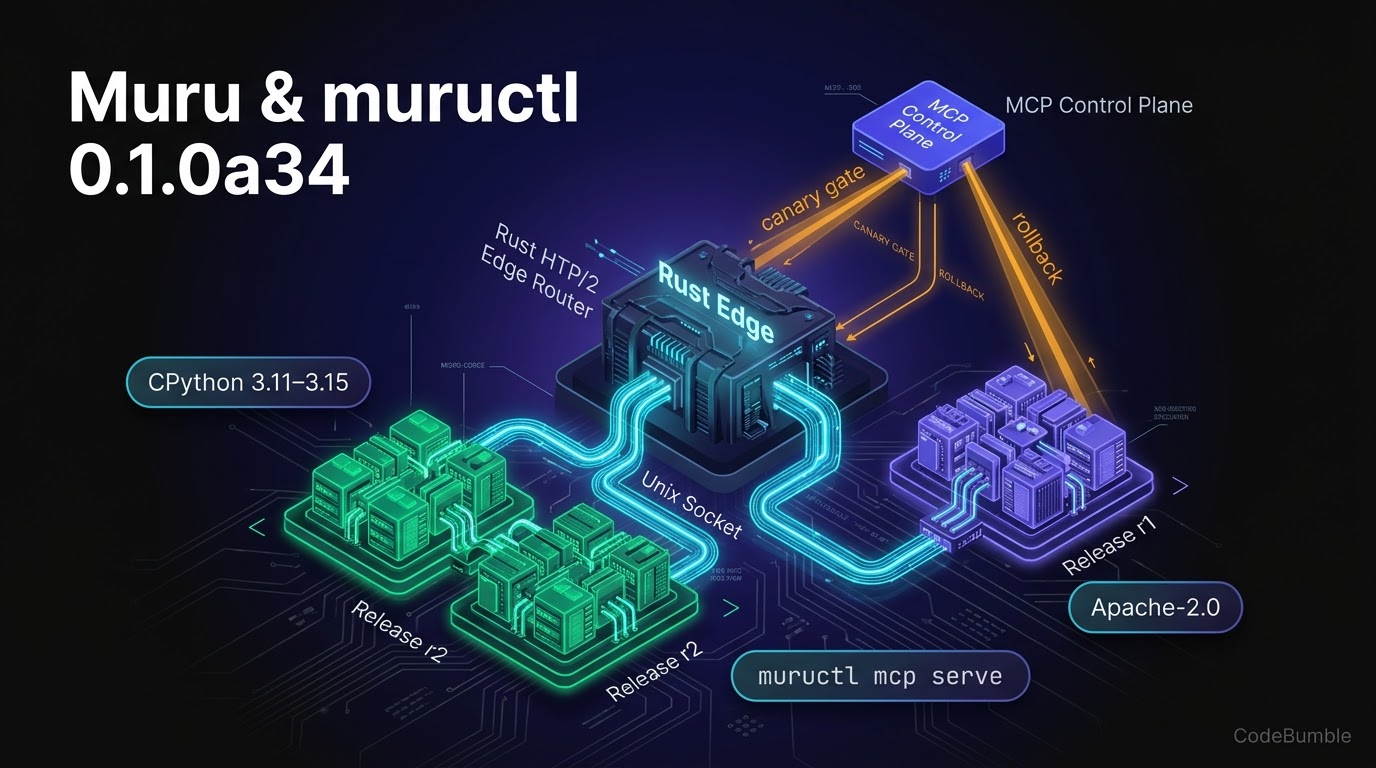
Executive Summary
- Featured Packages:
muructl(Rust CLI/edge/controller) andmuru(Python worker runtime), developed undermuruhq/muruby Graham Dumpleton, longtime maintainer ofmod_wsgi. - Ecosystem & Latest Version: Python / PyPI (
muructlandmurupre-releases) paired with a Rust core. Latest verified release tag is0.1.0a34(verified November 22, 2026). - Runtime & License: Apache-2.0 license; supports Linux and macOS on CPython 3.11–3.15, including free-threaded (no-GIL) builds. Optional request tracing via
wrapturerequires Python 3.12+. - AI & MCP Relevance: Includes
muructl mcp serve, an embedded Model Context Protocol (MCP) server that lets AI coding agents deploy code changes as immutable releases, run health checks, inspect request tracebacks and worker stacks, and trigger rollbacks when gates fail. - Primary Takeaway:
muructlcollapses the traditionalnginx+gunicorn/uvicorn+ process-supervisor stack into a single Rust-fronted runtime with blue/green and canary traffic policies. Because it is in active0.1.0alpha, teams should pin versions, test in staging or local development, and gate production MCP access behind human approval.
Adoption Telemetry & Version Changelog
As of November 22, 2026, muruhq/muru is an active early-stage alpha repository rather than a battle-tested incumbent, and its telemetry reflects rapid, maintainer-led iteration:
| Metric | Verified Value (Nov 22, 2026) | Source |
|---|---|---|
| Latest Release Tag | 0.1.0a34 (34 tags total) |
GitHub muruhq/muru |
| Commit History | 742 commits on develop |
GitHub muruhq/muru |
| Repository Stars / Forks | 14 stars / 0 forks | GitHub muruhq/muru |
| Language Composition | 72.5% Rust, 25.1% Python, 2.4% Web/Shell | GitHub muruhq/muru |
| License | Apache-2.0 | GitHub muruhq/muru |
| Supported Python Versions | CPython 3.11–3.15 (including free-threaded) | explainx.ai / Graham Dumpleton |
| Supported Platforms | Linux (production target) and macOS (dev) | Graham Dumpleton |
Key Milestones in the November 2026 Build Series
Between November 4 and November 22, 2026, Graham Dumpleton published an unusually detailed 19-post engineering diary alongside daily pre-releases—highlighted by Simon Willison on November 21, 2026:
- 2026-11-05 (
A first look at Muru): Introduced the two-piece installation model (uv tool install muructl),muructl rundevelopment mode, andqueue=vs.app=timing breakdown in access logs. - 2026-11-08 (
Muru: how it fits together): Documented the split between the Rust edge, the Rust controller, the Pythonmuru.hostprocess, and forked worker processes communicating over a typed Unix socket link. - 2026-11-11 (
WSGI and ASGI together): Added support for mounting ASGI beside WSGI or handing requests across in the same worker (for example, adding WebSockets to an existing WSGI application). - 2026-11-12 to 2026-11-14 (
Releases,Canaries,Containers): Shipped immutable side-by-side releases, PromQL-shaped condition gates for canary rollbacks without a service mesh, andmuructl servewith built-in PID 1initzombie reaping for containers. - 2026-11-20 to 2026-11-22 (
Toolbar,Tracing,0.1.0a34): Added the zero-dependency development toolbar,wrapture-backed SQL/outbound N+1 detection, and per-release static/shared data directory isolation in0.1.0a34.
Note on development model: muruhq/muru is developed with extensive use of AI coding agents (AGENTS.md and CLAUDE.md live in the repository root). Per CONTRIBUTING.md, the project accepts contributions as requirements and GitHub issues rather than external pull requests, with the maintainer implementing accepted specifications.
Architecture, MCP Server & Internals
How the Rust Edge and Python Workers Split Work
Traditional Python deployments often stack three separate tools: nginx or Caddy at the front, gunicorn or uvicorn for workers, and systemd or supervisord for process supervision. In muructl, those responsibilities are split across four distinct components:
flowchart LR
    Client["HTTP/1.1 & HTTP/2 Client"] -->|TLS / Requests| Edge["Rust Edge (muructl)"]
    Edge -->|Static files / Compression| Client
    Edge -->|Typed Binary Worker Link (Unix Socket)| W1["Python Worker Pool (Release r1)"]
    Edge -->|Canary / Blue-Green Traffic Policy| W2["Python Worker Pool (Release r2)"]
    Host["muru.host (Import Once, Fork Many)"] -->|Forks| W1
    Host2["muru.host (Import Once, Fork Many)"] -->|Forks| W2
    Controller["Rust Controller / Daemon"] -->|Traffic Policies & Lifecycle| Edge
    Controller -->|Starts / Stops| Host
    Controller -->|Starts / Stops| Host2
Agent["AI Coding Agent"] -->|MCP Tools (muructl mcp serve)| Controller- The Rust Edge: Accepts client connections, terminates TLS, speaks HTTP/1.1 and HTTP/2, serves static files, handles compression, and renders error pages. Because no Python runs in the edge, slow application handlers cannot stall connection handling or static asset delivery.
- The Typed Worker Link: Rather than serializing requests back into HTTP text between the proxy and Python, the edge sends pre-parsed method, path, headers, and connection metadata as small typed frames over a Unix socket. Response chunks are coalesced by the worker, and slow-client backpressure propagates cleanly with the Python interpreter released.
- The Python Host & Forked Workers:
muru.hostimports the application once, runs an import-safety check (flagging accidental database connections or background threads opened at import time that would break acrossfork()), and forks worker processes. - The Rust Controller: Tracks immutable releases and updates edge routing tables. Because the controller sits off the request hot path, restarting or upgrading the daemon does not drop active client connections.
Built for AI Coding Agents: muructl mcp serve
For teams wiring coding agents (such as Claude Code or MCP-enabled IDEs) into local or staging deployment loops, muructl mcp serve exposes the control plane directly over the Model Context Protocol. Instead of forcing agents to parse ad-hoc shell scripts or grep unstructured logs, the MCP server wraps muructl operations into structured tools:
- Release Deployment & Rollback: Agents can deploy a code change as a new numbered release (
r1,r2, ...) beside the running version and roll back immediately if health checks or canary gates fail. - Structured Observability: Agents can pull request records, worker stack traces, application logs, and
application/problem+jsonerror tracebacks via MCP or--jsonCLI flags. - Automated Request Diagnostics: When
toolbar = trueandtracing = trueare enabled in development,muructlintegrates withwrapture(wrapture-instrumentation) to record SQL queries and outbound HTTP calls. It automatically flags N+1 patterns (any SQL statement or grouped outbound endpoint called 5 or more times in one request, or single calls taking >= 25% of request time and >= 10 ms).
Clean Configuration & Usage Snippet
muructl keeps the runtime out of your application's pyproject.toml dependencies by fetching the matching muru wheel into your user cache directory on first run:
# Install the Rust CLI binary globally via uv (or pipx/pip)
uv tool install muructl

# Run a WSGI or ASGI app in development mode (auto-detects .venv)
muructl run app:application
To enable the development toolbar and wrapture SQL/HTTP tracing for Python 3.12+, add the following to pyproject.toml (or muru.local.toml for machine-local overrides):
[tool.muru]
entrypoint = "shop:app"
tracing = true

[tool.muru.run]
toolbar = true

[[tool.wrapture.instrument]]
name = "flask"

[[tool.wrapture.instrument]]
name = "sqlite3"
statement = true

[[tool.wrapture.instrument]]
name = "urllib.request"
Alpha Caveats, Security & Operational Risks
- API & CLI Churn:
0.1.0a34is explicitly an alpha pre-release; commands, flags, and[tool.muru]schema keys can change between0.1.0a*builds. - No Production SLAs: While
muructl daemon start(systemd) andmuructl serve(container PID 1) are designed for production topologies, the project has not reached1.0.0stability. - MCP Agent Guardrails: Exposing
muructl mcp servegives an AI agent the power to create releases and shift traffic. Treat MCP deploy permissions like CI/CD deployment keys: scope tokens tightly, keepmuructl runbound to loopback in development, and require explicit human approval before allowing agent-triggered changes on production daemons. - Zero-Vulnerability Notice: No specific CVEs or GHSAs have been filed against
muructlormuruin public advisories as of November 22, 2026, though supply-chain hygiene still requires pinning exact alpha versions in CI and container builds.
Ecosystem Comparison & Upgrade Checklist
How does muructl compare to established Python serving stacks in November 2026?
| Feature / Trade-Off | muructl (muru 0.1.0a34) |
gunicorn + nginx |
uvicorn / hypercorn |
Cloudflare Python Workers |
|---|---|---|---|---|
| Core Architecture | Rust HTTP/2 edge + Rust controller + Python workers | C/Event-loop proxy (nginx) + Python pre-fork (gunicorn) |
Pure Python/Cython ASGI event loop | Managed V8/Pyodide isolate at global edge |
| WSGI + ASGI Together | Yes (side-by-side or hand-off in one worker) | Requires separate uvicorn worker class |
ASGI-first (WSGI via adapter) | Workers runtime APIs |
| Zero-Downtime Releases | Built-in immutable releases, blue/green, canaries | Manual (SIGHUP reload or external LB) |
External orchestrator required | Managed platform deployments |
| Container PID 1 / Zombies | Built-in init zombie reaper (muructl serve) |
gunicorn reaps children; nginx varies |
Does not reap orphaned zombies without tini |
N/A (serverless) |
| AI Coding Agent MCP | Native (muructl mcp serve) |
None built-in | None built-in | Platform CLI / APIs |
| Maturity & Ecosystem | Alpha (0.1.0a34, 14 GitHub stars) |
Production standard, massive community | Production standard for FastAPI/ASGI | Managed GA service |
Safe Adoption & Pinning Checklist
- Pin Exact Alpha Versions: Never run unpinned upgrades in CI or Dockerfiles (
uv tool install "muructl==0.1.0a34"), and checkCHANGELOG.mdbefore bumping between0.1.0a*tags. - Verify
fork()Safety Early: Test your app startup undermuructl runto catch import-time threads or database connections flagged bymuru.hostbefore deploying to staging. - Use
muru.local.tomlfor Dev Overrides: Keep shared[tool.muru]application config inpyproject.toml, and place personaltoolbar = trueortracing = trueflags in an untrackedmuru.local.toml. - Separate Container vs. Daemon Roles: Use
muructl serveinside Docker/Kubernetes (where the orchestrator handles image rollouts andmuructlhandles PID 1 signal forwarding and memory guards), and reservemuructl daemon startfor single-host VM deployments.
Frequently Asked Questions
What is the difference between muructl and muru?
muructl is the single Rust CLI binary you install (for example via uv tool install muructl), containing the HTTP edge, controller, and MCP server. muru is the Python runtime library that muructl automatically fetches into your user cache directory for your target CPython version, so you do not need to add muru to your application's pyproject.toml.
Does muructl support both WSGI and ASGI applications?
Yes. Muru supports WSGI (such as Flask and Django) and ASGI (such as FastAPI and Starlette) in the same deployment. You can mount ASGI routes beside WSGI routes or hand off specific requests—like WebSockets—from WSGI to ASGI within the same worker.
Which Python versions and operating systems are supported?
As of 0.1.0a34, Muru supports Linux and macOS on CPython 3.11 through 3.15, including free-threaded (no-GIL) Python builds. Note that optional wrapture request tracing requires Python 3.12 or later.
How does muructl mcp serve work with AI coding agents?
Running muructl mcp serve starts a Model Context Protocol server that exposes muructl operations as structured tools. An AI coding agent can deploy edits as new immutable releases, run health checks, inspect request timings, logs, and tracebacks, and roll back traffic if a release fails.
Is muructl ready for production workloads?
Muru is currently in alpha (0.1.0a34). While it includes production-oriented features like systemd daemon management, container PID 1 zombie reaping, and canary rollback gates, its commands and configuration formats may still change between pre-releases. Evaluate it in local development and staging environments first.
Sources
- GitHub Repository (
muruhq/muru) — Routing edge, control plane and Python runtime for WSGI and ASGI applications (0.1.0a34, 742 commits, Apache-2.0): https://github.com/muruhq/muru (Verified November 22, 2026) - Graham Dumpleton — A first look at Muru: https://grahamdumpleton.me/posts/2026/11/a-first-look-at-muru/ (Published November 5, 2026)
- Graham Dumpleton — Muru: how it fits together: https://grahamdumpleton.me/posts/2026/11/muru-how-it-fits-together/ (Published November 8, 2026)
- Graham Dumpleton — Muru: tracing in the toolbar: https://grahamdumpleton.me/posts/2026/11/muru-tracing-in-the-toolbar/ (Published November 21, 2026)
- Simon Willison's Weblog — Muru: https://simonwillison.net/2026/Nov/21/muru/ (Published November 21, 2026)
- explainx.ai — Muru: Graham Dumpleton's Rust Python App Server With MCP for Coding Agents: https://explainx.ai/blog/muru-graham-dumpleton-rust-python-wsgi-asgi-server-mcp-agents-2026 (Published November 22, 2026)