

WordPress
Uncanny Automator 8.0.4 Adds a WordPress MCP Server: Features, Pricing & Bloat Review
Uncanny Automator 8.0.4 turns a 40,000+-site WordPress automation plugin into a remote MCP server for ChatGPT, Claude, and Gemini. Pricing and install stats verified as of November 22, 2026: free Lite includes 150 tool uses/day and 250 one-time app credits, while Pro starts at $199/year ($120 first-year Black Friday promo).
8 min read
Uncanny Automator 8.0.4 Adds a WordPress MCP Server: Features, Pricing & Bloat Review
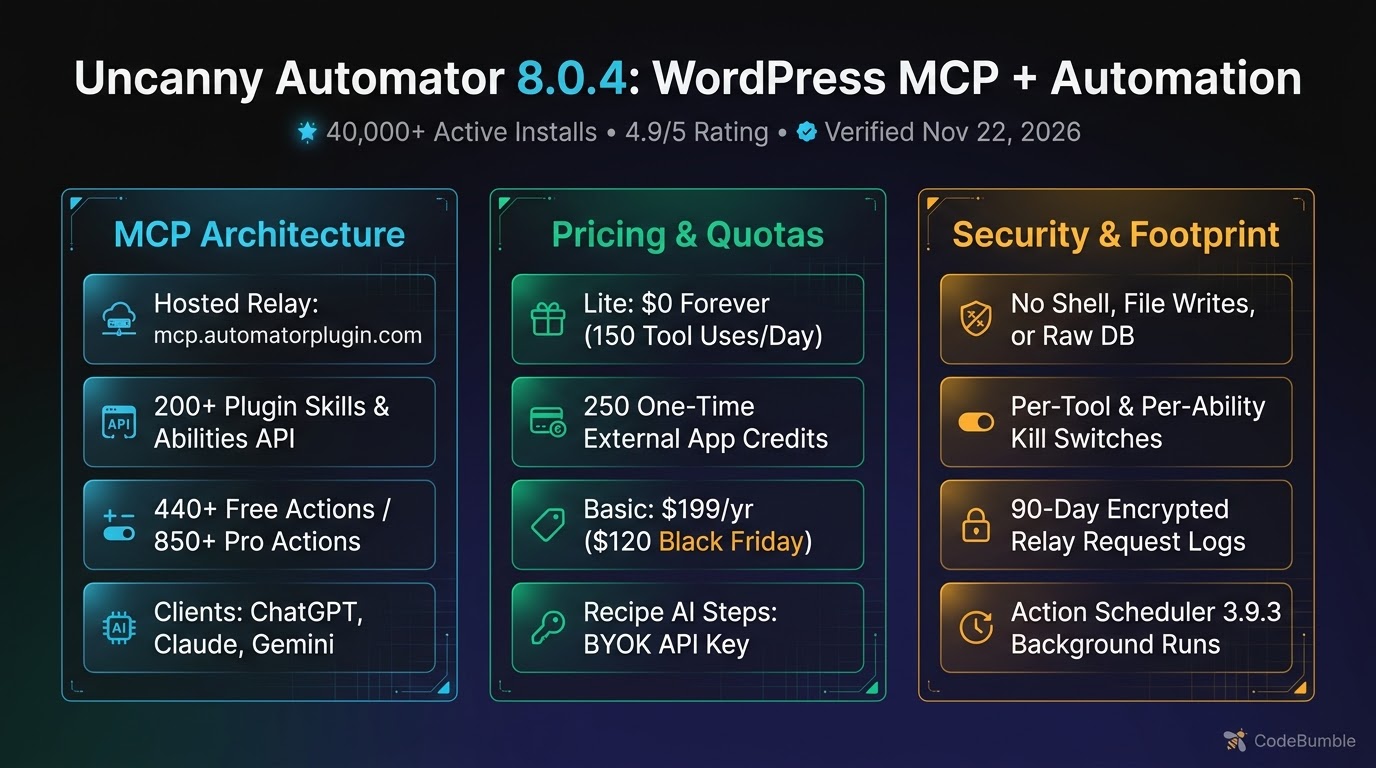
Executive Summary
Uncanny Automator has turned its established WordPress automation engine into a remote Model Context Protocol (MCP) server, giving site owners a single bridge to connect ChatGPT, Claude, Gemini, Copilot, and Perplexity to live WordPress workflows. Released in version 8.0.0 on November 2, 2026, and refined through version 8.0.4 on November 12, 2026, the update exposes WordPress core operations, 440+ to 850+ native Automator actions, and thousands of third-party plugin hooks registered through the WordPress Abilities API (WordPress.org, PRWeb).
Unlike standalone WordPress MCP connectors that only execute one-off chat commands, Uncanny Automator pairs its MCP server with a deterministic local recipe engine. An AI client can perform an immediate task in chat or translate a plain-English request into a scheduled, event-driven recipe that continues running on your WordPress host without an LLM in the loop (WordPress.org).
Pricing and install stats verified as of November 22, 2026: the plugin maintains 40,000+ active installations and a 4.9 out of 5 rating across 157 reviews (WordPress.org). The free Lite tier provides 150 MCP tool uses per day (300/day during week one) and 250 one-time external app credits, while paid Pro plans start at $199/year ($240/year regular, or $120 for year one during the Black Friday promotion ending November 30, 2026) for unlimited MCP tool usage (Uncanny Automator Pricing).
Growth Signals & WordPress.org Telemetry
Uncanny Automator is not a newly minted AI wrapper; Uncanny Owl has maintained the plugin since 2018 and operates as part of the Awesome Motive group of companies (WordPress.org, PRWeb). That seven-year head start gives its MCP rollout an immediate distribution advantage over newer WordPress AI connectors that have smaller install bases.
Key WordPress.org telemetry verified as of November 22, 2026 (WordPress.org):
| Metric | Verified Value | Context |
|---|---|---|
| Active Installations | 40,000+ | 2,000,000+ cumulative downloads |
| Current Version | 8.0.4 | Released November 12, 2026 (6 days ago) |
| User Rating | 4.9 / 5 stars | 151 5-star, 2 4-star, 1 2-star, 3 1-star (157 total) |
| WordPress Support | 6.2 or higher | Tested up to WordPress 7.1.4 |
| PHP Floor | 7.4 or higher | Lower requirement than Bit Flows (PHP 8.0+) |
| Support Resolution | 4 of 4 resolved | Measured over the trailing two-month window |
Development velocity around the 8.0 milestone has been rapid. Between November 2 and November 12, 2026, Uncanny Owl shipped five releases in ten days: 8.0.0 (November 2, introducing the public MCP server and Flow UI), 8.0.1 (November 4, fixing Abilities API OAuth token errors via run_ability), 8.0.2 (November 5, adding dependency resolution dialogs), 8.0.3 (November 9, resolving JWT Authentication and APCu object cache conflicts), and 8.0.4 (November 12, optimizing background memory usage and PHP 8.5 deprecation notices) (WordPress.org).
AI Architecture, Pricing Breakdown & Verification Timestamp
How the MCP Server & Automation Engine Work
Uncanny Automator's architecture splits responsibilities between a hosted connection relay, an on-site WordPress execution engine, and optional AI providers:
- Hosted MCP Relay (
mcp.automatorplugin.com): Instead of forcing users to configure WordPress application passwords or custom OAuth servers locally, external AI clients (ChatGPT, Claude, Gemini, Copilot, Perplexity, or any remote MCP client) authenticate throughmcp.automatorplugin.com(WordPress.org). The relay routes encrypted requests to the WordPress site and manages multi-site connections under one login. - Skills & WordPress Abilities API: To prevent LLMs from hallucinating plugin parameters, Uncanny Automator bundles 200+ skills (step-by-step instructional guides for WooCommerce, LearnDash, WPCode, Tutor LMS, WPForms, FluentCRM, and BuddyBoss, as well as Gutenberg, Spectra, Elementor, Divi, WPBakery, and the built-in Uncanny Page Builder) alongside hooks registered through the WordPress Abilities API (WordPress.org, Uncanny Automator Pricing). Note that the November 11 press release cites 250+ skills while the plugin listing and pricing page cite 200+ (PRWeb).
- Recipes vs. Interactive Chat: Once an AI builds a recipe, the workflow runs locally on your WordPress server via triggers, conditions, queues, and Action Scheduler without contacting the external AI client again (WordPress.org).
- Two Distinct AI Cost Paths:
- Uncanny Agent (Managed & Metered): Built into the WordPress dashboard for users without a ChatGPT or Claude subscription. It runs on models managed by Uncanny Owl, with metered usage pools and paid top-ups; access stops if a paid license lapses (WordPress.org, Bit Flows).
- Recipe AI Steps (BYOK): When embedding an LLM step inside an automated recipe (to summarize orders, classify form leads, translate posts, or generate SEO metadata), you connect your own API key (BYOK) for Claude, GPT, Gemini, Perplexity, Grok, Mistral, or Cohere (WordPress.org, Uncanny Automator Pricing).
Exact Pricing Breakdown (Verified November 22, 2026)
Pricing and install stats verified as of November 22, 2026 from Uncanny Automator's pricing page and Bit Flows' November 19, 2026 comparison:
| Plan | Monthly Price | Annual Price | Black Friday Promo (Ends Nov 30, 2026) | Site Limit | MCP Tool Usage & Key Quotas |
|---|---|---|---|---|---|
| Lite | $0 forever | $0 forever | N/A | Unlimited sites | 150 tool uses/day (300/day week 1), 440+ actions, 250 one-time app credits |
| Basic | $20/mo | $199/yr ($240 reg.) | $120 first year (2 sites) | 1 site (2 w/ BF) | Unlimited MCP tool uses, 850+ actions, 240+ integrations, unlimited app credits |
| Plus | $35/mo | $349/yr ($420 reg.) | $210 first year (20 sites) | 10 sites (20 w/ BF) | Everything in Basic + User Lists, Custom User Fields, Restrict Content addons |
| Elite | $60/mo | $599/yr ($720 reg.) | $360 first year (100 sites) | 50 sites (100 w/ BF) | Everything in Plus + Dynamic Content, Salesforce, QuickBooks Online addons |
Three pricing nuances deserve attention before deploying Uncanny Automator across client sites:
- Shared Daily & Lifetime Caps on Lite: The free 150 tool uses/day quota (resetting at 6:00 AM Eastern) and the 250 one-time external app credits (for Slack, Google Sheets, Mailchimp, and similar cloud apps) are shared across every site linked to your account, not granted per site (WordPress.org, Bit Flows). Once those 250 credits are spent, external app recipes stop until you upgrade.
- Pro-Gated Workflow Logic & Commerce: Conditional branching, scheduled recipes, delays/queues, loops, incoming webhooks, database queries, WooCommerce actions, and user creation are all locked behind paid plans (Uncanny Automator Pricing).
- Renewal Pricing Gap: While the official pricing page lists Basic at $199/year (discounted from $240/year) and $20/month, Bit Flows notes that post-discount 2026 AI + Automation renewal rates can reach $300/year ($25/month billed yearly) compared to legacy $199/year automation-only plans (Bit Flows). Confirm your exact renewal rate at checkout.
WordPress Performance Footprint, Security & Lock-In Check
Performance & Bloat Assessment
Because Uncanny Automator bundles a visual recipe builder, Action Scheduler (3.9.3), an AI-native page builder (Uncanny Page Builder), and 200+ skill definitions, its codebase is substantially larger than single-purpose MCP connectors. To mitigate runtime overhead on high-traffic sites, Uncanny Automator offloads external app actions and webhooks to background queues (Bit Flows). Crucially, version 8.0.4 introduced a targeted memory optimization so background requests load only the integrations used by active recipes rather than bootstrapping all 138+ to 240+ integrations on every job (WordPress.org).
Even with lazy integration loading, site owners who already run Elementor, Divi, or Gutenberg block themes do not need the bundled Uncanny Page Builder, and agencies running high-frequency loops or scheduled WooCommerce reports should verify that server WP-Cron or Action Scheduler queues have adequate PHP memory and execution headroom.
Security Controls & Attack Surface
Giving an external LLM write access to a production WordPress site carries obvious risk. Uncanny Automator addresses this with explicit architectural guardrails (WordPress.org, PRWeb):
- Hard-Coded Prohibitions: Connected AIs never receive shell access, cannot write or modify files on disk, cannot execute raw database changes, cannot delete WordPress users, and cannot open
wp-config.php, security keys, or backup directories. Core file inspection is strictly read-only and verified against official WordPress checksums. - Granular Kill Switches: Administrators approve each connection and can toggle individual switches per tool, per integration, per action, and per Abilities API hook, alongside master switches for database access, site management, and code reading. No AI client can modify those switches.
- Auditability: Every MCP call is logged with the calling AI app, target site, action taken, and outcome.
Lock-In & Relay Trade-Offs
The primary trade-off in Uncanny Automator's design is relay and platform dependency. While your posts, users, and recipes remain in your WordPress database, all remote MCP traffic passes through mcp.automatorplugin.com, which retains a record of each request and result (with credentials stripped) for 90 days (WordPress.org). External SaaS integrations likewise route through the hosted Automator Platform rather than direct site-to-API OAuth. If you require zero third-party relay logging, self-hosted alternatives like Bit Flows (which includes an MCP client free and MCP server in Pro at $59/year) or AutomatorWP ($149/year for 2 sites) keep more execution entirely on your own server.
Frequently Asked Questions
Does Uncanny Automator require a paid ChatGPT or Claude subscription?
No. You can connect an existing ChatGPT, Claude, Gemini, Copilot, or Perplexity account via remote MCP, or use the built-in Uncanny Agent inside your WordPress dashboard with no external AI account or API key required (WordPress.org).
What happens when the free 150 daily MCP tool uses run out?
The free Lite plan allows 300 tool uses per day for the first seven days after connecting an AI, then 150 tool uses per day forever, shared across all connected sites and resetting daily at 6:00 AM Eastern time (WordPress.org). Complex prompts can consume multiple tool uses if the AI queries posts or settings before acting.
Are the 250 external app credits on the free plan monthly or one-time?
They are one-time credits shared across every site on your free account (Uncanny Automator Pricing, Bit Flows). Plugin-to-plugin recipes inside WordPress remain unlimited on Lite, but actions sending data to Slack, Google Sheets, or Mailchimp stop once the 250 credits are exhausted.
Can an AI connected through Uncanny Automator edit my theme files or delete users?
No. Uncanny Automator blocks shell access, file writes, raw database edits, and user deletion for all connected AI clients, and blocks read access to wp-config.php, keys, and backups (WordPress.org).
Do published recipes stop working if I disconnect my AI client?
No. Once a recipe is created and published, it executes deterministically on your WordPress server via triggers and schedules without an active chat session, unless the recipe itself contains an AI step (WordPress.org).
Sources
- Uncanny Automator – MCP Server + Automation MCP for Claude & ChatGPT — WordPress.org Plugin Directory (Updated November 12, 2026; verified November 22, 2026)
- Uncanny Automator Pricing: Connect Your AI to Your WordPress Site (Verified November 22, 2026)
- Uncanny Automator Launches the Only WordPress MCP Server With a Built-in Automation Engine — PRWeb (Published November 11, 2026)
- Top Uncanny Automator Alternatives: 4 WordPress Automation Tools Compared — Bit Flows (Published November 19, 2026)