

Device
AMD Root Guest (ARG): Inside EPYC 9006 Venice's Zero-Guest-Change SEV-SNP Live Migration Architecture
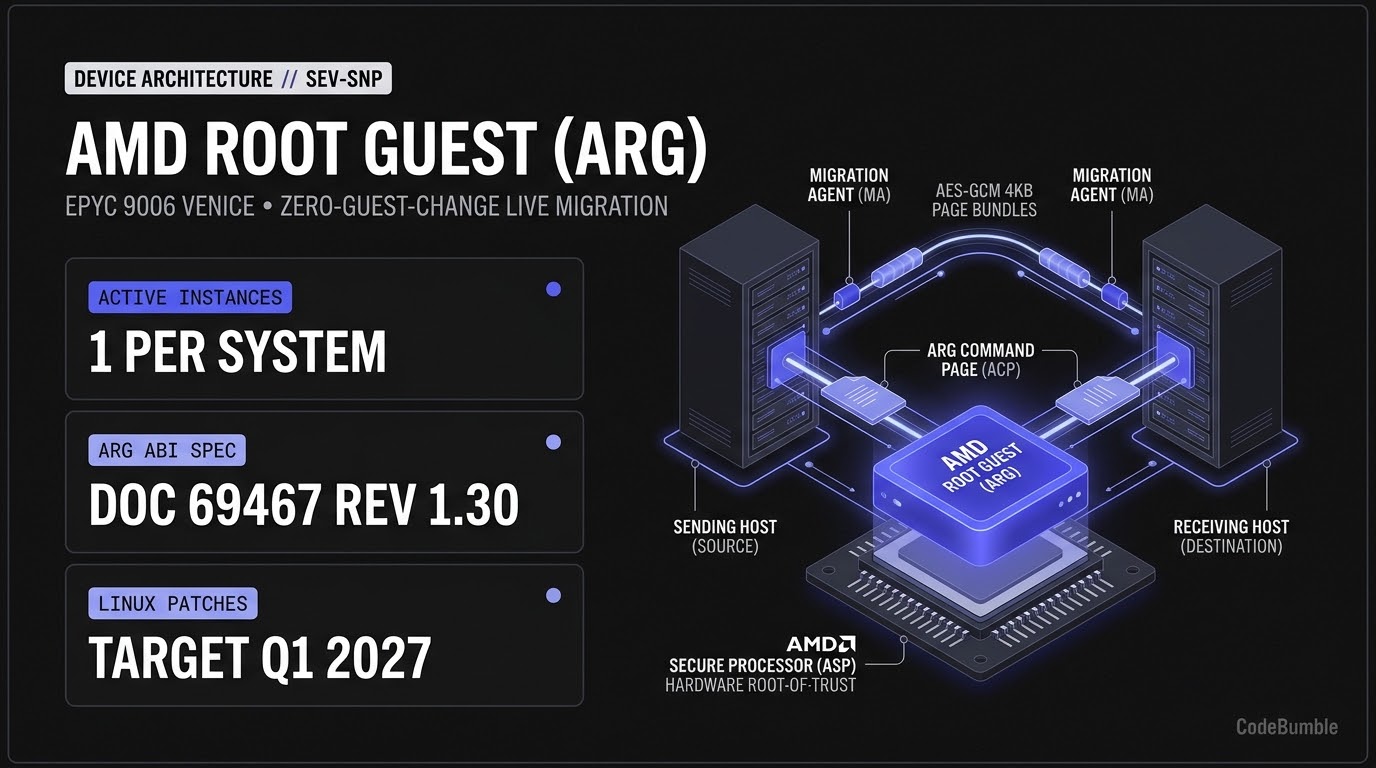
AMD's new Root Guest (ARG) architecture—detailed in ABI specification 69467 Rev 1.30 and presented at KVM Forum 2026—introduces a single signed SEV-SNP service VM per system to orchestrate encrypted live migration on EPYC 9006 'Venice' without modifying guest OS images, ahead of Q1 2027 Linux kernel patches.
12 min read
AMD Root Guest (ARG): Inside EPYC 9006 Venice's Zero-Guest-Change SEV-SNP Live Migration Architecture
Executive Summary
On November 10, 2026, AMD published Revision 1.30 of its SEV-SNP Live Migration Using AMD Root Guest (ARG) specification (Publication 69467), followed on November 13, 2026 by a technical presentation from AMD engineers David Kaplan and Tom Lendacky at KVM Forum 2026 in Vancouver, Canada. As reported by Phoronix on November 15, 2026, AMD Root Guest (ARG) is a new hardware- and firmware-backed trusted service component aligned with 6th Gen EPYC 9006 "Venice" server processors that enables secure live migration of AMD SEV-SNP confidential virtual machines without requiring any modifications to the guest VM image or guest operating system.
Historically, migrating SEV-SNP-protected virtual machines required either guest-assisted mechanisms (such as running migration logic inside a Secure VM Service Module) or complex coordination with a Migration Agent (MA) where the hypervisor could not directly inspect or re-encrypt private guest memory. ARG resolves this by introducing a single, AMD-signed SEV-SNP virtual machine per host with elevated platform privileges. Rooted in the AMD Secure Processor (ASP), the active ARG instance can access guest memory, manage Reverse Map Table (RMP) entries, and encrypt/decrypt 4 KB guest page bundles using AES-GCM under a session key negotiated by Migration Agents.
While the 69467-ARG_ABI_PUB specification is now public, Linux kernel and KVM enablement remains in the prototyping stage. According to Phoronix, no public Linux patches have been posted yet, with initial upstream ARG patches anticipated around Q1 2027. Because hardware and kernel implementations are not yet generally available, empirical live migration throughput, blackout duration, and dirty-page scan latency benchmarks are currently unavailable.
Why SEV-SNP Needed AMD Root Guest
Under the baseline SEV Secure Nested Paging Firmware ABI Specification (Publication 56860), confidential VMs rely on hardware memory encryption and the Reverse Map Table (RMP) to prevent an untrusted hypervisor from reading, tampering with, or remapping private guest pages. That strict isolation creates a structural challenge for cloud operators: when a workload must be live-migrated to another physical host for maintenance, load balancing, or hardware replacement, the hypervisor cannot read private guest pages to transmit them over the network.
Prior approaches forced trade-offs:
- Guest-assisted migration: Embedding migration logic inside the guest (for example, within an SVSM layer) requires guest image awareness, guest CPU cycles, and guest-side coordination.
- Pure ASP-driven export/import: Offloading bulk 4 KB page encryption, metadata tagging, and dirty-page scanning entirely onto the embedded AMD Secure Processor (ASP) microcontroller limits concurrency and throughput on high-memory server nodes.
AMD Root Guest (ARG) introduces an intermediate, hardware-authenticated execution tier on the main x86 cores. Rather than requiring guest OS changes or bottlenecking bulk page encryption inside the ASP, the hypervisor launches an AMD-signed ARG virtual machine that runs on x86 cores with minimal intercepts, scales across multiple donated worker threads, and executes inside the SEV-SNP Extended Trusted Computing Base (ETCB).
Technical Mechanics & Architecture
Trust Model, States, and Extended TCB (ETCB)
Per Chapter 2 of AMD Publication 69467, ARG is an AMD-signed SEV-SNP virtual machine authenticated by SEV-SNP firmware running on the ASP during launch (SNP_LAUNCH_START_EX with ARG_LAUNCH = 1 and a signed ID block supplied to SNP_LAUNCH_FINISH). Key architectural invariants include:
- Single active instance: Only one ARG VM may be in the
ACTIVATEDstate on a system at any given time. - Extended TCB attestation: When an active ARG is present, it is part of the SEV-SNP Extended TCB (ETCB). Its Security Version Number (SVN) is recorded in
CommittedEtcbupon first activation and reported in guest SEV-SNP attestation reports so relying parties can verify the platform's ARG version. - Anti-rollback enforcement: Once
CommittedEtcbrecords the ARG SVN—or after an upgrade is finalized viaSNP_ARG_COMMIT—firmware rejects any subsequent ARG image with a lower SVN. - Deactivated launch state: Every ARG boots into the
DEACTIVATEDstate with no special privileges beyond a normal SEV-SNP VM. Only a limited subset of commands (SNP_ARG_ACTIVATE,SNP_ARG_FEATURE_INFO,SNP_ARG_CREATE_THREAD,SNP_ARG_DESTROY_THREAD,SNP_ARG_SET_TRACE_ADDR,SNP_ARG_STATUS, andSNP_ARG_TRIGGER_FATAL_ERROR) is permitted before activation. Crucially, afterSNP_INIT_EX, an ARG must be activated before any other confidential guests can be launched.
+-----------------------------------------------------------------------+
|                       SENDING HOST (EPYC 9006)                        |
|                                                                       |
|  [ Target SEV-SNP Guest ]       [ Migration Agent (MA) ]              |
|     (Unmodified OS)                |  Attests & derives session key   |
|            |                       v  via MSG_SET_MIGRATION_INFO      |
|            v                +-----------------------------+           |
|  [ Hypervisor / KVM ] <---> |   AMD Root Guest (ARG)      |           |
|     VMRUN / VMGEXIT         |   1 Active VM per System    |           |
|     ACP @ MSR 0xC001_0130   |   ETCB / SVN Attested       |           |
|                             +--------------+--------------+           |
|                                            | SNP_GUEST_REQUEST        |
|                                            v (0x802 / 0x803)          |
|                             +-----------------------------+           |
|                             | AMD Secure Processor (ASP)  |           |
|                             +--------------+--------------+           |
+--------------------------------------------|--------------------------+
                                             | Encrypted 4KB Bundles
                                             | (AES-GCM + 28B Metadata)
                                             v
+-----------------------------------------------------------------------+
|                      RECEIVING HOST (EPYC 9006)                       |
|                                                                       |
|  [ Hypervisor / KVM ] <---> [ AMD Root Guest (ARG) ] <---> [ ASP ]    |
|     Imports via                Verifies AES-GCM tags &                |
|     SNP_ARG_IMPORT_PAGE        updates RMP Validated bits             |
+-----------------------------------------------------------------------+
ARG Guest Physical Address (GPA) Layout
Unlike standard confidential VMs, ARG requires a specialized four-region GPA layout managed by the hypervisor's nested page tables:
- SPA Map (
0x0to0x3FFF_FFFF_FFFF): The first 64 TB of ARG GPA space must map 1:1 to System Physical Addresses (GPA N == SPA N,C-bit = 0). The hypervisor may map this range read-only because ARG only reads hypervisor command buffers and guest pages from it. - ARG Static Memory: Regions defined by the ARG iGVM file containing static code and data mapped during launch.
- Donated Memory: Pages dynamically donated by the hypervisor for additional ARG worker threads (
SNP_ARG_CREATE_THREAD) or per-guest migration tracking (SNP_ARG_ADD_MIGRATION_MEMORY). These pages must fall within one or two GPA donation ranges advertised bySNP_ARG_FEATURE_INFO. - Output Memory (ARG Physical Addresses — APAs): Remaining GPA space used by ARG to write outputs (such as encrypted page data, metadata, dirty-scan GPA lists, and migration reports). To prevent confusion with SPAs (which always have bit 63 clear), an APA sets bit 63 = 1, bits
62:52 = 0, bits51:0 = GPA, and C-bit = 0.
Hypervisor-to-ARG Communication Protocol (ACP)
Because ARG does not expose MMIO registers and does not run concurrently with the hypervisor on the same vCPU, AMD Publication 69467 Chapter 5 defines a synchronous ring-like protocol centered on the ARG Command Page (ACP) and the GHCB MSR (0xC001_0130):
- Each ARG thread uses a contiguous shared memory region of at least 8 KB, where the first 4 KB page is the ACP.
- The ACP contains a 64-byte header (including an
ABORThypervisor flag at offset0x08and a 256-bitCommand Bitmapat offset0x20, with valid descriptors starting at bit 4) followed by 252 command descriptors of 16 bytes each. - To submit work, the hypervisor populates command buffers, sets bits in the ACP
Command Bitmap, writesARGInfo = 0x801andARGParams = AFN(ACP)to the GHCB MSR in ARG's VMCB, and executesVMRUN. - ARG processes descriptors from lowest set bit to highest set bit, writes a 16-byte
StatValin place, clears each bit, and exits viaVMGEXITwithARGInfo = 0x800when finished (or0x802when it needs the hypervisor to relay anSNP_GUEST_REQUESTto the ASP). - ARG runs with minimal intercepts (
VMRUN,#MC,INTR,NMI,SMI,INIT,VMGEXIT, andSHUTDOWNonly); enabling other intercepts can cause ARG to terminate.
Migration Agents (MA) and the Four-Phase Migration Lifecycle
While ARG handles bulk memory cryptography and RMP state transitions, Migration Agents (MAs) remain responsible for policy, platform trust verification, and session key establishment. As detailed in Chapters 3 and 4 of AMD Publication 69467:
- Pre-Migration: The sending and receiving MAs exchange attestation reports, verify platform trustworthiness, derive a shared migration session key, and bind it to the guest context via
MSG_SET_MIGRATION_INFO. MAs also support live upgrades (MSG_SET_HANDOFF_SECRET+SNP_REBIND_MAin handoff mode) and crash recovery (SNP_REBIND_MAin recovery mode). Alternatively, an SVSM-like component inside the guest can act as its own MA. - Pre-Copy (Epochs): The sending hypervisor initiates a session with
SNP_ARG_BEGIN_MIGRATIONand exports the guest context (SNP_ARG_EXPORT_GCTX). It then callsSNP_ARG_EXPORT_PAGEon bundles of 1 to 512 4 KB pages. Each page is encrypted with AES-GCM under the migration session key and paired with a 40-byte bundle header plus 28-byte per-page metadata (containing the AES-GCM tag, GPA, flags, and VMPL permissions). Pre-Copy is divided into 64-bit epochs (SNP_ARG_INCREMENT_EPOCH); a page may be exported at most once per epoch, and pages exported in an epoch must be imported in the same epoch viaSNP_ARG_IMPORT_PAGE. Contiguous 512-page 4 KB bundles aligned to 2 MB can be collapsed into 2 MB RMP entries on the receiving host ifLARGE_PAGEcriteria match. Pages transitioning from private to shared must be untracked (SNP_ARG_UNTRACK_PAGE) and unvalidated (SNP_ARG_UNVALIDATE_PAGE) within the same epoch. - Blackout: Once the hypervisor halts guest vCPUs, both hosts call
SNP_ARG_ENTER_BLACKOUT(setting the epoch to0xFFFFFFFFFFFFFFFF). During blackout, ARG fences the guest's ASID against device DMA (referencing SEV-TIOTIO_ASID_FENCE_CLEARif cancelled) and runsSNP_ARG_DIRTY_SCANacross tracked GPAs. Once all tracked pages are clean or re-exported, the sending ARG generates a 4 KB migration report (SNP_ARG_GET_MIGRATION_REPORT), transitioning the sending guest toSUSPENDED. The receiving ARG validates that report inSNP_ARG_START_GUESTbefore resuming execution. To prevent split-brain execution if a migration aborts after report generation, the sending ARG requires a rejection token fromSNP_ARG_REJECT_MIGRATIONbeforeSNP_ARG_END_MIGRATIONwill allow the source guest to resume. - Post-Copy (Optional): Pages not yet transferred during Pre-Copy or Blackout can be migrated after the guest starts on the receiving host while the sending guest remains
SUSPENDEDand the receiving guest is inPOST_COPY.
Seamless ARG Upgrades and Multi-Threading
Operational cloud fleets cannot afford to reboot hosts just to patch service firmware. SNP_ARG_CREATE_THREAD lets the hypervisor donate memory for parallel worker VMSAs (supporting General Purpose personality 0h or Management personality 1h). Furthermore, if ARG_FEATURES[1] is enabled, SNP_ARG_SWITCH allows a newly launched candidate ARG (with SVN >= CommittedEtcb) to atomically take over the ACTIVATED role without tearing down the system, followed by SNP_ARG_COMMIT once validated.
Defensive & Operational Hardening Playbook
For infrastructure architects and security teams preparing EPYC 9006 "Venice" hypervisor stacks for Q1 2027 Linux/KVM integration, the 69467-ARG_ABI_PUB specification highlights several concrete operational and defensive controls:
- Enforce Production Signing and Disable Debug ARG: Ensure
ARG_DBG_ENis strictly0duringSNP_INIT_EXin production. Debug ARG images are unsigned, replace platform keys with dummy keys, and lock outARG_DBG_EN=0until a full system reset. - Validate ETCB SVN in Relying-Party Attestation: Update remote attestation verifiers to inspect the Extended TCB (
CommittedEtcb) SVN fields in guest attestation reports so workloads refuse to run on hosts with outdated or vulnerable ARG images. - Commit Tested Upgrades Promptly: Use
SNP_ARG_SWITCHfor canary rollouts, then invokeSNP_ARG_COMMITonce stability is verified so rollback to older ARG SVNs is cryptographically blocked. - Prevent Migration Memory Exhaustion: Always invoke
SNP_ARG_REMOVE_MIGRATION_MEMORYuntilPADDR_INVALIDis returned afterSNP_ARG_END_MIGRATION, preventing resource exhaustion across encryption-capable ASIDs. - Audit ACP and APA Address Boundaries: Hypervisor drivers must validate that bit 63 is set on all APAs and zero on all SPAs, and ensure ACP reserved headers (
0x00,0x10) remain zeroed beforeVMRUN.
Below is a defensive C/Python-style structural validation helper (modeled directly on Tables 2-2 and 5-7 of AMD Publication 69467) that hypervisor developers or test harnesses can use to verify APA/SPA encoding and ACP header invariants prior to invoking ARG:
# Defensive invariant checker for AMD Root Guest (ARG) addresses & ACP headers
# Reference: AMD Publication 69467 Rev 1.30 (Tables 2-2, 5-7, 5-8)

APA_BIT63_MASK = 1 << 63
APA_RSVD_MASK  = 0x7FF0_0000_0000_0000  # Bits 62:52 must be zero

def is_valid_apa(addr: int) -> bool:
    """Verify an ARG Physical Address (bit 63 == 1, bits 62:52 == 0, 4KB aligned)."""
    has_apa_bit = (addr & APA_BIT63_MASK) != 0
    rsvd_clear  = (addr & APA_RSVD_MASK) == 0
    aligned_4kb = (addr & 0xFFF) == 0
    return has_apa_bit and rsvd_clear and aligned_4kb

def is_valid_spa_for_arg(addr: int) -> bool:
    """Verify a System Physical Address falls within ARG's 64TB 1:1 SPA map (bit 63 == 0)."""
    return (addr & APA_BIT63_MASK) == 0 and addr <= 0x3FFF_FFFF_FFFF and (addr & 0xFFF) == 0

def validate_acp_header(acp_bytes: bytes) -> None:
    """Check that reserved ACP header bytes (0x00..0x07, 0x10..0x1F) and bitmap bits 0..3 are zero."""
    if len(acp_bytes) != 4096:
        raise ValueError("ACP must be exactly 4096 bytes")
    if any(acp_bytes[0x00:0x08]) or any(acp_bytes[0x10:0x20]):
        raise ValueError("ACP reserved header bytes must be zero (MBZ)")
    if (acp_bytes[0x20] & 0x0F) != 0:
        raise ValueError("Command Bitmap bits 0..3 are reserved and must be zero")
Confidence & Evidence Assessment
- Specification & Architecture (High Confidence): All architectural details—including ARG states, GPA layout, ACP descriptors, 25+ ARG commands, AES-GCM 4 KB bundle metadata, and state-machine transitions—are directly verified from AMD Publication 69467 Rev 1.30, released November 10, 2026.
- Linux/KVM Roadmap & EPYC 9006 Alignment (Moderate-to-High Confidence): Phoronix and the KVM Forum 2026 session abstract confirm EPYC 9006 "Venice" alignment and the Q1 2027 target for initial Linux patches, though exact upstream kernel version targets and patch-series review timelines remain subject to change.
- Performance Benchmarks (Unavailable): No public throughput, blackout-window, or overhead benchmarks exist yet because Linux kernel and KVM prototypes have not been published.
Frequently Asked Questions (FAQ)
What is AMD Root Guest (ARG)?
AMD Root Guest (ARG) is an AMD-signed, elevated-privilege SEV-SNP virtual machine authenticated by the AMD Secure Processor (ASP). Only one ARG VM can be active per system at a time, and it provides trusted platform services—starting with zero-guest-change live migration—on EPYC 9006 "Venice" processors.
Does ARG require changes to confidential guest VM images or guest OS kernels?
No. According to Chapter 1 of AMD Publication 69467, the primary design goal of ARG + Migration Agent live migration is to migrate SEV-SNP guests without requiring any modifications to the guest VM image or guest operating system.
How does ARG interact with Migration Agents (MAs)?
The Migration Agent handles platform attestation, trust verification between source and destination hosts, and session key negotiation (MSG_SET_MIGRATION_INFO). Once the migration session key is established, ARG takes over encrypting, exporting, dirty-scanning, and importing 4 KB guest memory pages.
Can ARG be upgraded without rebooting the host or terminating running VMs?
Yes, if seamless upgrade support (ARG_FEATURES[1]) is enabled. The hypervisor launches a candidate ARG with an SVN greater than or equal to CommittedEtcb and invokes SNP_ARG_SWITCH to atomically promote the candidate, followed by SNP_ARG_COMMIT to lock in the new minimum SVN.
When will Linux and KVM support for AMD Root Guest arrive?
According to Phoronix's November 15, 2026 report covering AMD's KVM Forum 2026 presentation, the Linux implementation is currently being prototyped, with initial public patches anticipated around Q1 2027.
Sources
- AMD — SEV-SNP Live Migration Using AMD Root Guest (ARG), Publication 69467, Revision 1.30 (November 10, 2026) (Direct Document)
- Phoronix — AMD ARG "AMD Root Guest" Linux Patches Coming In 2027 (November 15, 2026)
- KVM Forum 2026 — An Introduction to the AMD Root Guest, Tom Lendacky & David Kaplan (November 13, 2026)
- AMD — SEV Secure Nested Paging Firmware ABI Specification, Publication 56860