

Device
Researchers Say Mior and Skyfall Break AMD SEV-SNP Isolation Across EPYC 7003–9005
Researchers from ETH Zurich and Google say two new hardware attacks—Mior (CVE-2026-0462) and Skyfall (CVE-2026-40671)—let rogue hosts bypass AMD SEV-SNP isolation on EPYC 7003–9005 servers. Learn how the flaws work, which firmware and microcode patches fix them, and how to enforce SNP TCB attestation.
11 min read
Researchers Say Mior and Skyfall Break AMD SEV-SNP Isolation Across EPYC 7003–9005
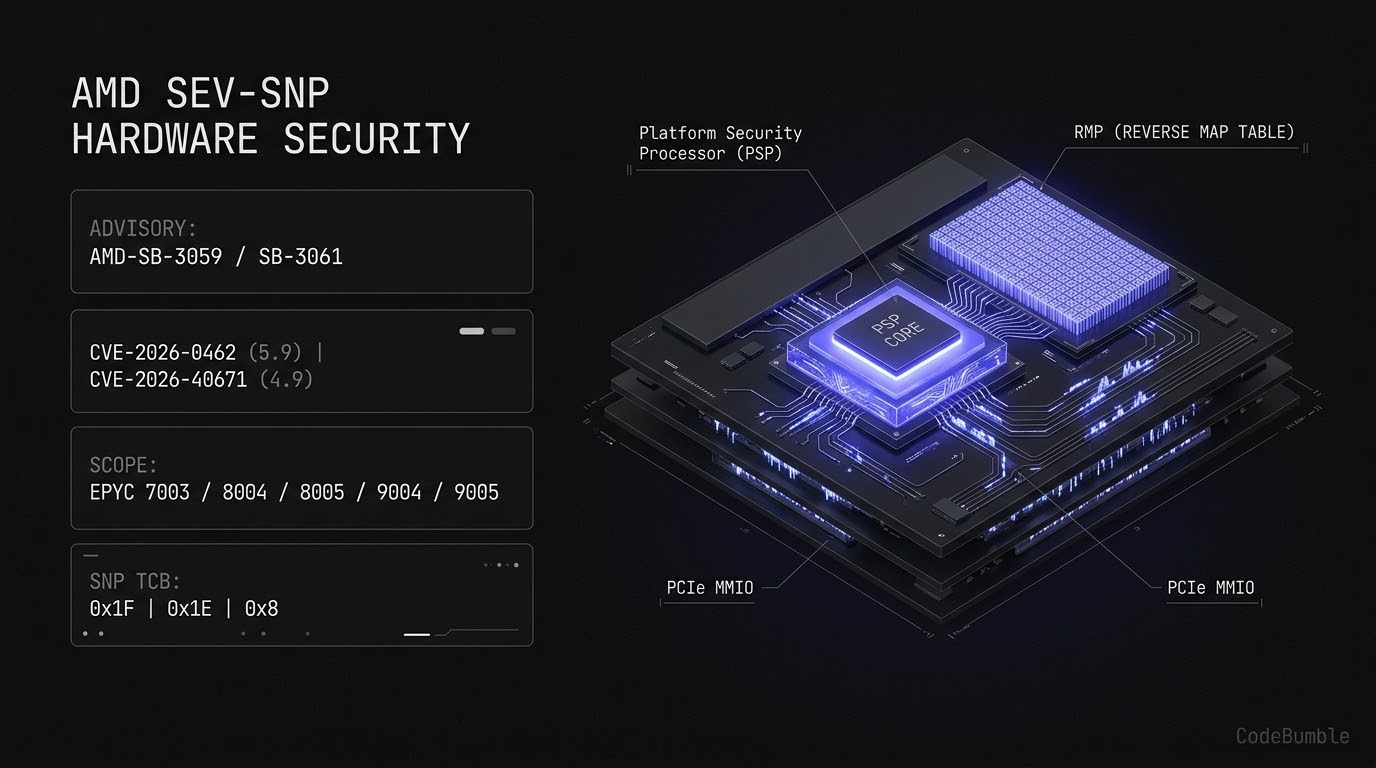
Executive Summary
Between November 10 and November 14, 2026, AMD and academic researchers from ETH Zurich and Google publicly disclosed two distinct hardware-level vulnerabilities affecting AMD Secure Encrypted Virtualization-Secure Nested Paging (SEV-SNP) on enterprise EPYC server processors: Mior (CVE-2026-0462, CVSS 4.0 Base Score 5.9) and Skyfall (CVE-2026-40671, CVSS 4.0 Base Score 4.9). Both disclosures challenge the zero-trust-hypervisor guarantee of confidential virtual machines (CVMs) across EPYC 7003 (Milan), 8004 (Siena), 8005 (Turin), 9004 (Genoa/Bergamo), and 9005 (Turin) server platforms, as well as Instinct MI300A accelerators (for Skyfall) and EPYC Embedded lines.
Mior exploits insufficient access-control granularity during boot-time initialization of the Reverse Map Table (RMP), allowing an attacker with control over both the host hypervisor and system BIOS/UEFI—paired with a controlled PCIe device—to redirect Platform Security Processor (PSP) writes, bypass RMP protections, read and modify encrypted guest memory even when ciphertext hiding is enabled, and forge SNP attestation reports (AMD-SB-3059, The Hacker News). Skyfall, by contrast, requires no hardware tampering or BIOS modification: a malicious hypervisor triggers deliberate VMRUN startup aborts and uses Transient Scheduler Attacks (TSA) to extract residual cached guest register state, disk-encryption keys, and targeted cache-line data (AMD-SB-3061, CASRAI).
Confidence Level: High for vulnerability mechanics, CVSS 4.0 scores, affected processor families, SEV firmware versions, microcode patch IDs, and SNP TCB values (all directly verified against AMD Security Bulletins AMD-SB-3059 and AMD-SB-3061). Moderate for OEM rollout timelines, as AMD lists Platform Initialization (PI) firmware packages as "Target release planned for Nov'26" (Skyfall) and "Target release planned for Dec'26" (Mior), meaning downstream server OEM BIOS and BMC availability varies by vendor. Neither AMD advisory reports active exploitation in the wild as of November 14, 2026.
Threat Model & Architectural Context
AMD SEV-SNP is designed to isolate confidential guest VMs from a potentially compromised or malicious host hypervisor, operating system, and UEFI/BIOS. Unlike legacy SEV and SEV-ES, SEV-SNP introduces hardware-enforced integrity protection via the Reverse Map Table (RMP)—a system-wide memory structure managed by the AMD Platform Security Processor (PSP) that tracks page ownership, guest assignment, and read/write permissions for every 4 KB or 2 MB page of physical DRAM.
Under AMD's published threat model for SEV-SNP, the hypervisor and UEFI/BIOS are explicitly untrusted components. Tenants rely on cryptographic remote attestation—signed by the PSP's Versioned Chip Endorsement Key (VCEK) and reporting the host's Trusted Computing Base (TCB) version—to verify that the underlying silicon, SEV firmware, and microcode are free of known architectural bypasses before unsealing secrets or provisioning decryption keys.
Mior and Skyfall demonstrate two complementary failure modes in that trust boundary:
- Boot-Time Interconnect & Initialization Integrity (Mior): If untrusted firmware leaves memory-routing registers unlocked during early boot, the PSP's own initialization writes to the RMP can be silently diverted to an attacker-controlled PCIe Memory-Mapped I/O (MMIO) target.
- Microarchitectural Cleanup on Fault Paths (Skyfall): Even when the RMP and boot sequence are intact, an aborted
VMRUNtransition can leave sensitive guest register state in microarchitectural buffers without full sanitization, exposing those registers to timing side channels.
Because both flaws live in host-side firmware, microcode, and platform initialization packages, guest operating systems cannot patch themselves. Tenants in multi-tenant cloud or colocation environments depend entirely on infrastructure operators applying OEM BIOS/BMC updates and must enforce strict TCB version policies in their attestation verifiers.
Technical Mechanics & Architecture
1. Mior (CVE-2026-0462): Device-as-Memory MMIO Redirection
Identified by researchers Chris Wech, Philipp Giersfeld, Benedict Schlüter, and Shweta Shinde at ETH Zurich (published at ACM CCS 2026 as Mior: Breaking AMD SEV-SNP with Device-as-Memory, xca-attacks), Mior targets the CWE-1220 (Insufficient Granularity of Access Control) flaw in SEV firmware initialization tracked in AMD-SB-3059 (CVSS 4.0 vector: CVSS:4.0/AV:L/AC:L/AT:N/PR:H/UI:N/VC:N/VI:N/VA:N/SC:N/SI:H/SA:N).
During system startup, the PSP allocates and populates the RMP in main DRAM and marks the RMP region itself as protected so the hypervisor cannot alter page-ownership entries at runtime. However, if a malicious host controls the UEFI/BIOS and leaves SoC memory-routing settings unlocked, it can configure Memory-Mapped I/O (MMIO) routing so that the PSP's RMP initialization writes are directed to the memory of a PCIe peripheral—such as a discrete graphics card—rather than main DRAM.
Normal Boot Initialization:
  [PSP Firmware] ──(RMP Init Writes)──> [DRAM: RMP Region] (Protected & Validated)

Mior MMIO Redirection Attack (BIOS + Hypervisor + PCIe Device):
  [UEFI/BIOS (Untrusted)] ──(Leaves MMIO Routing Unlocked)──> [SoC Interconnect]
                                                                    │
  [PSP Firmware] ──(RMP Init Writes)──────────────────────> [PCIe GPU / Device MMIO]
        ▲                                                           │
        └──────────(Device Echoes Expected Verification Reads)──────┘
  Result: Real DRAM RMP entries (incl. RMP self-protection) stay uninitialized!
  [Malicious Hypervisor] ──(Rewrites Unprotected RMP)──> [Enables PSP Debug / Forges Attestation]
Because the PSP reads back written values to verify initialization, the researchers' controlled PCIe graphics card returned the expected values, allowing boot to complete without triggering a PSP error. Yet the actual RMP in DRAM—including the entry protecting the RMP itself—remained uninitialized. Once the host booted, the hypervisor could rewrite RMP entries, enable PSP debug commands on confidential VMs that had debugging disabled, read and write guest memory (bypassing optional ciphertext hiding), and transplant a benign VM's launch measurement into a malicious VM to forge signed attestation reports (The Hacker News, CASRAI).
Importantly, AMD confirms in AMD-SB-3059 that SEV and SEV-ES are not affected (N), and only SEV-SNP is impacted (Y). Mior is also distinct from ETH Zurich's earlier interconnect attacks (Fabricked, BreakFAST, and Staleus).
2. Skyfall (CVE-2026-40671 & CVE-2026-18448): VMRUN Cleanup & TSA Side Channels
Disclosed by Alessandro Vezzù, Benedict Schlüter, and Shweta Shinde (ETH Zurich) alongside Daniel Moghimi (Google), Skyfall targets CWE-459 (Incomplete Cleanup) during VMRUN error handling (AMD-SB-3061, CVSS 4.0 Base Score 4.9, vector: CVSS:4.0/AV:L/AC:L/AT:N/PR:H/UI:N/VC:L/VI:N/VA:N/SC:N/SI:N/SA:N). Unlike Mior, Skyfall does not require BIOS modification or a PCIe device; it operates purely from a privileged host hypervisor.
When a hypervisor executes VMRUN to enter a confidential guest and intentionally engineers conditions that force an early startup abort, the processor has already loaded and cached portions of the VM's saved architectural state. Due to incomplete cleanup on the error path, residual state remains in microarchitectural structures, where it can be extracted using Transient Scheduler Attacks (TSA)—a timing side-channel class originally disclosed in July 2025.
In laboratory evaluations on EPYC 7313 (Zen 3), EPYC 9124 (Zen 4), and EPYC 9334 (Zen 4) processors, researchers extracted saved VM register state, recovered a guest disk-encryption key (noting that a real-world attacker could pair this with SEV-Step single-stepping rather than modifying the guest kernel), and leaked memory from three specific cache-line offsets (0x0c0, 0x380, and 0x3c0) per targeted page (The Hacker News, CASRAI). The researchers did not demonstrate the leak on Zen 5 chips, though AMD includes EPYC 8005 and 9005 (Turin) in AMD-SB-3061.
Additionally, the Skyfall team demonstrated leaking decrypted microcode updates and System Management Mode (SMM) registers across test chips. That SMM exposure is tracked separately by the EDK II project as CVE-2026-18448 (CVSS 5.6), stemming from missing TSA mitigations in EDK II firmware code (The Hacker News). Note that the IEEE Symposium on Security and Privacy program committee observed that practical VM exploitation faces strict operational constraints, including an idle processor core, high-rate VMRUN aborts and performance-counter sampling, and keeping the target VM from crashing or timing out.
Evidence, Benchmarks & Affected Platforms
The table below consolidates the verified firmware, Platform Initialization (PI), microcode, and SNP TCB values published by AMD across AMD-SB-3059 and AMD-SB-3061.
| Processor Family | Mior (CVE-2026-0462) SEV FW (2026-08-12) |
Mior PI Target (Dec '26) | Mior SNP TCB & Mitigation Bit | Skyfall (CVE-2026-40671) Microcode (2026-08-12) |
Skyfall PI Target (Nov '26) |
|---|---|---|---|---|---|
| EPYC 7003 (Milan) | 1.3A.03 |
MilanPI-SP3_1.0.0.L |
TCB[SNP]=0x1F, Bit=8 |
Milan-B1 0x0A0011E1 / B2 0x0A00124E |
MilanPI-SP3_1.0.0.L |
| EPYC 8004 (Siena) | 1.3A.4 |
GenoaPI_1.0.0.K |
TCB[SNP]=0x1E, Bit=6 |
Siena RSDN-A2 0x0AA0021F |
Genoa_100J Patch 3 |
| EPYC 8005 (Turin) | 1.3A.0A |
TurinPI_1.0.0.C |
TCB[SNP]=0x8, Bit=12 |
0x0B002176 |
TurinPI_1.0.0.C |
| EPYC 9004 (Genoa/Bergamo) | 1.3A.4 |
GenoaPI_1.0.0.K |
TCB[SNP]=0x1E, Bit=6 |
RS-B1 0x0A10115B / B2 0x0A10125B / Bergamo 0x0AA0021F |
Genoa_100J Patch 3 |
| EPYC 9005 (Turin) | 1.3A.0A |
TurinPI_1.0.0.C |
TCB[SNP]=0x8, Bit=12 |
Classic-BRH C1 0x0B002176 / Dense-BRH D B0 0x0B101067 |
TurinPI_1.0.0.C |
| Instinct MI300A | Not listed in SB-3059 | N/A | N/A | 0x0A900110 (2026-09-21) |
0x0A900110 (2026-09-21) |
| EPYC Embedded 7003–9005 | Version TBD |
Target Feb '27 | TBD | Version TBD |
Jan–Apr '27 |
Benchmark Availability Note: Neither AMD-SB-3059 nor AMD-SB-3061 publishes latency or throughput performance benchmarks for the August 12, 2026 SEV firmware or microcode mitigations. In lab testing, the Mior proof-of-concept succeeded in 1,000 of 1,000 attempts across two test runs on an EPYC 9135 (Zen 5) when using a modified BIOS; production performance overhead benchmarks remain unavailable from AMD as of November 15, 2026.
Defensive Hardening & Attestation Playbook
Because Mior and Skyfall sit below the guest OS boundary, defense requires a two-tier workflow: platform firmware remediation by bare-metal/cloud operators and cryptographic TCB enforcement by confidential VM tenants.
Step 1: Bare-Metal & Cloud Operator Firmware Remediation
- Audit EPYC Stepping & Current Microcode/PSP Versions: Inventory all EPYC 7003, 8004, 8005, 9004, and 9005 hosts, plus Instinct MI300A nodes, and map installed BIOS/AGESA PI versions against your OEM's security matrix.
- Apply OEM BIOS, SEV Firmware, Microcode, and BMC Updates: Deploy OEM BIOS packages incorporating the November/December 2026 PI releases (
MilanPI-SP3_1.0.0.L,Genoa_100J Patch 3/GenoaPI_1.0.0.K,TurinPI_1.0.0.C) and updated microcode. Note that server vendors such as Supermicro explicitly require both BIOS and Baseboard Management Controller (BMC) firmware updates on affected H12, H13, and H14 motherboards (The Hacker News). - Track EDK II (
CVE-2026-18448) Firmware Patches: Apply AMD's prior TSA mitigations alongside OEM EDK II updates as they ship to close the SMM register leak path. - Rollback & Compatibility Caution: Before staging BIOS updates across production SEV-SNP clusters, verify whether your hypervisor and attestation verifier support the updated
TCB[SNP]values (0x1F,0x1E,0x8). Note that rolling back PSP/SEV firmware after an anti-rollback fuse or TCB increment may be blocked by hardware policy on certain OEM platforms.
Step 2: Host Microcode & PSP Version Verification (Linux)
Operators managing bare-metal EPYC hosts can inspect active CPU stepping and microcode patch levels locally before and after OEM BIOS updates:
# Inspect CPU model, stepping, and active microcode revision on EPYC hosts
lscpu | grep -E "Model name|Stepping|Vendor ID"
grep -m1 "microcode" /proc/cpuinfo
dmesg | grep -iE "sev|psp|microcode" | tail -n 20
Step 3: Tenant Remote Attestation TCB Enforcement (Defensive Python Check)
Before unsealing disk-encryption keys or releasing sensitive workloads to an AMD SEV-SNP guest, your attestation relying party should inspect the reported_tcb (or committed_tcb) SNP field inside the signed attestation report and reject hosts below AMD's AMD-SB-3059 minimum SNP TCB thresholds (0x1F for EPYC 7003, 0x1E for EPYC 8004/9004, and 0x8 for EPYC 8005/9005). Below is a safe, defensive policy-validation helper for an attestation verifier pipeline:
# Defensive SEV-SNP TCB Policy Check (AMD-SB-3059 Minimums)
MIN_SNP_TCB_BY_FAMILY = {
    "EPYC_7003_MILAN": 0x1F,
    "EPYC_8004_SIENA": 0x1E,
    "EPYC_9004_GENOA": 0x1E,
    "EPYC_8005_TURIN": 0x08,
    "EPYC_9005_TURIN": 0x08,
}

def verify_snp_tcb_policy(cpu_family: str, reported_snp_tcb: int, debug_allowed: bool) -> tuple[bool, str]:
    """Enforce minimum SNP TCB and disallow debug-enabled confidential guests."""
    if debug_allowed:
        return False, "REJECT: Guest policy permits SEV-SNP debugging."
    required_tcb = MIN_SNP_TCB_BY_FAMILY.get(cpu_family)
    if required_tcb is None:
        return False, f"REJECT: Unrecognized EPYC family '{cpu_family}'."
    if reported_snp_tcb < required_tcb:
        return (
            False,
            f"REJECT: Host SNP TCB 0x{reported_snp_tcb:X} is below AMD-SB-3059 minimum 0x{required_tcb:X}.",
        )
    return True, f"PASS: Host SNP TCB 0x{reported_snp_tcb:X} meets AMD-SB-3059 policy."
Note: Per AMD-SB-3059, AMD lists the TCB[SNP] values next to the fixed SEV firmware versions; operators should also verify that the host attestation report is signed by a valid AMD VCEK certificate chain and that OEM PI/BIOS updates have been applied, since attestation alone cannot substitute for patched host firmware.
Frequently Asked Questions (FAQs)
1. Can an unprivileged guest VM or remote network attacker exploit Mior or Skyfall?
No. Both vulnerabilities require privileged host access (PR:H in CVSS 4.0). Mior requires control over both the host hypervisor and the UEFI/BIOS plus a controlled PCIe device, while Skyfall requires a malicious host hypervisor. They threaten the confidential computing boundary against a rogue or compromised cloud/host operator, not guest-to-host escapes.
2. Are legacy AMD SEV and SEV-ES virtual machines affected by Mior?
No. According to AMD-SB-3059, Mior (CVE-2026-0462) affects SEV-SNP only (SEV: N, SEV-ES: N, SEV-SNP: Y), because it targets initialization of the Reverse Map Table (RMP), which is unique to SEV-SNP.
3. Does enabling SEV-SNP ciphertext hiding stop the Mior attack? No. ETH Zurich researchers demonstrated that Mior's memory read/write and attestation forgery techniques succeeded even with ciphertext hiding enabled, because corrupting the RMP allows the hypervisor to enable PSP debug commands and manipulate page ownership directly.
4. Why do AMD-SB-3059 and AMD-SB-3061 list different target months for TurinPI_1.0.0.C?
AMD-SB-3061 (Skyfall) lists TurinPI_1.0.0.C with a target release planned for November 2026, whereas AMD-SB-3059 (Mior) lists the same package name with a target release planned for December 2026. Organizations should confirm with their server OEM or cloud provider that the installed BIOS/PI bundle explicitly addresses both AMD-SB-3059 and AMD-SB-3061.
5. What should confidential computing tenants do if their cloud provider has not yet rolled out December 2026 PI updates?
Audit your attestation verifier to enforce debug_allowed == False and check TCB[SNP] values against AMD-SB-3059 (0x1F, 0x1E, 0x8). Request formal confirmation from your cloud provider regarding deployment of the August 12, 2026 SEV firmware/microcode and upcoming November/December 2026 PI/BMC updates before unsealing regulated workloads.
Sources
- AMD Product Security Bulletin AMD-SB-3059 — AMD Secure Encrypted Virtualization (SEV) Vulnerability (
CVE-2026-0462) (Nov 10, 2026): https://www.amd.com/en/resources/product-security/bulletin/amd-sb-3059.html - AMD Product Security Bulletin AMD-SB-3061 — AMD SEV Incomplete Cleanup Vulnerability (
CVE-2026-40671) (Nov 10, 2026): https://www.amd.com/en/resources/product-security/bulletin/amd-sb-3061.html - ETH Zurich Secure and Trustworthy Systems Group (
xca-attacks) — XCA: Interconnect Corruption Attacks & Mior (ACM CCS 2026): https://github.com/xca-attacks - The Hacker News — New Mior and Skyfall Attacks Let Rogue Cloud Hosts Steal Secrets From AMD SEV-SNP VMs (Nov 13, 2026): https://thehackernews.com/2026/11/new-mior-and-skyfall-attacks-let-rogue.html
- CASRAI — Researchers disclose Mior and Skyfall attacks on AMD SEV-SNP confidential VMs (Nov 14, 2026): https://casrai.org/news/mior-skyfall-amd-sev-snp-confidential-vm-attacks-2026