

Device
SoC BSP Kernel Drift in November 2026: Linux 5.15 EOL Looms as ST, Qualcomm, and TI Split Between 6.18 and 7.3
Unpinned Yocto BSPs for ST STM32MP1/MP2 are silently shifting to Linux 6.18 while Linux 5.15 hits projected EOL in December 2026. Here is the verified vendor branch matrix and release-engineering playbook.
9 min read
SoC BSP Kernel Drift in November 2026: Linux 5.15 EOL Looms as ST, Qualcomm, and TI Split Between 6.18 and 7.3
Executive Summary
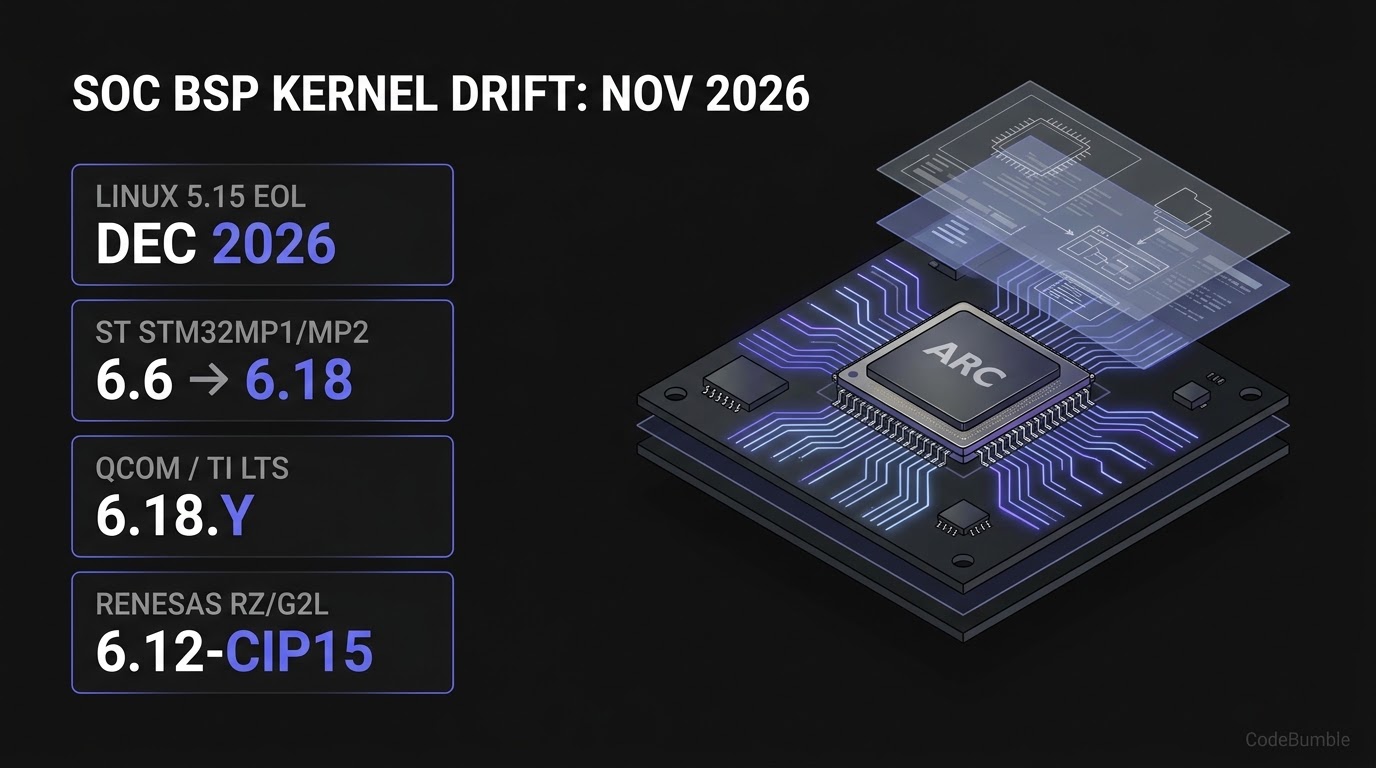
Between October 14 and November 13, 2026, multiple System-on-Chip (SoC) Board Support Package (BSP) repositories quietly shifted kernel branches—creating subtle build-reproducibility traps for Yocto manifests and urgent security lifecycle deadlines for embedded hardware teams. According to the TECH VEDA Vendor BSP Status Report (published November 13, 2026) and cross-checked against The Linux Kernel Archives (kernel.org) and STMicroelectronics' meta-st-stm32mp repository, three major dynamics define embedded Linux device engineering this month:
- Unpinned Yocto Branch Drift on ST STM32MP1 and STM32MP2: The unversioned
wrynosebranch ofmeta-st-stm32mpnow builds Linux 6.18 (v6.18-stm32mp-r1, Makefile6.18.37), whereas the versioned release branchwrynose_v26.02.18still builds Linux 6.6 (v6.6-stm32mp). Teams pinningwrynoseby branch name without a commit hash or release tag risk silently jumping kernel major series across CI builds. - Linux 6.18 LTS vs. 7.3 Branches on Qualcomm and TI: Qualcomm (
qcom-7.3, head November 11) and Texas Instruments (ti-linux-7.3.y, head November 10) have both published Linux 7.3 trees, but kernel.org does not list7.3as a longterm maintenance series. Production baselines on Qualcomm QCS6490 and TI AM335x/AM62A/AM62x/J721E should remain pinned toqcom-6.18.yandti-linux-6.18.y(projected EOL December 2028). - Imminent Linux 5.15 & 5.10 EOL (December 2026): With fewer than 60 days remaining before kernel.org's projected December 2026 end of life for Linux 5.15 and 5.10, SoC BSPs still anchored on 5.15—such as the Allwinner T507 and T527—must migrate to a supported LTS branch, move to mainline, or assume self-managed CVE backporting.
This briefing maps the verified November 2026 BSP branch movements, explains the Yocto/kernel lifecycle architecture behind these splits, and provides a read-only Python & Git audit script plus a hardening playbook for embedded device teams.
Technical Mechanics and Architecture
How Vendor BSP Branching Diverges from kernel.org LTS
Embedded Linux firmware rarely tracks mainline kernel.org directly. Instead, silicon vendors fork an upstream longterm kernel series, layer out-of-tree SoC device trees, GPU/NPU drivers, and power-management patches on top, and expose them through Yocto/OpenEmbedded BSP layers (such as meta-st-stm32mp). When a vendor introduces a new kernel series or Civil Infrastructure Platform (CIP) maintenance branch on an unversioned layer head, downstream product manifests that track branch names instead of immutable SHAs or versioned tags inherit breaking kernel-ABI and device-tree shifts:
+-----------------------------------------------------------------------------+
|       EMBEDDED SOC BSP BRANCHING & YOCTO PINNING ARCHITECTURE (NOV 2026)    |
+-----------------------------------------------------------------------------+
|                                                                             |
|  [ UPSTREAM KERNEL.ORG LONGTERM SERIES ]                                    |
|   |-- 5.10 / 5.15 -> Projected EOL: Dec 2026  (e.g., Allwinner T507/T527)   |
|   |-- 6.1  / 6.6  -> Projected EOL: Dec 2027  (e.g., Rockchip 6.1, ST 6.6)  |
|   |-- 6.12 / 6.18 -> Projected EOL: Dec 2028  (e.g., Renesas 6.12, Qcom/TI) |
|   +-- 7.3         -> Non-LTS (No longterm entry on kernel.org as of Nov 13) |
|             |                                                               |
|             v                                                               |
|  [ VENDOR KERNEL & YOCTO LAYER REPOSITORIES ]                               |
|   |-- ST meta-st-stm32mp:                                                   |
|   |    |-- wrynose (unversioned)    -> KERNEL: v6.18-stm32mp-r1             |
|   |    +-- wrynose_v26.02.18 (tag)  -> KERNEL: v6.6-stm32mp                 |
|   +-- Renesas RZ/G2L:                                                       |
|        +-- rz-6.12-cip14 (active Nov 11) vs rz-6.12-cip15 (tracker target)  |
|             |                                                               |
|             v                                                               |
|  [ DEVICE CI / PRODUCTION MANIFEST ]                                        |
|   |-- Unpinned branch ("wrynose")   -> Silent 6.6 -> 6.18 jump + DT breakage|
|   +-- Pinned tag / commit SHA       -> Reproducible builds + controlled port|
+-----------------------------------------------------------------------------+
Verified November 2026 SoC BSP Status Matrix
Data cross-checked on November 13–14, 2026 across TECH VEDA's BSP Tracker, kernel.org Releases, and STMicroelectronics GitHub:
| SoC / Platform | Active Production / Tracked Branch | Newer / Alternate Branch Observed | Upstream kernel.org Projected EOL |
Engineering Action Required |
|---|---|---|---|---|
| ST STM32MP1 / STM32MP2 | v6.6-stm32mp (wrynose_v26.02.18) |
v6.18-stm32mp (Makefile 6.18.37; unversioned wrynose layer) |
6.6: Dec 2027; 6.18: Dec 2028 |
Pin wrynose_v26.02.18 or exact SHA; evaluate 6.18 on dev boards before Dec 2027 |
| Renesas RZ/G2L | rz-6.12-cip15 (head Oct 30, 2026) |
rz-6.12-cip14 (still received commit Nov 11, 2026) |
6.12: Dec 2028 |
Audit whether recipe pins cip14 or cip15; diff patches before next maintenance release |
| Qualcomm QCS6490 | qcom-6.18.y (head Nov 12, 2026) |
qcom-7.3 (head Nov 11, 2026; non-LTS) |
6.18: Dec 2028 |
Stay on qcom-6.18.y; do not rebase shipping products to 7.3 unless promoted to LTS |
| TI AM335x / AM62A / AM62x / J721E | ti-linux-6.18.y (head Nov 5, 2026) |
ti-linux-7.3.y (head Nov 10, 2026; non-LTS) |
6.18: Dec 2028 |
Stay on ti-linux-6.18.y; monitor TI mirror vs. primary git host |
| AMD Zynq UltraScale+ MPSoC | xlnx_rebase_v6.18_LTS (head Nov 4, 2026) |
— | 6.18: Dec 2028 |
Routine LTS tracking; pull latest 6.18 security backports |
| Microchip SAMA7G5 | linux-6.18-mchp (head Nov 6, 2026) |
— | 6.18: Dec 2028 |
Routine LTS tracking; verify board defconfig against Nov 6 head |
| NXP i.MX6ULL / i.MX8M Plus / i.MX93 | lf-6.18.y (head Sep 8, 2026) |
— | 6.18: Dec 2028 |
Unchanged since Sep 8; monitor for Q4 CVE backports |
| Rockchip RK3588 / RK3588S | develop-6.1 (head Jul 29, 2026) |
— | 6.1: Dec 2027 |
No branch move; plan 2027 migration path ahead of Dec 2027 EOL |
| Allwinner T507 / T527 | Linux 5.15 |
— | Dec 2026 (<60 days) | Urgent: select newer vendor kernel, mainline migration, or internal CVE backporting |
Defensive Build-Engineering Code: Detecting Unpinned Yocto BSPs and Looming Kernel EOLs
To prevent CI pipelines from silently pulling an unpinned branch like ST's wrynose (or shipping a kernel approaching kernel.org EOL), embedded teams can run a read-only manifest audit script in CI. The following Python script parses a repo/KAS-style project configuration or uname -r inventory and flags unpinned branch references alongside kernel.org projected EOL dates:
import re
from dataclasses import dataclass

# Verified kernel.org longterm projected EOLs as of November 13, 2026
KERNEL_ORG_LTS_EOL = {
    "6.18": "2028-12",
    "6.12": "2028-12",
    "6.6": "2027-12",
    "6.1": "2027-12",
    "5.15": "2026-12",
    "5.10": "2026-12",
}

SHA1_RE = re.compile(r"^[0-9a-f]{40}$", re.IGNORECASE)

@dataclass
class BspSourceEntry:
    name: str
    branch_or_tag: str
    revision: str
    kernel_series: str

def audit_bsp_manifest(entries: list[BspSourceEntry]) -> list[str]:
    """
    Flags unpinned Yocto/BSP layer references, non-LTS kernel series,
    and kernels approaching kernel.org projected EOL (Dec 2026).
    """
    warnings: list[str] = []

    for entry in entries:
        is_sha_pinned = bool(SHA1_RE.match(entry.revision.strip()))
        if not is_sha_pinned:
            warnings.append(
                f"[UNPINNED] {entry.name} tracks '{entry.branch_or_tag}' "
                f"(rev='{entry.revision}') without an immutable 40-char commit SHA."
            )

        eol = KERNEL_ORG_LTS_EOL.get(entry.kernel_series)
        if eol is None:
            warnings.append(
                f"[NON-LTS] {entry.name} targets kernel {entry.kernel_series}, "
                "which is NOT listed on kernel.org's longterm table."
            )
        elif eol == "2026-12":
            warnings.append(
                f"[IMMINENT EOL] {entry.name} runs Linux {entry.kernel_series} "
                f"(projected EOL {eol}); plan migration or self-managed backports."
            )

    return warnings
Evidence: Upstream kernel.org Lifecycle and Verification Boundaries
Cross-checking the November 13, 2026 TECH VEDA report against primary sources confirms both the exact kernel timelines and several important verification boundaries:
- Primary
kernel.orgLTS Confirmation: kernel.org's Active Kernel Releases table confirms six active longterm maintenance series:6.18(released2025-11-30, EOLDec, 2028),6.12(released2024-11-17, EOLDec, 2028),6.6(released2023-10-29, EOLDec, 2027),6.1(released2022-12-11, EOLDec, 2027),5.15(released2021-10-31, EOLDec, 2026), and5.10(released2020-12-13, EOLDec, 2026). Kernel 7.3 is absent from the longterm table. - Primary STMicroelectronics Layer Confirmation: Inspecting
STMicroelectronics/meta-st-stm32mpon GitHub confirms that the defaultwrynosebranch actively carriesKERNEL: v6.18-stm32mp-r1,U-BOOT: v2026.04-stm32mp-r1,OPTEE: 4.8.0-stm32mp-r1, A/B firmware WIC examples, and SBOM fragment tooling—marking a full platform generation jump from the6.6recipe inwrynose_v26.02.18. - Renesas
cip14vs.cip15Nuance: Although the tracker moved RZ/G2L fromrz-6.12-cip14(last tracked commit May 25, 2026) torz-6.12-cip15(head October 30, 2026), a check on November 13 revealed a fresh commit oncip14dated November 11, 2026, provingcip14is not frozen. - Confidence & Benchmark Caveat: Confidence Level: High on
kernel.orgEOL projections, ST'swrynose6.18shift, and the presence of Qualcomm/TI7.3branches. Verification & Benchmark Caveats: Per TECH VEDA's disclosure, TI branches were read from TI's public GitHub mirror rather than its primary git host, and Allwinner/Amlogic/NVIDIA rows were not re-verified against vendor git remotes in the November 13 pass. Additionally, no cross-SoC runtime performance or boot-time benchmarks comparing6.6,6.12,6.18, and7.3were published in these advisories; teams should benchmark target peripherals locally before promoting6.18or7.3to production.
Hardening & Release-Engineering Playbook
Step 1: Audit All Yocto & Buildroot Manifests for Unpinned Branches
Inspect every KAS, repo XML, or bblayers.conf source entry for bare branch names like wrynose, scarthgap, or main without a commit / SRCREV pin. Use git ls-remote to verify where upstream heads point before running a clean CI build:
git ls-remote --heads https://github.com/STMicroelectronics/meta-st-stm32mp.git 'wrynose*'
git ls-remote --heads https://github.com/STMicroelectronics/linux.git 'v6.*-stm32mp'
Step 2: Lock Production Shipping Lines to 6.18.y / 6.12 LTS (Avoid 7.3 for Production)
If your team builds on Qualcomm QCS6490 or TI AM335x/AM62A/AM62x/J721E, keep production SRCREV pins on qcom-6.18.y or ti-linux-6.18.y (projected EOL December 2028). Treat qcom-7.3 and ti-linux-7.3.y strictly as evaluation branches until kernel.org designates a 7.x longterm series.
Step 3: Verify Running Target Kernels in the Field
On deployed hardware, confirm the exact kernel release and vendor suffix rather than relying on build-server assumptions:
uname -r
Step 4: Execute a Linux 5.15 / 5.10 Exit Plan Before December 2026
For any shipping device on Linux 5.15 or 5.10 (such as Allwinner T507/T527 platforms), decide immediately among three paths: (a) upgrade to a vendor 6.6/6.12/6.18 BSP, (b) evaluate mainline Linux support for your board's peripherals, or (c) establish an internal CVE triage and backporting workflow for out-of-support kernels.
Step 5: Rollback & Staged Evaluation Notes
Never migrate a shipping 6.6 product (such as STM32MP1/MP2) directly onto an unversioned 6.18 layer branch in production. Stand up a dedicated evaluation build on development hardware to catalog required Device Tree (DT) and out-of-tree driver API changes while keeping production CI pinned to the tagged wrynose_v26.02.18 release so you can roll back cleanly via a single manifest tag revert.
Frequently Asked Questions
1. Should embedded teams upgrade Qualcomm or TI boards to the new Linux 7.3 BSP branches?
No, not for shipping production devices. As of November 13, 2026, kernel.org does not list 7.3 on its longterm maintenance table; production baselines should remain on qcom-6.18.y and ti-linux-6.18.y, which have a projected EOL of December 2028.
2. Why did my ST STM32MP1/MP2 Yocto build suddenly switch from Linux 6.6 to 6.18?
If your manifest pins the unversioned wrynose branch of STMicroelectronics/meta-st-stm32mp, ST updated wrynose to carry v6.18-stm32mp-r1 recipes while the older versioned release wrynose_v26.02.18 continues to build Linux 6.6.
3. Does Renesas RZ/G2L moving from rz-6.12-cip14 to rz-6.12-cip15 change its EOL date?
No. Both cip14 and cip15 are based on Linux 6.12, for which kernel.org projects an end-of-life date of December 2028. However, because cip14 still received a commit on November 11, 2026, teams should verify which CIP branch their recipe pins.
4. What happens to devices running Linux 5.15 after December 2026?
kernel.org projects the end of upstream longterm maintenance for Linux 5.15 (and 5.10) in December 2026. After EOL, upstream stable maintainers stop backporting security and bug fixes, leaving product teams to upgrade kernels or maintain patches themselves.
5. Is a kernel.org "Projected EOL" date a hard cutoff?
No. As kernel.org notes, projected EOL dates are not set in stone—new longterm kernels typically start with a 2-year projection that can be extended based on industry demand—but engineering teams should treat projected EOLs as hard planning deadlines for compliance and CVE response.
Sources
- TECH VEDA: Vendor BSP Status, November 2026: Which Kernel Branches Moved, and Who Has to Act? — Published November 13, 2026.
- The Linux Kernel Archives (kernel.org): Active kernel releases — Verified November 13–14, 2026.
- GitHub: STMicroelectronics/meta-st-stm32mp (
wrynosebranch) — Verified November 14, 2026.