

Device
Apple M5 (t8142) Queued for Linux 7.5: Inside the Minimal DeviceTree Bringup and GPU Gaps
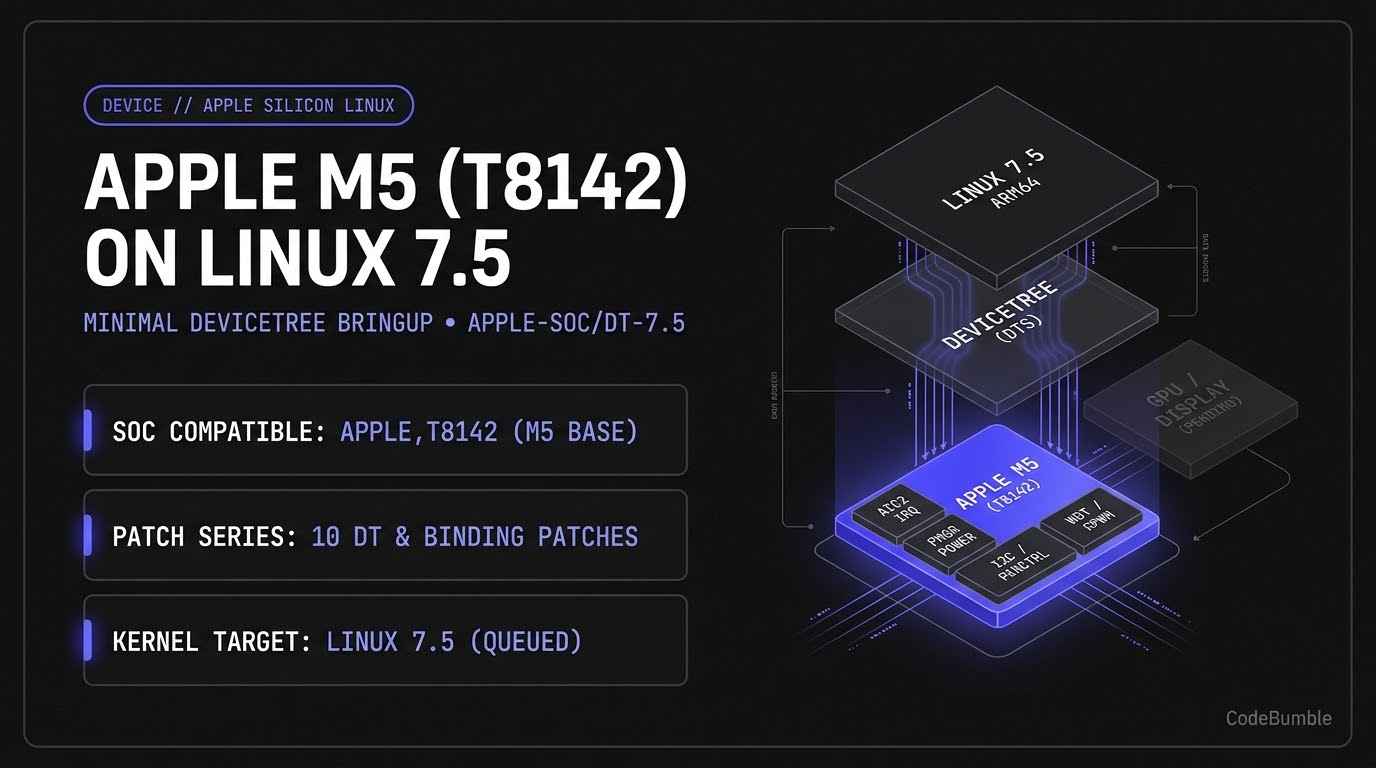
Initial base-model DeviceTree support for the Apple M5 (t8142) SoC has been queued into the apple-soc/dt-7.5 branch for Linux 7.5, following M4 in Linux 7.4 and M3 in Linux 7.2. Explore all 10 upstream patches, why GPU acceleration remains a major gap, and how to audit Asahi/mainline compatibility safely.
8 min read
Apple M5 (t8142) Queued for Linux 7.5: Inside the Minimal DeviceTree Bringup and GPU Gaps
Executive Summary
On November 14, 2026, Phoronix and BornCity reported that initial mainline Linux support for the Apple M5 base System-on-Chip (t8142) has been queued by maintainer Sven Peter into the apple-soc/dt-7.5 Git branch for the upcoming Linux 7.5 kernel cycle. Authored by Yureka Lilian, the 10-patch series (Patchwork [00/10]) establishes minimal DeviceTree bindings and base .dts definitions for Apple M5 silicon and M5-powered Macs.
This milestone continues a steady upstream cadence for Apple Silicon in the mainline Linux kernel: Apple M3 support landed in Linux 7.2, Apple M4 initial DeviceTrees arrived in Linux 7.4, and Apple M5 is now staged for Linux 7.5 (BornCity). However, both Lilian and Phoronix emphasize that this initial bringup is strictly foundational—covering only the "minimal amount of hardware" needed to boot and anchor future subsystem work. Crucially, proper GPU support for newer Apple M-series SoCs remains one of the biggest open obstacles before end-user Linux distributions can deliver full desktop acceleration on M5 hardware.
Because the apple-soc/dt-7.5 branch only provides early DeviceTree scaffolding ahead of the Linux 7.5 merge window, no Linux 7.5 performance benchmarks on Apple M5 hardware have been published.
Why Mainline Apple Silicon Bringup Starts With Minimal DeviceTrees
Unlike standard x86_64 PCs that expose standardized ACPI tables (_CPC, _CRS, MADT) and UEFI runtime services to the OS, Apple Silicon Macs use Apple's proprietary Apple Device Tree (ADT) inside iBoot/m1n1 alongside custom SoC peripherals. To boot a mainline ARM64 Linux kernel without out-of-tree forks, upstream maintainers must reverse-engineer hardware blocks, document Devicetree bindings (Documentation/devicetree/bindings/), and verify that existing mainline drivers can bind safely to new SoC compatibles.
As Yureka Lilian noted in the patch cover letter (Phoronix):
"This series covers only a minimal amount of hardware, which is useful as a basis for future developments. The hardware added here has remained largely unchanged from the earlier Apple Silicon generations."
That hardware continuity across Apple's base M-series silicon allows the t8142 bringup to reuse existing mainline drivers—such as apple,aic2 for interrupt routing and apple,pmgr for power-domain management—simply by adding apple,t8142 compatible strings and base register maps.
Technical Mechanics & Architecture
1. Breakdown of the 10-Patch t8142 (Apple M5) Series
Per the upstream Patchwork series (Patch [01/10]–[10/10]), the apple-soc/dt-7.5 bringup spans nine dt-bindings updates and the core arm64 DeviceTree files:
| Patch | Subsystem / Binding | Purpose in Apple M5 (t8142) Bringup |
|---|---|---|
01/10 |
watchdog: apple,wdt |
Adds t8142 compatible for the Apple SoC hardware watchdog timer |
02/10 |
interrupt-controller: apple,aic2 |
Adds t8142 compatible for the Apple Interrupt Controller v2 (AIC2) |
03/10 |
arm: cpus |
Registers Apple M5 CPU core compatibles for SMP topology & bringup |
04/10 |
arm: power: apple,pmgr-pwrstate |
Adds t8142 compatible for PMGR per-block power-state control |
05/10 |
arm: apple: apple,pmgr |
Adds t8142 compatible for the top-level Power Manager (PMGR) |
06/10 |
pwm: apple,s5l-fpwm |
Adds t8142 compatible for the SoC PWM controller |
07/10 |
pinctrl: apple,pinctrl |
Adds t8142 compatible for GPIO and pin-multiplexing controllers |
08/10 |
i2c: apple,i2c |
Adds t8142 compatible for I2C buses (sensors, power/USB-PD controllers) |
09/10 |
arm: apple |
Registers M5-based Mac board/device compatibles |
10/10 |
arm64: dts: apple |
Adds the minimal t8142 (M5) .dts/.dtsi DeviceTree files |
2. Boot Chain & Hardware Isolation Model on Apple Silicon
According to the Asahi Linux Documentation Glossary, Apple Silicon Macs enforce a strict separation between Apple-signed platform firmware and custom OS kernels:
- 1TR (One True RecoveryOS) & SFR: Installing or booting a custom OS such as Linux requires asserting physical presence via 1TR (holding the power button) to authorize a fuOS ("fully untrusted OS") boot policy, while System Firmware and Recovery (SFR) in NOR/internal storage remains Apple-managed.
- m1n1 & U-Boot Stage: The
m1n1bootloader translates Apple's hardware state and ADT into a standard Linux ARM64 boot environment, passing the compiled DeviceTree Blob (.dtb) fort8142to the Linux 7.5 kernel. - SEP & PMGR: The Secure Enclave Processor (SEP) handles Touch ID, cryptographic keys, and boot policy decisions independently of the Application Processor (AP), while PMGR (
apple,pmgr) gates clocks and power rails for SoC peripherals.
+-----------------------------------------------------------------------+
|                    APPLE M5 (t8142) HARDWARE & FIRMWARE               |
|                                                                       |
|  [ Secure Enclave (SEP) ]   [ iBoot1 / SFR ]   [ AP Cores (M5 CPU) ]  |
|   Boot Policy & Crypto       Apple Firmware     Main ARM64 Execution  |
+-----------------------------------+-----------------------------------+
                                    | 1TR Authorized Custom OS (fuOS)
                                    v
+-----------------------------------------------------------------------+
|                    m1n1 / U-BOOT STAGE                                |
|   Translates ADT -> Linux ARM64 Boot Protocol + t8142.dtb             |
+-----------------------------------+-----------------------------------+
                                    |
                                    v
+-----------------------------------------------------------------------+
|                    LINUX 7.5 KERNEL (apple-soc/dt-7.5)                |
|                                                                       |
|  [ Enabled in 7.5 ]                 [ Pending / Out-of-Tree ]         |
|  * apple,aic2 (IRQ)                 * Apple M5 GPU / Display Engine   |
|  * apple,pmgr & pmgr-pwrstate       * Advanced Audio / Thunderbolt    |
|  * apple,pinctrl / i2c / wdt / fpwm * Full Desktop Distro Support     |
+-----------------------------------------------------------------------+
Beyond the core boot chain, the Asahi Linux Documentation Glossary highlights several hardware-level constraints that explain why t8142 bringup is staged carefully:
- Production Debug Restrictions (
SWD): On production Apple Silicon Macs, Serial Wire Debug (SWD) for the main CPU/SoC is inaccessible due to hardware security restrictions, forcing kernel developers to rely onm1n1USB/UART proxies and early-boot telemetry rather than traditional JTAG hardware probes. - USB-PD & Vendor Defined Messages (
VDM): Apple Type-C ports rely on custom USB Power Delivery (VBUSup to 20V) and Apple-specific Vendor Defined Messages (SOP'DEBUG/SOP"DEBUG) over I2C/USB-PD controllers—explaining whyapple,i2candapple,pinctrlbindings are included in the very first 10-patcht8142bringup. - Recovery Mode Distinction (
1TRvs.Fallback Recovery OS): Only 1TR (holding down the power button) exposes Start Security Utility to authorize a custom OS (fuOS), whereas Fallback Recovery OS (double-click and hold) cannot alter security policies.
3. Why GPU & End-User Distribution Support Lags Behind
As BornCity and Phoronix both note, landing base .dts files in Linux 7.5 is only step one of a multi-kernel-cycle journey. Reverse-engineering Apple's proprietary GPU firmware interfaces, display coprocessors (DCP), and USB-C/Thunderbolt Vendor Defined Messages (VDMs) takes months of dedicated analysis beyond basic aic2/pmgr/i2c bringup. Consequently, end-user distributions (such as Fedora Asahi Remix) cannot ship a turnkey M5 desktop experience on Linux 7.5 alone until GPU and peripheral drivers mature in subsequent releases.
Evidence & Multi-Generation Kernel Timeline
- Mainline Kernel Progression: BornCity summarizes the mainline integration rhythm:
- Linux 7.2: Initial Apple M3 support integrated.
- Linux 7.4: Initial Apple M4 (and A18 Pro) DeviceTree support integrated.
- Linux 7.5: Initial Apple M5 (
t8142) base SoC DeviceTree support queued inapple-soc/dt-7.5.
- Patch Scope Verification (High Confidence): All 10 patch subjects and compatible strings (
apple,t8142acrosswdt,aic2,cpus,pmgr-pwrstate,pmgr,s5l-fpwm,pinctrl,i2c, andarm64: dts: apple) are directly verified in the October 27, 2026 Patchwork submission and confirmed queued on November 14, 2026 by Phoronix. - Performance Benchmarks (Unavailable): No Linux 7.5 benchmarks exist for Apple M5 yet because the patches only provide minimal early hardware enablement without GPU acceleration.
Device Bringup & Verification Playbook
For ARM64 kernel developers, Asahi Linux testers, and hardware engineers tracking apple-soc/dt-7.5, here is how to prepare a safe, reproducible test workflow without risking your macOS recovery or SFR partition:
- Preserve macOS & 1TR Recovery Partitions: Never wipe internal NVMe partitions manually before installing a dual-boot Linux stub; Apple Silicon relies on SFR and 1TR (
One True RecoveryOS) for firmware updates and custom OS authorization (Asahi Glossary). - Verify DeviceTree Bindings (
dtbs_check) Before Booting: When compiling a kernel fromapple-soc/dt-7.5or Linux 7.5-rc1, runmake ARCH=arm64 dtbs_checkagainstt8142.dtsfiles to catch schema mismatches inpmgr,aic2, orpinctrlnodes before flashingm1n1. - Check
t8142Compatible Strings in Compiled.dtb: Confirm your built DeviceTree blob exposes the expectedapple,t8142compatibles across interrupt, power, and I2C nodes. - Expect Serial / Framebuffer-Only Bringup Initially: Plan for headless UART/USB-C debug or simple framebuffer output rather than accelerated 3D/Vulkan graphics until M5 GPU support matures.
- Keep Rollback Boot Targets Intact: Maintain a separate macOS APFS volume and
m1n1chainload entry so you can immediately fall back to macOS or a known-good kernel image ifpmgrpower-domain transitions fail on early M5 revisions. - Test Watchdog & Reboot Loops (
apple,wdt): Before deploying test builds on unattended lab machines, verify thatapple,wdtwatchdog resets andapple,pmgr-pwrstatedomain shutdowns complete cleanly acrossrebootandkexeccycles without leaving the SoC hung inm1n1.
Below is a safe, read-only Python verification helper for kernel build hosts to inspect a compiled arm64 Apple Silicon .dts or /proc/device-tree export for expected t8142 bindings:
#!/usr/bin/env python3
'''Read-only checker for Apple M5 (t8142) DeviceTree compatibles in .dts/.dtsi or live sysfs.'''
from pathlib import Path

EXPECTED_T8142_SUBSYSTEMS = [
    "apple,t8142",
    "apple,aic2",
    "apple,pmgr",
    "apple,pmgr-pwrstate",
    "apple,pinctrl",
    "apple,i2c",
    "apple,wdt",
    "apple,s5l-fpwm",
]

def audit_dts_text(dts_path: Path) -> dict[str, bool]:
    text = dts_path.read_text(encoding="utf-8", errors="ignore")
    return {compat: (compat in text) for compat in EXPECTED_T8142_SUBSYSTEMS}

if __name__ == "__main__":
    live_compat = Path("/proc/device-tree/compatible")
    if live_compat.exists():
        raw = live_compat.read_bytes().replace(b"\x00", b" ").decode("utf-8", errors="ignore")
        print("Live system compatibles:", raw.strip())
    else:
        print("Run audit_dts_text(Path('arch/arm64/boot/dts/apple/t8142.dtsi')) in your Linux 7.5 tree.")
Frequently Asked Questions (FAQ)
What Apple M5 support is actually coming in Linux 7.5?
Linux 7.5 is queued to receive minimal base-model DeviceTree support (apple,t8142) covering CPU cores, aic2 interrupts, pmgr power management, wdt watchdog, pinctrl GPIO, i2c, and s5l-fpwm PWM (Patchwork, Phoronix).
Will Linux 7.5 include GPU acceleration for Apple M5 Macs?
No. Both Phoronix and BornCity note that proper GPU support for newer Apple M-series SoCs remains one of the biggest open obstacles and is not part of this minimal apple-soc/dt-7.5 DeviceTree bringup.
How does Apple M5 Linux enablement compare to M3 and M4?
Mainline Linux integrated initial Apple M3 support in Linux 7.2 and initial Apple M4 support in Linux 7.4; Apple M5 (t8142) follows the same staged bringup model for Linux 7.5 (BornCity).
Who authored and queued the Apple M5 Linux 7.5 patches?
The 10-patch DeviceTree and dt-bindings series was authored by Yureka Lilian and queued into the apple-soc/dt-7.5 branch by maintainer Sven Peter (Phoronix, BornCity).
Are Linux performance benchmarks available for the Apple M5 yet?
No. Because the queued patches only provide minimal base-SoC DeviceTree scaffolding ahead of the Linux 7.5 cycle, no Linux benchmarks exist yet.
Sources
- Phoronix — Basic Support For The Apple M5 Expected To Land For Linux 7.5 (November 14, 2026)
- Patchwork Linux I2C / Devicetree — Initial Apple Silicon M5 device trees and dt-bindings (
t8142,[00/10]–[10/10]) (October 27, 2026) - BornCity — Apple M5: Linux 7.5 soll erste grundlegende Chip-Unterstützung erhalten (November 14, 2026)
- Asahi Linux Documentation — Glossary (
1TR,PMGR,SEP,SFR)